

Cigna California Timely Filing Limit: What Cigna Publishes, What California Requires and Where the Two Meet
The Cigna California timely filing limit is 90 days from the date of service for participating providers and 180 days for out-of-network providers, according to Cigna’s published guidance. California regulation 28 CCR 1300.71 sets the same two numbers as a minimum for health plans, so Cigna cannot shorten them. Disputes follow a separate 365-day window.
Most guides stop at “90 days” and move on. In California, the more useful question is which of those days Cigna chose and which the state requires. This guide separates the two, tests five common myths about Cigna deadlines, and covers disputes, secondary claims and balance billing. It also gives four calculations and a self-assessment checklist near the end.
Cigna California deadlines at a glance
| Metric | Practical target/range | Review frequency | Source type |
| Participating provider claim | 90 days from the date of service | Annually | A |
| Out-of-network claim | 180 days from the date of service | Annually | A |
| California floor, contracted providers | Not less than 90 days from service | Annually | A |
| California floor, non-contracted providers | Not less than 180 days from service | Annually | A |
| California floor, secondary claims | Not less than 90 days from the primary payer’s payment or denial notice | Per claim | A |
| Cigna provider dispute, California | 365 calendar days from the initial payment or denial notice | Each Cigna update | A |
| Cigna general payment appeal | 180 calendar days from the initial payment or denial notice | Each Cigna update | A |
| Plan payment deadline, 2026 | 30 calendar days to pay, contest or deny | Annually | A |
| Claim submission turnaround | Within 30 days of service for 95% or more of claims | Weekly | C |
Source types: A = published government or payer source (Cigna guidance, California regulation and legislation as reported by named sources). B = named benchmarking data provider (none used). C = practical planning target from common industry practice. D = survey or study data (none used). Confirm against your contract and the current documents.
Myth: Cigna’s 90 days is the whole story
Cigna’s published guidance sets 90 days from the date of service for participating providers and 180 days for out-of-network providers, and it lists the exceptions that change those numbers. On Cigna’s When to File page, consecutive services such as a hospital stay run from the last date of service. Longer periods apply when applicable law requires them or when the provider agreement allows more time.
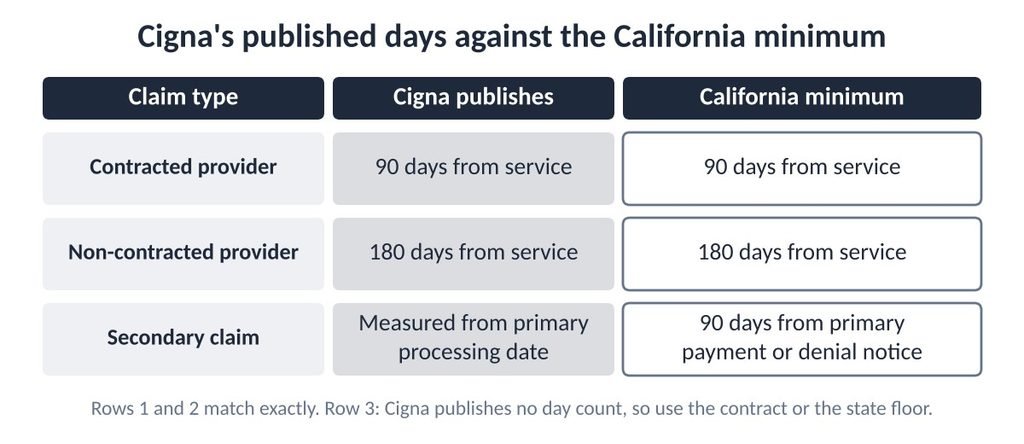
The same page lists three more exceptions: coordination of benefits, a resubmission that Cigna requested, and extraordinary circumstances that prevented timely filing. For secondary claims, timely filing is measured from the processing date on the primary carrier’s explanation of benefits. The page gives no day count for that case, so use your contract or the California floor described below.
| Situation | Clock Cigna describes | Starts at |
| Participating provider claim | 90 days | Date of service (last date for consecutive stays) |
| Out-of-network claim | 180 days | Date of service (last date for consecutive stays) |
| Secondary claim | Measured from the primary processing date; no day count published | Primary carrier’s explanation of benefits date |
| Resubmission Cigna requested | Exception to the filing limit | Cigna’s request |
| Extraordinary circumstances | Cigna may ask for evidence | Date of the event |
Source: Cigna When to File page, which shows no publication date. The page says state legislation and plan-specific language supersede Cigna’s administrative guidelines.
In billing audits, a common pattern is that offices apply 90 days to every Cigna card. Network status decides between 90 and 180, so confirm whether the practice is participating for that specific product, and not only with Cigna in general, before you count any days on the calendar.
Rule: California sets a floor under Cigna’s numbers
California health plan regulation 28 CCR 1300.71(b)(1) says a plan shall not impose a claim deadline of less than 90 days for contracted providers or 180 days for non-contracted providers after the date of service. For secondary claims, the deadline cannot be less than 90 days from the primary payer’s payment, contest, denial or notice. The California Medical Association’s Know Your Rights article summarized the same rule in 2016.
That means Cigna’s published 90 and 180 days sit exactly on the California floor. Cigna’s guidance has no room to go lower for California plans, and a contract can only be more generous to the provider. Whether the floor reaches your patient depends on whether the plan is a state-regulated health plan, a self-funded employer plan or a Medicare product.
California also changed the payer side of the clock. Under AB 3275, effective January 1, 2026, plans and insurers must pay, contest or deny claims within 30 calendar days, replacing earlier 30 or 45 working day periods, as summarized by Davis Wright Tremaine. Interest rates are unchanged at 15% for plans and 10% for insurers, according to that summary.
| California rule | What it says | What it means for billing |
| Contracted provider filing limit | A plan may not set less than 90 days | Cigna’s 90 days is the legal minimum |
| Non-contracted provider filing limit | A plan may not set less than 180 days | Cigna’s 180 days is the legal minimum |
| Secondary payer limit | Not less than 90 days from the primary’s payment or notice | Date-stamp every primary remittance |
| Payer response time, 2026 | Pay, contest or deny within 30 calendar days | Follow up at day 31, not day 46 |
| Late payment interest | 15% for plans, 10% for insurers | Track interest owed |
Source: 28 CCR 1300.71(b)(1) and (g); Davis Wright Tremaine summary of AB 3275 (September 25, 2025). Confirm current regulation and statute text; the AB 3275 summary does not address claim submission rules.
Myth: the dispute window is the filing window
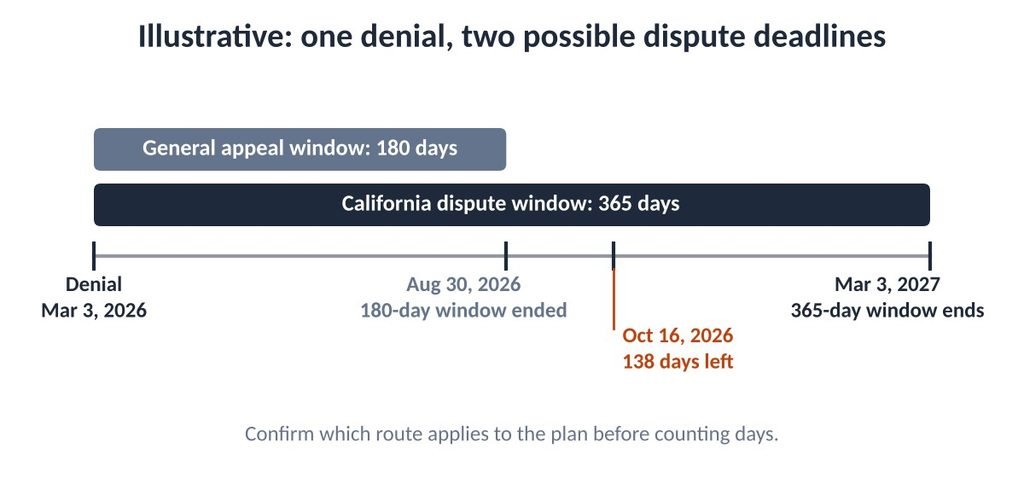
California providers have 365 calendar days to start a provider dispute with Cigna, counted from the initial payment or denial notice, according to Cigna’s California provider page. For an adjusted payment, the 365 days run from the adjustment. Cigna’s California provider dispute policy says to file in writing with the payment review form, the explanation of payment and any supporting records.
Cigna’s general appeals page states a shorter window of 180 calendar days for provider payment appeals, with arbitration within one year of the final decision. The California page and the general page disagree on the number, so identify which route applies before you count days. A dispute window never reopens a missed filing deadline, and our guide to timely filing versus appeal filing limits explains why.
| Route | Window | Clock starts |
| Cigna California provider dispute | 365 calendar days | Initial payment or denial notice; adjustment date if adjusted |
| Cigna general provider payment appeal | 180 calendar days | Initial payment or denial notice; last adjustment if adjusted |
| Arbitration request | One year | Letter communicating the final internal review decision |
Source: Cigna California provider page and Cigna appeals page; neither shows a revision date. Confirm which policy applies to your patient’s plan.
The CMA article also describes a “good cause” route to ask for a late claim to be accepted on appeal. That description is from 2016, so confirm with Cigna whether and how the route applies today before you rely on it.
Four calculations to run before a claim ages out
Four short calculations convert the rules into dates and rates. Run the first three on any claim older than 30 days, and the fourth every month. Each starts with the formula, then an illustrative scenario with real numbers that your team can copy into a spreadsheet.
Calculation 1: the participating deadline
Formula: deadline = date of service + 90 days.
Illustrative scenario (not an actual client record): a participating provider sees a patient on August 18, 2026. The deadline is November 16, 2026. On October 16, 2026, 59 days have passed and 31 remain. A claim still unbilled at day 59 needs an owner and a date.
Calculation 2: the out-of-network deadline
Formula: deadline = date of service + 180 days, counted from the last date for consecutive services.
Illustrative scenario (not an actual client record): a non-participating provider’s service ends on June 1, 2026. The deadline is November 28, 2026. On October 16, 2026, 43 days remain, so the claim belongs on this week’s worklist even though 180 days sounds generous.
Calculation 3: dispute window versus appeal window
Formula: dispute deadline = initial payment or denial notice date + 365 days for California disputes, or + 180 days for the general appeal route.
Illustrative scenario (not an actual client record): Cigna denies a claim on March 3, 2026. Under the 180-day route the window ended August 30, 2026, which is already past. Under the 365-day California route it ends March 3, 2027, leaving 138 days after October 16, 2026. Choosing the wrong route could mean the difference between a live dispute and a lost one.
Calculation 4: the on-time submission rate
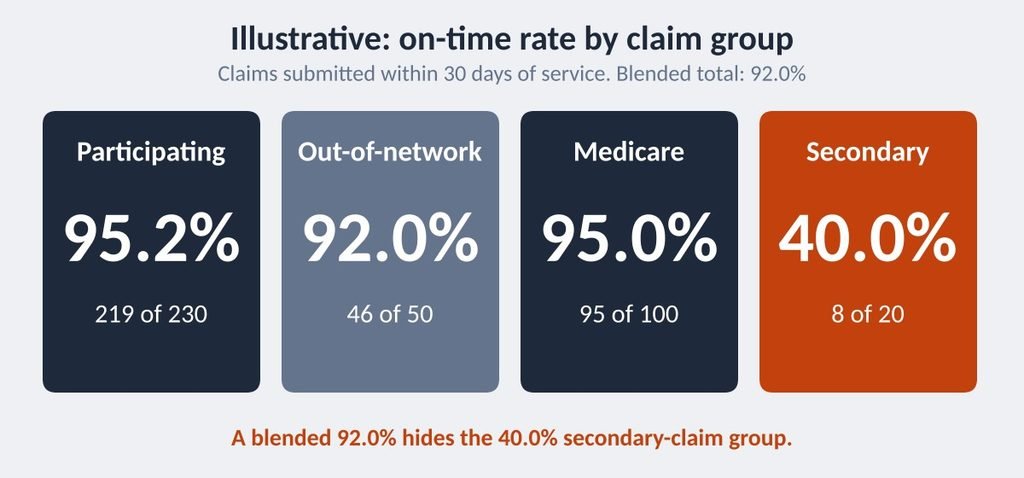
Formula: on-time rate = claims submitted within 30 days of service ÷ total claims × 100.
Illustrative scenario (not an actual client record): one month of Cigna claims for a California practice, split by claim group and shown next to the single blended total that most billing dashboards report by default.
| Claim group (Illustrative) | Claims | Submitted within 30 days | On-time rate |
| Participating commercial | 230 | 219 | 95.2% |
| Out-of-network | 50 | 46 | 92.0% |
| Medicare products | 100 | 95 | 95.0% |
| Secondary claims after a primary payer | 20 | 8 | 40.0% |
| Blended total | 400 | 368 | 92.0% |
Illustrative figures; actual rates vary by practice, specialty and plan mix.
The blended 92.0% sits near a 95% practical target, but the secondary-claims line sits at 40%. A single average would hide it. Review each group separately whenever one group waits on another payer, because a delay outside your control still counts against your deadline.
Reading the results without fooling yourself
Compare like for like. Participating, out-of-network, Medicare and secondary claims run on different clocks, so each belongs in its own row of your report. One missed benchmark is a signal to investigate, not a verdict on the billing operation or the team running it.
When a rate falls below target, check three things first. Was the deadline built from the right network status? Did the delay sit in registration, in coding or in waiting for a primary payer? Do the late claims share a trigger, such as a primary remittance that arrived weeks late? A cluster of late claims usually traces to one cause.
Myth: a late Cigna claim can be billed to the patient
Cigna’s guidance says the provider contract prohibits balance billing the patient for claims denied for late submission. That makes the cost of a missed deadline fully the practice’s. Look at the wording in your own agreement, and keep a written record of any exception Cigna grants.
Medicare products follow different rules. Cigna’s page lists a separate Cigna HealthCare for Seniors section with longer periods for non-participating professionals, and HealthSpring Medicare Advantage claims follow separate manuals. Treat commercial and Medicare claims as separate rows in the deadline table, and see our guide to the Medicare 12-month rule for the federal baseline.
In billing audits, a common pattern is that secondary claims age out because the primary remittance sat unposted for weeks. Date-stamp every primary explanation of benefits the day it arrives, and read our guide to secondary claim timely filing deadlines for how other payers handle the same trigger.
Habits that keep Cigna California claims on time
A workable routine for California practices has six steps, and each step is tied to a trigger such as a new contract, a primary remittance or a denial notice, so nobody has to remember it:
- Record network status and product at registration, and write the window in a deadline table; our guide to payer-specific claim submission rules shows the layout.
- Submit within 30 days of service as a practical target, and save the acknowledgment.
- Flag unpaid claims at 30, 60 and 90 days, using the method in tracking unpaid claims across payers.
- Date-stamp every primary remittance on the day it arrives.
- Send corrections promptly; our guide to corrected claim deadlines by payer compares the options.
- Review denials monthly by group, and refer aging balances to A/R management support when the in-house team cannot clear them.
Our walkthrough on how to track timely filing deadlines shows a simple spreadsheet layout that a small office can build in an afternoon. For other California payers, compare our guides to Aetna California, UHC California and Medi-Cal.
How long until the routine shows results?
These are general planning ranges, not guarantees. A deadline table and a daily worklist often reduce last-minute submissions within two to four weeks. Denial trends take longer to read. Three to six months of data is a reasonable horizon, and a full year shows whether disputes are filed on the right route.
Mistakes that turn good claims into late denials
- Applying 90 days to every Cigna card. Network status decides between 90 and 180.
- Assuming the contract can go below California’s floor. The regulation sets a minimum for health plans.
- Using the 180-day appeal window for California disputes. Check whether the 365-day route applies.
- Counting secondary claims from the date of service. Cigna measures from the primary’s processing date.
- Treating dispute windows as filing windows. Disputes never reopen a missed filing deadline.
- Billing the patient for a late denial. Cigna’s guidance says the contract prohibits it.
Quick summary
- The Cigna California timely filing limit is 90 days for participating providers and 180 days for out-of-network providers.
- California’s 28 CCR 1300.71 sets those numbers as the minimum for health plans.
- Cigna measures secondary claims from the primary payer’s processing date.
- California provider disputes get 365 days; Cigna’s general appeal window is 180 days.
- Plans must pay, contest or deny within 30 calendar days in 2026.
- A practical target is submission within 30 days of service for 95% or more of claims.
Self-assessment: is your Cigna California process safe?
Answer yes or no to each question below, then count your yes answers and compare the total with the three-tier scoring guide that follows the list of ten questions, which is tied to the numbers in this guide:
- Do you record network status and product at registration?
- Do you keep a written filing window for each Cigna product you bill?
- Do 95% or more of claims go out within 30 days of service?
- Do you count consecutive services from the last date of service?
- Do you date-stamp primary remittances for secondary claims?
- Do you know which dispute route applies to each Cigna plan?
- Do you flag unpaid claims at 30, 60 and 90 days?
- Do you keep payer acknowledgments, not only clearinghouse reports?
- Do you track on-time rates separately by claim group?
- Do you review late-filing denials monthly?
Scoring guide: 9 to 10 yes answers suggests a well-controlled process, so review it quarterly. 6 to 8 yes answers suggests gaps; fix the “no” items first, starting with questions 1 and 5. 0 to 5 yes answers suggests high exposure to late-filing denials and a good moment for an outside review.
When outside billing help makes sense
Outside support is worth considering when the in-house approach has reached its limits. These five signals suggest that point has arrived for a California practice that bills Cigna every week:
- Late-filing denials appear on Cigna claims more than one month in a row.
- Nobody can state the filing window for each Cigna product the practice bills.
- Primary remittances are not date-stamped, so secondary claims go out late.
- Disputes are filed on the wrong route or after the window.
- Deadline tracking depends on one person’s spreadsheet.
Look for a billing partner that keeps a written deadline table by payer and network status and retains acknowledgments. It should also report on-time rates by claim group and calendar every dispute window. Transparent reporting and clear pricing matter as much as the deadlines.
EON MED SOLUTIONS is one example: a US-based team that delivers medical billing, coding, credentialing, denial management and A/R follow-up with transparent reporting and no hidden fees. Results vary by practice. You can review the EON MED SOLUTIONS billing, coding and RCM services to see how the work is organized.
Expert Opinion
The Cigna California timely filing limit comes from two sources that happen to agree. The firm published standards in this guide are Cigna’s 90 and 180 days, California’s 90 and 180 day minimums, the 365-day California dispute window and the 30-calendar-day payer response period for 2026. The 30-day submission goal and the 30, 60 and 90 day alerts are practical targets.
The worked examples are illustrative scenarios, not client results. They show how to turn a rule into a date and how a blended rate can hide a 40% subgroup. Because Cigna, the state and your contract can change, recheck the numbers each year.
The natural next question is which of your Cigna groups has no written filing window today. If the answer is more than one, a team that tracks remittances and disputes daily can help; start with EON MED SOLUTIONS’ billing and RCM services.
Frequently asked questions
What is the Cigna California timely filing limit?
Cigna’s published guidance sets 90 days from the date of service for participating providers and 180 days for out-of-network providers. California regulation 28 CCR 1300.71 sets the same numbers as a minimum for health plans. Contracts and applicable law can allow longer, so check your agreement.
Is the Cigna timely filing limit different in California?
The filing days match Cigna’s national guidance, and California’s regulation sets them as a floor. The difference is the dispute window: Cigna’s California page gives 365 calendar days to start a provider dispute, while its general appeals page gives 180 calendar days. Confirm which route applies to your patient’s plan.
What is a good claim submission turnaround for Cigna claims?
A practical target is submitting most claims within a few business days, with 95% or more out within 30 days of service. This is an industry planning target, not a Cigna requirement. Early filing keeps most of the 90-day window in reserve for rejections and corrections.
What is a good on-time submission rate for Cigna claims?
No published benchmark exists. A practical goal is 95% or more within 30 days of service, tracked separately for participating, out-of-network, Medicare and secondary claims. When one group falls well below the blended rate, investigate that group’s trigger event first.
What is a good aging alert schedule for Cigna claims?
Because the participating window is 90 days, many practices flag unpaid claims at 30, 60 and 90 days from service. This is a planning schedule, not a Cigna rule. The 60-day flag leaves one month to file or correct before the 90-day deadline.
Can I bill the patient if Cigna denies a claim for late filing?
Cigna’s guidance says the provider contract prohibits balance billing the patient for claims denied for late submission. Check the wording in your own agreement. Keep records of any exception Cigna grants, such as extraordinary circumstances, because those records support an appeal.
Sources and methodology
(a) Published standards and definitions from named bodies
- Cigna Healthcare, When to File Claims (no publication date shown; footer ©2026): Cigna.
- Cigna Healthcare, California provider dispute policy: Cigna, and Cigna’s provider appeals and disputes page.
- California Code of Regulations, title 28, section 1300.71, subdivisions (b)(1) and (g), as quoted from the regulation text reviewed in October 2026.
- California Medical Association, Know Your Rights: Timely filing denials, November 8, 2016: CMA.
- Davis Wright Tremaine, California AB 3275 claim payment deadlines, September 25, 2025: DWT.
- California Department of Managed Health Care, All Plan Letter 23-008 (March 24, 2023), for the payer timely payment framework.
(b) Named benchmarking data providers. None used in this article.
(c) Practical or illustrative targets from general industry sources
- National Cigna timely filing guides (MedSole RCM, Prospyr) were reviewed for how competitors present Cigna rules. They agree on 90 and 180 days, but neither cites the California regulation as the source of a floor.
- The 30-day submission goal, the 95% target and the 30, 60 and 90 day alerts are practical planning targets. All worked-example figures are illustrative.
(d) Survey or study data. None used in this article.
Methodology: the research reviewed the top results for the keyword, Cigna’s published claim and dispute pages, the text of 28 CCR 1300.71 and named summaries of California law in October 2026. Cigna’s pages show no publication dates, so the article treats them as current as of the research date. The regulation’s reach to self-funded and Medicare products was not addressed in the sources reviewed. Results vary by contract, network status and funding type, and figures reflect information available at the time of research. Confirm every deadline against your current contract and the cited sources.


