

Timely Filing Limit vs Appeal Filing Limit: Key Differences
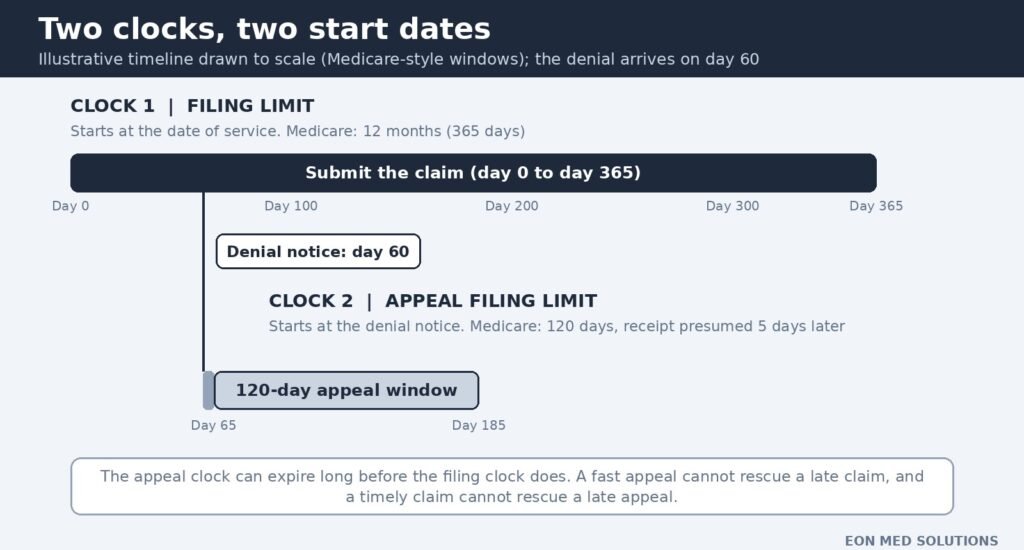
A timely filing limit is the deadline to submit an original claim, counted from the date of service. An appeal filing limit is a separate deadline to contest a denial, counted from the denial notice. Medicare, for example, allows 12 months to file and 120 days to request a redetermination.
Practices often track one deadline and forget the other. The first is the window to submit a claim. The second starts only after a payer denies it, and it is usually far shorter. This guide compares the timely filing limit vs appeal filing limit. It adds dated examples, a Medicare appeal ladder, and a decision path for denied claims. A short self-check near the end helps you test your own process. Each figure is labeled by source, so you can see what is fixed.
Timely Filing Limit vs Appeal Filing Limit at a Glance
| Metric | Practical Target/Range | Review Frequency | Primary Source |
| Original Medicare claim filing | 12 months from date of service | Every claim | ¹ Published federal standard |
| Medicare redetermination (first appeal) | 120 days from receipt; receipt presumed 5 days after the notice date | Per denial | ¹ Published federal standard |
| Medicare Advantage reconsideration | 60 days from receipt; receipt presumed 5 days after the notice date | Per denial | ¹ Published federal standard |
| Employer group plan appeal (claimant) | At least 180 days from receipt of the denial | Per denial | ¹ Published federal standard |
| Commercial appeal under provider contract | Commonly reported 60 to 180 days | At contract signing | ² Commonly reported range |
| Internal appeal target | Filed within about 30 days of the notice | Weekly | ³ Illustrative target |
¹ Published federal standard: Medicare rules, CMS manuals, and federal regulations define these figures. ² Commonly reported range: industry sources differ, so verify your own contract. ³ Illustrative target: a practical planning figure, not a payer requirement.
Timely Filing Limit vs Appeal Filing Limit: Two Start Dates
What Starts Each Clock?
The filing limit runs from the date of service. The appeal filing limit runs from the denial notice. That notice appears on a remittance advice or explanation of benefits. Medicare presumes you received that notice five days after its date, unless evidence shows otherwise. Some payers count from the notice date itself, so check each contract. The clocks are independent, so a claim filed on day one can still lose its appeal rights later. A late claim also cannot be rescued by a fast appeal.
Why Mixing Them Up Costs Money?
The consequences differ as well. A late claim usually earns a CO-29 denial, and the cause is your own delay. A late appeal is different. The payer’s original decision may have been wrong, yet the window to challenge it has closed. In one case, you lost the claim by waiting. In the other, you lost the chance to recover it. Neither problem shows up on a standard aging report. A dated log that records the service date and the notice date side by side prevents both.
Worked example 1: Medicare appeal deadline
Formula: Deadline = notice date + 5 days (presumed receipt) + 120 days.
A remittance advice is dated March 10, 2027. Medicare presumes receipt on March 15, 2027. Adding 120 days gives a redetermination deadline of Tuesday, July 13, 2027. The claim’s original filing deadline is a different date entirely, so calendar both. Log the notice date the day it arrives, and set a reminder well before July.
Medicare: One Filing Rule, Five Appeal Levels
Original Medicare pairs one filing rule with a formal appeal ladder. Claims must reach the MAC within 12 months of service. After an initial determination, the first appeal is a redetermination, requested within 120 days of receipt. Timely filing and appeals therefore run on different clocks, even inside one program. Later levels carry their own deadlines, and Palmetto GBA’s MAC guidance lists them. Levels three and five also require a minimum amount in controversy. Those thresholds change, so confirm current amounts before filing.
| Level | Reviewer | Deadline (published standard) |
| 1. Redetermination | Medicare Administrative Contractor | 120 days from receipt of the notice |
| 2. Reconsideration | Qualified Independent Contractor | 180 days from receipt of the redetermination |
| 3. Hearing | Administrative Law Judge | 60 days from receipt of the reconsideration |
| 4. Council review | Medicare Appeals Council | 60 days from the ALJ decision |
| 5. Judicial review | Federal district court | 60 days from the Council decision |
Late-Filing Denials Sit Outside the Ladder
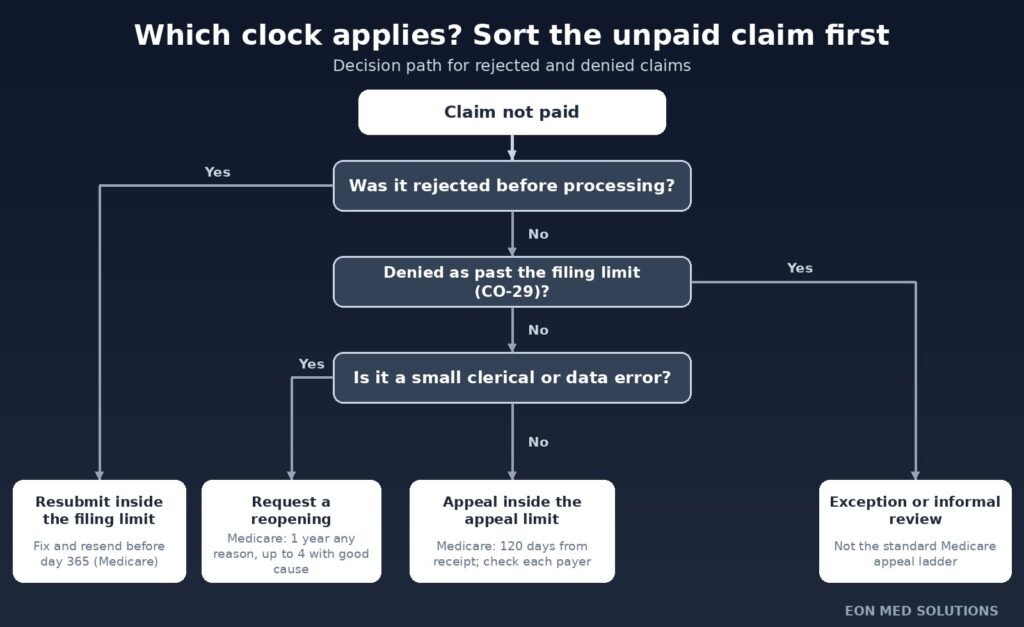
One point trips up many teams. The CMS Claims Processing Manual states that a late-filing denial is not an initial determination. It therefore cannot enter this appeal ladder. Your contractor may informally review the decision on request, and four narrow exceptions can extend the filing deadline. Do not spend the 120-day appeal window on a claim that was filed late. Work the exception route instead, with documentation. Contractors decide those requests based on what you submit. That is why the notice type matters before you calendar any deadline.
Choosing Between a Corrected Claim, Reopening, and Appeal
Not every denial calls for an appeal. A rejected claim never entered adjudication, so you fix the error and resubmit inside the original filing limit. A denied claim was processed, so you appeal it or, for small mistakes, request a reopening. Medicare allows reopening requests within one year of the initial determination for any reason. Good cause extends that to four years. Clerical errors are handled as reopenings, at the contractor’s discretion. When sorting denials by path feels overwhelming, structured denial management support can help.
Worked example 2: reopening window
Formula: Reopening limit = initial determination date + 1 year (any reason) or + 4 years (good cause).
A remittance is dated March 10, 2027. A request for any reason can be made through March 10, 2028. With good cause, such as new and material evidence, the outer limit is March 10, 2031. Do not assume a reopening request stops the appeal clock. Keep the 120-day appeal date on your calendar until the contractor decides.
Medicare Advantage and Commercial Appeal Windows
Medicare Advantage Reconsiderations
For Medicare Advantage, a reconsideration request must be filed within 60 calendar days after receipt. 42 CFR 422.582 sets that rule. The rule presumes receipt five days after the notice date. That works out to about 65 days from the notice. Some plans quote 60 days from the notice itself, so use the shorter date. A late request may be accepted when you show good cause in writing. Do not rely on that flexibility for routine work. Check the plan’s notice for the exact filing address.
Commercial Plans and Provider Contracts
For commercial plans, your participation agreement usually controls. Federal rules give claimants in many employer group health plans at least 180 days to appeal. Provider contracts can be shorter. Ask each payer where the notice date is printed. One commonly cited example is 65 days, and that payer’s own guidance points back to the agreement. Do not assume an appeal pauses the filing clock either. Industry sources disagree, so treat the original limit as still running unless your contract says otherwise.
Worked example 3: average days to file an appeal
Formula: Average days to appeal = total days from notice to filing ÷ number of appeals.
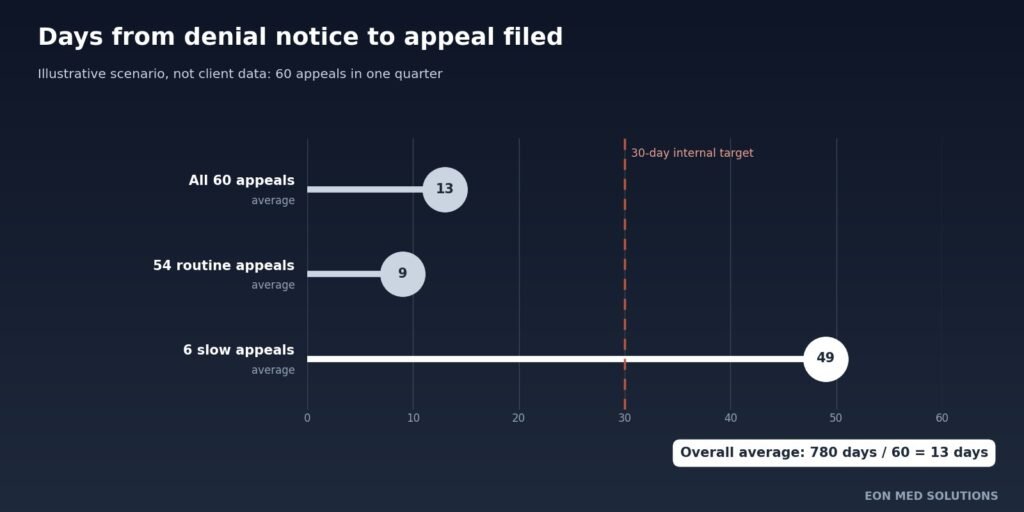
Illustrative scenario (not an actual client record): a practice files 60 appeals in a quarter. Fifty-four average 9 days from notice to filing, totaling 486 days. Six average 49 days, totaling 294 days. The overall average is 780 ÷ 60, or 13 days, well under a 30-day internal target. Yet those six slow appeals ran past the target, and against a short commercial window they could have expired. Watch the slowest appeals, not only the average.
Comparing Deadlines Fairly
A deadline figure is useful only next to the right comparison. Compare Medicare with Medicare, and one commercial contract with itself. Keep filing limits and appeal limits in separate columns, because mixing them hides risk. The 30-day internal target is a planning figure, not a payer rule. One late appeal is a signal to check your notice log, not a verdict on your team. Start with the payer group that misses most often, then trace the cause to one step.
How Fast Two-Clock Tracking Pays Off?
| Fix | Partial Results | Fuller Results | What It Takes | Key Constraint |
| Denial-notice log with dates | 1–2 weeks | 1–2 months | Logging each notice on arrival | Mail and portal delays |
| Two-clock payer calendar | 2–4 weeks | 1–3 months | Written windows per payer | Locating current contracts |
| Weekly denial triage | 2–3 weeks | 2–3 months | Sorting by path and deadline | Staff time |
Illustrative planning ranges only. They are not guarantees, and results vary by practice.
The Short Version
- A timely filing limit starts at the date of service; an appeal filing limit starts at the denial notice.
- Medicare allows 12 months to file and 120 days for a redetermination (published federal standards).
- Medicare late-filing denials are not appealed on the standard ladder; use exceptions instead.
- Medicare Advantage and commercial appeal windows depend on rules and contracts, so verify each one.
- A 30-day internal appeal target is a practical goal, not a payer mandate.
Self-Check: Are You Watching Both Clocks?
Answer yes or no to each question, then read the scoring guide below.
- Do you record the notice date for every denial on the day it arrives?
- Is each payer’s appeal window documented in writing?
- Can you list every denial with fewer than 30 days left to appeal?
- Do you separate rejected claims from denied claims?
- Does your team know late-filing denials follow a different Medicare route?
- Do you track Medicare Advantage windows apart from Medicare’s 120 days?
- Do you keep proof of the original filing date for appeals?
- Does one person own the appeal calendar?
- 7–8 yes: Well protected. Review the calendar monthly.
- 4–6 yes: Gaps exist. Fix the “no” answers first, starting with questions 1 to 3.
- 0–3 yes: At risk. Audit open denials by days remaining this week.
Expert Opinion
The firm parts of the timely filing limit vs appeal filing limit rules are few. Medicare allows 12 months to file and 120 days to request a redetermination. Late-filing denials are not appealed on the standard ladder. Medicare Advantage reconsiderations follow 42 CFR 422.582. Those points come from published federal sources. Everything else is a practical or illustrative planning figure. That includes the 30-day internal target, the commonly reported commercial ranges, and the improvement timeframes. Adjust each one to your payer mix, and confirm every contract yourself. Nothing here replaces the wording of your own agreements.
One pattern is worth naming directly. Most teams build a calendar for filing deadlines because the service date is known in advance. Appeal deadlines start only when a notice arrives, so they depend on someone logging it. Missed appeals often trace back to an unlogged notice, not to a hard case. A simple intake habit fixes that, and it supports broader work such as reducing claim denials. Assign the log to one person, and review it every week. Small habits beat heroic clean-ups.
Frequently Asked Questions
What is the difference between a timely filing limit and an appeal filing limit?
A timely filing limit is the deadline to submit an original claim, counted from the date of service. An appeal filing limit is the deadline to contest a denial, counted from the notice date.
What is the Medicare appeal filing limit?
The first appeal, a redetermination, must be requested within 120 days of receiving the notice. Medicare presumes receipt five days after the notice date. Later levels have their own deadlines.
Does filing an appeal stop the timely filing clock?
Not by default. Some industry sources say it often pauses the clock, but they disagree. Treat the original limit as running unless your contract states otherwise.
Can you appeal a timely filing denial?
For Original Medicare, generally not; CMS says such a denial is not an initial determination. Commercial payers vary, and some review proof of timely filing, so check the contract.
What happens if you miss the appeal deadline?
The denial usually becomes final. Some programs allow a late request with a written good-cause explanation, but approval is not guaranteed.
Is a corrected claim the same as an appeal?
No. A corrected claim fixes a rejected or incorrect submission. An appeal challenges a payer’s decision, and each follows different deadlines and rules.
What is a good appeal filing limit for internal planning?
Payers set the official limits, so no universal figure exists. Many teams aim to file within about 30 days, an illustrative target that leaves room for records.
What is a good on-time appeal rate?
No official benchmark exists. Many practices aim for close to 100%, as an illustrative goal. Track it by payer, and watch the slowest appeals, because an average can hide late filings.
When Deadline Tracking Outgrows Your Team?
Watch for these signals that tracking the timely filing limit vs appeal filing limit has outgrown your team:
- Denial notices arrive by mail, portal, and fax, and nobody logs them the same day.
- Appeals are filed close to the deadline, or sometimes after it.
- Nobody can list denials by days remaining on demand.
Ask any outside team how it logs each denial notice on the day it arrives, how it chooses between a corrected claim, a reopening, and an appeal, and how it tracks both clocks. A written payer-window calendar, weekly triage, and a named contact should be standard. Confirm HIPAA safeguards and clear reporting. EON MED SOLUTIONS is one option to weigh against that list. Its US-based team offers end-to-end medical billing, coding, credentialing, denial management, and A/R management, so denial work and follow-up stay connected. It emphasizes transparent reporting and no hidden fees. Results vary by practice and situation, so compare its services against your own self-check results.
Sources and Methodology
- Published standards: CMS Claims Processing Manual, Chapter 1, Section 70 (Rev. 12909); 42 CFR 405.942 and 405.980 (Medicare appeals and reopenings); 42 CFR 422.582; 29 CFR 2560.503-1(h)(3)(i). Palmetto GBA’s MAC guidance supports the appeal levels.
- Named benchmarking data providers: none used.
- Practical or illustrative targets: the 30-day internal target, improvement timeframes, and both illustrative scenarios. Commercial windows are commonly reported industry ranges that disagree.
- Survey data: none used.
Actual results vary by practice and situation. Figures reflect information available in September 2026, so verify current rules with each payer before acting.


