

Secondary Claim Timely Filing Limit: Deadlines and Rules
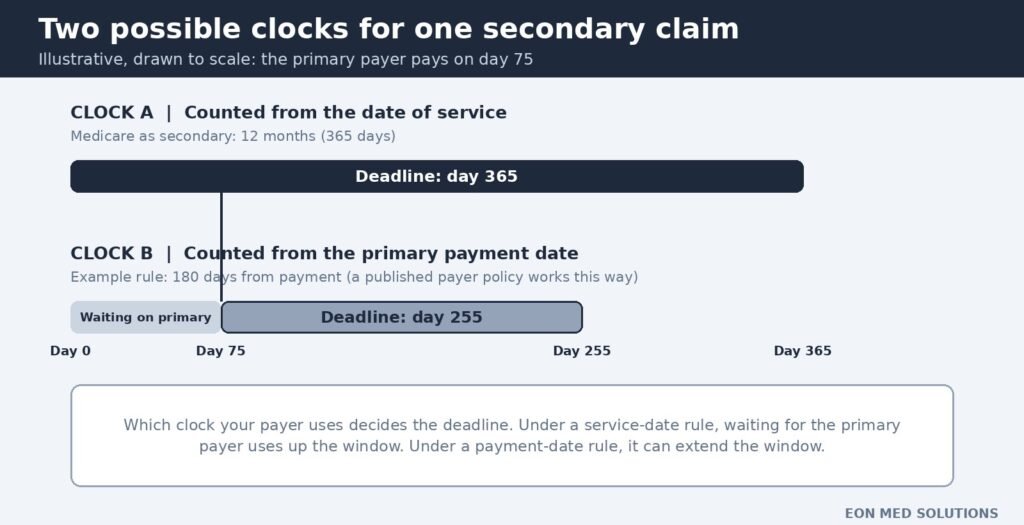
The secondary claim timely filing limit is the deadline for billing the second payer. Some payers count it from the date of service, and others from the primary payer’s payment date. Medicare, as secondary, counts 12 months from the service date.
Waiting on the primary payer can quietly cost you the secondary payment. The primary claim gets attention, while the second claim sits until the explanation of benefits arrives. By then, part of the window may be gone. This guide explains the secondary claim timely filing limit. It shows where each payer starts the count and how to track it. You will find published payer examples, worked date calculations, and a workflow. A short self-check near the end tests your process. Every figure is labeled by source. It is written for practice owners and billing managers.
Secondary Claim Timely Filing Limit at a Glance
| Metric | Practical Target/Range | Review Frequency | Primary Source |
| Medicare as secondary payer | 12 months from date of service | Every claim | ¹ Published federal standard |
| Medica as secondary payer | 180 days from the payment date on the primary remittance or EOB | At policy updates | ⁴ Published payer or state policy |
| Security Health Plan commercial, coordination of benefits | 180 days from service or 180 days from the other payer’s statement, whichever is later | At policy updates | ⁴ Published payer or state policy |
| Texas Medicaid, dual-eligible clients | 95 days from the date of Medicare disposition | At rule updates | ⁴ Published payer or state policy |
| Other commercial and Medicaid secondaries | Commonly reported 30 to 180 days from the primary EOB; some allow the service-date limit instead | At contract signing | ² Commonly reported range |
| Internal secondary target | Secondary claim filed within about 7 days of the primary payment | Weekly | ³ Illustrative target |
¹ Published federal standard: 42 CFR 424.44 and MAC guidance. ² Commonly reported range: industry sources differ, so verify each contract. ³ Illustrative target: a practical planning figure, not a payer requirement. ⁴ Published payer or state policy: applies only to the named payer or state.
Why Primary and Secondary Claims Run on Different Clocks?
Two Common Ways to Start the Count
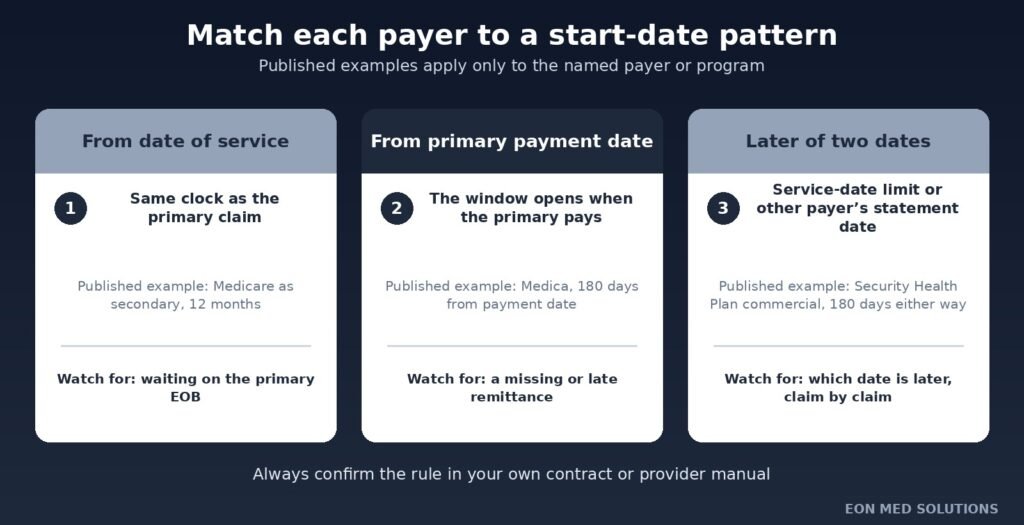
Every secondary claim depends on coordination of benefits, which decides who pays first. Payers then choose a start date. Some count from the date of service, exactly as they do for the primary claim. Others count from the primary payer’s payment or statement date, which gives extra time. A third group uses whichever date is later. Your contract or provider manual states the pattern, and one plan can use different patterns for different products. Never assume the primary clock and the secondary clock match.
The Primary Payer’s Deadline Still Matters
A secondary payer usually expects the primary claim to have been filed on time. Security Health Plan, for example, requires proof that the first submission met its filing limit. That rule applies when coordination of benefits occurs. A late primary claim can therefore sink the secondary payment as well. File the primary claim promptly, and keep proof of acceptance. Then confirm what the secondary payer wants attached. Many require the primary remittance or EOB with the claim. Keep the acceptance report with the claim record.
Medicare as the Secondary Payer
Medicare does not restart its clock when another insurer pays first. Palmetto GBA’s Medicare Secondary Payer guidance) says primary and secondary claims share one limit. That limit is one calendar year from the date of service. It also tells providers to follow up when a primary delay threatens the deadline. The listed federal exceptions do not include a slow primary payer. Track the original service date, and set a firm internal target for the primary payer’s response. Record the deadline on the account the day the service occurs.
Worked example 1: a Medicare secondary deadline
Formula: Deadline = date of service + 1 calendar year, whatever date the primary payer pays.
A service occurs on September 14, 2026. The primary payer pays in January 2027, and the team files the secondary claim in August. The Medicare deadline is still Tuesday, September 14, 2027. The primary payment date does not extend it. Had the primary payer stayed silent until June 2027, about three months would remain. Follow up early rather than waiting for the EOB.
Commercial and Medicaid Secondary Windows
Outside Medicare, the rule lives in each payer’s manual, contract, or state code. The table shows three patterns with published examples. Each example applies only to the named payer or state. Industry sources add more figures. One reports 60 days from the primary EOB, or 180 days from service, whichever is later, for a national carrier. Those reports help you know what to ask, but they do not replace the contract. Verify every figure before you build a calendar around it. Ask each payer for its rule in writing.
| Pattern | How the window works | Published example |
| From the primary payment date | The clock runs from the primary remittance or EOB payment date | Medica: 180 days from the payment date |
| Later of two dates | The service-date limit or the other payer’s statement date, whichever is later | Security Health Plan: 180 days either way for affiliated commercial providers |
| Government secondary program | A state rule counts from the primary payer’s final decision | Texas Medicaid: 95 days from Medicare disposition for dual-eligible clients |
Worked example 2: a payment-date deadline
Formula: Deadline = primary payment date + payer’s window in days.
Illustrative scenario (not an actual client record): a payer allows 180 days from the primary payment date. The primary payer pays on March 1, 2027. Adding 180 days gives Saturday, August 28, 2027. Some payers do not extend deadlines for weekends, so the practical date is Friday, August 27. File well before that day, and attach the primary remittance.
A Secondary Billing Workflow That Beats the Deadline
Secondary claims slip because they wait for an event. A short routine keeps them moving. Assign one owner, and review the queue every week. Front-end accuracy helps too. These claims processing best practices reduce rejections that delay the primary claim. Faster primary payment starts the secondary clock sooner where that rule applies. Late secondary claims often return as denials, so pair the routine with structured denial management. It helps decide whether an exception, a reopening, or an appeal is the right path.
- Identify every payer at registration, and record the order of benefits.
- Submit the primary claim promptly, and confirm it was accepted.
- Check primary claims still unpaid at 30 and 60 days (illustrative).
- When the primary pays, file the secondary claim with the remittance attached.
- Record both deadlines and both proofs of filing.
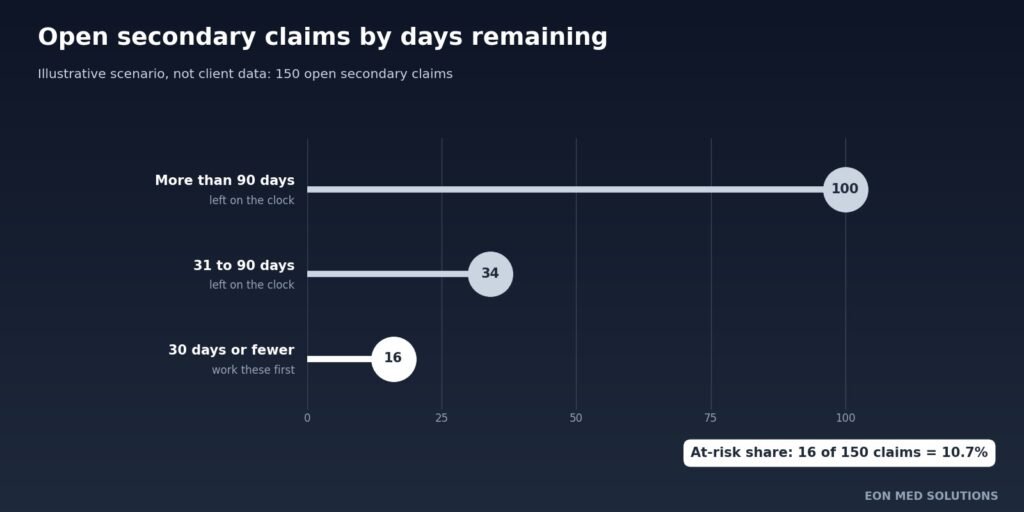
Worked example 3: days remaining on open secondary claims
Formula: Days remaining = filing deadline date − today’s date. At-risk share = claims with 30 or fewer days remaining ÷ open claims × 100.
Illustrative scenario (not an actual client record): a practice has 150 open secondary claims. Days remaining shows 100 claims with more than 90 days left, 34 with 31 to 90 days, and 16 with 30 days or fewer. The at-risk share is 16 ÷ 150, or 10.7%. A past on-time rate cannot show this, because it counts only claims already filed. A forward view shows which claims need work this week.
Reading These Numbers Like for Like
A deadline is meaningful only against the right clock start. Compare Medicare secondary’s with Medicare secondary’s, and one payer’s policy with that payer’s own history. Do not compare a service-date limit with a payment-date limit directly. The 7-day internal target is a planning figure, not a payer rule. One late secondary claim is a signal to check your dates, not a verdict on your team. Start with the group that misses most often, and keep every comparison inside it. Then trace the cause to one step.
How Fast Secondary Tracking Improves?
Illustrative planning ranges only. They are not guarantees, and results vary by practice.
| Fix | Partial Results | Fuller Results | What It Takes | Key Constraint |
| Clock-start field per payer | 1–2 weeks | 1–2 months | Reading manuals and contracts | Locating current policies |
| Secondary queue with two dates | 2–3 weeks | 1–3 months | Logging service and payment dates | Consistent data entry |
| Weekly primary-status check | 2–4 weeks | 2–3 months | A fixed slot and one owner | Staff time |
The Short Version
- Medicare as secondary counts 12 months from the date of service (published federal standard).
- Other payers may count from service, from the primary payment date, or from the later of the two.
- A late primary claim can sink the secondary payment, so keep proof of both filings.
- Medica, Security Health Plan, and Texas Medicaid rules apply only to those payers.
- A 7-day internal target after primary payment is a practical goal, not a mandate.
Self-Check: Are Your Secondary Claims Protected?
Answer yes or no to each question, then read the scoring guide below.
- Do you record each payer’s secondary clock start in writing?
- Do you identify the secondary payer at registration?
- Do you track unpaid primary claims by days since service?
- Do you log both the service date and the primary payment date?
- Can you list open secondaries by days remaining in under an hour?
- Do you attach the primary remittance when the payer requires it?
- Do you keep proof that the primary claim was filed on time?
- Does one person own the secondary queue?
- 7–8 yes: Well protected. Review payer policies quarterly.
- 4–6 yes: Gaps exist. Fix the “no” answers first, starting with questions 1 to 3.
- 0–3 yes: At risk. Audit open secondaries by deadline this week.
Expert Opinion
The firm parts of the secondary claim timely filing limit are narrow. Medicare counts 12 months from the date of service, even when it pays second. Medica, Security Health Plan, and Texas Medicaid figures are firm only for those payers, and only as published. Everything else is practical or illustrative, including the 7-day target, the follow-up checkpoints, and the improvement timeframes. Payers update rules, so verify each contract yourself. Review your payer matrix every quarter, and note every rule change with its date.
One pattern is worth naming directly. Teams treat the primary claim as the real work and the secondary claim as paperwork that follows. In practice, the secondary payer has its own clock. It often starts running before the primary explanation of benefits arrives. Tracking both dates from the first day closes that gap. Assign the queue to one person, and review it weekly. It also improves A/R management, because unpaid secondaries stay visible until they are resolved. Small, steady checks catch problems while they are still cheap to fix.
Frequently Asked Questions
What is the secondary claim timely filing limit?
It is the deadline to bill the second payer after the first has processed the claim. It depends on the payer, and it may run from service, from the primary payment date, or from the later of the two.
Does the secondary clock start at the primary EOB?
For some payers, yes. Medica counts 180 days from the primary payment date, but Medicare counts from service. Check the payer’s manual for its start rule.
What is the Medicare secondary payer timely filing limit?
One calendar year from the date of service, according to MAC guidance. A slow primary payer does not extend it.
What is the Medicaid timely filing limit as a secondary payer?
It is set by each state. Texas, for example, publishes 95 days from Medicare disposition for dual-eligible clients. Verify your own state’s rule.
Do you need the primary payer’s EOB to file a secondary claim?
Many payers require the primary remittance or EOB with the claim. Ask each payer what it accepts, including electronic remittance data.
What if the primary payer is slow to pay?
Follow up early, and calendar the service-date deadline as your outer limit. Keep proof of the primary submission in case the secondary payer asks for it.
What is a good internal deadline for secondary claims?
No standard exists. Many teams aim to file within about 7 days of the primary payment, an illustrative target that leaves a buffer.
What is a good on-time secondary filing rate?
No official benchmark exists. Many practices aim for close to 100%, as an illustrative goal. Track it by payer group and watch days remaining on open claims, because a past rate cannot show what is about to expire.
When Secondary Billing Outgrows Your Team?
Watch for these signals that your secondary process has reached its limits:
- Secondary claims wait for an EOB nobody is tracking.
- Nobody can say which date starts each payer’s secondary clock.
- Late secondary denials keep appearing, even after clean-ups.
Secondary billing depends on coordination of benefits, so ask how a partner captures each primary EOB, tracks every payer’s start date, and follows claims whose crossover never arrives. A work queue showing both dates is a good sign, and so is a named contact who knows your practice. Confirm HIPAA safeguards and clear reporting. EON MED SOLUTIONS is one company that fits this description. Its US-based team offers end-to-end medical billing, coding, credentialing, denial management, and A/R management, which keeps primary and secondary work in one place. It emphasizes transparent reporting and no hidden fees. Results vary by practice and situation, so compare its services against your self-check results.
Sources and Methodology
- Published standards: 42 CFR 424.44; Palmetto GBA Medicare Secondary Payer FAQ (MAC guidance).
- Named payer and state policies: Medica’s Timely Filing and Late Claims Policy; the Security Health Plan provider manual; 1 Tex. Admin. Code § 354.1003. Each applies only to that payer or state.
- Practical or illustrative targets: the 7-day target, follow-up checkpoints, improvement timeframes, and both illustrative scenarios. Other commercial and Medicaid windows are commonly reported industry ranges that differ.
- Named benchmarking data providers and surveys: none used.
Actual results vary by practice and situation. Figures reflect information available in September 2026, so verify current rules with each payer before acting.


