

BCBS California Timely Filing Limit: Anthem vs Blue Shield (2026 Guide)
The BCBS California timely filing limit depends on which Blue plan processes the claim. Anthem Blue Cross is commonly reported at 90 days from the date of service for commercial and Medicare Advantage professional claims. Blue Shield of California’s provider manual cites 12 months unless a contract says otherwise. California regulation sets a 90-day floor for contracted providers.
California has no single “BCBS” plan, and that is why the BCBS California timely filing limit trips up so many practices. Anthem Blue Cross and Blue Shield of California are separate companies with separate contracts, and a claim sent to the wrong deadline calendar is a claim lost. This guide separates the two, explains the state rules behind both, and walks through worked deadline examples, a seven-step workflow and a self-assessment checklist.
Most timely filing denials do not announce themselves. They arrive weeks later as a CO-29 denial on a remittance, after the payment window has closed. The figures below reflect information available in October 2026. Payer manuals and California regulations (including 28 CCR §1300.71) are updated, so confirm anything that touches a live claim.
Which Numbers Should Sit Beside Your Billing Screen?
Eight numbers cover most Blue plan filing decisions in California, and only some of them are set by regulation. The table separates published rules from payer guidance and from practical targets, so your team knows which figures are fixed and which are internal habits. Check the source label on each row before loading a number into your practice management system.
Key numbers cheat sheet for BCBS claims in California
| Metric | Practical target/range | Review frequency | Source type |
| Anthem Blue Cross commercial and Medicare Advantage professional claims | 90 days from date of service | At contract renewal | B |
| Blue Shield of California, contracted providers | 12 months from date of service unless the contract states otherwise | Annually | B |
| Regulatory floor for contracted providers (state-licensed plans) | No shorter than 90 days from date of service | Annually | A |
| Regulatory floor for non-contracted providers | No shorter than 180 days from date of service | Annually | A |
| Secondary (coordination of benefits) claim floor | No shorter than 90 days from the primary payer’s payment, contest, denial or notice | Monthly | A |
| Anthem Medi-Cal managed care | 180 days participating; 210 days nonparticipating | When the policy updates | B |
| Provider dispute window, Blue Shield of California | 365 days from the plan’s action, or the contract period if longer | Annually | B |
| Internal submission target and alert | Within 5 business days of service; alert near day 55 on a 90-day plan | Weekly | D |
Source labels: A = California regulation (28 CCR §1300.71). B = payer-published manual, policy or notice; verify the wording in your own agreement. C = commonly reported across industry sources, not a verified mandate. D = practical target used by billing teams, not a mandate.
Is There Really One BCBS California Timely Filing Limit?
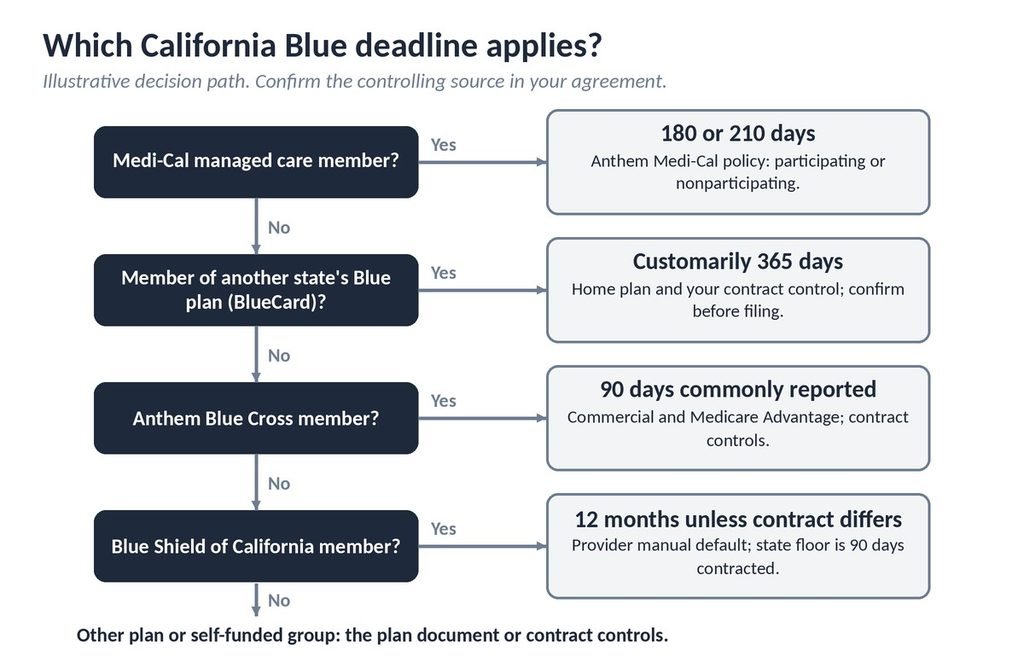
No single BCBS California timely filing limit exists, because California’s two Blue plans write their own deadlines into their own contracts. Anthem Blue Cross is a trade name of Blue Cross of California and belongs to Elevance Health. Blue Shield of California is a separate, independent licensee. A practice that bills both needs two calendars, plus a third for Medi-Cal managed care.
Several top-ranking lists show “Blue Cross of California: 180 days” on one row and “Anthem California: 90 days” on another, as if they were different payers. Anthem Blue Cross is the Blue Cross of California product line, so the two rows cannot both describe the same commercial claim. The 180-day figure may reflect an older contract or Medi-Cal; confirm it before using it.
Illustrative summary: BCBS plan lines in California (compiled from named sources; actual windows vary by contract)
| Plan line | Commonly cited window | What controls it | Confidence |
| Anthem Blue Cross commercial | 90 days from date of service | Provider agreement as amended Oct. 1, 2019 | Reported by CMA; confirm in contract |
| Anthem Blue Cross Medicare Advantage | 90 days from date of service | Provider agreement | Reported; confirm in contract |
| Blue Shield of California, contracted | 12 months unless contract differs | Independent Physician and Provider Manual | Manual dated Feb. 2024; check for updates |
| Anthem Medi-Cal managed care | 180 days participating; 210 days nonparticipating | Anthem Medi-Cal reimbursement policy | Policy document; check current version |
| Out-of-state Blue members (BlueCard) | Customarily 365 days | Home plan and your contract | Blue Shield BlueCard guide |
| Federal Employee Program | 365 days commonly reported | FEP provider guidance | Industry-reported; verify |
Two neighboring programs follow different rulebooks. Medi-Cal managed care plans, including Anthem’s, operate under the state program, which our Medi-Cal timely filing guide covers in detail. Original Medicare keeps its own 12-month rule, explained in our Medicare timely filing limit guide, and does not follow either Blue plan’s contract window.
Anthem Blue Cross
The California Medical Association reported that Anthem amended its Prudent Buyer Plan Participating Physician Agreement to require commercial and Medicare Advantage claims within 90 days of the date of service. The change applied to claims submitted on or after October 1, 2019, and CMA noted that 90 days meets the legal minimum for contracting physicians.
Provider guides published in 2026 still describe 90 days as Anthem’s commercial standard. Your own agreement and the current Anthem California provider manual decide whether that applies to a specific group or product, so read the filing clause before changing any calendar rule in your system.
Blue Shield of California
Blue Shield’s Independent Physician and Provider Manual tells providers to submit claims within 12 months of the date of service unless the contract states otherwise. The same section reflects the state floors for contracting and non-contracting providers and the 90-day secondary claim rule. Many groups have contract terms shorter than 12 months, so check the agreement before relying on the manual default.
Out-of-state Blue members seen in California
California practices treat many patients who carry another state’s Blue plan. Blue Shield’s BlueCard claims guide for professional providers describes 365 days from the date of service as the customary filing period for those claims, and it tells providers to consult their contract for specific terms. File to the local Blue plan, then confirm which agreement governs.
How Does California Law Limit What a Blue Plan Can Demand?
California regulation sets a floor under filing deadlines: a state-licensed health plan cannot require a claim sooner than 90 days after the date of service for contracted providers or 180 days for non-contracted providers. Title 28 CCR §1300.71 states this rule, with an exception for deadlines required by other state or federal law.
The same regulation says a plan that pays second cannot impose a coordination of benefits filing deadline shorter than 90 days from the primary payer’s payment, contest, denial or notice. For inpatient services, the date of service is the discharge date. A plan that denies a claim as late must accept and adjudicate it when the provider shows good cause through the provider dispute process.
In billing audits, a common pattern is that practices treat the payer’s contract number as untouchable and never test it against the state floor. That is a mistake in the other direction too, because the floor protects only claims covered by the regulation. Some products are regulated by the California Department of Insurance rather than the Department of Managed Health Care, and self-funded employer plans generally sit outside both. Confirm the regulator and funding type before assuming the floor applies.
When Does the BCBS Filing Clock Start, Restart or Stretch?
The clock usually starts on the date of service, but facility, secondary, corrected and misdirected claims each follow a different start point. Identify the plan type first, then the event that begins the count, because a discharge date, a primary remittance and a resubmission can each move a deadline by weeks.
Facility and inpatient claims
Under §1300.71, the date of service for inpatient services is the discharge date, while outpatient and emergency services use the date the separately billable service was delivered. Professional claims count from the individual service date. When a facility bills a multi-day stay, enter the discharge date as the clock start in your system.
Secondary claims
California’s floor for secondary claims is 90 days from the date the primary payer paid, contested, denied or sent notice. The contract may set a longer period, but it may not be shorter for a plan licensed under the regulation. Add a field for the primary remittance date, and see our secondary claim timely filing guide for sequencing rules.
Corrected claims
The sources reviewed for commercial Anthem and Blue Shield plans did not publish a separate corrected-claim window. When the original deadline is near, submit the correction inside it. Our corrected claim deadlines by payer guide compares how payers treat the clock after a rejection.
Claims sent to the wrong plan
Under §1300.71, a plan that receives a claim belonging to a capitated provider must forward it within ten working days, or deny it with instructions. The “date of receipt” for a misdirected claim becomes the day it reaches the correct party. Keep proof of the first submission, because that evidence supports a good-cause dispute if a deadline is missed.
Disasters and good cause
Anthem’s Medi-Cal reimbursement policy reserves the right to waive timely filing requirements on a temporary basis in certain circumstances. For other plans, the route is a provider dispute showing good cause. Neither route is automatic, so document the cause on the day it happens.
How Do You Calculate a Blue Plan Deadline?
A deadline equals the clock start date plus the filing limit, and your billing system should calculate it rather than staff counting by hand. Each example below uses a different formula and a different plan line, so your team can copy the logic into a spreadsheet or a practice management rule.
Worked example 1: an Anthem commercial claim
Illustrative scenario (not an actual client record): A California practice sees a patient on an Anthem Blue Cross commercial plan on August 18, 2026. Formula: deadline = date of service + 90 days. August 18 plus 90 days is Monday, November 16, 2026. An internal alert at 60 percent of the window (54 days) falls on Sunday, October 11, so the practical alert date is Friday, October 9.
Worked example 2: a secondary claim
Illustrative scenario (not an actual client record): The primary payer’s remittance for a different patient is dated September 14, 2026, and the Blue plan is secondary. Formula: secondary deadline = primary payment date + 90 days. September 14 plus 90 days is Sunday, December 13, 2026. Neither the regulation nor the manuals reviewed describe a weekend roll-forward, so the practical hard stop is Friday, December 11.
Worked example 3: how a blended average hides a problem
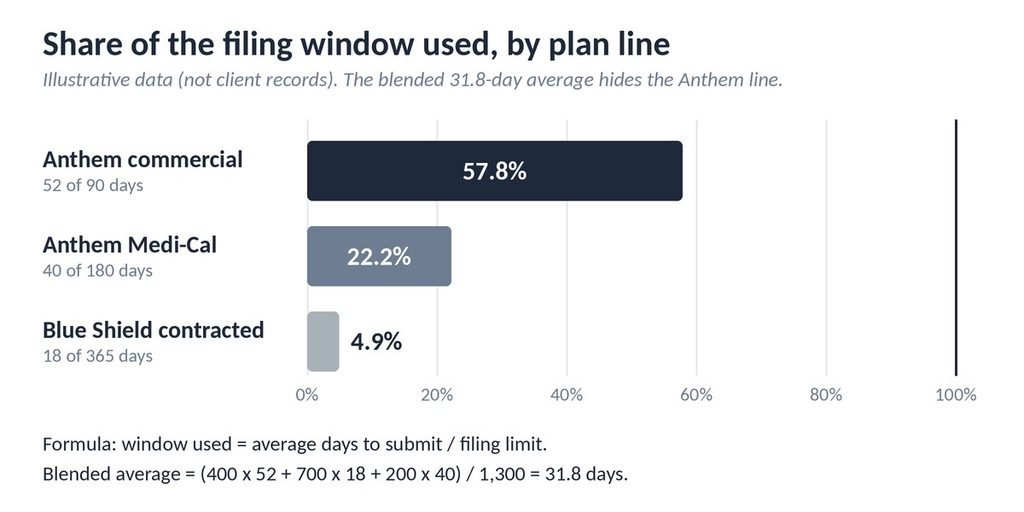
Illustrative scenario (not an actual client record): A practice reviews average days from service to submission across three plan lines. Formula: window used = average days to submit ÷ filing limit. The figures are invented for teaching and contain no client information, and real practices will see different spreads.
Illustrative data: average days to submit by plan line (actual figures vary)
| Plan line | Claims | Average days to submit | Filing limit used | Window used |
| Anthem commercial | 400 | 52 | 90 | 57.8% |
| Blue Shield contracted | 700 | 18 | 365 (manual default) | 4.9% |
| Anthem Medi-Cal | 200 | 40 | 180 | 22.2% |
| Blended | 1,300 | 31.8 | n/a | n/a |
The blended average is (400 × 52 + 700 × 18 + 200 × 40) ÷ 1,300 = 31.8 days, which looks safe against any limit shown. The Anthem commercial line already uses 57.8 percent of its 90-day window on average, so slower claims in that line are at risk. Track the share of claims submitted after day 60 for each plan line, not just the overall mean.
Which Seven Steps Keep California Blue Claims Safe?
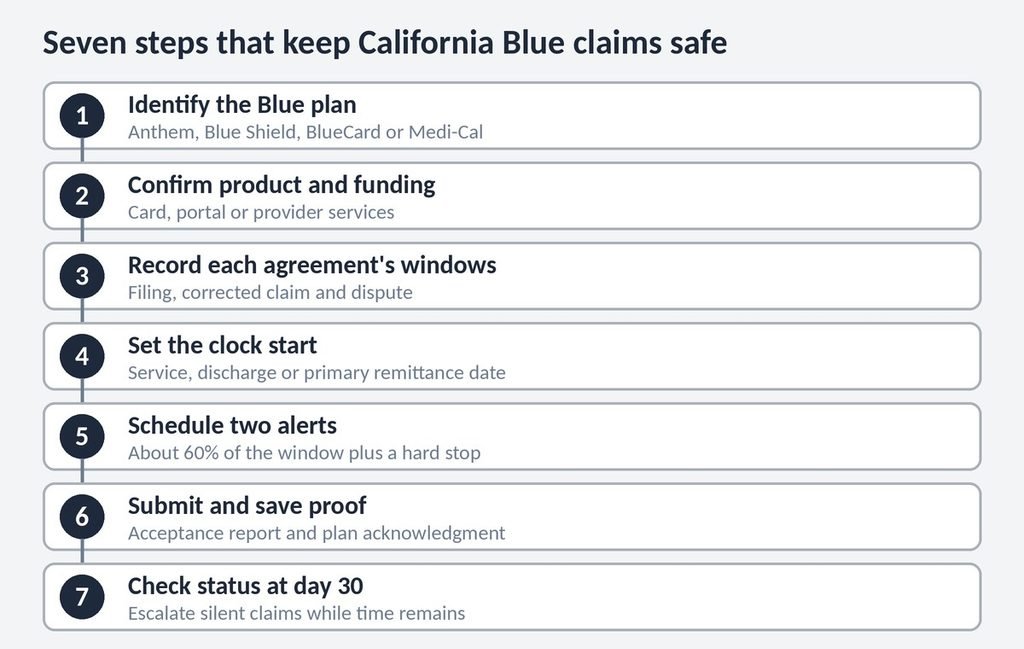
Seven steps keep claims inside the window when your practice sees Anthem, Blue Shield, BlueCard and Medi-Cal patients. They work in order, and each step produces a date or a document that a later step relies on. Skip none when claim volume is high.
- Identify the Blue plan at registration. Scan both sides of the card and separate Anthem Blue Cross, Blue Shield of California, out-of-state Blue plans and Medi-Cal managed care.
- Confirm the product and funding type when the card does not say. Use the payer portal or provider services line.
- Record the filing, corrected-claim and dispute windows from each agreement in your practice management system.
- Set the clock start: date of service, discharge date or primary remittance date for secondary claims.
- Schedule two alerts: an internal alert near 60 percent of the window and a hard stop two business days before the deadline.
- Submit electronically and save the clearinghouse acceptance report and the plan’s acknowledgment with the claim record.
- Check claim status around day 30 and escalate silent claims while time remains to refile.
Weekly worklists do most of the protecting, because a dated queue catches a stalled claim long before the deadline does. Our step-by-step guide to tracking timely filing deadlines covers worklist design. When the worklist outgrows the front-office team, EON MED SOLUTIONS handles this follow-up inside its A/R management service.
What Proves a California Claim Was Filed On Time?
The strongest proof of timely filing is the clearinghouse acceptance report plus the plan’s own acknowledgment, because California-licensed health plans must acknowledge electronic claims within two working days and to let you confirm the recorded receipt date. A claim sitting only in your own system log carries little weight in a dispute.
Anthem’s California Medi-Cal reimbursement policy says services denied for timely filing are not reimbursable unless the provider presents documentation that a clean claim was filed within the limit. Blue Shield states that disputes must be submitted within 365 days of the plan’s action, or the contract period if longer, and that failing to dispute on time waives further remedies.
In denial work, a common pattern is that the acceptance report existed on the day of submission but was never attached to the claim record. The dispute clock is separate from the filing clock, so read the denial on the day it arrives; our timely filing limit versus appeal filing limit guide explains the difference. Practices that want help assembling dispute files can review EON MED SOLUTIONS’ denial management service.
Where Do California Practices Lose Blue Plan Revenue to the Clock?
Most losses trace to workflow errors, not payer surprises. Each fix below applies under a stated condition, so start with the ones that match your payer mix and your monthly claim volume, and add the rest as capacity allows.
- Using one “BCBS” number for every Blue plan. When your payer mix includes Anthem and Blue Shield, set the limit per plan line and per agreement.
- Counting from the day the claim was sent. When staff count from submission, recount from the date of service, discharge date or primary remittance date.
- Treating a rejection as a filed claim. A claim rejected at the front end was not accepted. When a rejection report appears, fix and resubmit the same day.
- Trusting a website list over the contract. When the agreement has not been abstracted into your system, do that before the next renewal cycle.
- Forgetting Medi-Cal and BlueCard patients. When these patients make up part of your schedule, give each its own deadline rule.
- Skipping front-end checks. Eligibility and registration errors delay submission, so review your claim payer rules guide when rejections run high.
How Should You Read These Numbers, and How Fast Can Practices Improve?
Compare like for like: judge Anthem commercial lag against Anthem commercial, and Medi-Cal against Medi-Cal. One late claim is a signal to investigate the workflow, not a verdict on the team. A single month’s average also hides seasonal swings, so look at three months before changing staffing.
Planning ranges help set expectations. Alert rules, worklists and plan-line limits can often be in place within 30 to 60 days. Contract abstraction, rejection cleanup and consistent proof storage commonly take 90 to 180 days. These are general planning ranges, not guarantees, and they vary with claim volume and software. Other California payers differ, as our UHC California timely filing guide and Aetna California timely filing guide show.
Quick Summary
- No single BCBS California timely filing limit exists; Anthem Blue Cross and Blue Shield of California set separate deadlines.
- Anthem commercial and Medicare Advantage professional claims are commonly reported at 90 days; Blue Shield’s manual default is 12 months unless the contract differs.
- California’s floor is 90 days for contracted and 180 days for non-contracted providers on plans the regulation covers.
- Secondary claims have a 90-day floor from the primary payer’s action; inpatient claims count from discharge.
- A practical target is submission within 5 business days, with an alert near day 55 on a 90-day plan.
- Acceptance reports plus plan acknowledgments are the proof that wins disputes.
Is Your Practice Protected? A Self-Assessment Checklist
Answer yes or no to each question below, using your last full month of billing activity as the reference point. Count your yes answers, then compare the total with the three-tier scoring guide that follows the list.
- Do you separate Anthem Blue Cross, Blue Shield of California, BlueCard and Medi-Cal claims at registration?
- Has someone read the filing language in each Blue agreement in the last 12 months?
- Is 90 days loaded for Anthem commercial and Medicare Advantage claims, unless your contract says otherwise?
- Do most claims reach the plan within five business days of service?
- Do you store clearinghouse acceptance reports with each claim record?
- Do you have an alert near 60 percent of the filing window for unpaid claims?
- Do you check status around day 30 on electronic claims?
- Do you track the primary remittance date for every secondary claim?
- Do you review average days to submit by plan line, not only overall?
- Do you know the dispute deadline in each Blue agreement?
Scoring guide: 9 to 10 yes answers suggests a strong process; keep reviewing quarterly. 6 to 8 yes answers suggests gaps; fix each “no” within 30 to 60 days. 0 to 5 yes answers suggests high exposure; audit your filing workflow before the next billing cycle.
When Should a California Practice Consider Professional Billing Support?
In-house teams reach a limit when deadline tracking depends on memory instead of a system, or when volume outgrows the people available to work the aging report. Five signals suggest outside help may be worth a look before the next quarter closes:
- CO-29 write-offs appear in more than one month’s remittance reports.
- Staff cannot say which Blue plan carries which deadline.
- Secondary or Medi-Cal claims regularly age past day 60.
- Acceptance reports are not stored with claims.
- One employee holds the deadline knowledge, and turnover would erase it.
When evaluating outside support, look for plan-line deadline tracking, stored proof of submission, reporting on submission lag and write-offs by reason, clear contract and fee terms, and a team that works in a HIPAA-compliant way. EON MED SOLUTIONS is one example: it provides end-to-end medical billing, coding, credentialing, denial management and compliance support through a US-based team with transparent reporting and no hidden fees. Results vary by practice. You can explore the EON MED SOLUTIONS billing and RCM services to see how that support is structured.
Expert Opinion
The BCBS California timely filing limit is a plan-line question first and a calendar question second. Anthem, Blue Shield, BlueCard and Medi-Cal each carry their own clock, and the safest practices answer both questions at registration. A calendar built on one remembered number will be wrong for part of any mixed payer book.
Firm published standards in this guide are the California 90-day and 180-day floors, the 90-day secondary claim floor, the discharge-date rule for inpatient claims and the good-cause route in 28 CCR §1300.71. Payer deadlines such as Anthem’s 90 days and Blue Shield’s 12 months come from payer guidance and contracts. The five-business-day target and the day 55 alert are practical or illustrative targets.
The natural next question is which of your open Blue claims sit closest to their deadline today, and who owns each one. If you want a second set of eyes on that answer, review how EON MED SOLUTIONS supports billing and revenue cycle workflows.
Frequently Asked Questions
What is the BCBS California timely filing limit?
No single limit exists. Anthem Blue Cross is commonly reported at 90 days from the date of service for commercial and Medicare Advantage claims, while Blue Shield of California’s manual cites 12 months unless the contract differs. State regulation sets a 90-day floor for contracted providers, so check your agreement.
What is a good days-to-submit target for Blue plan claims in California?
A commonly used practical target is submission within five business days of service. Many teams also investigate when an average uses more than about half of a plan’s filing window. For a 90-day plan, that is roughly 45 days. These are practical targets, not payer mandates.
What is a good alert point for unpaid Anthem claims?
A practical alert point is about 60 percent of the window, which is day 54 on a 90-day plan. At that point, confirm the acceptance report, check claim status and resubmit if needed while enough time remains to prove timely filing.
Do non-contracted providers get more time in California?
On plans covered by 28 CCR §1300.71, a plan cannot set a deadline shorter than 180 days from the date of service for non-contracted providers. Contracted providers get at least 90 days. Self-funded employer plans and products regulated elsewhere may follow different rules.
How long do I have to file a secondary claim to a Blue plan in California?
For plans covered by the regulation, the floor is 90 days from the primary payer’s payment, contest, denial or notice. Your contract may allow longer. Record the primary remittance date on every secondary claim, because that date starts the clock.
What should a practice do after a Blue timely filing denial?
Gather the clearinghouse acceptance report and the plan’s acknowledgment, then file a provider dispute inside the stated window. California rules require acceptance of a late claim when good cause is shown. Without proof, the amount is usually written off under the contract.
Sources and Methodology
(a) Published standards and definitions from named bodies
- California Code of Regulations, Title 28, §1300.71 (Claims Settlement Practices), including §1300.71(b)(1), (b)(2), (b)(4), (c) and the definition of date of service in (a)(7).
- California Department of Managed Health Care, Claims Management Technical Assistance Guide (references to Rule 1300.71 compliance checks).
(b) Named benchmarking data providers
- No benchmarking data provider figures were used in this article.
(c) Practical or illustrative targets from general industry sources
- The five-business-day submission target, the 60 percent alert point, the Federal Employee Program 365-day figure and the 30 to 60 and 90 to 180 day planning ranges are commonly reported across industry sources or are illustrative. All worked examples are illustrative.
(d) Survey or study data with a named source
- No survey or study data were used in this article.
Payer and trade guidance reviewed: California Medical Association news report on Anthem Blue Cross’s 90-day amendment (2019); Blue Shield of California Independent Physician and Provider Manual, Section 4 (February 2024 edition) and BlueCard claims guide for professional providers; Blue Shield of California dispute process page; Anthem Blue Cross Medi-Cal managed care claims timely filing reimbursement policy; Anthem 2026 provider-education summaries from third-party publishers.
Methodology: This article is a research-based approximation of current search results and payer rules, not verified rank-tracking data. Research was completed in October 2026. Results vary by practice, contract and plan, and figures reflect information available at the time of research.


