

Medicaid California Timely Filing Limit: Medi-Cal Guide
The Medicaid California timely filing limit for Medi-Cal fee-for-service claims is six months after the month of service for full payment. Claims received in months seven through nine are paid at 75%, months ten through twelve at 50%, and later claims are denied unless an approved delay reason applies. Medi-Cal managed care plans set their own contract deadlines instead.
Medicaid California timely filing limit-Search for this rule and you will find three different answers: 90 days, six months, and twelve months. Each is partly right, which is exactly why Medi-Cal claims go out late. This guide untangles them. It explains how Medi-Cal counts the months, what happens to payment as a claim ages, and which delay reason codes can protect a late claim. It also covers managed care plan deadlines, appeals, worked calculations, and illustrative internal targets. Near the end, a ten-question self-audit shows how well your current process protects Medi-Cal revenue.
Medi-Cal Filing Windows: Quick Reference Table
Use this table to set due dates. Official rules appear first; internal goals are labeled illustrative.
| Metric / Deadline | Practical Target or Rule | Review Frequency | Primary Source |
| FFS full-payment window | Received within 6 months after the month of service | Weekly | Published standard: Medi-Cal Provider Manual (DHCS) |
| FFS claim received months 7–9 | Paid at 75% of payable amount | Weekly | Published standard: Medi-Cal Provider Manual; W&I Code §14115 |
| FFS claim received months 10–12 | Paid at 50% of payable amount | Weekly | Published standard: Medi-Cal Provider Manual; W&I Code §14115 |
| FFS claim after month 12 | Denied unless an over-one-year exception applies | Monthly | Published standard: Medi-Cal Provider Manual |
| Late proof of eligibility (code 1) | 60 days after proof is received; proof within 1 year | Per claim | Published standard: Medi-Cal Provider Manual |
| Medicare / other coverage delay (code 7) | Bill OHC within 12 months; Medi-Cal within 60 days of OHC result | Per claim | Published standard: Medi-Cal Provider Manual |
| Over-one-year exceptions (code 10) | 60 days after the delay is resolved | Per claim | Published standard: Medi-Cal Provider Manual |
| FFS appeal of a denied claim | 90 days from RAD date | Per denial | Published standard: Medi-Cal Provider Manual |
| Federal Medicaid ceiling | 12 months from date of service | Reference | Published standard: 42 CFR §447.45(d)(1) |
| Federal state payment standard | 90% of clean practitioner claims in 30 days; 99% in 90 days | Reference | Published standard: 42 CFR §447.45(d)(2)–(3) |
| Managed care plan filing window | Per contract; licensed plans at least 90 days (contracted) / 180 (non-contracted) | Per plan | Published standard: 28 CCR §1300.71; plan contract controls |
| Days to bill (internal) | 3–7 days from date of service | Weekly | Illustrative target |
| Claims received in full-pay window | 99%+ | Monthly | Illustrative target |
Source labels: “Published standard” means the rule appears in DHCS’s Medi-Cal Provider Manual, California statute or regulation, or federal regulation. “Illustrative target” means a practical internal goal from general industry practice; no agency mandates it. Rules and manual pages change, so confirm current versions.
How the Medicaid California Timely Filing Limit Really Works?
Why the clock counts months, not days?
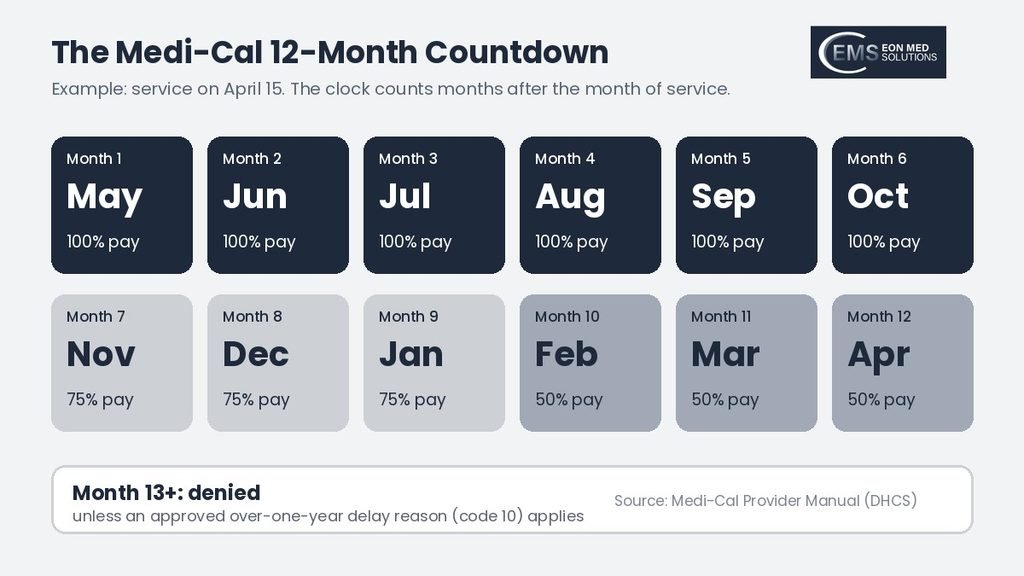
Medi-Cal calls its core rule the six-month billing limit. According to the Medi-Cal Provider Manual, original claims must reach the state’s fiscal intermediary within six months following the month of service. The count starts after the month ends, not on the service date. The manual’s own example uses an April 15 visit, which must arrive before October 31. That gives nearly six and a half months in practice. Still, receipt is what counts, not the date you pressed send or dropped paper in the mail.
The 75% and 50% payment steps
Missing six months does not end the claim immediately. Instead, DHCS pays in steps, as its provider bulletin explains. Claims received in months seven through nine get 75% of the payable amount. Months ten through twelve drop to 50%, and anything later is denied. Providers billing in months seven through twelve without a qualifying reason enter delay code 11. This is where confusion starts: some guides call the limit “12 months” because claims are still accepted. Accepted is not the same as fully paid.
| Worked Example 1 — Mapping the Payment Tiers Formula: Tier = number of months between the end of the month of service and the month the claim is received. Scenario: Date of service April 15, 2026. • Full payment: received by October 30, 2026 (the manual says before October 31). • 75% payment: received November 2026 through January 2027. • 50% payment: received February through April 2027. • Denied: received May 2027 or later, unless an over-one-year exception applies. |
| Worked Example 2 — What a Late Claim Actually Costs Formula: Revenue lost = Payable amount × (1 − payment percentage) Scenario: 40 claims averaging $120 each are received in month eight. Paid: 40 × $120 × 0.75 = $3,600. Lost: 40 × $120 × 0.25 = $1,200. If they slip to month eleven, the loss doubles to $2,400. |
How the federal 12-month rule fits in?
Federal regulation 42 CFR §447.45 requires every state Medicaid agency to demand claims within 12 months of the date of service. That is a ceiling, not a promise of full payment. California works inside it, using the six-month limit plus reduced payment through month twelve. So both “six months” and “twelve months” appear in credible sources. The practical rule is simple: bill as if six months is the deadline, and treat months seven through twelve as damage control.
Delay Reason Codes That Can Save a Late Claim
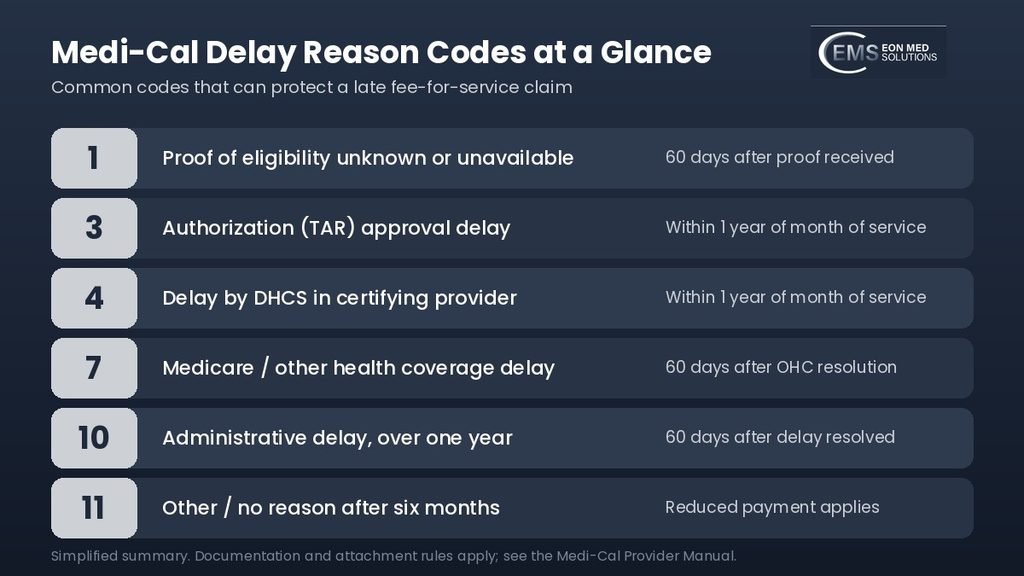
Medi-Cal allows exceptions when a delay was outside the provider’s control. Each code has its own clock and documentation rules, and many require attachments. That means some claims must go on paper or electronically with a Claim Attachment Control Form. The codes most practices meet are summarized below, but always check the current manual before relying on one.
Late proof of eligibility and retroactive coverage
Delay code 1 covers patients whose Medi-Cal eligibility was unknown or unavailable at the visit. The claim must arrive within 60 days after you receive proof of eligibility. That proof itself must be obtained within one year after the month of service. Retroactive eligibility is common in urgent care and emergency settings, where patients apply after treatment. Record the exact date proof arrived in the claim’s additional information field. Without that date, the claim looks late and gets reduced.
| Worked Example 3 — Retroactive Eligibility Window Formula: Claim due date = Date proof of eligibility received + 60 days Scenario: Proof arrives June 20, 2026 for a February visit. The claim must be received by August 19, 2026, which is still within one year of the month of service. |
Medicare and other health coverage delays
Medi-Cal is the payer of last resort, so other health coverage (OHC) and Medicare bill first. Under delay code 7, you must bill the other carrier within 12 months after the month of service. Then Medi-Cal must receive the claim within 60 days of the other carrier’s payment or denial, with that EOB attached. Most crossover claims move from Medicare automatically. When one does not cross over, the 60-day clock is easy to miss. Track it separately from your standard six-month queue.
Claims older than one year
What qualifies for code 10
Claims over one year old require delay code 10 and hard-copy billing to a special unit. Qualifying causes include court or fair hearing decisions, county eligibility errors, reversed authorization denials, and some coverage delays. Each also needs specific documents, such as an eligibility letter of authorization. The claim must arrive within 60 days after the delay is resolved. These cases are rare but valuable, so assign one person to own them.
Why “no reason” is not a strategy
Delay code 11, used without an attachment, simply confirms the claim is late. It accepts the reduced payment rather than avoiding it. If your team uses code 11 often, the problem sits upstream in charge entry or eligibility checks.
Managed Care Plans, Appeals, and Corrected Claims
Medi-Cal managed care deadlines are set by contract
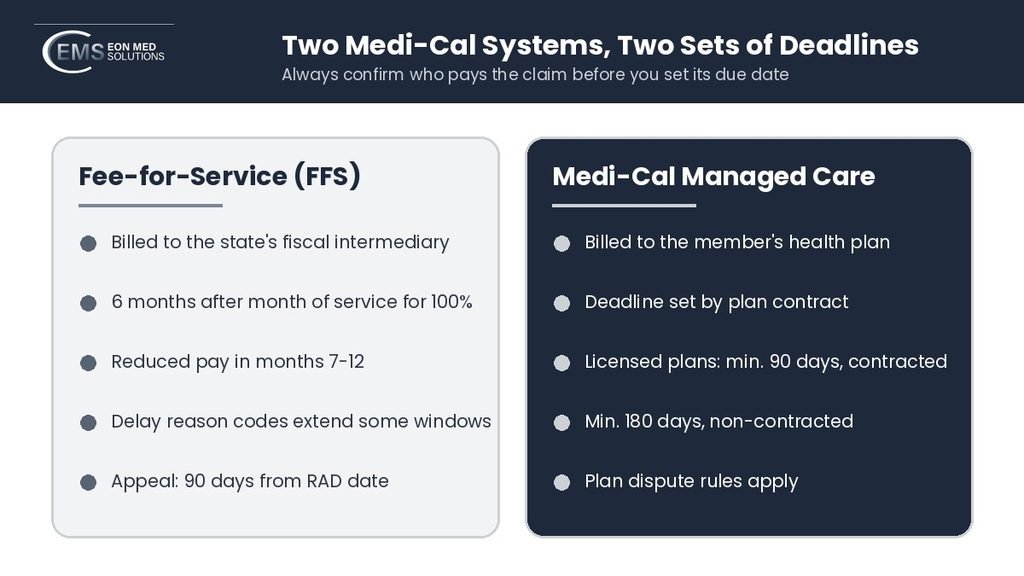
Most Medi-Cal members now receive care through Medi-Cal managed care plans, not fee-for-service. Those plans process their own claims and set filing deadlines in provider contracts. For plans licensed under California’s Knox-Keene Act, regulation 28 CCR §1300.71 sets minimums. Plans cannot require filing in less than 90 days for contracted providers or 180 days for non-contracted providers. Some plans allow longer, so read each contract. Assuming the six-month FFS rule for a 90-day plan contract is a costly mistake.
Appeals and Claims Inquiry Forms
For fee-for-service claims, a denied claim can be appealed within 90 days of the Remittance Advice Details (RAD) date. Before appealing, many issues can be fixed through a Claims Inquiry Form (CIF), used for adjustments, reconsiderations, and claim tracers. A tracer matters when a claim never appears on a RAD, because proof of timely submission may decide an appeal. Managed care plans run separate dispute processes with their own clocks. If denials keep piling up, structured denial management support keeps each window visible.
Measuring Medi-Cal Claim Timeliness Inside Your Practice
Statutory limits show when money is lost. Internal measures show the risk weeks earlier. The figures below are illustrative targets from general industry practice, not published Medi-Cal benchmarks. Actual figures vary by specialty, payer mix, and staffing, so verify against your own data where precision matters. For a wider view, compare them with other medical billing KPIs you already track.
| Metric (Illustrative) | Formula | Illustrative Target |
| Days to bill | Total days from service to submission ÷ claims submitted | 3–7 days |
| Full-pay window rate | Claims received within six-month limit ÷ total claims | 99%+ |
| Late-payment reduction loss | Sum of 25% and 50% reductions in the period | $0 |
| Delay code documentation rate | Delay-coded claims with required attachment ÷ delay-coded claims | 100% |
| Managed care contract compliance | Plan claims received within contract window ÷ plan claims | 99%+ |
Illustrative: compiled from general industry practice, not a named benchmark. Actual figures vary.
| Worked Example 4 — Full-Pay Window Rate Formula: Claims received within the six-month limit ÷ total claims × 100 Scenario: 1,164 of 1,200 Medi-Cal claims arrived on time. 1,164 ÷ 1,200 = 97%. The 36 late claims form the root-cause list. |
How a blended rate can hide one struggling plan?
Illustrative scenario (not an actual client record): a family practice bills Medi-Cal FFS and two managed care plans. Its blended on-time rate is 95%, which feels acceptable. Split by payer, FFS and Plan A look strong, but Plan B sits at 82%. Plan B uses a 90-day contract window, while staff assumed six months. The blended number never showed it. Those Plan B claims also inflate aging, so dedicated accounts receivable management helps surface them early.
| Payer (Illustrative) | Claims | On Time | Rate |
| Medi-Cal FFS | 300 | 297 | 99.0% |
| Plan A (180-day window) | 250 | 245 | 98.0% |
| Plan B (90-day window) | 150 | 123 | 82.0% |
| Blended | 700 | 665 | 95.0% |
Comparing Your Numbers Fairly
The six-month limit and payment tiers are fixed rules, not benchmarks, so they apply to everyone equally. Internal targets need more care. Compare like-for-like: the same payer type, a similar service mix, a comparable practice size, and the same reporting period. A clinic with heavy retroactive eligibility will naturally show more delay-coded claims than a pediatric office. One missed target is a signal to investigate, not a verdict on your staff. Find the cause first, then change the process.
Realistic Timelines for Seeing Improvement
These are general planning ranges, not guarantees for any specific practice. Backlog size, payer mix, and staffing will shift them.
| Fix | Partial Results | Fuller Results |
| Due dates set by payer type (FFS vs each plan contract) | 2–4 weeks | 1–2 months |
| Eligibility checks at every visit | 2–4 weeks | 2–3 months |
| Clearing claims already in months 5–6 | 1–3 weeks | 1–2 months |
| Delay code and attachment workflow | 1 month | 2–3 months |
| Denial, CIF, and appeal tracking | 1 month | 3 months |
Key Takeaways in Brief
- Medi-Cal FFS full payment requires receipt within six months after the month of service (published standard, DHCS).
- Months 7–9 pay 75%, months 10–12 pay 50%, and later claims are denied without an approved exception.
- Delay reason codes carry their own clocks, often 60 days after proof or resolution.
- Managed care deadlines follow each plan contract; licensed plans must allow at least 90 or 180 days.
- Targets like 3–7 days to bill and a 99%+ full-pay rate are illustrative goals, not mandates.
Medi-Cal Timeliness Self-Audit: 10 Yes-or-No Questions
Answer each question honestly, then count your yes answers.
- Do you verify Medi-Cal eligibility and plan assignment at every visit?
- Does each claim get a due date based on its actual payer, FFS or plan contract?
- Is your average days to bill at or under seven days?
- Did 99% or more of FFS claims arrive within the six-month limit last month?
- Did your practice lose $0 to 75% or 50% late-payment reductions last quarter?
- Do you record the date proof of eligibility arrives for retroactive cases?
- Is every delay-coded claim sent with its required attachment?
- Do you track Medicare and other-coverage results against the 60-day Medi-Cal window?
- Are denied FFS claims appealed well within 90 days of the RAD date?
- Do you review on-time rates separately for each managed care plan?
9–10 yes: Strong control; keep reviewing monthly. 6–8 yes: Real gaps; fix the “no” items this quarter. 0–5 yes: Medi-Cal revenue is probably leaking now; audit claims older than four months this week.
When Outside Billing Support Makes Sense?
Many practices manage the Medicaid California timely filing limit well in-house. Others hit a ceiling. These signals suggest yours has:
- Late-payment reductions appear on your RADs more than occasionally.
- Nobody can say which managed care contract uses a 90-day window.
- Retroactive eligibility claims are billed without the proof-received date.
- Crossover claims that failed to cross over sit unnoticed for months.
- Appeals are filed near, or after, the 90-day limit.
Good outside support should offer payer-specific due dates, routine eligibility checks, and a documented delay-code workflow. Look for transparent reporting you can read yourself, HIPAA-compliant handling, and one named point of contact. EON MED SOLUTIONS is one example of that structure. Its US-based team provides end-to-end medical billing, coding, credentialing, denial management, and compliance support, with a dedicated agent per provider and no hidden fees. Results vary by practice and situation. You can explore the full list of services here.
Expert Opinion
The Medicaid California timely filing limit is really several limits. For fee-for-service, six months after the month of service protects full payment, and each later quarter costs more. Delay codes can rescue qualifying claims, but only with the right clock and documents. Managed care plans play by their own contracts.
To be clear about sources: the six-month limit, 75% and 50% tiers, delay-code windows, and 90-day appeal window are published Medi-Cal standards. The 12-month ceiling and payment percentages come from federal regulation, and the 90/180-day plan minimums from California regulation. Days to bill, the 99% on-time rate, and the improvement timelines are illustrative targets to adapt to your own data.
Frequently Asked Questions
What is the Medicaid California timely filing limit?
For Medi-Cal fee-for-service, claims must be received within six months after the month of service for full payment. Late claims are paid at 75% or 50% through month twelve, then denied unless an exception applies.
Is the Medi-Cal filing limit six months or twelve months?
Both appear because they describe different things. Six months protects full payment, while twelve months is the outer point after which claims are denied without an approved delay reason.
What is a good days-to-bill target for Medi-Cal claims?
Many practices aim for three to seven days from the date of service. This is an illustrative target, not a DHCS standard, but it keeps even 90-day plan contracts safe.
What is a good on-time claim rate for Medi-Cal billing?
A practical internal goal is 99% or more of claims received within the full-payment window. It is an illustrative target; any late claim still deserves a root-cause check.
What is a good way to handle retroactive Medi-Cal eligibility?
Record the date proof of eligibility arrives and bill within 60 days using delay code 1. The proof must be obtained within one year after the month of service.
What is the timely filing limit for Medi-Cal managed care plans?
It depends on your plan contract. Knox-Keene-licensed plans must allow at least 90 days for contracted providers and 180 days for non-contracted providers.
How long do I have to appeal a denied Medi-Cal claim?
Fee-for-service appeals are due within 90 days of the RAD date. Managed care plans use their own dispute timelines, which appear in the provider manual or contract.
Does Medicare secondary billing change the Medi-Cal deadline?
Yes. Bill Medicare or other coverage within 12 months after the month of service, then send Medi-Cal the claim within 60 days of that payer’s decision.
Can a Medi-Cal claim older than one year be paid?
Only in specific situations, such as court decisions, county eligibility errors, or reversed authorization denials. These use delay code 10, hard-copy billing, and must arrive within 60 days of the delay being resolved.
Sources, Methods, and Limits of This Guide
(a) Published standards: DHCS Medi-Cal Provider Manual (claim submission and timeliness sections) and DHCS provider bulletins; California Welfare and Institutions Code §14115; 28 CCR §1300.71; and 42 CFR §447.45. (b) Named benchmarking data providers: none used. (c) Practical or illustrative targets: days to bill, on-time rates, documentation rates, and improvement timeframes, compiled from general industry practice. (d) Survey data: none used. Actual results vary by practice and situation, and all figures reflect information available at the time of research in September 2026.
This article is educational and is not legal or billing-compliance advice. Confirm current rules in the Medi-Cal Provider Manual and your plan contracts.


One Comment