

California Workers’ Compensation Timely Filing Limit Guide
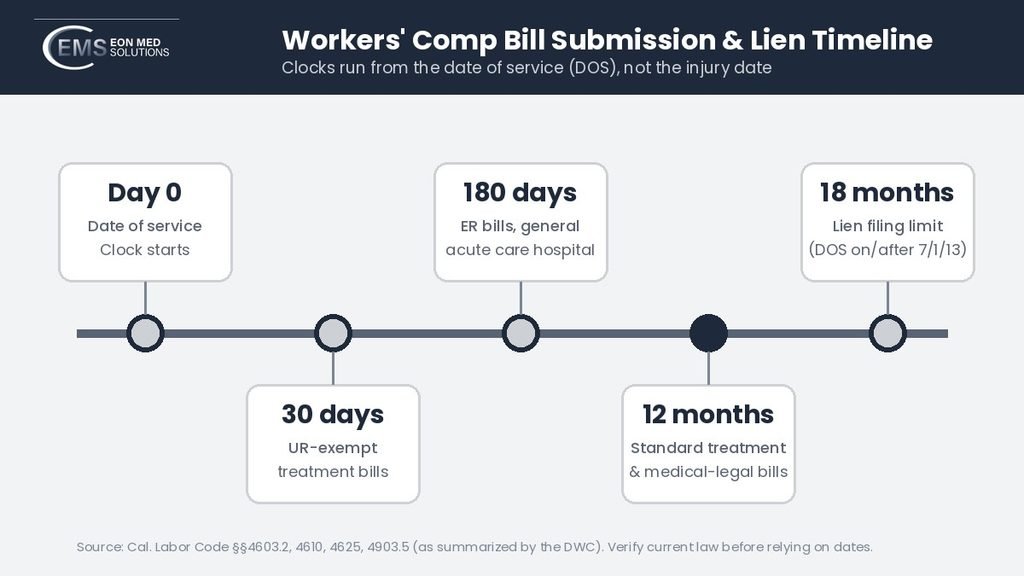
The California workers’ compensation timely filing limit for medical treatment bills is 12 months from the date of service, or 12 months from discharge for inpatient care, under Labor Code §4603.2 for services on or after January 1, 2017. Shorter statutory windows apply in some cases: 30 days for services exempt from prospective utilization review and 180 days for emergency care in a general acute care hospital. A bill submitted after its deadline is barred, so payment is generally lost.
A workers’ comp bill that sits in a queue too long does not simply get paid late. In California, it can stop being payable at all. That is the hard edge of the California workers’ compensation timely filing limit, and many practices learn it only after a denial arrives. This guide explains every deadline that touches a workers’ comp bill, from first submission to second review, Independent Bill Review, and lien filing. You will get a quick reference table, worked calculations, and illustrative internal targets you can adapt. Near the end, a nine-question self-check shows whether your process is deadline-ready or quietly leaking revenue.
Workers’ Comp Billing Deadlines at a Glance
Keep this table close to whoever handles timely filing for workers’ comp bills. Statutory deadlines are pass/fail, so the aim is to finish well inside each window.
| Metric / Deadline | Practical Target or Rule | Review Frequency | Primary Source |
| Standard treatment bill submission | Within 12 months of DOS (or inpatient discharge) | Weekly aging check | Published standard: Labor Code §4603.2(b)(1)(B) |
| Bills for services exempt from prospective UR | Within 30 days of DOS | Daily / weekly | Published standard: Labor Code §4610(d)(1), per DWC |
| Emergency care, general acute care hospital | Within 180 days | Weekly | Published standard: Labor Code §4610(d)(2), per DWC |
| Medical-legal bills | Within 12 months; no good-cause exception | Weekly | Published standard: Labor Code §4625 |
| Payer pays uncontested paper bill | 45 days from receipt (60 for government employers) | Per bill | Published standard: Labor Code §4603.2, per DWC |
| Payer pays uncontested e-bill | 15 working days from receipt | Per bill | Published standard: Labor Code §4603.4 |
| Payer flags contested or incomplete bill | 30 days from receipt | Per bill | Published standard: Labor Code §4603.2, per DWC |
| Request for second review | 90 days from service of EOR | Per EOR | Published standard: Labor Code §4603.2(e), per DWC |
| Independent Bill Review request | 30 days from second-review EOR | Per EOR | Published standard: Labor Code §4603.6, per DWC |
| Lien filing | 18 months from DOS (services on/after 7/1/2013) | Monthly | Published standard: Labor Code §4903.5(a) |
| Days to bill (internal) | 3–7 days from DOS | Weekly | Illustrative target |
| Timely submission rate (internal) | 98%+ of bills within internal target | Monthly | Illustrative target |
Source labels: “Published standard” means the figure is set by the California Labor Code as summarized by the Division of Workers’ Compensation. “Illustrative target” means a practical internal goal compiled from general industry practice; no standards body mandates it. Statutes change, so confirm current text before relying on any date.
What the California Workers’ Compensation Timely Filing Limit Requires?
The statute behind the 12-month deadline
The core rule comes from Labor Code §4603.2, amended by SB 1175 in 2016. For services on or after January 1, 2017, a provider must send the itemized bill within 12 months of the date of service. For inpatient facility services, the clock starts at discharge instead. The statute states plainly that a request for payment is barred unless timely submitted. The rule reaches physicians, hospitals, pharmacies, therapy clinics, and other treatment providers. Importantly, the deadline runs from the service date, not the injury date. That single detail trips up many front offices that organize workers’ comp files by injury.
Shorter windows that practices often overlook
Twelve months is the outer limit, not the only limit. According to the Division of Workers’ Compensation (DWC), bills for services exempt from prospective utilization review must arrive within 30 days of service. That rule has applied since January 1, 2018. Emergency care in a general acute care hospital gets 180 days. Urgent care and occupational medicine clinics often deliver early treatment, so some of their bills may fall into these faster categories. If your team treats every workers’ comp bill as a 12-month bill, some could be late within weeks. Confirm each service’s category before setting its due date.
Medical-legal bills follow a stricter path
Medical-legal evaluations, such as QME reports, are billed separately from treatment. SB 1175 also amended Labor Code §4625, requiring these bills within 12 months of service. Unlike treatment bills, the medical-legal rule contains no good-cause exception, according to industry summaries of the bill. Practices that provide both treatment and evaluations should track the two streams in separate queues. Payment rules and fee schedules differ as well. Mixing both in one aging report hides which deadline governs each line, and that confusion is exactly how bills slip past the limit unnoticed.
Are there exceptions to the 12-month limit?
The statute tells the DWC to define good cause for exceptions, including a non-occupational injury later found compensable. However, industry billing sources report that no implementing rules had been adopted when they published. In practice, some claims administrators reportedly auto-deny any bill older than 365 days. That makes exceptions an argument for a dispute, not a safety net. Build your workflow as if no exception exists. If a genuine good-cause situation appears, document it thoroughly and submit immediately rather than waiting for clearer rules.
When a claim starts under group health
Illustrative scenario (not an actual client record): a patient’s back injury is billed to commercial insurance in March. In November, the employer accepts it as work-related. The practice now holds eight months of services that belong under workers’ comp. The safest move is rebilling the workers’ comp carrier right away, with records showing when liability became known. Waiting for a formal good-cause rule could let the earliest dates of service cross the 12-month line. Every week of delay puts another older visit at risk.
Where the “five-year” figure comes from?
Some billing articles mention a five-year extension for workers’ comp. That figure likely traces to Labor Code §4903.5(b), which covers lien claims by health plans and other non-industrial payers. Those entities get 12 months from learning of the industrial claim, capped at five years from service. It is not a general extension for treating providers. Relying on it for ordinary treatment bills could cost a practice real money.
Worked example: mapping every clock for one visit
| Worked Example 1 — Deadline Calculation Formula: Deadline = Date of service (or EOR service date) + statutory window Scenario: Routine follow-up visit on March 10, 2026. • 12-month bill deadline: March 10, 2027. • Lien deadline (18 months): September 10, 2027. • If the same visit were exempt from prospective UR, the bill would be due by April 9, 2026 (30 days). • If the payer serves an EOR on June 1, 2026, a second-review request is due by August 30, 2026 (90 days). Tip: Set internal due dates weeks earlier than the legal date to absorb mail time and rejections. |
After Submission: Payer Clocks, Penalties, and Appeals
How long the payer has to pay?
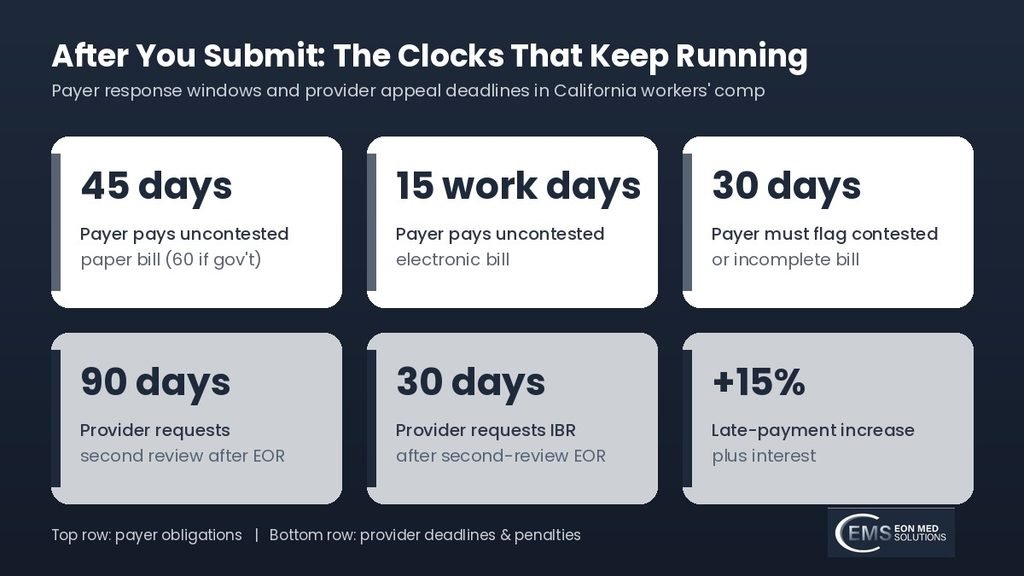
Once a complete bill arrives, the pressure shifts to the payer. Per the DWC, uncontested paper bills must be paid within 45 days of receipt, or 60 days for government employers. Electronic bills carry a 15-working-day payment window under Labor Code §4603.4. If a payer contests a bill or finds it incomplete, it must say so within 30 days. That notice comes through an Explanation of Review (EOR), which must list any missing information. E-billing therefore offers two advantages at once: faster payment and a cleaner, time-stamped paper trail for disputes.
What late payment adds to the bill?
Under Labor Code §4603.2(b)(2), properly documented amounts not paid on time increase by 15 percent. Interest also accrues at the civil-judgment rate, retroactive to the date the payer received the bill. That rate is commonly applied as 10 percent per year in California, and panel decisions reflect it. These add-ons only apply when your bill was complete and timely. Check each late payment to see whether the payer included them on its own, because many offices never ask.
| Worked Example 2 — Late-Payment Penalty and Interest Formula: Amount due = Unpaid amount + (Unpaid × 15%) + (Unpaid × 10% × days since receipt ÷ 365) Scenario: A $1,200 uncontested paper bill is received April 1 and paid on day 105. Penalty: $1,200 × 0.15 = $180.00. Interest: $1,200 × 0.10 × 105 ÷ 365 = $34.52. Total owed: $1,414.52, not $1,200. |
Second review and Independent Bill Review windows
If you dispute the amount paid, the next deadlines are tight. A request for second review must reach the claims administrator within 90 days of service of the EOR. Miss it, and the DWC treats the bill as satisfied. After the second-review EOR, a provider still disputing the amount has 30 days to request Independent Bill Review (IBR). Both windows run from service of the EOR, so log those dates the day mail arrives. If these dates keep slipping, structured denial management support can keep every appeal on calendar.
Lien filing: the 18-month backstop
When liability is disputed, or a service falls outside the Official Medical Fee Schedule (OMFS) without a contract, a lien claim may be the only route. For services on or after July 1, 2013, Labor Code §4903.5(a) bars liens filed more than 18 months after service. The DWC notes that no tolling applies for liability disputes, unlike IBR. A long dispute can therefore quietly consume the entire lien window. Calendar the 18-month date for each contested service the day the denial arrives.
Turning Deadlines Into Trackable Practice Metrics
Statutory limits tell you when a bill dies. Internal metrics tell you, weeks earlier, that a bill is drifting toward the California workers’ compensation timely filing limit. The table below lists practical measures for workers’ comp billing and claim submission. These figures are illustrative targets, not published benchmarks. Actual figures vary by specialty, payer mix, and staffing, so verify against your own data where precision matters. They pair well with the broader medical billing KPIs every practice should track.
| Metric (Illustrative) | Formula | Illustrative Target |
| Days to bill | Total days from DOS to submission ÷ bills submitted | 3–7 days |
| Timely submission rate | Bills sent within internal target ÷ total bills | 98%+ |
| Unbilled WC dollars over 270 days | Sum of unbilled charges older than 270 days | $0 |
| Second-review compliance | Requests filed within 60 days of EOR ÷ disputed EORs | 100% |
| Lien calendar coverage | Contested DOS with lien date logged ÷ contested DOS | 100% |
Illustrative: these targets are compiled from general industry practice, not a named benchmark. Actual figures vary.
| Worked Example 3 — Timely Submission Rate Formula: Bills submitted within internal target ÷ total bills × 100 Scenario: 188 of 200 workers’ comp bills went out within seven days. 188 ÷ 200 = 94%. The 12 late bills are the investigation list. |
| Worked Example 4 — Days to Bill and Revenue at Risk Days to bill: 1,050 total days ÷ 150 bills = 7.0 days, right at the edge of the illustrative range. Revenue at risk: 14 unbilled services older than 270 days × $385 average charge = $5,390 approaching the 12-month limit. |
How a blended average can hide one problem payer?
Illustrative scenario (not an actual client record): a clinic bills three claims administrators. Its overall timely submission rate is 94.5%, which looks close to target. Split by payer, the picture changes. Two payers sit near 99% and 98%, while the third sits at 77.5%. The cause is a portal that rejects bills silently, so staff believe they submitted on time. Without the split, nobody notices until denials arrive. Aging balances like these are an A/R problem as much as a billing one, and dedicated accounts receivable management keeps them visible.
| Claims Administrator (Illustrative) | Bills | Submitted on Time | Rate |
| Payer A | 100 | 99 | 99.0% |
| Payer B | 60 | 59 | 98.3% |
| Payer C | 40 | 31 | 77.5% |
| Blended | 200 | 189 | 94.5% |
Reading These Numbers in the Right Context
Statutory deadlines are not benchmarks; they are hard limits that apply to everyone. Internal targets are different, and they only mean something when compared like-for-like. Compare the same payer type, a similar service mix, comparable practice size, and the same reporting period. An occupational medicine clinic with daily injury visits will look different from an orthopedic group billing surgeries. One missed internal target is a signal to investigate, not a verdict on your team. Look for the cause first, whether it is a portal issue, missing reports, or a staffing gap, before changing the process.
How Soon Process Fixes Start Paying Off
The ranges below are general planning estimates, not guarantees for any specific practice. Your starting backlog, payer mix, and staffing will shift them.
| Fix | Partial Results | Fuller Results |
| Deadline calendar by bill type (30-day, 180-day, 12-month) | 2–4 weeks | 1–2 months |
| Clearing the unbilled workers’ comp backlog | 2–6 weeks | 2–3 months |
| Moving to electronic billing and EOR tracking | 1–2 months | 3–4 months |
| Second-review, IBR, and lien diary for every EOR | 1 month | 3 months |
| Staff training on California workers’ comp rules | 2–4 weeks | 2–3 months |
The Short Version
- Standard treatment bills: 12 months from date of service or discharge (published standard, Labor Code §4603.2).
- UR-exempt services: 30 days; emergency hospital care: 180 days (published standard, Labor Code §4610).
- Payers owe payment in 45 days for paper bills and 15 working days for e-bills; late amounts add 15% plus interest.
- Second review: 90 days from the EOR; IBR: 30 days after that. Liens: 18 months from service.
- Internal targets like 3–7 days to bill and a 98%+ timely submission rate are illustrative goals, not mandates.
Is Your Practice Deadline-Ready? A 9-Point Check?
Answer yes or no. Count your yes answers.
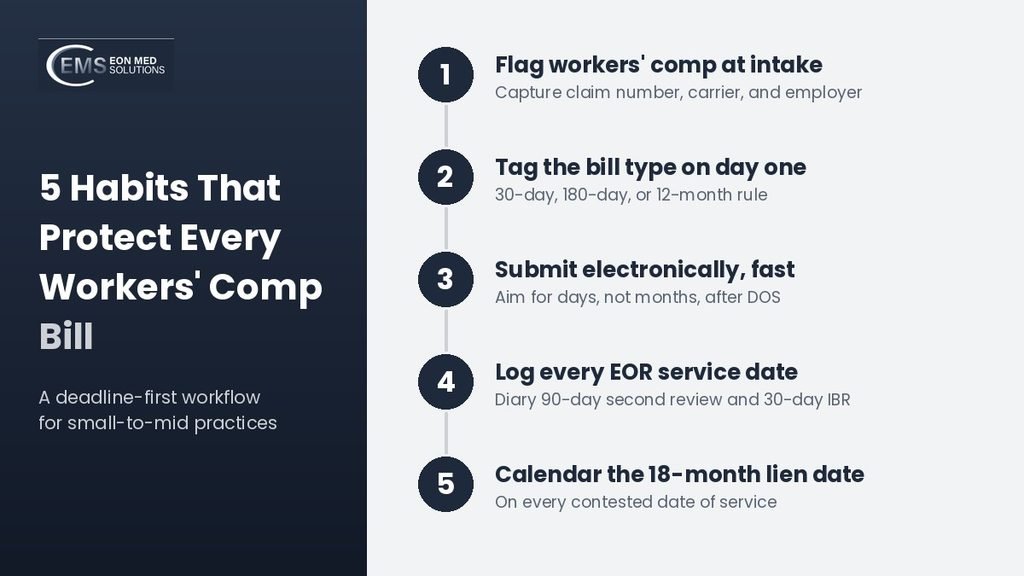
- Do you flag workers’ comp cases at intake, with claim number and carrier captured?
- Does every bill carry a due date based on its category (30-day, 180-day, or 12-month)?
- Is your average days to bill at or under seven days?
- Is your timely submission rate at 98% or higher this month?
- Do you have zero unbilled workers’ comp charges older than 270 days?
- Do you submit workers’ comp bills electronically where payers accept them?
- Do you log the service date of every EOR the day it arrives?
- Are all second-review requests filed within 60 days of the EOR?
- Is an 18-month lien date calendared for every contested date of service?
8–9 yes: Your process is deadline-ready; keep reviewing monthly. 5–7 yes: Gaps exist; fix the “no” items within the next quarter. 0–4 yes: Revenue is likely at risk now; audit aging workers’ comp bills this week.
Signs It’s Time to Bring in Billing Help
Some practices handle workers’ comp comfortably in-house. Others reach a point where the California workers’ compensation timely filing limit and related rules outpace the team. Watch for these signals:
- Workers’ comp bills regularly go out more than two weeks after the date of service.
- You have received at least one “untimely submission” denial in the past year.
- Nobody can say, today, which contested services are nearing the 18-month lien limit.
- Second-review deadlines are tracked in personal inboxes rather than a shared calendar.
- Late-payment penalties and interest are never checked on overdue payments.
Good outside support should offer a documented workflow for each deadline category and electronic billing capability. Look for transparent reporting you can review yourself, HIPAA-compliant handling, and a named point of contact. It should also connect coding, submission, and appeals, so no deadline falls between teams. EON MED SOLUTIONS is one example of that structure. Its US-based team provides end-to-end medical billing, coding, credentialing, denial management, and compliance support, with a dedicated agent for each provider and no hidden fees. Results vary by practice and situation. You can review the full range of services here.
Expert Opinion
The California workers’ compensation timely filing limit is less forgiving than most commercial payer rules. A late bill is not reduced; it is barred. The 12-month rule gets the attention, but the 30-day and 180-day windows, the 90-day second review, and the 18-month lien limit matter just as much. Knowing which clock applies to each service is the real protection.
To be clear about sources: the 12-month, 30-day, 180-day, 45-day, 15-working-day, 90-day, 30-day IBR, and 18-month figures are firm published standards from the California Labor Code. The days-to-bill range, the 98% submission rate, and the other internal targets are practical, illustrative goals. Use them as starting points, then set targets that fit your own practice data.
Frequently Asked Questions
What is the timely filing limit for workers’ comp bills in California?
Under the California workers’ compensation timely filing limit, treatment bills for services on or after January 1, 2017, must be submitted within 12 months of the date of service or inpatient discharge. Services exempt from prospective utilization review have 30 days, and emergency care in a general acute care hospital has 180 days.
Does the 12-month limit start at the injury date or the date of service?
It starts at the date of service, or at discharge for inpatient facility bills. The injury date controls the worker’s own claim deadlines, not the provider’s billing deadline.
What is a good days-to-bill target for workers’ comp claims?
A commonly used internal goal is three to seven days from the date of service. This is an illustrative target, not a published standard, and it helps keep even 30-day bills safely inside their window.
What is a good timely submission rate for workers’ comp billing?
Many practices aim for 98% or higher of bills sent within their internal target. That figure is an illustrative practical target; any late bill still deserves a quick root-cause check.
What is a good way to track workers’ comp billing deadlines?
Tag every bill with its deadline category at creation, then review an aging report weekly. Log EOR service dates and calendar the 90-day, 30-day, and 18-month follow-up dates automatically.
Can a late workers’ comp bill be appealed?
The statute bars untimely bills, and good-cause exception rules have reportedly not been adopted. A provider can still dispute a denial with strong documentation, but success is uncertain, so prevention is far safer.
How long does a California workers’ comp payer have to pay a medical bill?
Uncontested paper bills are due within 45 days of receipt, or 60 days for government employers. Electronic bills are due within 15 working days, and late amounts increase by 15% plus interest.
What is the deadline to file a workers’ comp lien in California?
For services on or after July 1, 2013, a lien must be filed within 18 months of the date of service under Labor Code §4903.5(a). Liability disputes do not pause that clock.
How is the provider deadline different from the injured worker’s deadline?
Injured workers generally must notify the employer within 30 days and file a claim within one year under Labor Code §§5400 and 5405. Provider billing deadlines are separate and run from each date of service.
Where These Figures Come From?
(a) Published standards: California Labor Code §§4603.2, 4603.4, 4603.6, 4610, 4625, 4903.5, 5400, and 5405, as presented in DWC billing and IBR guidance. (b) Named benchmarking data providers: none used. (c) Practical or illustrative targets: days to bill, timely submission rate, aging thresholds, and improvement timeframes, compiled from general industry practice. The 10% interest figure reflects the rate commonly applied to California civil judgments. (d) Survey data: none used. Actual results vary by practice and situation, and all figures reflect information available at the time of research in September 2026.
This article is educational and is not legal advice. Consult the current statute or a workers’ compensation attorney for case-specific questions.


