

Aetna Texas Timely Filing Limit: 95-Day Rule Explained
The Aetna Texas timely filing limit for most fully insured commercial claims is 95 days from the date of service, set by Texas law, unless your provider contract allows longer. Institutional claims count from discharge, and secondary claims count from the primary payer’s decision. Self-funded and Medicare Advantage plans follow their own contract terms instead.
In most states, a late commercial claim is a denial you can often fight. Texas uses a stronger word: forfeit. Miss day 95 on a fully insured Aetna claim, and the right to payment can disappear. This guide explains where the 95-day rule comes from, when the clock starts, and which Aetna plans it covers. It also explains Texas prompt pay penalties and what to do when a timely claim is wrongly denied. A ten-question check-up near the end shows how exposed your workflow is today.
Aetna Texas Filing Rules at a Glance
Statutes and payer rules come first; internal goals sit at the bottom.
| Metric / Deadline | Practical Target or Rule | Review | Primary Source |
| Fully insured commercial claim | 95 days from date of service (contract may extend) | Weekly | Published standard: 28 TAC §21.2806; Tex. Ins. Code §§843.337, 1301.102 |
| Institutional claim | 95 days from discharge | Weekly | Published standard: 28 TAC §21.2806 |
| Secondary (COB) claim | 95 days from notice of primary payment or denial | Per claim | Published standard: 28 TAC §21.2806 |
| Catastrophic event | Request a TDI extension within 5 days of disruption | As needed | Published standard: 28 TAC §21.2819 |
| Clean claim payment | 30 days electronic; 45 days paper | Monthly | Published standard: Texas Prompt Pay Act |
| Late-payment penalty | 50% / 100% / 100% + 18% interest, capped | Per claim | Published standard: Tex. Ins. Code §§843.342, 1301.137 |
| Aetna Better Health of Texas | 95 days from DOS, or from EOB for COB | Weekly | Payer policy: plan billing page |
| Aetna dispute window | 180 days from decision (no state exception) | Per denial | Payer policy: Aetna appeals page |
| Days to bill | 2–5 days from DOS | Weekly | Illustrative target |
| Claims accepted by day 45 | 99%+ | Monthly | Illustrative target |
Source labels: “Published standard” means Texas statute or TDI regulation sets the rule. “Payer policy” means Aetna publishes it. “Illustrative target” is a practical internal goal from general industry practice; no agency or payer mandates it. Confirm your own contract before relying on any date.
Why Texas Sets the Aetna Deadline at 95 Days?
What the law actually says?
Texas wrote the deadline into law rather than leaving it to payers. Under 28 TAC §21.2806, a physician or provider must submit a claim by the 95th day after delivering care. The Insurance Code sets the same rule for HMOs and preferred provider plans. A provider who misses the deadline forfeits payment, unless a certified catastrophic event caused the delay. That makes timely filing in Texas a legal condition of payment on fully insured plans. The regulation also lets both parties extend the window by contract, but never shorten it.
How Aetna’s Texas policy lines up?
Industry billing sources report that Aetna aligned its Texas filing window with the state’s 95-day rule on May 1, 2023. That change reportedly did not override provider agreements that already had their own filing terms. So read your contract, since some Texas agreements allow longer windows. Whatever number applies, set your internal deadline well inside it to leave room for fixing rejections.
| Worked Example 1 — Professional Claim Deadline Formula: Filing deadline = Date of service + 95 days Scenario: Office visit on July 7, 2026. Day 95 falls on Saturday, October 10, 2026. Tip: The rule says “not later than the 95th day,” so transmit electronically before the weekend. |
The catastrophic event exception
Texas excuses late filing only when a catastrophic event caused it. Think of a fire, flood, or major storm that disrupts normal business operations. According to TDI’s prompt pay guidance, the affected provider must contact TDI within five days of the disruption. The request goes to PromptPay@tdi.texas.gov and must describe the event, the dates, and each affected location. Once TDI approves, the deadlines are paused for the disruption period. Routine problems, such as staff turnover or a software upgrade, do not qualify.
When the 95-Day Countdown Begins?
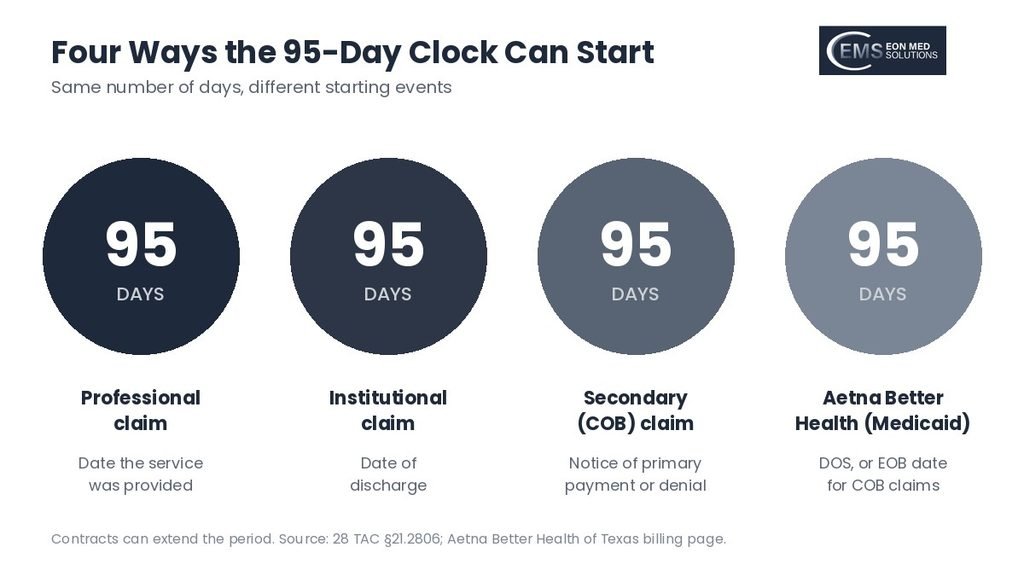
The day count stays at 95, but the starting event changes with the claim type. Choosing the wrong start date is one of the most common Texas errors. For hospitals and other institutional providers, the count begins at discharge, so a long stay does not eat into the window. Under coordination of benefits, the secondary clock starts when you receive the primary payer’s payment or denial. Record the date that notice arrived, not just the EOB print date.
| Worked Example 2 — Institutional and Secondary Deadlines Formula: Deadline = Starting event + 95 days Inpatient discharge on August 20, 2026 → claim due November 23, 2026. Primary payer’s denial received September 1, 2026 → Aetna secondary claim due December 5, 2026. |
Which Aetna Plans Follow Texas Rules?
Fully insured versus self-funded coverage
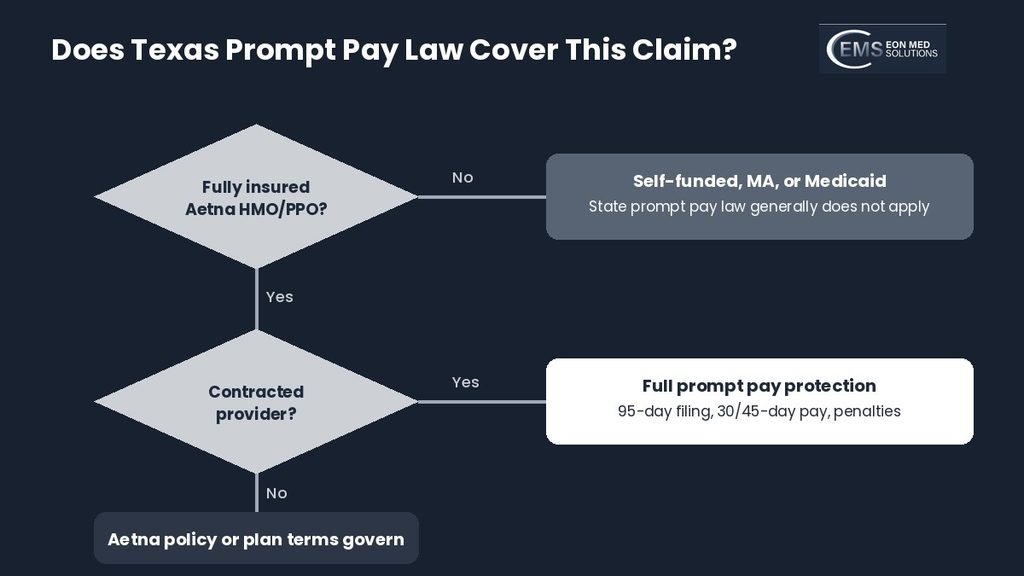
The 95-day rule and prompt pay protections apply to fully insured plans regulated by the Texas Department of Insurance. Aetna also administers many self-funded employer plans, where the employer carries the risk. Those plans fall mainly under ERISA, so Texas prompt pay generally does not reach them. Filing windows then come from your Aetna agreement and the plan terms, which may differ from 95 days. Record the funding type at eligibility, because the cards often look identical. If mixed-up plan types have already caused denials, structured denial management support can help sort them out.
Medicaid and Medicare Advantage lines
Aetna Better Health of Texas, the Medicaid and CHIP plan, lists 95 days from the date of service. For coordination of benefits claims, it allows 95 days from the EOB. Aetna Medicare Advantage claims fall under federal rules and your Medicare Advantage agreement, not the Texas Insurance Code. Contracted providers should use the filing period in their agreement. Non-contracted providers should confirm the window with Aetna, since published figures vary.
What Aetna Owes When a Clean Claim Pays Late?
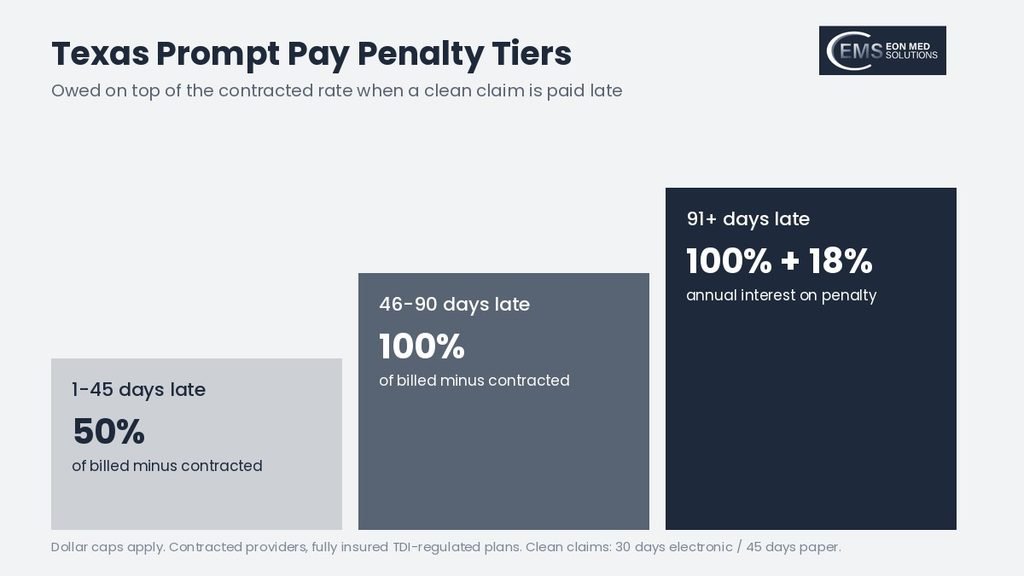
Texas pairs its strict filing rule with strict payment deadlines. For contracted providers on fully insured plans, a clean claim must be paid within 30 days electronically or 45 days on paper. When a carrier misses that deadline, the Texas Medical Association explains that it owes the contracted rate plus a tiered penalty. The penalty equals 50% of billed charges minus the contracted rate for payments 1–45 days late. It rises to 100% for 46–90 days late. After that, 18% annual interest accrues on the penalty from the date payment was due. Dollar caps apply to each tier.
| Worked Example 3 — Prompt Pay Penalty Formula: Penalty = Tier percentage × (Billed charges − Contracted rate) Scenario: Billed $1,000; contracted rate $400; difference $600; electronic clean claim. Paid 20 days late (Tier 1): 0.50 × $600 = $300. Paid 60 days late (Tier 2): 1.00 × $600 = $600. Paid 100 days late (Tier 3): $600 plus 18% × $600 × 100/365 = about $29.59 in interest. |
When Aetna denies a claim you filed on time?
Sometimes a claim arrives on time but still gets denied as late. Don’t resubmit it as a new claim, because the new receipt date works against you. Instead, file a reconsideration or appeal with proof of timely submission attached. The strongest proof is a clearinghouse acceptance report or a payer receipt confirmation. Aetna’s published dispute window is 180 days from the decision where no state exception applies. For fully insured plans, a provider can also file a prompt pay complaint with TDI.
Watching Aetna Timeliness Inside Your Practice
The statute tells you when payment is lost, but internal measures warn you weeks earlier. The two most useful are days to bill and the share of Aetna claims accepted by day 45. Both targets in the table above are illustrative goals, not Aetna or TDI benchmarks. Actual figures vary by specialty, product mix, and staffing, so verify them against your own data. They fit alongside the broader medical billing KPIs you may already track.
| Worked Example 4 — Day-45 Acceptance Rate Formula: Claims accepted by day 45 ÷ Total Aetna claims × 100 Scenario: 441 of 450 claims accepted = 98%, just under the 99% illustrative goal. Exposure: 9 late claims × $150 average = $1,350 that could be lost after day 95. |
How a blended rate hides one weak product?
Illustrative scenario (not an actual client record): a Houston multi-specialty group bills three Aetna lines. Its blended on-time rate is 95.8%, which looks fine. Split by product, the self-funded plans sit at 88%, because staff assumed the statutory 95 days applied everywhere. Those plans actually ran on a shorter 90-day contract window. Aging balances like these deserve dedicated accounts receivable management attention.
Illustrative product split
| Aetna Product (Illustrative) | Claims | On Time | Rate |
| Fully insured PPO | 200 | 199 | 99.5% |
| Self-funded (90-day contract) | 150 | 132 | 88.0% |
| Aetna Better Health of Texas | 150 | 148 | 98.7% |
| Blended | 500 | 479 | 95.8% |
Comparing Your Numbers Fairly
The 95-day rule and payment deadlines are legal requirements, so they apply to every provider equally. Internal targets work differently and only mean something when compared like-for-like. Compare the same Aetna product, a similar service mix, a comparable practice size, and the same reporting period. One missed target is a signal to investigate, not a verdict on your team.
How Soon Fixes Usually Show Results?
These are general planning ranges, not guarantees. Backlog size, product mix, and staffing will change them for any practice.
| Fix | Early Signs | Steadier Results |
| Due dates keyed to claim type and funding type | Within one billing cycle | Within a quarter |
| Daily rejection review before day 30 | Within a few weeks | Within a quarter |
| Prompt pay penalty audit on late payments | Within one to two months | Over two quarters |
Key Takeaways
- Texas law requires fully insured claims by day 95, or payment is forfeited (published standard).
- Institutional claims start at discharge; secondary claims start when the primary notice arrives.
- A catastrophic event requires a TDI extension request within five days of the disruption.
- Self-funded, Medicare Advantage, and Aetna Better Health plans follow their own rules.
- Two to five days to bill and 99%+ acceptance by day 45 are illustrative goals, not mandates.
Aetna Texas Filing Check-Up: 10 Questions
Answer each with yes or no, then count your yes answers.
- Do you know whether your Aetna agreement extends the 95-day window?
- Do you record whether each Aetna plan is fully insured or self-funded?
- Do institutional claims use the discharge date as the start?
- Do you log the date primary payer notices arrive?
- Is your average days to bill five days or fewer?
- Were 99% or more of Aetna claims accepted by day 45 last month?
- Did you have zero Aetna claims lost to timely filing last quarter?
- Do you check late fully insured payments for prompt pay penalties?
- Do you appeal timely-filing denials with clearinghouse proof instead of resubmitting?
- Do you track Aetna Better Health and Medicare Advantage on separate calendars?
9–10 yes: Strong control; review monthly. 6–8 yes: Gaps exist; fix the “no” items this quarter. 0–5 yes: Revenue is likely slipping now; review every Aetna claim older than 45 days this week.
Signs Your Team Needs Outside Help
Many practices handle these deadlines well in-house. These signals suggest your current process has reached its limit:
- Aetna claims routinely go out more than two weeks after the visit.
- Nobody can say which Aetna members have self-funded coverage.
- Late payments arrive without penalties, and no one notices.
- Any claim was lost to the 95-day rule in the past year.
Good outside support should set due dates by claim type, capture funding type at eligibility, and audit late payments. EON MED SOLUTIONS works this way, assigning a dedicated agent to each provider for medical billing, coding, credentialing, and denial follow-up. Results depend on each practice’s situation. You can see how the services fit together here.
Expert Opinion
The Aetna Texas timely filing limit rests on state law, not just payer policy. Ninety-five days is the standard for fully insured claims, and the start date depends on claim type. On the other side, Texas prompt pay penalties give contracted providers real leverage when Aetna pays late.
To be clear about sources: the 95-day rule, forfeiture, the catastrophic event process, the 30/45-day payment deadlines, and the penalty tiers are published Texas standards. Aetna’s 2023 alignment, Aetna Better Health’s 95-day rule, and the 180-day dispute window are payer policies. Days to bill, the day-45 goal, and the improvement ranges are illustrative targets to adapt to your own data.
Frequently Asked Questions
What is the Aetna Texas timely filing limit?
For fully insured commercial plans, claims are due by the 95th day after the date of service, unless your contract allows longer. Institutional claims count from discharge.
What happens if I file an Aetna claim in Texas after 95 days?
On fully insured plans, the provider loses the right to payment. The main exception is a catastrophic event reported to TDI within five days of the disruption.
What if Aetna denies a claim I filed on time?
File a reconsideration or appeal with your clearinghouse acceptance report attached. Aetna’s published dispute window is 180 days where no state exception applies.
What is a good days-to-bill target for Aetna Texas claims?
Many practices aim for two to five days from service. This is an illustrative goal, not a Texas rule, but it leaves time to fix rejections.
What is a good acceptance rate for Aetna claims in Texas?
A practical goal is 99% or more accepted by day 45. That illustrative target builds a buffer well before day 95.
Does the 95-day rule apply to self-funded Aetna plans?
Generally no. Self-funded plans fall mainly under ERISA and your contract, so their windows may differ from the Texas rule.
How long does Aetna have to pay a clean claim in Texas?
For contracted providers on fully insured plans, 30 days for electronic claims and 45 days for paper. Late payments trigger tiered penalties.
How do I prove an Aetna claim was filed on time in Texas?
Keep clearinghouse acceptance reports and payer receipt confirmations. Texas also accepts proof that the claim was timely sent to another carrier.
Sources and Methodology
(a) Published standards: Texas Insurance Code §§843.337, 1301.102, 843.342, and 1301.137; 28 Texas Administrative Code §§21.2806 and 21.2819; TDI prompt pay FAQ; Texas Medical Association prompt pay summaries. (b) Named benchmarking data providers: none used. (c) Practical or illustrative targets: days to bill, day-45 acceptance, and improvement ranges, compiled from general industry practice. Aetna’s 2023 Texas alignment is a payer policy reported by industry sources. Aetna Better Health’s rule and the 180-day dispute window come from their published provider pages. (d) Survey data: none used. Actual results vary by practice and situation. All figures reflect information available at the time of research in September 2026.
This article is educational and is not legal advice. Confirm deadlines in your Aetna agreement and current Texas rules. EON MED SOLUTIONS is not affiliated with Aetna.


