

Medicaid Florida Timely Filing Limit: FFS & SMMC Guide
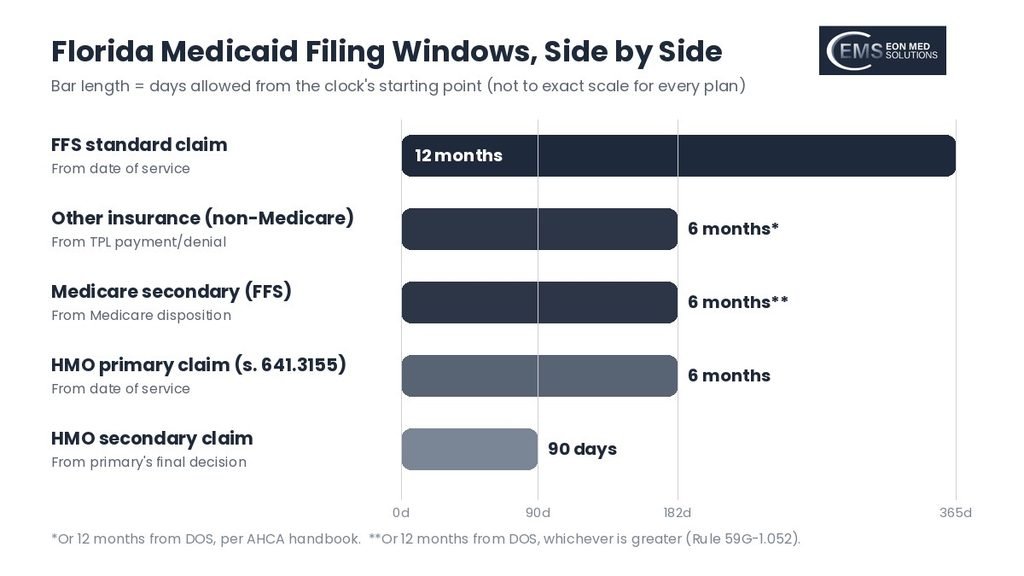
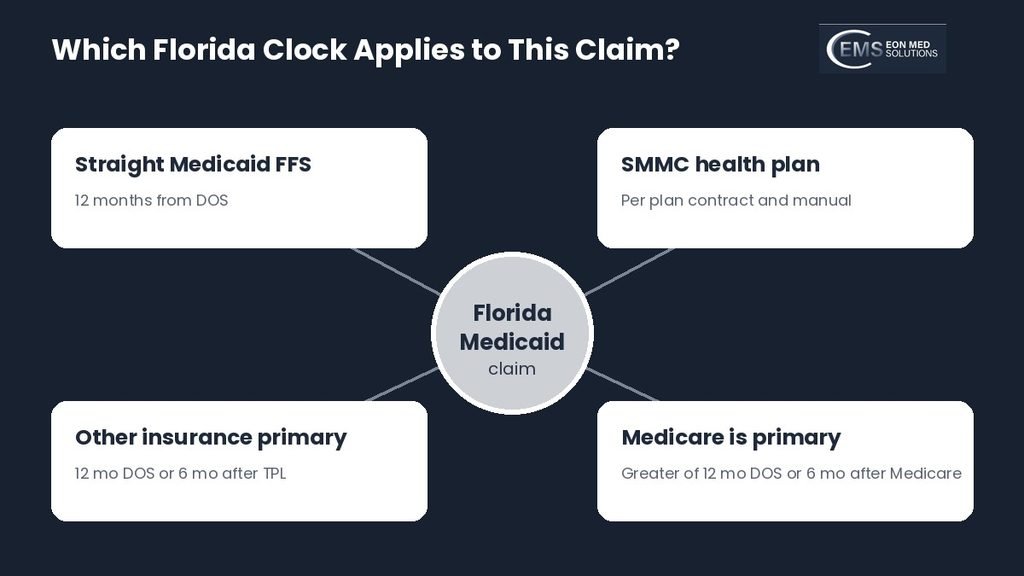
The Medicaid Florida timely filing limit for fee-for-service claims is 12 months from the date of service, according to AHCA’s provider reimbursement handbook. Claims secondary to Medicare may be filed within 12 months of service or 6 months after the Medicare decision, whichever is greater. Statewide Medicaid Managed Care (SMMC) plans set their own contract deadlines, and Florida’s HMO prompt-pay law sets 6 months for primary claims and 90 days for secondary claims.
Florida looks generous at first glance: a full year to file a Medicaid claim. Yet many practices still lose Florida Medicaid revenue to timely filing denials. The reason is simple. Most members are in managed care plans, and those plans often use far shorter windows. This guide separates the rules for fee-for-service (FFS) claims, SMMC health plans, and secondary claims after Medicare or other insurance. You will also find worked calculations and illustrative internal targets. A nine-question health check near the end shows where your process may be exposed.
Florida Medicaid Filing Deadlines: Reference Chart
Use this chart to assign due dates. Official rules appear first; internal goals are labeled illustrative.
| Metric / Deadline | Practical Target or Rule | Review Frequency | Primary Source |
| FFS clean claim | 12 months from date of service | Monthly | Published standard: AHCA Provider Reimbursement Handbook |
| FFS claim secondary to Medicare | Greater of 12 months from DOS or 6 months after Medicare disposition | Per claim | Published standard: Rule 59G-1.052(15), F.A.C. |
| FFS claim with other insurance | 12 months from DOS or 6 months from TPL payment/denial | Per claim | Published standard: AHCA Provider Reimbursement Handbook |
| FFS claim adjustment request | 12 months from original payment | Per claim | Published standard: AHCA Provider Reimbursement Handbook |
| HMO primary claim | 6 months after service or discharge (and correct plan info) | Weekly | Published standard: s. 641.3155, F.S. |
| HMO secondary claim | 90 days after primary’s final determination | Per claim | Published standard: s. 641.3155, F.S. |
| SMMC plan filing window | Per plan manual and contract; varies by participation status | Per plan | Plan-specific: provider manuals and contracts |
| Retroactive eligibility | Adults 21+: none before application month; children and pregnant women: up to 3 months | Per case | Published policy: AHCA retroactive eligibility page |
| Federal Medicaid ceiling | 12 months from DOS | Reference | Published standard: 42 CFR §447.45(d)(1) |
| Days to bill (internal) | 3–7 days from DOS | Weekly | Illustrative target |
| Claims accepted within 60 days (internal) | 99%+ | Monthly | Illustrative target |
Source labels: “Published standard” means the rule appears in an AHCA handbook, the Florida Administrative Code, Florida Statutes, or federal regulation. “Plan-specific” means each health plan sets it. “Illustrative target” means a practical internal goal from general industry practice; no agency mandates it. Confirm current versions before relying on any date.
Understanding the Medicaid Florida Timely Filing Limit
The 12-month rule for fee-for-service claims
AHCA’s Provider Reimbursement Handbook states that a clean claim must be received by Medicaid or its fiscal agent within 12 months of the date of service. That matches the federal ceiling in 42 CFR §447.45. Receipt is what counts. For paper claims, the fiscal agent’s date stamp becomes the receipt date; for electronic claims, it is the transmission date the fiscal agent records. The handbook still hosted by AHCA dates from 2008, so check for newer policy updates before relying on edge cases.
| Worked Example 1 — FFS Filing Deadline Formula: FFS deadline = Date of service + 12 months Scenario: Clinic visit on February 18, 2026. The claim must be received by February 18, 2027. Tip: Set the internal due date months earlier, so rejections can be fixed inside the window. |
Why the 12-month window rarely applies in practice?
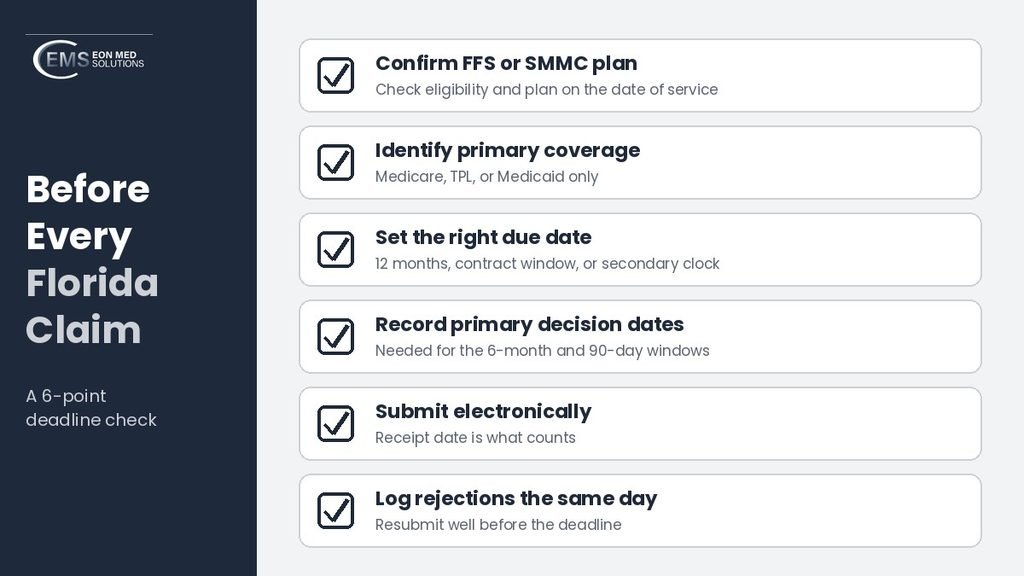
Most Florida Medicaid members receive care through Statewide Medicaid Managed Care (SMMC) plans rather than straight fee-for-service. Their claims go to the member’s health plan, which applies its own deadline. So a front desk that assumes “Florida gives us a year” may be working from the wrong rule for most visits. Always identify the payer on the date of service. Eligibility checks should capture both Medicaid status and plan assignment, because plans can change from month to month.
Retroactive eligibility has narrowed
Florida changed retroactive coverage in 2019. According to AHCA, the three-month retroactive period ended for non-pregnant adults 21 and older. Their coverage now begins on the first day of the application month. Pregnant women and children under 21 can still receive up to three months of retroactive eligibility. For billing teams, that means fewer backdated adult claims. It also means an adult treated before applying may never become billable to Medicaid at all.
Secondary Claims: Medicare and Other Insurance
Claims secondary to Medicare
Florida Medicaid is the payer of last resort, so Medicare crossover and other third-party liability (TPL) claims follow special timing. Under Rule 59G-1.052(15), FFS claims secondary to Medicare may be filed within 12 months of service. Alternatively, they may be filed within 6 months after the Medicare decision is received, whichever is greater. Some older guides and plan manuals still cite a 36-month crossover rule. For FFS claims, the current rule text is the safer reference.
| Worked Example 2 — Medicare Secondary Deadline Formula: Deadline = the later of (Date of service + 12 months) or (Medicare disposition notice + 6 months) Scenario: Service January 5, 2026; Medicare decision received November 20, 2026. 12 months from service = January 5, 2027. Six months after Medicare = May 20, 2027. The later date controls. |
Claims with other insurance
For recipients with commercial or other non-Medicare coverage, the AHCA handbook sets two paths. The claim must reach Medicaid within 12 months of service or within 6 months of the other payer’s payment or denial. Record that disposition date on every secondary claim, because it becomes your proof of timeliness. Also remember that Medicaid pays only the difference up to its own rate. If the primary payment already meets or exceeds the Medicaid rate, no Medicaid payment follows.
Adjustments and corrections
The handbook requires adjustment requests within 12 months of the original payment. Corrections should never wait until the end of that window.
SMMC Managed Care Plans Play by Different Rules
What Florida’s HMO prompt-pay law requires?
Many SMMC plans operate as health maintenance organizations. For HMOs, section 641.3155, Florida Statutes, requires primary claims within 6 months after service or discharge. That clock also depends on the provider having the patient’s correct plan name and address. Secondary claims must reach the plan within 90 days after the primary payer’s final determination. Plan manuals then add their own details, such as longer windows for non-participating providers. Read each contract instead of assuming one statewide number.
| Worked Example 3 — SMMC Plan Dates Formula: Plan deadline = Date of service + contract window; Secondary deadline = Primary decision + 90 days Scenario: Service April 10, 2026 under a 180-day plan contract. Claim due October 7, 2026. If another payer was primary and decided on September 1, 2026, the secondary claim is due November 30, 2026. |
Plan appeals and disputes
Each SMMC plan runs its own claim dispute and appeal process, with separate deadlines for billing disputes and medical necessity appeals. These appear in plan provider manuals, not in one state rule. Build a simple table listing each plan’s filing, corrected-claim, and appeal windows, and review it whenever manuals update. When denials start piling up across several plans, structured denial management support keeps every window visible.
Monitoring Timely Filing With Practice-Level Metrics
Official deadlines show when revenue is lost. Internal measures reveal the risk much earlier. The figures below are illustrative targets from general industry practice, not published Florida Medicaid benchmarks. Actual figures vary by specialty, payer mix, and staffing, so verify against your own data where precision matters. They pair well with the broader medical billing KPIs many practices already track.
| Metric (Illustrative) | Formula | Illustrative Target |
| Days to bill | Total days from service to submission ÷ claims submitted | 3–7 days |
| Accepted within 60 days | Claims accepted by day 60 ÷ total claims | 99%+ |
| Timely filing denial rate | Claims denied as late ÷ total claims | 0% |
| Secondary claims sent within 30 days | Secondaries sent within 30 days of primary decision ÷ secondaries | 100% |
| Plan deadline table current | Plans with verified windows ÷ plans billed | 100% |
Illustrative: compiled from general industry practice, not a named benchmark. Actual figures vary.
| Worked Example 4 — Acceptance Rate and Revenue at Risk Acceptance rate formula: Claims accepted by day 60 ÷ total claims × 100. Scenario: 1,470 of 1,500 = 98%. Revenue at risk formula: Claims past the internal target × average payment. Scenario: 30 × $110 = $3,300 needing immediate follow-up. |
How a blended rate can hide one problem plan?
Illustrative scenario (not an actual client record): a family practice bills Florida Medicaid FFS and two SMMC plans. Its blended on-time rate is 96%, which seems healthy. Split by payer, FFS and Plan A sit near 99%. Plan B sits at 88%, because staff assumed the 12-month FFS rule for a 180-day contract. The blended rate hid the pattern until denials arrived. Aging claims like these deserve dedicated accounts receivable management attention.
| Payer (Illustrative) | Claims | On Time | Rate |
| Florida Medicaid FFS | 200 | 199 | 99.5% |
| SMMC Plan A | 300 | 297 | 99.0% |
| SMMC Plan B (180-day contract) | 200 | 176 | 88.0% |
| Blended | 700 | 672 | 96.0% |
Putting Benchmarks in Proper Perspective
Statutory and handbook deadlines are fixed rules, not benchmarks, so they apply to every provider equally. Internal targets are different and only meaningful when compared like-for-like. Compare the same payer type, a similar service mix, a comparable practice size, and the same reporting period. A clinic with many dual-eligible patients will naturally show more secondary claims than a pediatric office. One missed target is a signal to investigate, not a verdict on your team. Find the cause first, then adjust the workflow.
How Long Improvements Usually Take?
These are general planning ranges, not guarantees for any specific practice. Backlog, payer mix, and staffing will shift them.
| Fix | Partial Results | Fuller Results |
| Eligibility and plan verification at each visit | 2–4 weeks | 1–2 months |
| Plan-by-plan deadline table | 1–2 weeks | 1 month |
| Secondary claim workflow tied to primary decisions | 1 month | 2–3 months |
| Clearing claims near plan deadlines | 1–3 weeks | 1–2 months |
| Denial and appeal tracking by plan | 1 month | 3 months |
Summary Points to Remember
- Florida Medicaid FFS allows 12 months from the date of service (published standard, AHCA handbook).
- FFS claims secondary to Medicare: the greater of 12 months from service or 6 months after Medicare’s decision.
- HMO law sets 6 months for primary claims and 90 days after the primary decision for secondary claims.
- SMMC plan windows vary by contract, so maintain a verified table for each plan.
- Targets like 3–7 days to bill and 99%+ acceptance by day 60 are illustrative goals, not mandates.
Florida Medicaid Filing Health Check: 9 Questions
Answer yes or no, then total your yes answers.
- Do you verify Medicaid eligibility and SMMC plan assignment at every visit?
- Does each claim get a due date based on its actual payer and contract?
- Is your average days to bill at or under seven days?
- Were 99% or more of claims accepted within 60 days last month?
- Did you receive zero timely filing denials last quarter?
- Do you record Medicare and other-insurance decision dates on secondary claims?
- Are secondary claims sent within 30 days of the primary decision?
- Do you keep a verified filing and appeal table for every SMMC plan you bill?
- Do you review on-time rates separately for FFS and each plan?
8–9 yes: Solid control; review monthly. 5–7 yes: Gaps exist; fix the “no” items this quarter. 0–4 yes: Revenue is likely slipping now; audit every claim older than 90 days this week.
Recognizing When Your Team Needs Backup
Many practices manage the Medicaid Florida timely filing limit well in-house. Others find the mix of FFS, plan, and secondary rules too much to track. Watch for these signals:
- Timely filing denials show up from more than one SMMC plan.
- Staff routinely assume a 12-month window for every Florida Medicaid claim.
- Secondary claims wait weeks after the primary decision arrives.
- No one can name each plan’s filing and appeal deadlines.
- Rejected claims sit unworked for several days.
Strong outside support should offer plan-specific due dates, eligibility checks at scheduling, and a clear secondary-claim workflow. Look for transparent reporting you can review, HIPAA-compliant processes, and one named contact. EON MED SOLUTIONS is one example of that structure. Its US-based team provides end-to-end medical billing, coding, credentialing, denial management, and compliance support, with a dedicated agent per provider and no hidden fees. Results vary by practice and situation. You can browse the full service list here.
Expert Opinion
The Medicaid Florida timely filing limit depends on who pays the claim. Fee-for-service gets 12 months, Medicare-secondary claims may get longer, and SMMC plans often expect much faster filing. The safest habit is identifying the payer and primary coverage at every visit, then setting the due date from that fact.
To be clear about sources: the 12-month FFS limit, the Medicare-secondary rule, the other-insurance and adjustment windows, the HMO 6-month and 90-day rules, and the 12-month federal ceiling are published standards. SMMC plan windows are plan-specific. Days to bill, the day-60 target, and the improvement timelines are illustrative goals to adapt to your own data.
Frequently Asked Questions
What is the Medicaid Florida timely filing limit?
For fee-for-service claims, AHCA requires receipt within 12 months of the date of service. SMMC health plans follow their own contract deadlines, which are often shorter.
Is the Florida Medicaid filing limit 12 months or 180 days?
Both appear because they describe different payers. Twelve months applies to fee-for-service, while 180 days is a common window in some plan contracts for participating providers.
What is a good days-to-bill target for Florida Medicaid?
Many practices aim for three to seven days from service. This is an illustrative target, not an AHCA rule, but it protects even short plan windows.
What is a good acceptance rate for Florida Medicaid claims?
A practical goal is 99% or more of claims accepted within 60 days. That illustrative target leaves room to fix rejections before any deadline.
How long do I have to bill Florida Medicaid after Medicare pays?
Under Rule 59G-1.052, FFS claims can be filed within 12 months of service or 6 months after the Medicare decision, whichever is later.
What is the deadline for secondary claims to a Florida HMO?
Florida’s HMO prompt-pay law requires secondary claims within 90 days after the primary payer’s final determination. Check your plan manual for any added requirements.
Does retroactive eligibility extend Florida Medicaid deadlines?
Retroactive coverage now applies mainly to children under 21 and pregnant women, up to three months before application. Confirm filing timing for these cases directly with AHCA or the plan.
What is a good way to track SMMC plan deadlines?
Keep one table listing each plan’s filing, corrected-claim, and appeal windows. Update it whenever a plan publishes a new provider manual.
Can I correct a paid Florida Medicaid FFS claim?
Yes. The AHCA handbook requires adjustment requests within 12 months of the original payment date.
Research Notes and Source Categories
(a) Published standards: AHCA Florida Medicaid Provider Reimbursement Handbook (CMS-1500, July 2008 edition still hosted by AHCA); Rule 59G-1.052, F.A.C.; section 641.3155, Florida Statutes; AHCA retroactive eligibility policy; and 42 CFR §447.45. (b) Named benchmarking data providers: none used. (c) Practical or illustrative targets: days to bill, day-60 acceptance, secondary-claim timing, and improvement timeframes, compiled from general industry practice. (d) Survey data: none used. SMMC plan windows are plan-specific. Actual results vary by practice and situation, and all figures reflect information available at the time of research in September 2026.
This article is educational and is not legal or compliance advice. Confirm current rules with AHCA and each plan’s provider manual.


