

BCBS Pennsylvania Timely Filing Limit: Highmark, Independence and Capital Deadlines for 2026
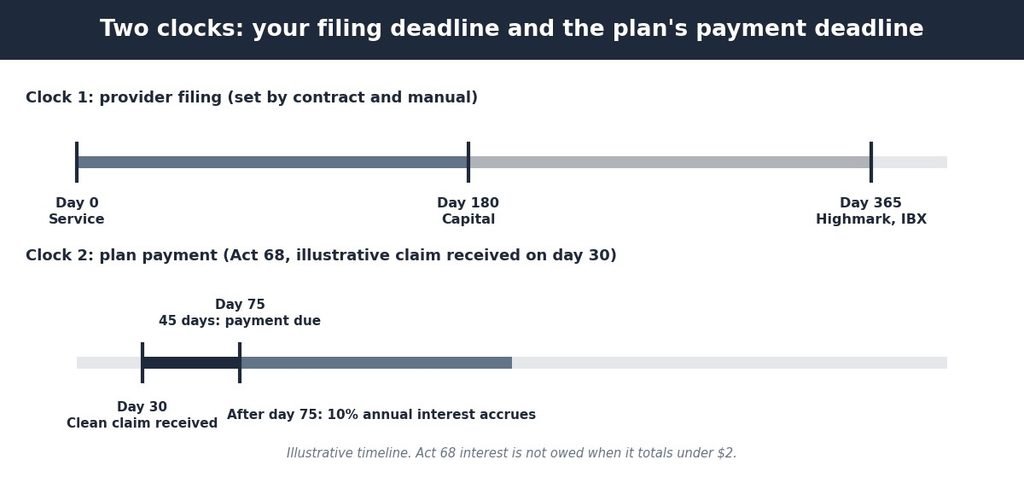
The BCBS Pennsylvania timely filing limit depends on the Blue plan. Highmark Blue Cross Blue Shield and Independence Blue Cross publish 365 days from the date of service, while Capital Blue Cross publishes 180 days for professional claims unless the contract says otherwise. Act 68 governs how fast plans pay clean claims, not how fast providers file.
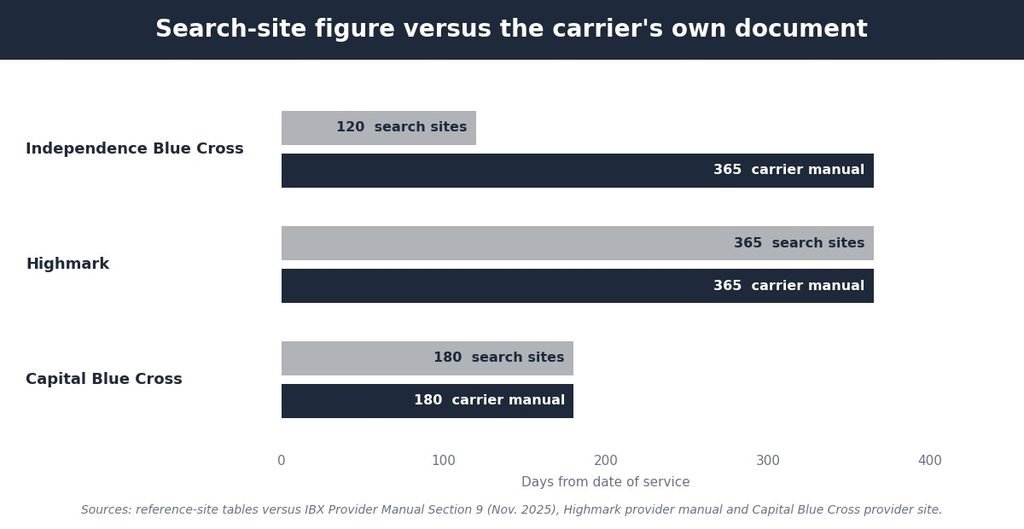
Search charts say Independence Blue Cross allows 120 days, yet its November 2025 billing manual says 365. That gap is typical of the BCBS Pennsylvania timely filing limit, which is not one number. Highmark, Independence and Capital each write their own rule, and the state prompt-pay law governs plan payment speed rather than provider filing.
This guide separates the carriers, tests common online claims against carrier documents, explains Highmark’s September 2026 corrected-claim rule, and shows how to build alerts. A self-assessment checklist near the end lets you score your process, and the sources section names every document behind the numbers.
| Situation | Usual window |
| Claim to Highmark Blue Cross Blue Shield or Highmark Blue Shield | 365 days from the last date of service unless the contract states another period |
| Claim to Independence Blue Cross | 365 days from the date of service |
| Capital Blue Cross professional or ancillary claim | 180 days unless the contract states otherwise |
| Capital Blue Cross Medicare Advantage claim | 365 days, following the Medicare guideline |
Confirm every row in your own agreement. The sections below give sources, dates and exceptions.
BCBS Pennsylvania filing numbers at a glance
Three Blue carriers publish two main windows for Pennsylvania claims, 365 days and 180 days, plus a separate correction rule at Highmark. The table labels each number by source type so that a published policy is not confused with a practical target, and it reflects information available in October 2026.
| Metric | Practical target or range | Review frequency | Source type |
| Highmark initial claims | 365 days from the last date of service unless the contract differs | Each January | P: Highmark provider manual |
| Highmark corrected claims | 455 days (15 months) from original claim finalization, from Sept. 1, 2026 | Quarterly | P: Highmark provider news, 2026 |
| Independence Blue Cross claims | 365 days from date of service | Each January | P: IBX Provider Manual, Nov. 2025 |
| Capital Blue Cross professional claims | 180 days unless the contract states otherwise | Each January | P: Capital provider site |
| Capital Blue Cross Medicare Advantage | 365 days | Each January | P: Capital provider site |
| Plan payment of a clean claim | 45 days from receipt; 10% annual interest if late | Annually | S: 40 P.S. §991.2166 (Act 68) |
| Internal submission lag and CO-29 rate | 5 business days or fewer; under 1% of claims | Weekly and monthly | G: commonly used billing targets |
Source labels: S = statute. P = payer publication. G = practical target commonly used across billing teams; not a legal or payer requirement. Carrier documents change, so confirm each figure in the current edition.
Which Blue plan sets the BCBS Pennsylvania timely filing limit?
The plan that holds your contract sets it. Blue Cross Blue Shield is a federation of independent licensees, and Pennsylvania providers mainly meet three. Highmark’s provider site labels its regions WPA/NEPA for Highmark Blue Cross Blue Shield and CPA/SEPA for Highmark Blue Shield, while Independence describes itself as serving Philadelphia and southeastern Pennsylvania.
Contract language beats any chart. Highmark’s manual applies 365 days in Pennsylvania when timely filing is not established within the contract. Capital’s page says 180 days applies unless the contract states otherwise. Read the agreement first, then the current manual, and use an online chart last.
In billing audits, a common pattern is one “BCBS” line in the billing system that hides three carriers. A 180-day alert then protects Capital claims but rushes Highmark and Independence claims, while a 365-day alert does the reverse damage. Splitting the line by carrier is a small setup task with a large effect. See the payer-specific claim submission rules for the wider habit.
Myth versus manual: what search sites say about Pennsylvania Blue plans
Search charts are right for Highmark and Capital but out of date for Independence Blue Cross. Two reference sites list Independence at 120 days, while its Provider Manual Section 9 and Hospital Manual billing section both state 365 days from the date of service. An IBX Provider News Center notice also says the carrier clarified its guidelines to 365 days in all manuals.
| What online charts say | What the carrier document says | Source type |
| Independence Blue Cross: 120 days | 365 days from date of service | P: IBX Provider Manual, Section 9 |
| BCBS Pennsylvania and West Virginia: 1 year | Correct for Highmark; Capital uses 180 days for professional claims | P: Highmark manual; Capital site |
| Capital Blue Cross: 180 days | Matches the Capital provider site, unless the contract states otherwise | P: Capital provider site |
| Corrected claims follow the original window | Highmark counts 455 days from finalization of the original claim, from Sept. 1, 2026 | P: Highmark provider news |
Reference-site figures were compared with carrier documents in October 2026. Carriers update manuals, so confirm yours.
When a chart and a manual disagree, follow the manual and save a dated copy of the page or PDF. That copy becomes your evidence if a denial cites a different number. Re-read the manual each January and after every carrier notice, because a window that matched last year may have changed.
Highmark: 365 days, plus a 455-day corrected-claim rule from September 2026
Highmark’s Pennsylvania rule is 365 days from the last date of service when the contract sets no other period, according to its provider manual. The manual defines timely filing as filing within a set period after the last date of service, or after the primary payer’s payment or denial, so the clock can start from a different event on secondary claims.
Effective September 1, 2026, a corrected claim must arrive within 15 months (455 calendar days) of the original claim’s finalization date. Highmark’s provider news, published in May 2026 and updated in July 2026, says the rule covers commercial, Medicare Advantage and Federal Employee Program lines in the Pennsylvania regions. It excludes BlueCard Home corrected claims and identifies corrections by frequency code 5 or 7 on professional claims. See also corrected claim deadlines by payer.
In billing audits, a common pattern is replacement claims sent weeks after a payment posts and tracked only by the original submission date. Highmark counts from finalization, so the log needs the processing-complete date from the remittance. Add that field when your system tracks only receipt dates.
Independence Blue Cross: 365 days in the current manuals
Independence Blue Cross requires claims within 365 days of the date of service, as the November 2025 edition of its Provider Manual Section 9 states. The July 2026 Hospital Manual billing section repeats the same 365 days. Treat older 120-day figures as outdated unless your own agreement states a shorter period.
Filing and dispute clocks differ. IBX’s 2023 appeals manual gives 180 days to file a first-level billing dispute after the provider explanation and 60 days for a second-level dispute. Verify those numbers in the current edition, and use the guide on timely filing versus appeal filing limits to keep the calendars apart.
Capital Blue Cross: 180 days, with Medicare Advantage at 365
Capital Blue Cross lists 180 days from the date of service for professional and ancillary providers unless the contract states otherwise, on its new provider welcome center. Capital-adds that Medicare timely filing guidelines apply to its Medicare Advantage members, so those claims run 365 days for all provider types, in line with Medicare’s 12-month rule.
At 180 days, Capital is the shortest published window among the three carriers. Set Capital professional alerts from 180 days and do not inherit the 365-day alert used for Highmark and Independence. Capital also notes that it does not manage the professional provider relationship for Federal Employee Program members, so confirm the right plan before billing those claims.
Does Pennsylvania law set a filing deadline for Blue claims?
Pennsylvania law regulates how fast plans pay, and the statute and regulations reviewed contain no minimum provider filing period. Act 68 of 1998, codified at 40 P.S. §991.2166, requires insurers to pay a clean claim within 45 days of receipt and to add 10% annual interest when late. No interest is owed when it totals under $2.
Blue plans sit in a special position. The Pennsylvania Insurance Department’s statement of policy at 31 Pa. Code §301.416 says Blue Cross and Blue Shield plans, historically not defined as licensed insurers, will use the section 2166 standards for prompt payment. Highmark’s manual describes the same 45-day and 10% rules, so the payment clock is predictable even though the filing clock is contractual.
Because no filing floor surfaced, the contract and the carrier manual control. When a denial cites a window shorter than the manual states, escalate through the carrier’s dispute process and ask counsel before relying on any state-law argument. This is research-based guidance, not legal advice.
Which clock applies to BlueCard, secondary and out-of-area claims?
Out-of-area BlueCard claims go to the local plan, so the local plan’s filing limit is the working deadline. Independence’s BlueCard manual, an October 2021 edition, says the provider submits the claim to Independence as the local Blue plan. Professional providers contracted with other area Blues, including Highmark Blue Shield and Capital Blue Cross, submit to those plans instead.
Secondary claims often count from the primary payer’s action. Highmark defines timely filing by reference to the primary payer’s payment or denial, and Capital’s Medicare Advantage rule follows Medicare. Attach the primary EOB and read the secondary claim timely filing rules before billing a crossover.
A clean claim matters on both clocks. A claim rejected for missing data may never start the 45-day payment clock, and a claim that was never accepted may not count as filed. Work on clean claim rate improvement when rejections run high.
What happens when a Pennsylvania Blue claim is late?
A claim past its window is denied as a timely filing denial, usually coded CO-29 (CARC 29, the time limit for filing has expired), and the practice generally absorbs the loss. Participating agreements commonly bar billing the member for a late claim, so check yours before moving a balance to patient responsibility.
No state reconsideration right surfaced in the research, so recovery depends on evidence and carrier process. The strongest evidence is proof of timely filing: a clearinghouse acceptance record dated inside the window. Send it with the dispute, and calendar the carrier’s dispute deadline separately, as IBX’s 180-day first-level window shows.
In billing audits, a common pattern is that the only evidence of timely filing is a batch confirmation from the clearinghouse. Carriers rarely treat that as acceptance, so file the acceptance record with the claim when it leaves in the final 30 days of a window. When late disputes pile up faster than staff can document them, denial management services can take over the paperwork and follow-up.
How do you calculate each deadline and the plan’s interest?
Five calculations turn the rules into dates and dollars. Each has a formula and a numeric walkthrough, and each should be rerun with your own window whenever a manual or contract changes. Repeat them when a new Blue product joins your payer mix.
Deadline date
Deadline = last date of service + filing window in days
For a service on March 3, 2026, a 180-day Capital window ends August 30, 2026, while a 365-day Highmark or Independence window ends March 3, 2027. Choose the window by carrier and line of business, not by the word “BCBS” on the card.
Highmark corrected-claim deadline
Corrected-claim deadline = original claim finalization date + 455 days
If Highmark finalized the original claim on July 14, 2026, the corrected claim must arrive by October 12, 2027. Take the finalization date from the remittance, and send the correction well before the limit when the claim affects a payment you rely on.
Alert dates
Alert day = date of service + (window × 50%, 75% and 90%)
For a 180-day window and a service on April 10, 2026, alerts fall on July 9, August 23 and September 19, with a deadline of October 7. These thresholds are practical targets, not carrier rules. Use the shortest window when a claim could belong to more than one carrier.
CO-29 denial rate
CO-29 rate = (CO-29 denials ÷ claims submitted) × 100
Illustrative scenario (not an actual client record): a practice submits 1,000 Pennsylvania Blue claims and receives 12 CO-29 denials, a blended rate of 1.2%. The table splits the same claims by carrier and line, which shows where the problem sits.
Illustrative
| Carrier and line (illustrative) | Claims submitted | CO-29 denials | CO-29 rate |
| Highmark | 400 | 2 | 0.5% |
| Independence Blue Cross | 300 | 1 | 0.3% |
| Capital professional | 250 | 9 | 3.6% |
| Capital Medicare Advantage | 50 | 0 | 0.0% |
| Blended total | 1,000 | 12 | 1.2% |
Illustrative figures only. Actual denial rates vary by practice, payer mix and specialty.
The blended 1.2% looks acceptable, but Capital professional claims run at 3.6%, three times the blended rate. Investigate any line above the 1% target, and ask your billing team for carrier-level reporting and analytics so the average cannot hide the 180-day line.
Act 68 interest
Interest = (0.10 ÷ 365) × amount paid × penalty days
Penalty days are the days beyond the 45-day deadline. A $1,000 payment issued 30 days late carries (0.10 ÷ 365) × $1,000 × 30, or $8.22 in interest. A $200 payment issued 20 days late works out to $1.10, which is under the $2 threshold, so no interest is owed.
How should you use these numbers correctly?
Compare like with like. Measure each carrier on its own, because a blended rate mixes 180-day and 365-day windows. A 3% rate on a 180-day line is a tighter problem than a 3% rate on a 365-day line, so pair every rate with the window it was measured against.
Treat one missed benchmark as a signal, not a verdict. When one month spikes on a single carrier, pull the claims, confirm which window applied, and check for rejections that never reached acceptance before changing the whole workflow. Compare the same carrier across two or three months before acting.
How long does it take to fix a Pennsylvania Blue filing problem?
Alert changes and daily rejection work often show up in CO-29 trends within 30 to 60 days. Clearing aged claims and settling contract questions commonly takes 90 to 180 days. These are general planning ranges, not guarantees, and they depend on volume and staffing.
Start with claims nearest their limits. When one carrier’s window is much shorter than its peers, raise it at renewal using these payer contract negotiation tips. When the aged list outgrows your team, accounts receivable management support can work the oldest balances first.
What is the step-by-step process for tracking Pennsylvania Blue deadlines?
A five-step routine ties every claim to a verified window and a stored proof. It builds on how to track timely filing deadlines and on claims processing best practices for the days after submission. Assign one owner per step when the team is small, so nothing depends on memory.
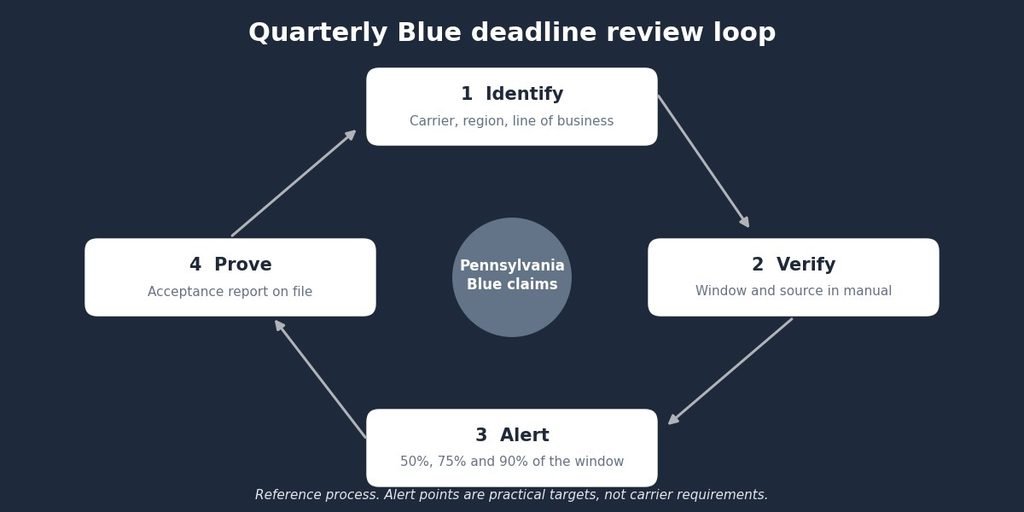
- Identify the carrier, region and line. Read the card and eligibility response to separate Highmark, Independence, Capital, Medicare Advantage and BlueCard claims. Call the plan when a prefix is unfamiliar.
- Verify the window in the current manual. Record the number, the clock start and a dated copy of the page. Use the shorter window until the contract is read when two sources disagree.
- Set alerts at 50%, 75% and 90%. Assign each alert an owner, and add a manager review at 75% when a claim is unpaid or rejected.
- Submit and prove. Send electronically, file the acceptance record, and rework rejections within two business days.
- Review quarterly. Recheck carrier manuals, log Highmark finalization dates for corrections, and compare payment dates with the 45-day deadline.
Red flags in Pennsylvania Blue billing and how to respond
| Red flag | Response |
| A chart shows 120 days for Independence Blue Cross | Replace it with 365 days from the November 2025 manual, and keep a dated copy |
| One alert covers every BCBS claim | Split Highmark, Independence and Capital, and use 180 days for Capital professional claims |
| Corrected claims are counted from the date of service | Count Highmark corrections from finalization when the claim carries frequency code 5 or 7 |
| A batch confirmation serves as proof | Store the acceptance record whenever a claim goes out in the final 30 days of a window |
| Payment dates are never compared with the 45-day deadline | Run a monthly check when volume is high, and ask the carrier about interest on late payments |
Responses apply when the condition in the left column matches your workflow.
Quick summary
- The BCBS Pennsylvania timely filing limit depends on the carrier, the line of business and your contract.
- Published windows are 365 days at Highmark and Independence Blue Cross and 180 days at Capital Blue Cross for professional claims.
- Capital Blue Cross Medicare Advantage claims follow a 365-day Medicare guideline.
- Highmark corrected claims have a 455-day window from original finalization, effective September 1, 2026.
- Act 68 sets a 45-day payment deadline and 10% interest for plans, and no filing floor for providers surfaced in the research.
- A practical target is submission within 5 business days and a CO-29 rate under 1%, tracked by carrier.
Self-assessment: do your Pennsylvania Blue deadlines hold up?
Answer yes or no to each question, and count a partial answer as no. Add up your yes answers and compare the total with the scoring guide that follows. Repeat the exercise each quarter, since manuals and payer mix change.
- Do your payer records separate Highmark, Independence and Capital?
- Did you confirm each carrier’s window in its current manual rather than an online chart?
- Do you keep a dated copy of the page or PDF behind each window?
- Do most claims leave your office within 5 business days of the visit?
- Is your CO-29 rate under 1%, measured by carrier?
- Do Capital professional claims use a 180-day alert while Highmark and Independence use 365?
- Do you log the finalization date for Highmark corrected claims?
- Do you hold an acceptance record for claims sent in the final 30 days of a window?
- Do you compare payment dates with the 45-day Act 68 deadline?
- Do you know which local plan handles your BlueCard claims?
| Yes answers | What it suggests |
| 8 to 10 | Locked in. Review windows each January and at every contract renewal. |
| 5 to 7 | Gaps to close. Fix carrier splits, dated evidence and alerts first. |
| 0 to 4 | Reset needed. Rebuild the carrier map before changing anything else, then consider outside support. |
When should a practice consider outside billing support?
Outside help makes sense when the in-house approach has reached its limits and denials keep returning despite steady effort. The signals below are common in practice, and any three of them together usually justify a closer look at outside support, even if a capable biller is already on staff:
- A CO-29 rate above 1% on any carrier for two months in a row.
- Capital claims regularly leaving the office after day 90 of a 180-day window.
- No dated copy of any carrier’s filing rule exists in the office.
- Corrected claims are tracked from receipt dates instead of finalization dates.
- Nobody owns the acceptance records or the quarterly manual review.
When choosing a billing partner, look for a US-based team, carrier-level deadline mapping, written escalation steps for late disputes, and reporting that separates carriers instead of blending them. Ask how the team proves timely filing and who tracks carrier manual updates.
EON MED SOLUTIONS is one example. The company provides end-to-end medical billing, coding, credentialing, denial management and compliance support through a US-based team with transparent reporting. Review the medical billing, credentialing and RCM services to see how that process works. Results vary by practice.
Expert Opinion
Pennsylvania’s Blue plans do not share one clock. The BCBS Pennsylvania timely filing limit is 365 days at Highmark and Independence Blue Cross and 180 days at Capital Blue Cross for professional claims, unless your contract says otherwise. A practice that confirms each window in the current manual and saves dated evidence rarely meets a surprise denial.
Some numbers here are firm. The 45-day payment deadline, the 10% interest rate and the $2 threshold come from Pennsylvania’s prompt-pay statute. The carrier windows come from published manuals and notices, which can change. The 5-business-day target, the 1% CO-29 target, the 50/75/90 alerts, the planning timeframes and every dollar figure in the examples are practical or illustrative.
The natural next question is whether your own contracts match the manuals. A carrier-by-carrier comparison of agreements answers it, and the EON MED SOLUTIONS billing and RCM services team can help you run that comparison. Ask for the review to cover Medicare Advantage, BlueCard and corrected-claim rules, because those lines often differ from the commercial window.
Frequently asked questions
What is the timely filing limit for BCBS in Pennsylvania?
It depends on the carrier. Highmark and Independence Blue Cross publish 365 days from the date of service, and Capital Blue Cross publishes 180 days for professional claims unless the contract states otherwise. Capital Medicare Advantage claims run 365 days. Confirm the number in your own agreement and current manual.
What is the Independence Blue Cross timely filing limit?
Independence Blue Cross requires claims within 365 days of the date of service, according to its November 2025 Provider Manual billing section and its July 2026 Hospital Manual. Some reference sites still list 120 days. Treat those as outdated unless your own agreement states a shorter period.
What is the Capital Blue Cross timely filing limit?
Capital Blue Cross lists 180 days from the date of service for professional and ancillary providers unless the contract states otherwise. Medicare Advantage claims follow the Medicare guideline of 365 days for all provider types. Check the provider manual and your contract before setting alerts.
What is a good timely filing denial rate?
A commonly used practical target is a CO-29 rate under 1% of submitted claims, tracked by carrier rather than blended. This is an industry convention, not a payer or legal standard. When any carrier exceeds 1%, review its window, rejection backlog and proof records.
What is a good submission lag for Blue claims?
Many billing teams aim to send claims within 5 business days of the visit. That is a practical target, not a carrier rule. Faster submission leaves room to fix rejections before the shortest window closes, which matters most for Capital’s 180-day professional limit.
How long does Highmark allow for corrected claims in Pennsylvania?
From September 1, 2026, Highmark requires corrected claims within 15 months (455 calendar days) of the original claim’s finalization date. The rule covers commercial, Medicare Advantage and Federal Employee Program lines and excludes BlueCard Home corrected claims. Count from finalization, not from the receipt date.
Sources and methodology
Research was completed on October 6, 2026. The list below groups each source by type. Results vary by practice, and figures reflect information available at the time of research. Where sources conflict, the article gives the range and names the sources.
(a) Published standards and definitions from named bodies
- 40 P.S. §991.2166, Prompt payment of claims (Act 68 of 1998), and 31 Pa. Code §154.18, Prompt payment.
- Pennsylvania Insurance Department statement of policy, 31 Pa. Code §301.416, Prompt payment (Pennsylvania Bulletin).
- Highmark Provider Manual, Chapter 6, Unit 1: General Claim Submission Guidelines, and Highmark provider news on corrected claims (published May 21, 2026; updated July 24, 2026).
- Independence Blue Cross Provider Manual Section 9 (November 2025), Hospital Manual billing sections (July 2026 and November 2025), IBX Provider News Center notice on manual updates, appeals manual (May 2023) and BlueCard Provider Manual (October 2021).
- Capital Blue Cross provider site, new provider welcome center (claim filing guidelines).
(b) Named benchmarking data providers
- None used. This article does not rely on proprietary benchmarking data.
(c) Practical or illustrative targets from general industry sources
- The 5-business-day submission target, the 1% CO-29 target, the 50/75/90 alert schedule and the improvement timeframes are commonly used practical targets, not mandates.
- Reference sites (eBridge RCM, BellMedEx, Muni Health and others) report 120-day, one-year and 180-day figures for Pennsylvania Blue plans. These are commonly cited across industry sources and conflict with carrier documents in places.
- All dollar amounts, claim counts and carrier rates in worked examples are illustrative.
(d) Survey or study data
- None used.


