

Medicaid Georgia Timely Filing Limit: The Six-Month, Month-End Rule Explained
The Medicaid Georgia timely filing limit requires fee-for-service claims to reach Georgia Medicaid within six months after the month the service was provided, so any March 2026 service is due by September 30, 2026. Secondary and Medicare crossover claims generally receive 12 months from the month of service.
A March 1 visit and a March 31 visit expire on the same day in Georgia, which surprises teams used to counting days from the date of service. This guide explains the Medicaid Georgia timely filing limit, the separate clocks for crossovers, denials and retroactive eligibility, how Georgia Families plans differ, and how to calculate each deadline. A self-assessment checklist near the end shows where your office stands.
Which Georgia Medicaid Filing Numbers Should Your Team Know?
Six published windows drive Georgia Medicaid filing: six months for the initial fee-for-service claim, 12 months for secondary and crossover claims, 90 days after a Medicare denial, three months to resubmit a denied claim, six months after a retroactive eligibility decision, and the federal 12-month ceiling. The table separates published rules from practical internal targets.
Key numbers cheat sheet
| Metric | Practical target / range | Review frequency | Source type |
| Initial fee-for-service (FFS) claim | Received within six months after the month of service | Every claim | Published state standard ¹ |
| Secondary claim (other insurance paid first) | Within 12 months of the month of service | Every secondary claim | Published state standard ¹ |
| Medicare crossover not auto-crossed | Bill after waiting 45 days from Medicare payment; stay inside 12 months | Weekly | Published state standard ¹ |
| Claim denied by Medicare | Within 90 days of the Medicare denial | Every denial | Published state standard ¹ |
| Resubmitting a denied claim | Within three months of the month of denial | Weekly | Published state standard ¹ |
| Federal ceiling for state Medicaid claims | 12 months from the date of service | Reference only | Federal regulation ² |
| Georgia Families plan claims | Commonly six months, one plan cites 180 days; confirm per plan | Each contract renewal | Plan policy ³ |
| Days to bill (service to submission) | 7 days or fewer | Weekly | Practical target ⁴ |
| Internal stop date for open claims | 30 days before the payer deadline | Weekly | Practical target ⁴ |
| Timely filing write-off rate | Near 0%; investigate above 0.5% | Monthly | Practical target ⁴ |
¹ Published state standard: Georgia Department of Community Health (DCH) Part I Policies and Procedures and Gainwell Technologies provider training on crossover claims. ² Federal regulation: 42 CFR 447.45. ³ Plan policy: published by each Georgia Families care management organization and subject to change. ⁴ Practical target: an internal benchmark commonly reported across billing operations, not a figure DCH, CMS or any professional body mandates.
What Is the Medicaid Georgia Timely Filing Limit for Fee-for-Service Claims?
The Medicaid Georgia timely filing limit for fee-for-service claims is six months after the month in which the service was provided, counted to the last day of that sixth month. DCH publishes the rule in Part I of its Policies and Procedures manual, and Gainwell Technologies, the state fiscal agent, enforces it through GAMMIS, the Georgia Medicaid Management Information System web portal.
Why the service month, not the service day, sets the deadline
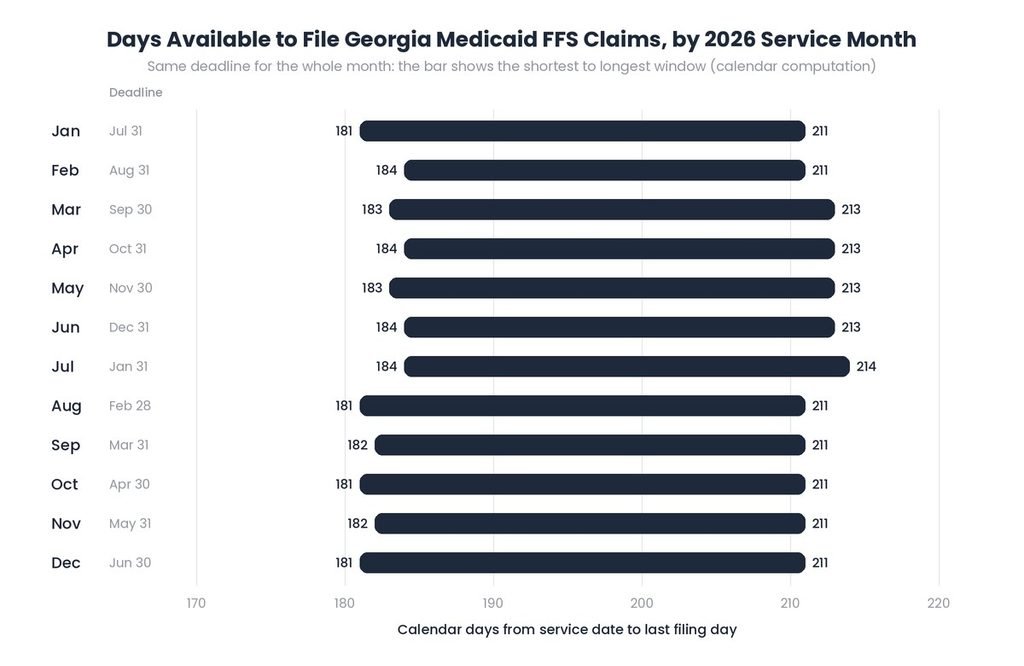
Georgia counts from the month of service, so every date within one calendar month shares one Georgia Medicaid claim deadline. A March 10, 2026 visit is due September 30, 2026, which is 204 days later. A March 31 visit has the same deadline, giving only 183 days. Across 2026, the window runs from 181 to 214 days depending on the month and the day.
A flat 180-day tracker never runs late against this rule, but it wastes up to a month of working time on early-month services. Do the reverse mistake and apply “six months from the date” arithmetic, and a March 10 claim looks due September 10. Configure the deadline as month-end plus six months when your billing system allows payer-specific rules.
The 2026 deadline calendar
Georgia Medicaid FFS deadline by 2026 service month
| Service month | Last filing day | Window if served on the 1st | Window if served on the last day |
| January 2026 | July 31, 2026 | 211 days | 181 days |
| February 2026 | August 31, 2026 | 211 days | 184 days |
| March 2026 | September 30, 2026 | 213 days | 183 days |
| April 2026 | October 31, 2026 | 213 days | 184 days |
| May 2026 | November 30, 2026 | 213 days | 183 days |
| June 2026 | December 31, 2026 | 213 days | 184 days |
| July 2026 | January 31, 2027 | 214 days | 184 days |
| August 2026 | February 28, 2027 | 211 days | 181 days |
| September 2026 | March 31, 2027 | 211 days | 182 days |
| October 2026 | April 30, 2027 | 211 days | 181 days |
| November 2026 | May 31, 2027 | 211 days | 182 days |
| December 2026 | June 30, 2027 | 211 days | 181 days |
Calendar computation applying the six-month rule in DCH Part I. The table does not assume any extension for weekends or holidays, so file ahead of the date shown.
In billing audits, a common pattern is a team that stores one deadline per claim at entry and never recalculates it after a rejection. The date stays correct, but the queue is sorted by service date, so a January claim and a February claim look equally urgent when they are not. Sort the work queue by deadline, not by service date.
Which Other Georgia Medicaid Clocks Run Next to the Six-Month Rule?
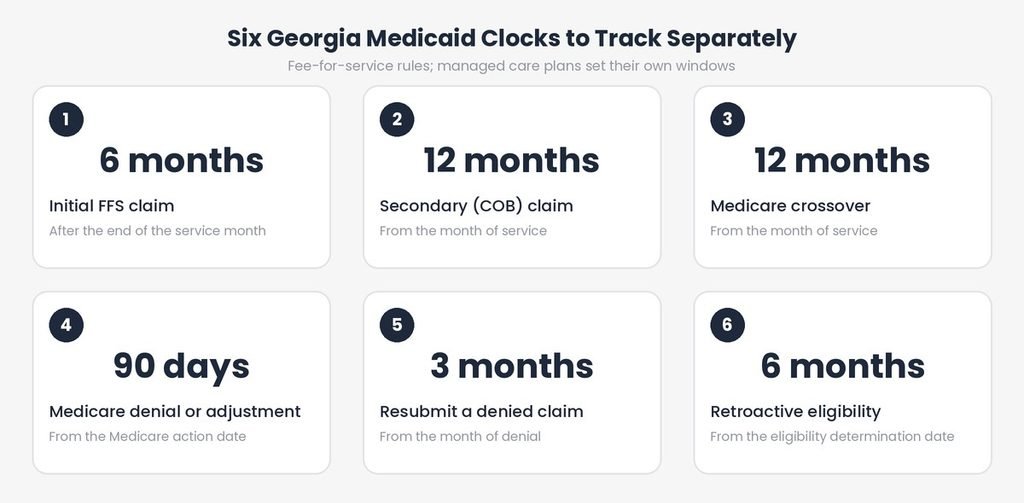
At least seven separate clocks can apply to one Georgia Medicaid patient, and each starts from a different event. Treat the six-month rule as the default for first-time billing, then switch to a different clock when other insurance, Medicare, a denial or a retroactive eligibility date is involved.
Georgia Medicaid claim clocks at a glance
| Situation | Deadline | Clock starts | Source type |
| Initial FFS claim | Six months | After the end of the service month | DCH Part I ¹ |
| Secondary claim, other insurance primary | 12 months | From the month of service | DCH Part I / Gainwell ¹ |
| Medicare crossover not auto-crossed | 12 months | Month of service; wait 45 days after Medicare payment first | Gainwell crossover training ¹ |
| Medicare-denied claim | 90 days | Date of the Medicare denial | Gainwell crossover training ¹ |
| Resubmitting a denied claim | Three months | Month of the denial | Gainwell claims training ¹ |
| Adjusting a paid claim | Three months | Month of payment | Gainwell claims training ¹ |
| Retroactive eligibility | Six months | Date of the eligibility determination | DCH Part I ¹ |
¹ Published state standard. Georgia posts these rules in DCH manuals and Gainwell training decks on the GAMMIS portal; wording has changed across versions, so confirm against the current manual before relying on a date.
Medicare crossover and other-insurance claims
A secondary or crossover claim gets 12 months from the month of service, longer than the first-claim window because the primary payer must act first. When Medicare pays but the claim does not cross over automatically, wait 45 days after the Medicare payment, then bill Georgia Medicaid directly. Compare this with the Medicare 12-month timely filing rule, which governs the primary claim.
Medicare Advantage as the primary payer
Georgia training materials state that Medicare Advantage claims do not cross over automatically, so staff enter them manually in GAMMIS. Do this at once when a patient has a Medicare Advantage plan, because the 45-day wait does not protect you if nobody ever starts the claim. A secondary claim timely filing guide covers the coordination of benefits steps.
Claims denied or adjusted by Medicare
When Medicare denies a claim, Georgia gives 90 days from the denial. A Medicare adjustment follows a 90-day window as well, and Georgia ties it to a specific paper adjustment form, so confirm the form named in the current crossover training before billing. Set the denial date, not the original service date, as the trigger in your tracker.
Resubmitting denied claims and adjusting paid claims
A denied Georgia FFS claim should be resubmitted within three months of the month of denial, and an adjustment to a paid claim follows a three-month window from the month of payment. Georgia’s published materials do not promise that a timely original keeps the six-month window alive, so treat the three-month limit as its own clock. Our note on filing limits versus appeal limits shows why a dispute deadline is a different clock again.
Retroactive eligibility
When a member’s Medicaid coverage is approved retroactively, known as retroactive eligibility, the filing window runs from the eligibility determination date rather than the service month. Georgia can grant coverage for up to three months before the application month. Do this when a patient was uninsured on the service date: verify eligibility weekly and bill within six months of the determination.
The 365-day edit and the edited-claim trap
A GAMMIS banner dated April 12, 2018 announced an edit that rejects claims submitted more than 365 days after the date of service. Treat 365 days as the outer boundary for any claim without a documented exception. It also exposes a tension: a March 10, 2026 secondary claim reaches day 365 on March 10, 2027, three weeks before month-end counting would end 12 months. Call the Provider Contact Center before relying on late-month secondary dates.
An edited or corrected claim is a new claim, and the six-month rule is still measured from the service month, so the clock does not restart. Review the corrected claim timely filing limits by payer when your team corrects claims for several states.
Do Georgia Families Plans Follow the Same Filing Deadline?
Not always. Georgia Families care management organizations (CMOs) publish their own claim deadlines, and the published versions share the six-month idea but differ on how it is counted and on secondary and resubmitted claims. For a member enrolled in a plan, the plan policy controls, not the DCH fee-for-service rule.
Illustrative comparison: Georgia Medicaid payers and filing windows
| Payer | Initial claim window | Other-insurance or resubmission rule | Published in |
| Georgia Medicaid FFS (DCH / Gainwell) | Six months after the month of service | Secondary 12 months; denial resubmission three months from month of denial | DCH Part I, July 2026 |
| Amerigroup (Georgia Medicaid) | Six months following the month of service | When another payer is primary, counted from that payer’s explanation of payment date | Policy G-06050, approved June 2025 |
| Peach State Health Plan | Six months from the service month | Resubmission: six months from service month or three months from denial month, whichever is later; other-insurance claims 180 days from primary EOP but never beyond 12 months from the service month | Claims time-frame guide (2021 copy) |
| CareSource Georgia | 180 calendar days (start point not confirmed here) | Confirm in the current provider manual | Plan quick reference, 2023 |
Illustrative: plan rules change with contract amendments and plan rosters change over time. Confirm against the current provider manual or your participation agreement. The Amerigroup policy is available as the Amerigroup Georgia timely filing reimbursement policy.
The sharpest difference is how the days are counted. A plan that counts 180 calendar days from the service date can end weeks before the DCH month-end deadline, so applying the FFS date to such a plan loses claims. Store a deadline rule per payer, as our guide to payer-specific claim submission rules recommends. Next door in Florida, Medicaid Florida timely filing limits show the same fee-for-service versus managed care split.
Can a Georgia Practice Get More Time After the Deadline?
Only in narrow, documented situations, and a practice should never plan around one. Georgia law lets the commissioner of DCH extend filing, and the rules that start the clock later are tied to eligibility or enrollment events outside the provider’s control.
The 2006 text of Georgia Code § 49-4-145 allows an extension of up to 12 months when the delay was beyond the provider’s control. The federal ceiling in 42 CFR 447.45 requires states to demand claims within 12 months of service, with limited exceptions, so Georgia’s six-month rule is the stricter layer. Check the current statute text before citing it in a request.
Provider enrollment gaps
Part I sets enrollment effective-date rules in Chapter 100 and discusses retroactive enrollment requests with a 60-day request window. Claims for dates before your effective date cannot be paid, so the safest fix is prevention. Start provider credentialing and enrollment before a clinician’s first Georgia Medicaid visit, not after the first rejection.
What does not buy more time
Waiting on a patient to supply insurance details, waiting for a resubmission queue to clear, or fixing a claim late are not exceptions. Georgia also bars billing the member for a claim denied for timely filing under Part I, section 106.17, so a missed deadline becomes a write-off, not patient balance.
How Do You Calculate Georgia Deadlines and Billing Speed? Four Worked Examples
You calculate a Georgia deadline from the last day of the service month and judge performance with two ratios, days to bill and write-off rate. The examples below use real calendar arithmetic; the performance examples are clearly labeled as illustrative. The medical billing KPIs worth tracking put these ratios in a wider dashboard.
Example 1: A standard FFS deadline
Formula: deadline = last day of the sixth month after the service month. Walkthrough: a patient is seen on March 10, 2026. Six months after March is September, so the deadline is September 30, 2026. That is 204 days from the visit. Setting an internal stop date 30 days earlier gives August 31, 2026.
Example 2: A crossover with Medicare payment and denial
Formula: earliest direct bill = Medicare payment date + 45 days. Walkthrough: Medicare pays the March 10 claim on April 15, 2026 and no crossover arrives. April 15 plus 45 days is May 30, 2026, so bill Georgia Medicaid that day. If Medicare had denied on June 1 instead, 90 days later is August 30, 2026.
Example 3: Days to bill and the blended-average trap
Formula: average days to bill = total days from service to submission divided by claims submitted. Illustrative scenario (not an actual client record): a practice submits 1,160 Georgia claims. Office visits (1,000 claims) average 6 days, a second site (100 claims) averages 7 days, and an ancillary service (60 claims) averages 41 days. Total days are 9,160, so the blend is 7.9 days.
A 7.9-day blend looks near the 7-day practical target, yet the ancillary line takes 41 days, which uses 22.7 percent of the shortest 181-day window before any rejection. Do this when any sub-group exceeds the target: report days to bill by site and service line, not only in total.
Example 4: Write-off rate by payer
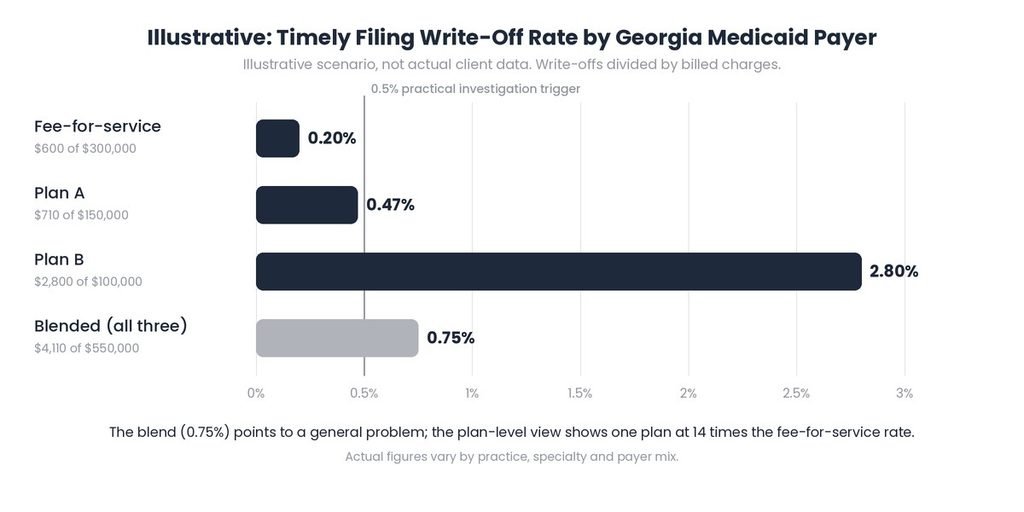
Formula: write-off rate = timely filing write-offs divided by billed charges. Illustrative scenario (not an actual client record): fee-for-service shows $600 on $300,000 (0.20 percent), Plan A $710 on $150,000 (0.47 percent) and Plan B $2,800 on $100,000 (2.80 percent). The blend is $4,110 on $550,000, or 0.75 percent. Plan B loses claims at 14 times the fee-for-service rate.
The blend suggests a diffuse problem and invites a broad retraining plan. The split shows one plan, which points to a plan-specific cause such as a deadline counted from the wrong date. A report that breaks losses out by payer pays for itself here, which is why we pair denial management with payer-level reporting.
How Should You Compare Your Georgia Results Fairly?
Compare like with like: fee-for-service against fee-for-service, and each plan against its own deadline rule. A practice with mostly office visits and one with mostly hospital-based services will have very different days to bill, so a single benchmark misleads.
Treat one missed number as a signal to investigate, not a verdict. If the write-off rate passes 0.5 percent in one month, check whether a single payer, site or staff member explains it before changing the process. If it passes 0.5 percent for two months running, the cause is probably structural.
What Is a Seven-Step Process for Never Missing a Georgia Deadline?
A reliable Georgia deadline process runs in seven steps, and each step has an owner and a trigger. The steps below work for a solo practice or a multi-site group, though the tooling will differ. Our guide to tracking timely filing deadlines goes deeper on the tracker itself.
- Verify Georgia Medicaid eligibility on the date of service, and identify whether the member is in fee-for-service or a Georgia Families plan.
- Record every other payer, including Medicare Advantage, before the claim leaves your system.
- Calculate the deadline for the correct clock and store it on the claim, with an internal stop date 30 days earlier.
- Submit within 7 days of service when documentation is complete, and confirm acceptance within three business days.
- Review open claims weekly, sorted by deadline, and escalate any claim inside its stop date.
- Log denials with the denial month, then restart a three-month clock for resubmission.
- Report write-offs by payer each month and investigate any payer above 0.5 percent.
Steps 5 and 6 are where most practices slip, because the weekly review competes with front-desk and posting work. When the open-claim list spans many payers, a practical approach to tracking unpaid claims keeps the review short enough to finish every week.
How Long Until a Deadline Program Starts Paying Off?
Planning ranges, not guarantees: most practices see the weekly worklist change within two to four weeks of installing deadline sorting, measurable write-off improvement in roughly two to three months, and consistent plan-by-plan compliance in four to six months. Results depend on claim volume, staffing and payer mix.
Which Georgia Filing Mistakes Cost the Most?
The most expensive mistakes are applying one deadline to every payer, ignoring the Medicare Advantage manual step, and treating rejections as low priority. Each has a simple fix once the cause is visible, and most of the fixes cost staff time rather than software.
- Using a single company-wide deadline. Do this instead: store the rule per payer, because a plan using 180 days ends before the FFS month-end date.
- Forgetting that Medicare Advantage claims do not cross over automatically. In billing audits, a common pattern is these claims sitting unbilled because staff assumed the crossover would arrive. Enter them manually when the patient has a Medicare Advantage plan.
- Working rejections by dollar value. A common pattern is a small-dollar claim aging past its date because larger claims were worked first. Sort by deadline whenever the queue exceeds what staff can clear in a week.
- Treating a corrected claim as a fresh start. The six-month rule still runs from the service month, so correct within days.
- Billing the patient after a timely filing denial. Georgia bars it under Part I, so route the amount to write-off review instead.
Quick Summary of Georgia Medicaid Filing Targets
- Initial FFS claims: six months after the service month, so March services are due September 30, 2026.
- Secondary and crossover claims: within 12 months of the month of service; wait 45 days after Medicare payment before billing a missing crossover.
- Medicare denials: 90 days from the denial.
- Denied claims: resubmit within three months of the month of denial.
- Georgia Families plans: confirm each plan’s policy; one published plan policy counts 180 days.
- Practical targets: days to bill of 7 or fewer, an internal stop date 30 days before the deadline, and a write-off rate near 0 percent with investigation above 0.5 percent.
Georgia Medicaid Timely Filing Self-Assessment
Answer yes or no to each question about your current Georgia Medicaid process, using the numbers from this guide as the standard. Count your yes answers at the end, then use the three-tier scoring guide that follows the list.
- Does your system calculate Georgia FFS deadlines as month-end plus six months, not 180 days from service?
- Is every open Georgia claim reviewed at least 30 days before its deadline?
- Is your average days to bill 7 or fewer, reported by site and service line?
- Do you confirm claim acceptance within three business days of submission?
- Do you hold crossover claims for 45 days after Medicare payment before billing Georgia Medicaid directly?
- Do staff enter Medicare Advantage secondary claims manually, the same day?
- Do you track the three-month resubmission window as its own clock?
- Is your timely filing write-off rate reported by payer and kept under 0.5 percent?
- Does each Georgia Families plan have a stored deadline rule that you checked in the last 12 months?
- Do you recheck eligibility for retroactive coverage on uninsured patients every week?
Scoring: 9 to 10 yes answers means your process is strong; keep the annual plan review. 6 to 8 means you have gaps; fix the lowest-numbered no answers first. 0 to 5 means timely filing losses are likely; start with questions 1, 2 and 8 this month.
When Should a Georgia Practice Consider Outside Billing Support?
Outside support makes sense when the in-house process has hit a limit that more effort will not fix, for example when the same deadline errors return after retraining. Five signals usually show it:
- Timely filing write-offs stay above 0.5 percent for two months in a row.
- Nobody owns the rejected-claim queue, so claims age while staff handle other work.
- Medicare Advantage and other secondary claims are entered late or not at all.
- The practice added Georgia Families plans, and deadlines now differ by payer.
- Billing staff turnover keeps resetting your process knowledge.
When you evaluate vendors, look for written deadline tracking by payer, payer-level reporting, a US-based team, clear contract terms with no hidden fees, and a plan for medical billing that includes follow-up on denials, not only submission.
EON MED SOLUTIONS is one example of this kind of provider. The company delivers end-to-end billing, coding, credentialing, denial management and compliance support through a US-based team with transparent reporting. The process is deadline-based tracking by payer and monthly reporting by payer. Results vary by practice. To see how the service works, review our medical billing and RCM services.
Expert Opinion
The Medicaid Georgia timely filing limit is simple to state and easy to miscount: six months after the service month, with separate clocks for crossovers, denials and retroactive eligibility. Most losses come from applying the wrong clock, not from slow billing alone.
Firm published standards in this guide are the six-month FFS rule, the 12-month secondary and crossover windows, the 90-day Medicare denial window, the three-month resubmission window and the 12-month federal ceiling. Days to bill of 7 or fewer, the 30-day stop date and the 0.5 percent write-off trigger are practical targets, and the payer comparison is illustrative.
So the natural next question is which of your open Georgia claims are closest to a deadline today. If you want a second set of eyes on that list, see EON MED SOLUTIONS billing and RCM services and start with the payer-level report.
Frequently Asked Questions
What is the timely filing limit for Georgia Medicaid?
Georgia Medicaid fee-for-service claims are due within six months after the month in which the service was provided. A March 2026 service is therefore due by September 30, 2026. Secondary and crossover claims generally have 12 months from the month of service, and managed care plans publish their own deadlines.
What is a good days-to-bill target for Georgia Medicaid claims?
A commonly cited practical target is 7 days or fewer from service to submission. No Georgia agency mandates it. Compare like with like by reporting days to bill separately by site and service line, because a blended average can hide a slow ancillary line.
What is a good timely filing write-off rate?
A practical target is near 0 percent, with investigation above 0.5 percent of billed charges. This is an industry convention, not a Georgia or CMS standard. Report it by payer each month, since a low blended rate can sit on top of one plan with a much higher loss rate.
How long does a practice have to bill Georgia Medicaid secondary claims?
Georgia gives secondary and crossover claims 12 months from the month of service. If Medicare pays and no crossover arrives, wait 45 days after the payment, then bill directly. A Medicare denial has its own 90-day window, and the 365-day edit means late-month dates deserve a call to the Provider Contact Center.
Does a rejected Georgia Medicaid claim get a new six months?
No. An edited or corrected claim is treated as a new claim, but the six-month rule is still measured from the service month. A denied claim has a separate three-month resubmission window from the month of denial. Track both dates and do not assume the first resets.
Can a Georgia practice bill the patient after a timely filing denial?
Georgia Medicaid Part I, section 106.17, states that members may not be billed for claims denied for timely filing. The amount becomes a write-off. Review the denial for an eligibility or enrollment explanation first, since those events can start a later clock.
Sources and Methodology
(a) Published standards and definitions from named bodies. Georgia Department of Community Health, Part I Policies and Procedures for Medicaid and PeachCare for Kids (Q3, July 2026), Chapters 100 and 200; Gainwell Technologies provider training on crossover and claims submission, posted on the Georgia Medicaid Management Information System portal (2019 to 2022 versions); GAMMIS portal notice on the 365-day edit (April 12, 2018); Georgia Code § 49-4-145 (2006 text published by Justia); 42 CFR 447.45 (eCFR, current). Published plan policies: Amerigroup policy G-06050 (approved June 2025), Peach State Health Plan claims time-frame guide (2021 copy), CareSource Georgia quick reference (2023).
(b) Named benchmarking data providers. None used in this article.
(c) Practical or illustrative targets from general industry sources. Days to bill of 7 or fewer, the 30-day internal stop date, the three-business-day acceptance check and the 0.5 percent write-off trigger are commonly reported internal benchmarks. The worked examples and plan comparison are illustrative.
(d) Survey or study data. None used in this article.
Methodology: research reflects publicly available information as of October 2026. Rules, plan rosters and policy documents change, and results vary by practice, so confirm every date against the current DCH manual or plan policy before relying on it. This guide is general information, not legal advice.


