

UHC California Timely Filing Limit: 2026 Provider Guide
| The UHC California timely filing limit is set by your UnitedHealthcare Participation Agreement, and a 90-day window from the date of service is common for contracted providers. For state-regulated UHC plans, California law bars deadlines shorter than 90 days for contracted providers and 180 days for non-contracted providers. Medicare Advantage and self-funded employer plans follow their own rules, so confirm the member’s product first. |
Search for UnitedHealthcare’s filing deadline and you will see 90 days, 180 days, and 365 days, often on the same page. For California practices, the real answer depends on three things: your contract, the member’s product, and California law. This guide explains how those layers fit together, including state minimums, secondary claims, provider disputes, and the new 30-day payment rule. You will also get worked date calculations and illustrative internal targets. Near the end, a nine-question self-assessment helps you check whether your UHC workflow is protecting revenue.
UHC California Deadline Snapshot
Use this snapshot to set due dates. Legal floors and payer rules come first; internal goals are labeled illustrative.
| Metric / Deadline | Practical Target or Rule | Review Frequency | Primary Source |
| Initial claim, contracted provider | Per Participation Agreement; 90 days common | Weekly | Payer contract; UHC Administrative Guide defers to it |
| State floor, contracted provider | No deadline shorter than 90 days from DOS | Reference | Published standard: 28 CCR §1300.71(b)(1); Ins. Code §10133.66 |
| State floor, non-contracted provider | No deadline shorter than 180 days from DOS | Reference | Published standard: 28 CCR §1300.71(b)(1); Ins. Code §10133.66 |
| Secondary (COB) claim floor | At least 90 days from primary payment or denial | Per claim | Published standard: 28 CCR §1300.71(b)(1) |
| Provider dispute (DMHC plans) | At least 365 days from the plan’s action | Per denial | Published standard: 28 CCR §1300.71.38(d) |
| Late claim with good cause | Plan must adjudicate via provider dispute | Per claim | Published standard: 28 CCR §1300.71(b)(4) |
| Plan payment on complete claim | 30 calendar days (claims received on/after 1/1/2026) | Monthly | Published standard: AB 3275; DMHC APL 25-007 |
| Late-payment interest (DMHC plans) | 15% per year, plus $15 or 10% of interest if not auto-paid | Per claim | Published standard: H&S Code §1371, per DMHC APL 25-007 |
| Non-contracted Medicare Advantage | 365 days from through date of service | Per claim | Payer guidance: UHC supplement, as reported by industry sources |
| Days to bill (internal) | 2–5 days from DOS | Weekly | Illustrative target |
| Claims accepted by day 45 (internal) | 99%+ | Monthly | Illustrative target |
Source labels: “Published standard” means California statute, regulation, or DMHC guidance sets the rule. “Payer contract” and “payer guidance” mean UnitedHealthcare documents control, and they vary by agreement. “Illustrative target” means a practical internal goal from general industry practice; no agency mandates it. Confirm your own contract before relying on any figure.
What Actually Sets the UHC California Timely Filing Limit?
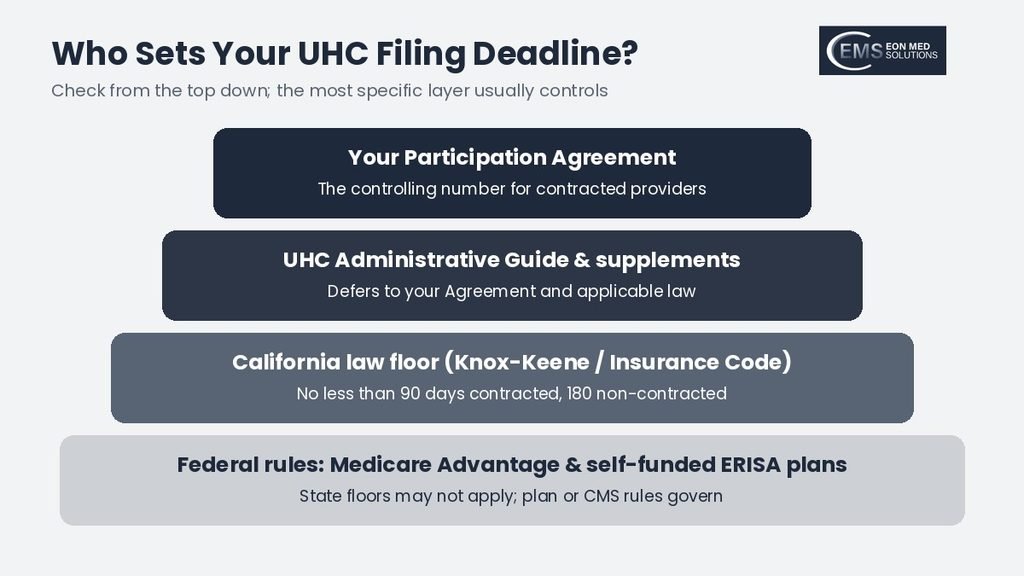
Your Participation Agreement comes first
UnitedHealthcare’s Administrative Guide does not publish one national filing deadline for every provider. Recent editions direct providers to their Participation Agreement or contracting contact for timely filing terms. In practice, many commercial agreements use 90 days from the date of service, which is why that number appears everywhere online. Still, some contracts allow more, and delegated arrangements may add their own terms. Pull your agreement, find the timely filing clause, and write the exact number into your billing system.
The member’s product changes the rules
UHC sells several product types in California, and each follows a different rulebook. Fully insured HMO plans fall under the Department of Managed Health Care (DMHC) and the Knox-Keene Act. Insured PPO products generally fall under the California Department of Insurance. Medicare Advantage follows federal rules and the contract terms, while self-funded employer plans are governed mainly by ERISA and the plan document. The same patient card logo can hide very different deadlines. Capture the product type during eligibility checks, not after a denial.
Delegated HMO claims in California
Many UHC HMO members in California are assigned to a medical group or IPA that handles claims. In those cases, the claim may go to the delegated group rather than UHC itself. California’s claims rules also apply to a plan’s capitated provider that pays claims.
California’s Legal Floor Under Every UHC Contract
The 90-day and 180-day minimums
For DMHC-regulated plans, 28 CCR §1300.71 bars any filing deadline shorter than 90 days for contracted providers. For non-contracted providers, the minimum is 180 days after the date of service. California Insurance Code §10133.66 applies similar minimums to insurers regulated by the Department of Insurance. So a UHC contract cannot legally shorten those windows for state-regulated products. However, the floor is only a minimum. Your agreement may allow longer, and that longer number is the one you should track.
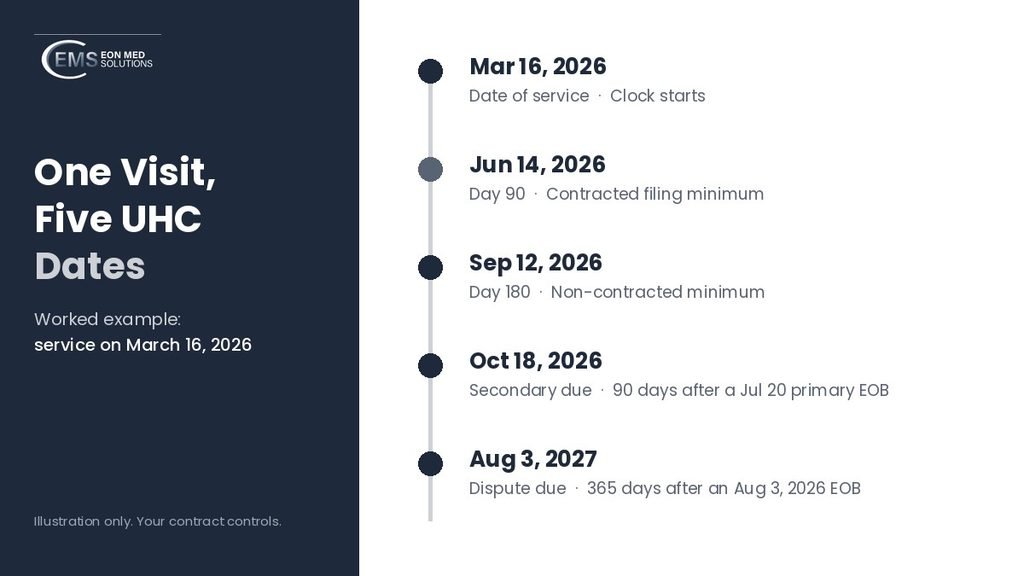
| Worked Example 1 — Contracted vs. Non-Contracted Deadlines Formula: Filing deadline = Date of service + contract window (never less than the state floor) Scenario: Service on March 16, 2026. • Contracted provider with a 90-day agreement: claim due June 14, 2026. • Non-contracted provider (180-day floor): claim due September 12, 2026. |
Late claims with good cause
California rules include a safety valve. Under §1300.71(b)(4), a plan that denies a claim as late must adjudicate it if the provider files a provider dispute and shows good cause for the delay. Good cause is not defined as “we were busy.” It usually means events outside your control, such as incorrect eligibility information or a payer system outage. Keep screenshots, clearinghouse reports, and eligibility responses. Without documentation, a good-cause argument rarely succeeds.
Secondary Claims, Corrections, and Disputes With UHC
When UHC is the secondary payer?
When another plan pays first, the clock for UHC usually restarts from the primary decision. California rules require DMHC-regulated plans to allow at least 90 days from the primary payer’s payment, denial, or contest notice. Record the primary EOB date on every coordination of benefits (COB) claim. That date is your proof if UHC later denies the secondary claim as late.
| Worked Example 2 — Secondary and Dispute Deadlines Formula: Secondary deadline = Primary EOB date + 90 days; Dispute deadline = UHC action date + 365 days Scenario: Primary EOB dated July 20, 2026 → UHC secondary claim due by October 18, 2026. UHC denial on an EOB dated August 3, 2026 → provider dispute due by August 3, 2027. |
Corrected claims and reconsiderations
Industry sources disagree on UHC’s corrected claim window, citing figures from 180 to 365 days. Recent UHC guidance reportedly applies the Agreement’s filing period to corrections too, measured from the date of service. Because the figures conflict, treat your contract as the only reliable source. Submit corrections with the proper frequency code and the original claim reference. If denials are stacking up across reason codes, structured denial management support can keep each window visible.
Provider disputes under California law
For DMHC-regulated plans, 28 CCR §1300.71.38 gives providers at least 365 days from the plan’s action to file a dispute. If the plan never acted, the clock starts when its time to contest expired. Non-contracted providers also have access to this process. Insurers regulated by the Department of Insurance must offer a similar dispute resolution mechanism before a complaint can go to the state.
Payment Timelines Under AB 3275
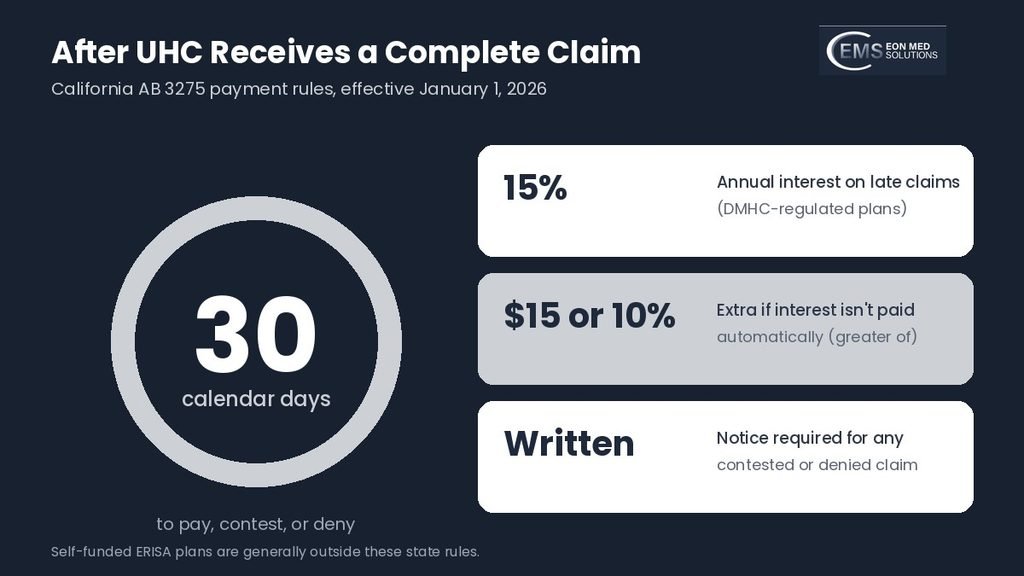
Filing on time is only half the story. For complete claims received on or after January 1, 2026, AB 3275 requires plans and insurers to pay, contest, or deny within 30 calendar days. Per DMHC’s guidance(4_1_2025).pdf), late payments on DMHC-regulated plans accrue 15% annual interest. If the plan fails to include that interest automatically, it owes an extra $15 or 10% of the interest, whichever is greater. Self-funded employer plans generally fall outside these state rules.
| Worked Example 3 — Late-Payment Interest Formula: Interest = Claim amount × 15% × days late ÷ 365 Scenario: A $500 complete claim is paid 30 days after the 30-day deadline. Interest: $500 × 0.15 × 30 ÷ 365 = $6.16. If not paid automatically, add the greater of $15 or $0.62 = $15. Total owed: $521.16. |
Watching Your UHC Numbers Month to Month
Contract deadlines show when money is lost. Internal measures warn you weeks earlier. The figures below are illustrative targets from general industry practice, not published UHC benchmarks. Actual figures vary by specialty, product mix, and staffing, so verify against your own data where precision matters. They fit naturally beside the medical billing KPIs you already track.
| Metric (Illustrative) | Formula | Illustrative Target |
| Days to bill | Total days from service to submission ÷ claims submitted | 2–5 days |
| Accepted by day 45 | UHC claims accepted by day 45 ÷ UHC claims | 99%+ |
| CO-29 (timely filing) denial rate | CO-29 denials ÷ UHC claims | 0% |
| Secondary claims within 30 days | Secondaries sent within 30 days of primary EOB ÷ secondaries | 100% |
| Interest captured on late payments | Late payments with correct interest ÷ late payments | 100% |
Illustrative: compiled from general industry practice, not a named benchmark. Actual figures vary.
| Worked Example 4 — Acceptance Rate Formula: UHC claims accepted by day 45 ÷ total UHC claims × 100 Scenario: 485 of 500 claims = 97%. The 15 late claims, averaging $140, put $2,100 at risk if a 90-day contract applies. |
How a blended rate can hide one UHC product line?
Illustrative scenario (not an actual client record): an urgent care group bills UHC commercial PPO, UHC HMO through a delegated IPA, and UHC Medicare Advantage. Its blended on-time rate is 96%. Split by product, PPO and Medicare Advantage sit near 99%, but the IPA line sits at 88%. Claims went to UHC instead of the IPA, so they bounced and aged. Aging claims like these deserve dedicated accounts receivable management attention.
| UHC Product (Illustrative) | Claims | On Time | Rate |
| Commercial PPO | 300 | 297 | 99.0% |
| HMO via delegated IPA | 200 | 176 | 88.0% |
| Medicare Advantage | 200 | 198 | 99.0% |
| Blended | 700 | 671 | 95.9% |
Keeping Comparisons Fair and Useful
State minimums and contract deadlines are fixed rules, not benchmarks. Internal targets are different, and they only mean something when compared like-for-like. Compare the same UHC product, a similar service mix, comparable practice size, and the same reporting period. A group with heavy delegated HMO volume will look different from a PPO-focused specialty practice. One missed target is a signal to investigate, not a verdict on your staff. Identify the cause, whether routing, eligibility, or a portal issue, before changing the whole workflow.
Improvement Timelines You Can Plan Around
These are general planning ranges, not guarantees for any specific practice. Backlog size, product mix, and staffing will shift them.
| Fix | Partial Results | Fuller Results |
| Loading contract deadlines into the billing system | 1–2 weeks | 1 month |
| Capturing product type and delegated group at intake | 2–4 weeks | 1–2 months |
| Daily clearinghouse rejection review | 1–2 weeks | 1 month |
| Secondary and dispute date tracking | 1 month | 2–3 months |
| Auditing late payments for AB 3275 interest | 1 month | 3 months |
Quick Recap for Busy Billing Teams
- Your UHC Participation Agreement sets the filing deadline; 90 days is common but not universal.
- California law bars deadlines under 90 days (contracted) or 180 days (non-contracted) for state-regulated plans.
- Secondary claims get at least 90 days from the primary decision; disputes get at least 365 days from the plan’s action.
- Complete claims received from 2026 onward must be paid, contested, or denied within 30 calendar days.
- Targets like 2–5 days to bill and 99%+ acceptance by day 45 are illustrative goals, not mandates.
UHC California Filing Self-Assessment: 9 Questions
Answer yes or no, then count your yes answers.
- Do you know the exact filing window in your current UHC Participation Agreement?
- Do you capture the UHC product type and any delegated group at every visit?
- Is your average days to bill at or under five days?
- Were 99% or more of UHC claims accepted by day 45 last month?
- Did you have zero CO-29 timely filing denials from UHC last quarter?
- Do you record the primary EOB date on every UHC secondary claim?
- Do you calendar a 365-day dispute date for each denial from a state-regulated UHC plan?
- Do you check late UHC payments for AB 3275 interest and penalties?
- Do you review on-time rates separately for each UHC product line?
8–9 yes: Strong control; review monthly. 5–7 yes: Gaps exist; fix the “no” items this quarter. 0–4 yes: Revenue is likely slipping now; audit every UHC claim older than 45 days this week.
Signals You Have Outgrown In-House UHC Billing
Many practices manage the UHC California timely filing limit well on their own. Others find the mix of contracts, products, and delegated groups too much to track. Watch for these signals:
- CO-29 denials from UHC appear more than once a quarter.
- Nobody can quote the filing clause in your current UHC agreement.
- HMO claims regularly go to UHC when they belong with a delegated IPA.
- Late payments arrive without interest, and no one checks.
- Denials sit for months before anyone files a dispute.
Strong outside support should load contract-specific deadlines, route claims to the right payer, and track dispute windows automatically. Look for transparent reporting you can review, HIPAA-compliant processes, and one named contact. Since network status drives your deadline, keeping credentialing current matters too. EON MED SOLUTIONS is one example of that structure. Its US-based team provides end-to-end medical billing, coding, credentialing, denial management, and compliance support, with a dedicated agent per provider and no hidden fees. Results vary by practice and situation. You can review every service here.
Expert Opinion
The UHC California timely filing limit is really a stack of rules. Your agreement sets the working number, California law sets a floor for state-regulated products, and federal rules take over for Medicare Advantage and self-funded plans. Knowing which layer controls each claim prevents most late-filing losses.
To be clear about sources: the 90-day and 180-day floors, the 90-day secondary minimum, the 365-day dispute window, and the AB 3275 payment and interest rules are published California standards. Contract windows and corrected-claim terms are payer-specific. Days to bill, the day-45 target, and the improvement timelines are illustrative goals to adapt to your data.
Frequently Asked Questions
What is the UHC California timely filing limit?
It is set by your UHC Participation Agreement, often 90 days from the date of service for contracted providers. For state-regulated plans, California law bars deadlines under 90 days (contracted) or 180 days (non-contracted).
Is the UHC filing limit 90 days or 180 days?
Both figures appear because they apply to different situations. Ninety days is common for contracted providers, while 180 days is the California minimum for non-contracted providers.
What is a good days-to-bill target for UHC claims?
Many practices aim for two to five days from service. This is an illustrative target, not a UHC rule, but it protects a 90-day contract window.
What is a good acceptance rate for UHC claims?
A practical goal is 99% or more of claims accepted by day 45. It is an illustrative target that leaves room to fix rejections.
How long do I have to dispute a UHC claim decision in California?
For DMHC-regulated plans, California rules give at least 365 days from the plan’s action. Your contract may describe additional reconsideration steps.
Does California law apply to self-funded UHC plans?
Generally no. Self-funded employer plans are governed mainly by federal ERISA rules and the plan document, so California’s floors may not apply.
What is the timely filing limit for UHC Medicare Advantage?
Contracted providers follow their agreement. Industry sources report that UHC allows non-contracted Medicare Advantage providers 365 days from the through date of service.
How fast must UHC pay a California claim in 2026?
For complete claims received on or after January 1, 2026, state-regulated plans must pay, contest, or deny within 30 calendar days under AB 3275.
What is a good way to prove a UHC claim was filed on time?
Keep clearinghouse acceptance reports and payer acknowledgment files for every batch. These timestamped records are the strongest evidence in a timely filing dispute.
Sources and Method Behind This Guide
(a) Published standards: 28 CCR §§1300.71 and 1300.71.38; California Insurance Code §10133.66; Health and Safety Code §1371 as amended by AB 3275; DMHC All Plan Letter 25-007; and California Department of Insurance provider guidance. (b) Named benchmarking data providers: none used. (c) Practical or illustrative targets: days to bill, day-45 acceptance, secondary timing, and improvement timeframes, compiled from general industry practice. UHC contract and product terms are payer-specific and were summarized from UHC guidance and industry sources. (d) Survey data: none used. Actual results vary by practice and situation, and all figures reflect information available at the time of research in September 2026.
This article is educational and is not legal advice. Confirm your deadlines in your UHC Participation Agreement and current UHC guidance. EON MED SOLUTIONS is not affiliated with UnitedHealthcare.


One Comment