

Medicaid Timely Filing Limit: Federal Rule and State Clocks
The Medicaid timely filing limit is the deadline for submitting a claim to a state Medicaid program, and federal rules under 42 CFR 447.45(d) direct state agencies to require providers to file all claims within 12 months of the date of service. Many states choose shorter windows: Texas uses 95 days, New York 90 days, and California six months after the month of service. This guide shows which clock applies to a claim, how state rules differ, and how to keep expired claims out of your medical billing workflow.
| Key takeaways Federal ceiling: 12 months from the date of service under 42 CFR 447.45(d); states can set shorter limits.Texas (95 days), New York (90 days) and California (six months after the month of service) show how far state clocks differ.Managed care plans can set their own windows in contracts and manuals, so check the plan, not only the state.Secondary and Medicare crossover claims often run on a separate clock tied to the other payer’s decision date. |
Which Medicaid Clock Applies to a Claim?
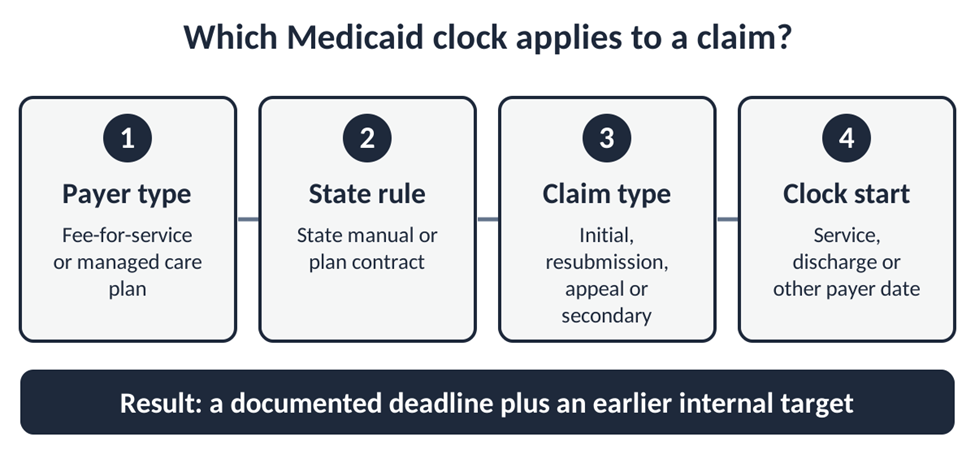
Four facts decide the Medicaid deadline for any claim: the payer type, the state rule, the claim type and the date the clock starts. Work through them in order, and write the result on the claim record before the claim goes out.
- Identify whether the claim goes to the state fee-for-service program or to a Medicaid managed care plan.
- Open the state provider manual, or the plan’s manual, and find the filing deadline.
- Name the claim type: initial, resubmission after a rejection, appeal, or secondary after Medicare or other insurance.
- Find the clock start: date of service, discharge date, month of service, or the other payer’s decision date.
- Record the deadline with its source, plus an earlier internal target for submission.
Fee-for-service means the state agency pays the claim directly; managed care means a Medicaid health plan pays under its own contract. The windows can differ, so a deadline learned for one payer should never be copied to the other. In billing audits, a common pattern is staff applying the fee-for-service deadline to managed care claims. A deadline tracker that stores payer type beside each date prevents that.
What Does Federal Law Set as the Medicaid Filing Limit?
Federal regulation 42 CFR 447.45(d) directs state Medicaid agencies to require providers to submit all claims no later than 12 months from the date of service. That 12-month figure is a ceiling, not a default, and each state decides whether to set a shorter window. The rule is published in the Code of Federal Regulations, and states carry it out through their provider manuals and statutes.
The rule also contains exceptions. When a Medicare claim was filed on time, the agency may pay a related Medicaid claim within six months after notice of the Medicare decision, and court orders or hearing decisions can allow payment at any time. Separate payment standards require agencies to pay 90 percent of clean practitioner claims within 30 days and 99 percent within 90 days.
Do not read the federal ceiling as the practice deadline unless your state manual says so. A claim that is safe under 12 months can already be expired under a 90-day or 95-day state rule, and no federal exception will reopen it automatically.
How Do State Medicaid Timely Filing Limits Differ?
Three large programs show how far state limits differ: Texas allows 95 days, New York allows 90 days, and California allows six months after the month of service, all inside the federal 12-month ceiling. The table compares what starts each clock and what happens to late claims. Figures come from each state’s published manual or statute and apply to fee-for-service claims.
| State | Initial claim window | Clock starts | Late claims and exceptions | Resubmission or appeal |
| Texas | 95 days | Date of service (inpatient hospital: date of discharge) | The federal 365-day deadline applies to all claims, including those with retroactive eligibility; HHSC may consider exceptions in special circumstances | Appeals within 120 days of the remittance and status report disposition date |
| New York | 90 days | Date of service | Later claims need a numeric delay reason with documentation; most reasons carry their own deadline; claims must be payable within two years | Rejected or denied claims corrected and resubmitted within 60 days of notification |
| California | Six months after the month of service, for full payment | Month of service | Months 7 to 9: payment reduced 25 percent; months 10 to 12: reduced 50 percent; later claims need a delay exception | Check the current Medi-Cal provider manual for appeal rules |
Sources: Texas Medicaid Provider Procedures Manual, Section 6; 1 Texas Administrative Code 354.1003; New York eMedNY General Billing, version 2025-1; California Welfare and Institutions Code 14115. Managed care plans may differ. Check your state manual for current rules.
Texas Medicaid Provider Procedures Manual
In Texas, the 95-day clock runs from each date of service, according to the Texas Medicaid Provider Procedures Manual, and the manual states that retroactive eligibility does not excuse the federal filing deadline. A late eligibility add date therefore rarely rescues an old claim.
New York’s eMedNY General Billing manual sets 90 days from the date of service and allows later claims only with a listed delay reason, usually with a deadline counted from an event such as notification of eligibility. It also requires claims to be payable within two years of service, which limits even documented delays.
California’s six-month rule comes from Welfare and Institutions Code 14115, which also reduces payment for late claims. Illustrative example (fictional amounts): a claim payable at 200 dollars paid in month 8 is reduced by 25 percent to 150 dollars, and the same claim in month 11 is reduced by 50 percent to 100 dollars. A DHCS Medi-Cal bulletin describes how claims past 12 months are handled when they meet late submission requirements.
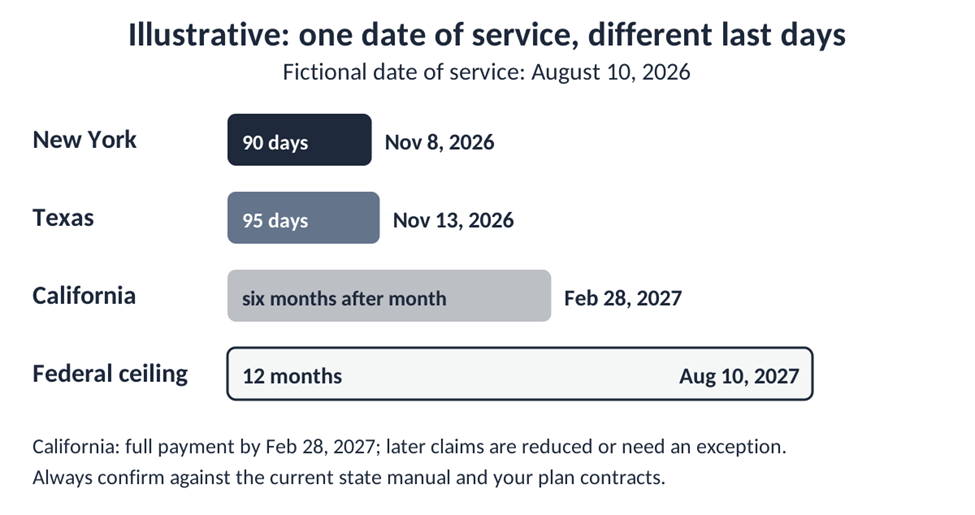
Illustrative scenario (not an actual client record): the same fictional date of service, August 10, 2026, produces different last days. Formula: last day = date of service + state window (California: the last day of the sixth month after the month of service).
| State or rule | Rule applied | Last day for full payment |
| New York | 90 days from the date of service | November 8, 2026 |
| Texas | 95 days from the date of service | November 13, 2026 |
| California | End of the sixth month after the month of service | February 28, 2027 |
| Federal ceiling | 12 months from the date of service | August 10, 2027 |
How Do Managed Care Plans and Medicare Crossovers Change the Deadline?
Medicaid managed care plans and Medicare crossover claims can each carry a separate clock, so the state fee-for-service deadline is only the starting point. Plans set filing windows in provider contracts and manuals, and those windows may be shorter or longer than the state clock. Read the manual of every plan you bill and record each deadline separately.
Crossover and secondary claims often run on the other payer’s decision date. Federal rules let an agency pay a related Medicaid claim within six months after notice of a timely Medicare claim’s disposition, and Texas requires the Medicaid claim within 95 days of the Medicare disposition date. Keep the Medicare remittance on file. The guide to secondary claim timely filing limits explains the workflow, and Medicare’s 12-month rule covers the primary clock.
Where Can You Find the Exact Limit for Your State?
The exact limit for a state sits in that state’s provider manual, and the guides below summarize each program’s fee-for-service and managed care rules in one place. Start with the program that pays the claim.
- Texas Medicaid 95-day rule guide: the 95-day rule, appeal windows and the 365-day federal deadline.
- New York Medicaid filing limit guide: the 90-day rule, delay reasons and the two-year limit.
- Medi-Cal timely filing guide: the six-month rule and reduced payment for late claims.
- Florida Medicaid timely filing guide: fee-for-service versus Statewide Medicaid Managed Care plans, secondary claims and retroactive eligibility.
- Illinois Medicaid timely filing guide: fee-for-service rules, HealthChoice Illinois plans with contract-based windows, crossovers and third-party liability.
- Pennsylvania Medicaid timely filing guide: original claims, resubmissions and adjustments, plus HealthChoices plans that set their own windows.
- Washington Apple Health timely filing guide: ProviderOne fee-for-service claims, resubmissions, crossovers and separate plan windows.
- Georgia Medicaid timely filing guide: fee-for-service deadlines, Georgia Families plans, and separate secondary and crossover rules.
Which Mistakes Cost Practices Medicaid Claims?
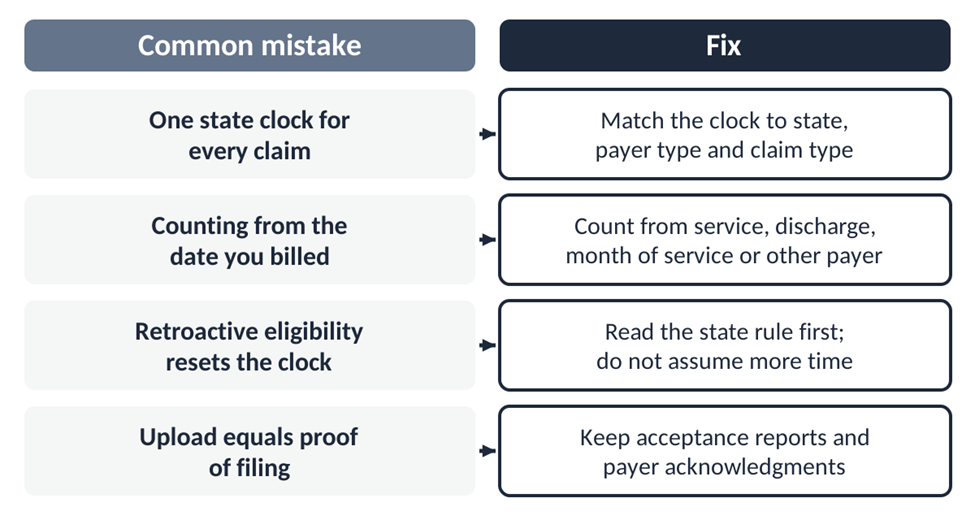
Most expired Medicaid claims trace to four mistakes: using one state’s clock everywhere, counting from the billing date, assuming retroactive eligibility resets the clock, and treating an upload as proof of filing. The table pairs each mistake with its fix.
| Mistake | Why it hurts | Fix |
| One state clock for every claim | Windows differ by state, payer type and claim type | Match the clock to all three before billing |
| Counting from the date you billed | Clocks start at service, discharge, month of service or the other payer’s decision | Calculate from the correct start date on day one |
| Assuming retroactive eligibility resets the clock | Some states, such as Texas, state that it does not excuse the federal deadline | Read the state rule before assuming extra time |
| Treating an upload as proof of filing | A rejected file was never accepted as a claim | Keep acceptance reports and payer acknowledgments |
In billing audits, a common pattern is write-offs clustered in managed care plans where staff applied the fee-for-service deadline. Another is a late eligibility add date treated as a fresh start. Do review every timely filing write-off by payer and state each month, and compare it with the plan manual, before assuming the denial was fair.
Filing and appeal windows run separately, and a missed filing deadline is rarely fixed by appealing. The comparison of timely filing limit vs appeal filing limit explains where each clock starts. Do build both dates into the claim record when a claim is created, not when it denies.
When Does Medicaid Deadline Tracking Need Outside Support?
Deadline tracking needs outside support when expired Medicaid claims keep appearing and in-house review no longer catches them. Four signals point that way:
- Fee-for-service and managed care claims share one deadline rule in your system.
- Timely filing write-offs recur every month.
- No one reviews rejection reports daily.
- Crossover or secondary claims wait on other payers with no tracked date.
When evaluating outside support, look for tracking by state and plan, proof-of-filing records, and reports you can read without asking. EON Med Solutions is one example: its US-based team provides end-to-end billing, coding, credentialing, denial management and A/R follow-up with transparent reporting, described on its services page. Results vary by practice.
Medicaid Filing Deadline Questions, Answered
What is the Medicaid timely filing limit?
The Medicaid timely filing limit is the deadline for submitting a claim to a state Medicaid program. Federal regulation directs state agencies to require claims within 12 months of the date of service, and many states set shorter limits, such as 95 days in Texas and 90 days in New York.
Is the Medicaid filing limit the same in every state?
No. Each state sets its own window inside the federal 12-month ceiling, and the clock can start on the date of service, the discharge date or the month of service. Texas, New York and California each use a different rule, so check the manual for the state that pays your claim.
Do Medicaid managed care plans follow the state deadline?
Not necessarily. Managed care plans set filing windows in provider contracts and manuals, and those windows can be shorter or longer than the fee-for-service deadline. Read the provider manual for each plan you bill, and record the deadline separately from the state fee-for-service rule.
What happens if a Medicaid claim is filed late?
Late claims are usually denied unless an exception applies, such as a documented delay reason in New York. California instead reduces payment by 25 percent in months seven to nine and 50 percent in months ten to twelve. Rules vary, so confirm the late-claim process in your state manual.
How do secondary Medicaid claims work after Medicare pays?
Secondary and crossover claims often run on a separate clock tied to the other payer’s decision. Federal rules let an agency pay within six months of notice of a timely Medicare claim’s disposition, and Texas requires filing within 95 days of the Medicare disposition date. Keep the Medicare remittance with the claim.
Expert Opinion
The Medicaid timely filing limit is a federal ceiling with a state-by-state reality underneath it. The 12-month rule comes from 42 CFR 447.45(d), and the Texas, New York and California rules come from their published manuals and statutes. The sample dates, the 25 and 50 percent payment example and the internal submission target are illustrative planning tools, not published deadlines.
Practices lose the most claims at the boundaries: between fee-for-service and managed care, between a primary payer’s decision and the secondary claim, and between eligibility dates and service dates. Do record the payer type, the clock start and the proof of filing for every claim, and review expired-claim write-offs monthly when you bill several states.
The natural next question is which of your payers and states need their own tracked deadline today. The EON Med Solutions team can help you map them through the contact page, or you can review the services overview first.
Sources: 42 CFR 447.45 (Code of Federal Regulations); Texas Medicaid Provider Procedures Manual, Section 6, and 1 Texas Administrative Code 354.1003; New York eMedNY Information for All Providers, General Billing, version 2025-1; California Welfare and Institutions Code 14115 and a DHCS Medi-Cal bulletin. Results vary by state, plan and contract; figures reflect information available at the time of research. This article is general information, not legal advice.


