

UHC Pennsylvania Timely Filing Limit: Which Deadline Applies to Your Claim in 2026
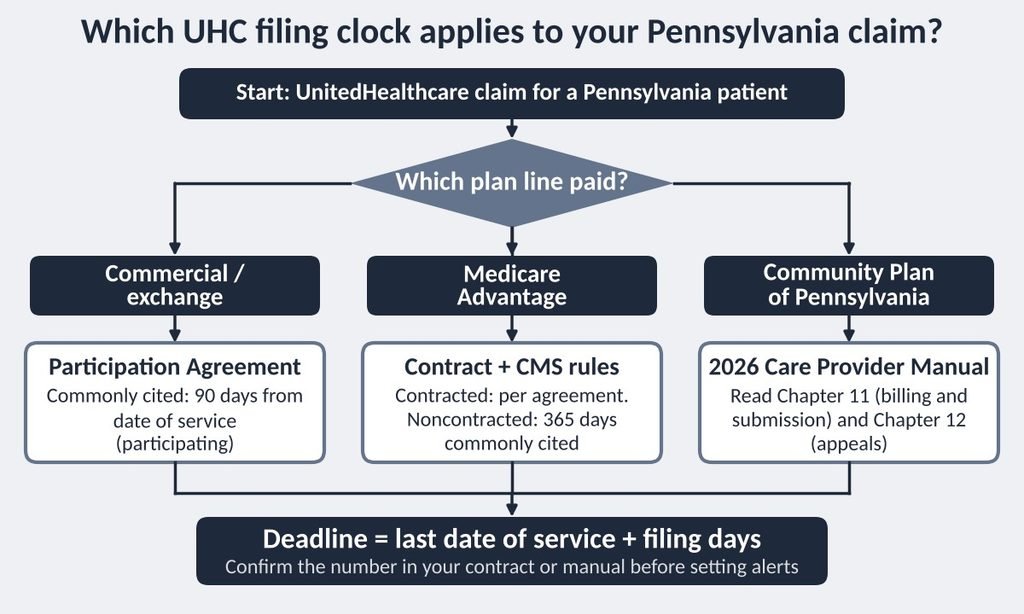
UnitedHealthcare does not publish one UHC Pennsylvania timely filing limit. Commercial claims follow each provider’s Participation Agreement, and 90 days from the date of service is the figure most often cited for participating providers. Medicare Advantage claims follow CMS rules and the contract, while Community Plan of Pennsylvania claims follow a separate care provider manual.
A practice that bills UnitedHealthcare in Pennsylvania can hold three different filing clocks on three claims sent the same day. Most of those clocks start at the date of service, yet none is guaranteed to match the number a billing forum quotes. This guide explains which UHC Pennsylvania timely filing limit applies to commercial, Medicare Advantage and Community Plan claims. It also shows how to calculate the exact date. A self-assessment checklist near the end lets you test your own process.
Key numbers to keep at your desk
| Metric | Practical target/range | Review frequency | Source type |
| UHC commercial initial claim window (participating) | Set by the Participation Agreement; 90 days from date of service is commonly cited | At each contract renewal | A, C |
| Medicare fee-for-service claim window | 12 months (one calendar year) from the service | Annually | A |
| Pennsylvania Medical Assistance fee-for-service invoices | 180 days from service; 365 days for resubmissions | Annually | A |
| UHC Community Plan of Pennsylvania window | Stated in Chapter 11 of the 2026 Care Provider Manual | At each manual update | A |
| UHC reconsideration plus appeal | Up to 12 months combined under the 2026 national guide, as industry sources report | Quarterly | C |
| Insurer payment of a clean claim in Pennsylvania | 45 days from receipt | Each remittance cycle | A |
| Claim submission turnaround | 3 to 5 business days typical; 95% or more within 30 days | Weekly | C |
| Unpaid-claim follow-up alerts | 30, 60 and 75 days from service | Daily worklist | C |
Source types: A = published government or payer source (UnitedHealthcare, CMS, Pennsylvania Code). B = named benchmarking data provider (none used in this article). C = commonly reported across industry sources, or a practical planning target. D = survey or study data (none used). Your contract controls where it differs.
What is the UHC Pennsylvania timely filing limit for each plan type?
The UHC Pennsylvania timely filing limit depends on the plan line and the provider contract, not on the state alone. UnitedHealthcare’s own claims guidance says the agreement requires all claim information, including corrected claims. The deadline is a set number of days after the date of service, discharge or final outpatient visit. The page publishes no single national number. The Participation Agreement is the controlling document, which makes the UnitedHealthcare timely filing limit a contract lookup. The table below compiles the figures most often cited.
| Plan line | Where the deadline lives | Commonly cited window | Clock starts | Source type |
| Commercial and exchange, participating | Participation Agreement | 90 days | Date of service, discharge or final outpatient visit | A, C |
| Commercial, nonparticipating | Plan rules and state law | Up to 180 days | Date of service | C |
| Medicare Advantage, contracted | Participation Agreement | Per contract | Per contract | A |
| Medicare Advantage, noncontracted | CMS rules | 365 days | Through date of service | C |
| UHC Community Plan of Pennsylvania | 2026 Care Provider Manual, Chapter 11 | Confirm in the manual | Per manual | A |
| Medicare fee-for-service (benchmark) | CMS | 12 months | “From” date; “through” date for institutional span claims | A |
Compiled from the named sources; confirm every figure against your own contract before setting alerts.
Other states differ, as the UHC California timely filing limit guide clearly shows. A figure learned in one state, or from one UHC product, should never be copied to a Pennsylvania claim without checking the document that governs it. Pennsylvania adds its own layers through Medical Assistance rules and state insurance regulation.
Commercial and exchange plans: the contract decides
For participating providers, the contract sets the number. Industry guides commonly cite 90 days from the date of service for participating commercial claims and up to 180 days for nonparticipating providers. UnitedHealthcare’s own example uses a 90-day limit: with a last date of service of May 1, every piece of claim information must arrive by July 30. Treat the common figures as starting points, and confirm them against the signed agreement and the payer-specific claim submission rules you keep on file.
In billing audits, a common pattern is that one payer’s number gets applied to every UnitedHealthcare product after a single contract is checked. Practices holding more than one UHC agreement, such as a group contract plus a separate exchange or Medicare Advantage addendum, should log each number separately. Secondary claim timely filing adds another variable, because the clock often runs from the primary payer’s decision; our guide to secondary claim deadlines covers that.
Medicare Advantage: contract first, CMS timing second
Medicare Advantage timely filing follows the contract for contracted providers, and industry reports cite 365 days from the through date of service for noncontracted providers. The fee-for-service benchmark comes from CMS Transmittal 12909 (2024). Medicare denies a claim as untimely when it is received more than 12 months, or one calendar year, after the service. Novitas Solutions processes Pennsylvania’s Part B fee-for-service claims as the Jurisdiction L contractor. For the full rule, read the Medicare 12-month rule explained.
Community Plan of Pennsylvania: the manual decides
Claims for UHC Community Plan of Pennsylvania follow a separate document, the 2026 Care Provider Manual, which covers Medical Assistance under HealthChoices and CHIP. Its Chapter 11 (Billing and submission) and Chapter 12 (Claim reconsiderations, appeals, and grievances) hold the exact windows, and Provider Services can confirm them by phone. Do not borrow a commercial or Texas figure for these claims.
For context, the state’s fee-for-service Pennsylvania Medical Assistance rule, 55 Pa. Code §1101.68, requires original invoices within 180 days of service and resubmissions within 365 days. It allows narrow exceptions when eligibility or third-party payment was requested within 60 days of service, and none for provider error. That rule governs the state program, so a managed care plan may apply its own number; use it as a sanity check, not a substitute.
In billing audits, a common pattern is that Community Plan claims with pending eligibility sit unworked because they never appear on the commercial aging report. When eligibility is pending at the time of service, log the date it was requested and set a separate alert for that claim.
What changed for UHC corrected claims in 2026?
UnitedHealthcare revised Chapter 10 of its 2026 administrative guide with an update to timely filing requirements for corrected claims. According to UnitedHealthcare’s network news notice, the guide takes effect April 1, 2026 for currently contracted providers. Providers contracted on or after January 1, 2026 follow it from that date. The notice covers commercial, individual exchange and Medicare Advantage plans. It does not restate the new deadline, so read Chapter 10 itself and log the number against each agreement.
Corrected claim timely filing is measured, in UnitedHealthcare’s claims guidance, from the date of service, discharge or final outpatient visit, not from the remittance date. A remittance advice is therefore not a safe starting point for a correction clock. A frequent pattern in denial reviews is a corrected claim sent after the remittance arrives, which lands past the original window. Our comparison of corrected claim deadlines by payer shows how widely the rules vary.
When a correction is needed, follow these conditions:
- Wait for the original claim to finish adjudicating when it is still pending, because UnitedHealthcare warns that early resubmission can create a duplicate.
- Send the correction with frequency code 7 and the original claim number.
- Include every service billed on the original claim, since UnitedHealthcare states that omitted services trigger overpayment recovery.
- Confirm receipt well before the original window closes.
Separately, a December 2025 industry report described UnitedHealthcare rejecting some diagnosis-code and procedure-code corrections sent with replacement or void indicators (reason code A3-21). Check current payer notices before choosing a frequency code. Keep a dated copy of the notice you relied on, in case a correction is questioned later.
How do you calculate your real deadline and your write-off risk?
Four short calculations turn a payer’s day count into a date, a cushion, a rate and a dollar figure. Run them when the contract number is confirmed; when it is not, use the shortest figure in the table above until it is verified.
Calculation 1: the deadline date
Formula: deadline = last date of service + filing days (calendar days from the agreement).
Illustrative scenario (not an actual client record): a claim has a last date of service of August 20, 2026 and a 90-day limit. August 20 plus 90 days is November 18, 2026. On October 16, 2026, 33 days remain. A claim at day 57 of a 90-day window should already be on a priority worklist.
Calculation 2: the cushion
Formula: cushion = filing days − day of first submission.
Illustrative scenario (not an actual client record): a claim goes out on day 25 against a 90-day limit, leaving a 65-day cushion for rejections and corrections. The same claim submitted on day 80 leaves 10 days, which is rarely enough to fix a rejection and resend. Practices that file in 3 to 5 business days, a practical target, keep most of the window in reserve.
Calculation 3: the on-time submission rate
Formula: on-time rate = claims submitted within 30 days of service ÷ total claims × 100.
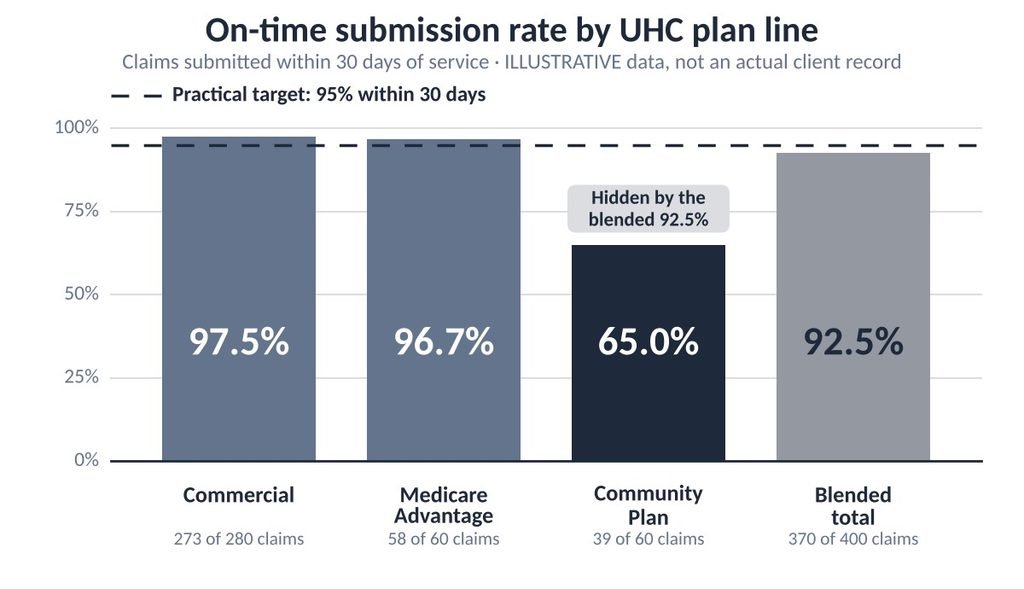
Illustrative scenario (not an actual client record): a practice reviews one month of UnitedHealthcare claims by plan line. It counts how many went out within 30 days of service. The table shows each line, then the blended total most dashboards display.
| Plan line (Illustrative) | Claims | Submitted within 30 days | On-time rate |
| Commercial | 280 | 273 | 97.5% |
| Medicare Advantage | 60 | 58 | 96.7% |
| Community Plan | 60 | 39 | 65.0% |
| Blended total | 400 | 370 | 92.5% |
Illustrative figures; actual rates vary by practice, specialty and payer mix.
The blended 92.5% looks acceptable on a dashboard. The Community Plan line at 65% is the real problem, and a single combined number would never show it. Review each plan line separately whenever one line has different eligibility, authorization or manual requirements from the others.
Calculation 4: write-off exposure
Formula: monthly exposure = UHC claims per month × late-claim rate × average allowed amount per claim.
Illustrative scenario (not an actual client record): 400 claims × 3% late × $145 average allowed amount = $1,740 per month, or $20,880 over 12 months. When that figure exceeds the cost of fixing the process, a team may want help with denial management or A/R management while the worklist is built.
How should you read these numbers?
Compare like for like. A commercial claim and a Community Plan claim run on different documents. Their on-time rates belong in separate rows. A specialty or location difference deserves its own row too. One missed benchmark is a signal to investigate, not a verdict on the whole billing operation.
When a rate falls below target, check three things before changing the process. Was the plan line’s deadline recorded correctly? Did the delay sit in charge entry or in rejections? Do the claims share a date-of-service cohort? Cohorts matter because a staffing gap in one month can create a cluster of late claims that disappears the next month.
What happens when a UHC Pennsylvania claim misses the deadline?
A late claim is denied with CARC 29, the claim adjustment reason code meaning the filing time limit has expired, and the revenue is usually lost. A September 2025 article in The Journal of Urgent Care Medicine notes that payers generally do not allow providers to bill the patient after a late-filing timely filing denial. Contract terms can vary.
Overturning the denial requires proof of timely filing. When a clearinghouse acceptance report or payer acknowledgment shows an earlier receipt date, attach it to the appeal. The same article notes that a claim rejected at the clearinghouse still counts against the deadline, so work rejections the day they post. Recognized exceptions typically include payer system errors, retroactive eligibility and declared emergencies. For Medicare, CMS Transmittal 12909 lists administrative error and retroactive entitlement among its exceptions.
The UHC appeal filing deadline is a separate clock. Industry sources citing the 2026 national guide report up to 12 months to complete reconsideration and post-service appeal from the original remittance. The agreement, state law or product rules can set a shorter period. The same sources report that electronic filing of post-service appeals became required February 1, 2026 for commercial and Medicare Advantage members. Our explainer on timely filing versus appeal filing limits separates the two.
How do you build a UHC deadline-tracking workflow?
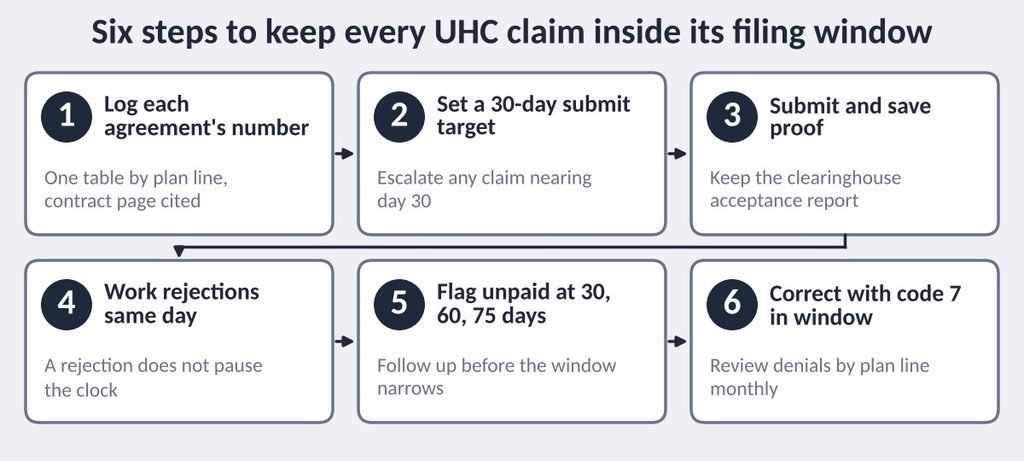
A workable workflow has six steps, and each one has a trigger condition:
- Record each UHC agreement’s filing number in one table by plan line (commercial, exchange, Medicare Advantage, Community Plan), with the contract page cited.
- Set a 30-day submission target from the date of service, and escalate any claim approaching it.
- Submit electronically and save the acceptance report as proof; our tips on electronic claim submission cover the mechanics.
- Work rejections the same business day, since a rejection does not pause the clock; a strong clean claim rate reduces the volume.
- Flag unpaid claims at 30, 60 and 75 days from service, using the method in tracking unpaid claims across payers.
- Send corrections with frequency code 7 inside the original window, and review denials by plan line each month.
For a deeper setup guide, see how to track timely filing deadlines step by step. Pair that tracker with the contract table from step 1. Each claim then carries its own deadline date rather than a generic number. Review the table whenever a contract renews or a new UHC product is added.
How long until the process shows results?
These are general planning ranges, not guarantees. Alerts and a plan-line worklist often show fewer last-minute submissions within two to four weeks. Because claims age toward a 90-day window, a full quarter of data is a reasonable horizon for judging denial trends. Contract clean-up, such as collecting every agreement’s filing number, can take longer when several agreements or locations are involved.
What mistakes cause most timely filing denials?
Most timely filing denials trace back to a handful of avoidable habits:
- Applying 90 days to every plan. Check the agreement or manual when the plan line is not confirmed.
- Counting corrections from the remittance date. Count from the date of service, discharge or final outpatient visit.
- Treating a clearinghouse rejection as a filed claim. Work rejections the day they appear.
- Skipping the Community Plan manual. Read Chapter 11 when any claim carries a Pennsylvania Medical Assistance or CHIP plan.
- Waiting until late in the window to submit. File early enough that a rejection can still be fixed.
- Not saving proof. Keep acceptance reports for every UHC claim.
Quick summary
- The UHC Pennsylvania timely filing limit is contract-based for commercial plans; 90 days is commonly cited for participating providers.
- Community Plan of Pennsylvania claims follow the 2026 Care Provider Manual, Chapters 11 and 12.
- Medicare fee-for-service uses a 12-month rule; Pennsylvania Medical Assistance fee-for-service uses 180 and 365 days.
- UnitedHealthcare revised its corrected-claim timely filing language in the 2026 guide, Chapter 10.
- A practical target is submission in 3 to 5 business days, with follow-up alerts at 30, 60 and 75 days.
- Track on-time rates by plan line, because a blended number hides weak spots.
Self-assessment checklist: how exposed is your practice?
Answer yes or no to each question:
- Have you recorded the filing number from each UHC agreement instead of relying on a forum figure?
- Have you read Chapter 11 of the 2026 Community Plan manual for Pennsylvania claims?
- Do you count deadlines from the last date of service rather than the remittance date?
- Do 95% or more of UHC claims go out within 30 days of service?
- Do you submit most claims within 3 to 5 business days?
- Do you flag unpaid UHC claims at 30, 60 and 75 days?
- Do you save clearinghouse acceptance reports as proof of timely filing?
- Do you work clearinghouse rejections within one business day?
- Do you track on-time rates separately for each plan line?
- Do corrected claims go out with frequency code 7 inside the original window?
Scoring guide: 9 to 10 yes answers suggests a well-controlled process, so review it quarterly. 6 to 8 yes answers suggests gaps; fix the “no” items first, starting with questions 1 and 2. 0 to 5 yes answers suggests high exposure to timely filing denials and a good moment for an outside review.
When should a practice bring in outside billing support?
Outside support is worth considering when the in-house approach shows these limits:
- The same plan line produces timely filing denials in more than one month.
- Staff cannot state the filing number for each UHC agreement.
- Community Plan or pending-eligibility claims sit outside the main aging report.
- Deadline tracking depends on one person’s memory or spreadsheet.
- Rejections routinely wait more than a day before anyone works them.
Look for a billing partner that keeps a written filing-deadline table by payer, reports on-time rates by plan line, retains proof of filing and works denials against an appeal calendar. Transparent reporting and clear pricing matter as much as the deadlines themselves.
EON MED SOLUTIONS is one example: a US-based team that delivers medical billing, coding, credentialing, denial management and A/R follow-up with transparent reporting and no hidden fees. Results vary by practice. You can review the EON MED SOLUTIONS billing, coding and RCM services to see how the work is organized.
Expert Opinion
The UHC Pennsylvania timely filing limit is a contract question first and a calendar question second. The firm published standards in this guide are the CMS 12-month rule and Pennsylvania’s 180-day and 365-day fee-for-service Medical Assistance windows. Add the 45-day insurer payment rule and UnitedHealthcare’s statement that the agreement controls. Everything else is a commonly cited or practical target: the 90-day commercial figure, the 3 to 5 business day turnaround and the 30, 60 and 75 day alerts.
The worked examples are illustrative scenarios, not client results. Their purpose is to show how to calculate a deadline date, a cushion, a plan-line rate and a dollar exposure from numbers you already have. They also show how a blended average can hide a 65% line.
The natural next question is which of your UHC agreements still has no filing number on file. If that list is long, a team that handles claims, rejections and denial follow-up daily can help you close the gap. Start with EON MED SOLUTIONS’ billing and RCM services.
Frequently asked questions
What is the timely filing limit for UnitedHealthcare in Pennsylvania?
UnitedHealthcare sets the limit by plan type and provider contract. Commercial participating claims commonly carry 90 days from the date of service. Medicare Advantage follows the contract and CMS timing. Community Plan of Pennsylvania claims follow the 2026 Care Provider Manual. Confirm the exact number in your Participation Agreement before setting alerts.
What is a good claim submission turnaround for UHC claims?
A practical target is submitting most claims within 3 to 5 business days of service, with 95% or more out within 30 days. This is an industry planning target, not a UnitedHealthcare requirement. Faster filing leaves more of the window available to fix rejections and send corrections.
What is a good timely filing denial rate?
No published benchmark exists, so treat the practical goal as near zero. Late filings that the practice caused are preventable. When timely filing denials appear in the same plan line more than once, investigate the process, starting with plan-line deadlines and the speed of rejection follow-up.
What is a good schedule for following up on unpaid UHC claims?
Many practices flag unpaid claims at 30, 60 and 75 days from the date of service. This is a commonly suggested planning schedule, not a payer rule. The 75-day flag leaves time to resubmit or appeal inside a 90-day window when the contract uses that figure.
Can a Pennsylvania practice bill the patient after a UHC timely filing denial?
Payers generally do not allow providers to bill patients for claims denied for late filing. That is the view in a September 2025 article in The Journal of Urgent Care Medicine, though contract terms can vary. Read your Participation Agreement or the Community Plan manual before sending any patient statement for a late-filing denial.
Does a clearinghouse rejection stop the timely filing clock?
No. A claim rejected at the clearinghouse still counts against the deadline, so the clock keeps running while the rejection waits. Work rejections the same business day, correct the data, resubmit, and save the later acceptance report together with the original submission record as proof.
Sources and methodology
(a) Published standards and definitions from named bodies
- UnitedHealthcare, “Reduce claim returns and rework” (UnitedHealthcare provider claims guidance, 2026).
- UnitedHealthcare network news, “2026 Care Provider Administrative Guide” (January 1, 2026), describing the Chapter 10 corrected-claim update and the April 1, 2026 and January 1, 2026 effective dates.
- UnitedHealthcare Community Plan of Pennsylvania, 2026 Care Provider Manual: UHC provider site PDF.
- CMS, Transmittal 12909 (Change Request 13834), October 24, 2024: cms.gov.
- 55 Pa. Code §1101.68, Invoicing for services: Justia text of the Pennsylvania Code.
- 31 Pa. Code §154.18, Prompt payment (45-day clean claim payment rule).
- X12 claim adjustment reason code list (code 29, time limit for filing has expired).
(b) Named benchmarking data providers. None used in this article.
(c) Practical or illustrative targets from general industry sources
- Industry timely filing guides from Happy Billing LLC (updated September 2026), MedSole RCM, I-Med Claims (August 2026) and A3 Medical Billing (July 2026), used for commonly cited commercial, Medicare Advantage and appeal figures. These sources vary and some do not cite UnitedHealthcare documents.
- Nikki Benedict, “Timely Filing: What Every Practice Needs to Know,” The Journal of Urgent Care Medicine, September 2025.
- XIFIN Billing Beat, December 2025 report on UnitedHealthcare corrected-claim rejections.
- The 3 to 5 business day turnaround, the 95% within 30 days goal and the 30, 60 and 75 day alerts are practical planning targets from common industry practice. All worked-example figures are illustrative.
(d) Survey or study data. None used in this article.
Methodology: the research reviewed the top results for the keyword, UnitedHealthcare’s published provider pages and the cited regulations in October 2026. Chapter 11 of the Pennsylvania Community Plan manual could not be read in full during research. The article therefore directs readers to that chapter instead of quoting a figure. Results vary by contract, plan and state, and figures reflect information available at the time of research. Confirm every deadline against your own Participation Agreement or manual.


