

Medicaid Washington Timely Filing Limit: The 365-Day Rule, the 24-Month Ceiling and the Six-Month Medicare Trap
The Medicaid Washington timely filing limit requires providers to submit an initial fee-for-service claim and have a transaction control number (TCN) assigned within 365 calendar days of the date of service. Timely claims can be resubmitted, modified or adjusted for up to 24 months, and Medicare crossovers follow a separate six-month clock.
Which of those three numbers governs your claim depends on who paid first and whether the patient is in fee-for-service or a managed care plan. This guide explains the Washington Apple Health rule, the extensions the state allows, how managed care plans differ, and how to calculate each date from real examples. A self-assessment checklist near the end shows where your billing process is exposed.
Which Washington Medicaid Filing Numbers Should Your Team Track?
Seven numbers cover most Washington Apple Health billing: 365 days for the first claim, 24 months to resubmit, six months after Medicare pays, 15 months for drug resubmissions, 365 days for trauma-fund claims, and plan-specific windows for managed care. The table separates published rules from practical internal targets.
Key numbers cheat sheet
| Metric | Practical target / range | Review frequency | Source type |
| Initial claim with a TCN assigned | Within 365 calendar days of the date of service | Every claim | Published state standard ¹ |
| Resubmit, modify or adjust a timely claim | Within 24 months of the date of service | Weekly | Published state standard ¹ |
| Claim after Medicare pays | Within six months of the Medicare processing date | Every crossover | Published state standard ¹ |
| Claim after Medicare denies | 365-day limit applies | Every denial | Published state standard ¹ |
| Prescription drug claim resubmission | Within 15 months of service, if the original had a timely TCN | Monthly | Published state standard ¹ |
| Coordinated Care first-time claims | Best efforts at 180 days; hard stop at 365 days | Each contract renewal | Plan guidance ² |
| Days from service to accepted claim | 7 days or fewer | Weekly | Practical target ³ |
| Internal stop date for open claims | 30 days before the payer deadline | Weekly | Practical target ³ |
| Timely filing write-off rate | Near 0%; investigate above 0.5% | Monthly | Practical target ³ |
¹ Published state standard: Washington Administrative Code (WAC) 182-502-0150, Health Care Authority (HCA). ² Plan guidance: published by the managed care plan and subject to change. ³ Practical target: an internal benchmark commonly reported across billing operations, not mandated by HCA, CMS or any professional body.
What Is the Medicaid Washington Timely Filing Limit?
The Medicaid Washington timely filing limit is 365 calendar days: providers must submit the initial claim and have the HCA assign a TCN within that period. The rule sits in WAC 182-502-0150, and providers send claims through ProviderOne, the state billing system described in the ProviderOne Billing and Resource Guide.
A TCN, not a transmission, stops the clock
The rule requires a TCN assigned by the agency, so a claim you transmitted but the payer rejected before assignment has not met the limit. Do this after every batch: confirm each claim received a TCN, and treat a missing TCN as an unsubmitted claim. A rejection at the clearinghouse costs days from the same 365.
When the 365 days start from something other than the service date
The 365 days run from the service date, a final fair hearing decision, a court order, or the agency’s delayed-certification date. Use the later event only when you have the document that proves it. In billing audits, a common pattern is a practice that bills from a hearing decision but cannot produce the decision letter when HCA asks.
The state may also extend the 365 days for retroactive certification of a client or other extenuating circumstances. Treat that as a safety net, not a plan. Our guide to tracking timely filing deadlines shows how to flag claims that need an exception file before the deadline passes.
How Long Can You Resubmit, Modify or Adjust a Washington Claim?
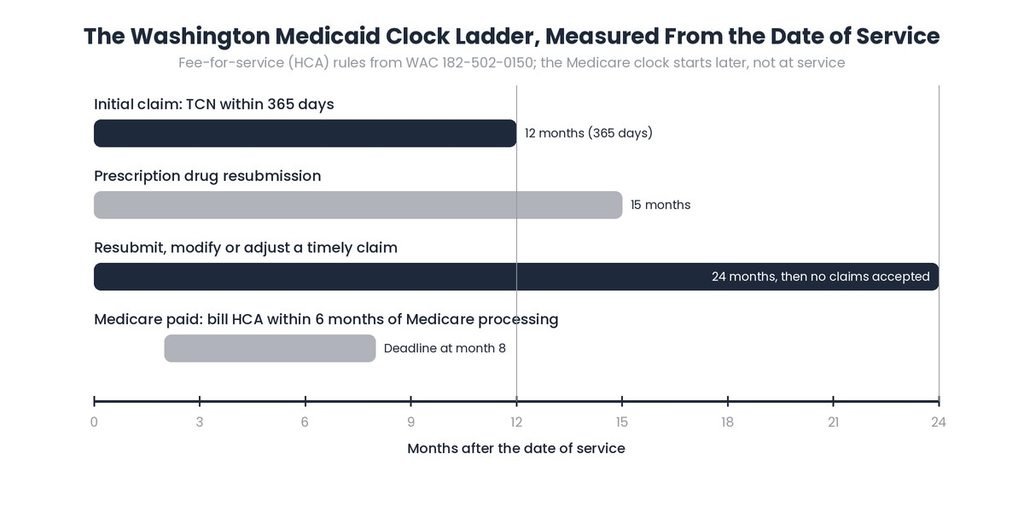
Up to 24 months from the date of service, provided the initial claim was timely. After 24 months, HCA does not accept any claim for that service. The two clocks work as a ladder: 365 days to get in, 24 months to fix what is wrong.
Washington fee-for-service clock ladder
| Situation | Deadline | Clock starts | Source type |
| Initial claim, TCN assigned | 365 days | Date of service, hearing decision, court order or delayed-certification date | WAC ¹ |
| Resubmit, modify or adjust a timely claim | 24 months | Date the service was provided | WAC ¹ |
| Prescription drug resubmission | 15 months | With a timely TCN on the original | WAC ¹ |
| Trauma-fund claim resubmission | 365 days | Date of service | WAC ¹ |
| Medicare paid first | Six months | Medicare processing date | WAC ¹ |
| Medicare denied | 365 days | Date of service | WAC ¹ |
¹ Published state standard from WAC 182-502-0150, 2024 edition of the code archive, last amended in 2015. Recent HCA rule filings checked did not amend this section; confirm the current text before relying on a date.
The practical effect is that a denied claim is rarely dead on day 366 but can become dead at month 24. A practice that works denials in the same quarter keeps most of the ladder available. Our overview of denial management explains why the first 60 days of a denial matter most.
Corrections versus new claims
Do this when the original claim had a timely TCN and needs correction: send it as a resubmission or adjustment inside the 24 months. If the original never received a TCN, the 24-month window is not available, and only the 365-day rule or an exception applies. Compare corrected claim deadlines by payer when your billers handle several states.
How Does Medicare Crossover Billing Change the Washington Deadline?
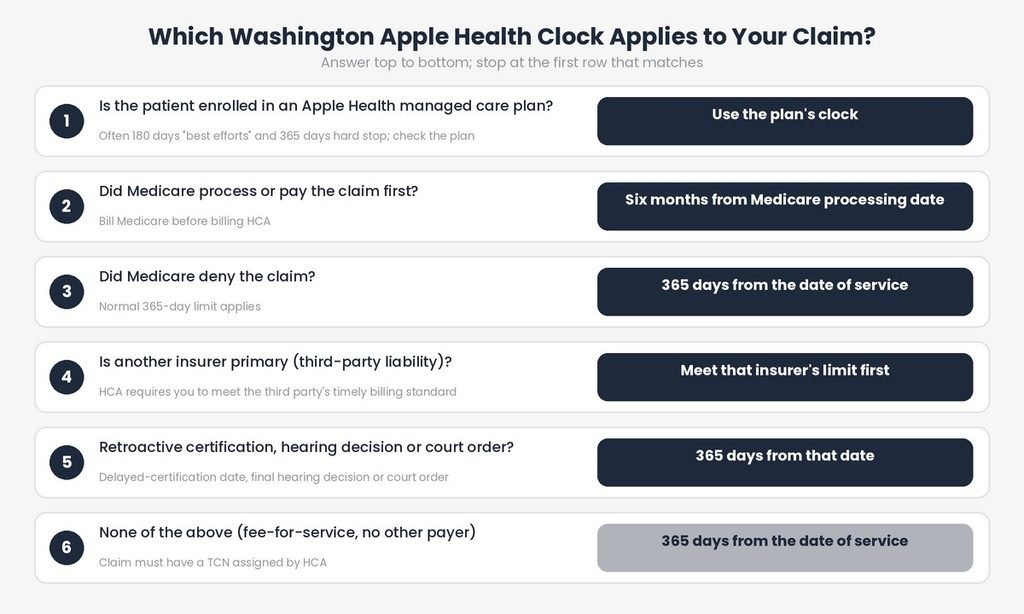
When a client has Medicare and Medicaid, you bill Medicare first, and if Medicare pays, HCA must receive your claim within six months of the Medicare processing date. That clock can be shorter than the 365-day clock, even though it starts later.
Medicare paid, Medicare denied, other insurance
If Medicare denies, the normal 365-day limit applies instead. For other insurers, the rule requires providers to bill known third parties and to meet the third party’s timely billing standard, so a commercial plan with a 90-day limit effectively shortens your Medicaid window. Our guides to Medicare’s 12-month rule and secondary insurance claims cover the primary-payer side.
In billing audits, a common pattern is a team that tracks the 365 days carefully and ignores the six-month Medicare clock. Add the six-month date to the claim the day Medicare posts, not when the secondary is first worked. For a deeper look at the primary-payer side, see our secondary claim timely filing rules.
Do Washington Apple Health Managed Care Plans Use the Same Deadline?
Not necessarily. HCA states that the time to file a clean claim with a managed care organization depends on your specific contract. The plan documents reviewed use 365 days as the hard stop, but one plan also publishes an earlier “best efforts” target.
Illustrative comparison: Washington Medicaid payers and filing windows
| Payer | Initial claim window | Secondary, corrected claim or dispute rule | Published in |
| HCA fee-for-service (ProviderOne) | TCN within 365 days of service | Resubmit, modify or adjust within 24 months | WAC 182-502-0150 |
| Coordinated Care of Washington | Best efforts at 180 days; no payment after 365 days from service | Secondary within 365 days of the primary’s final determination; corrected claims and disputes within 24 months of notice | Provider quick reference guide, circa 2025 |
| Contracted MCO providers, general | Set by each plan contract; HCA’s standard template uses 365 days for new contracts in the document reviewed | Appeal within 24 months of the explanation of payment | HCA onboarding guide |
Illustrative: plan rules change with contract amendments. The HCA guide lists Coordinated Care, Community Health Plan of Washington, Molina, UnitedHealthcare and Wellpoint (undated); only Coordinated Care’s published guide was reviewed in detail, so confirm the other four in their manuals. Sources: HCA managed care onboarding guide and Coordinated Care provider quick reference.
Do this when a patient shows a managed care card: check the plan’s guide before using the HCA ladder. A claim that is on time for 365 days may still be missed against a 180-day best-efforts target, and a late claim can face denial even when the plan’s hard stop has not passed. For comparison, Medicaid Texas and Medi-Cal use very different limits, which is why one company-wide default fails.
Can Washington Give You More Time, and Can You Bill the Patient?
The state may extend the 365 days for a retroactive certification or other extenuating circumstances, and the delayed-certification date can restart the count. It does not let you bill the client for a claim you billed incorrectly: the rule bars billing the client or estate when the agency denies payment for that reason.
Plan for the exception file before you need it. Keep the eligibility response, the certification letter and your first attempt at billing, with dates. Enrollment gaps are avoidable: start provider credentialing and enrollment before a clinician’s first Washington Medicaid visit, because claims for dates before your effective date cannot be paid.
How Do You Calculate Washington Deadlines and Billing Speed? Four Worked Examples
You calculate a Washington deadline by adding the right window to the right start date, then judge process health by how long claims take to be accepted. The first three examples use real calendar arithmetic; the fourth is illustrative. The medical billing KPIs worth tracking fit the same dashboard.
Example 1: A standard 365-day deadline
Formula: deadline = date of service + 365 calendar days. Walkthrough: a client is seen on March 10, 2026. Adding 365 days gives March 10, 2027. With an internal stop date 30 days earlier, the team treats February 8, 2027 as the working deadline.
Example 2: The 24-month resubmission ceiling
Formula: ceiling = date of service + 24 months. Walkthrough: the same March 10, 2026 service has a ceiling of March 10, 2028, but only if the initial claim received a timely TCN. A claim denied in April 2026 and first fixed in 2028 is almost out of time; fix denials within the quarter.
Example 3: Medicare crossover, where the later clock is earlier
Formula: deadline = Medicare processing date + six months. Walkthrough: a service on July 1, 2026 is processed by Medicare on August 12, 2026. HCA must receive the claim by February 12, 2027. The 365-day date from service would be July 1, 2027, so the Medicare clock ends 139 days sooner.
Example 4: Days to accepted claim and the blended-average trap
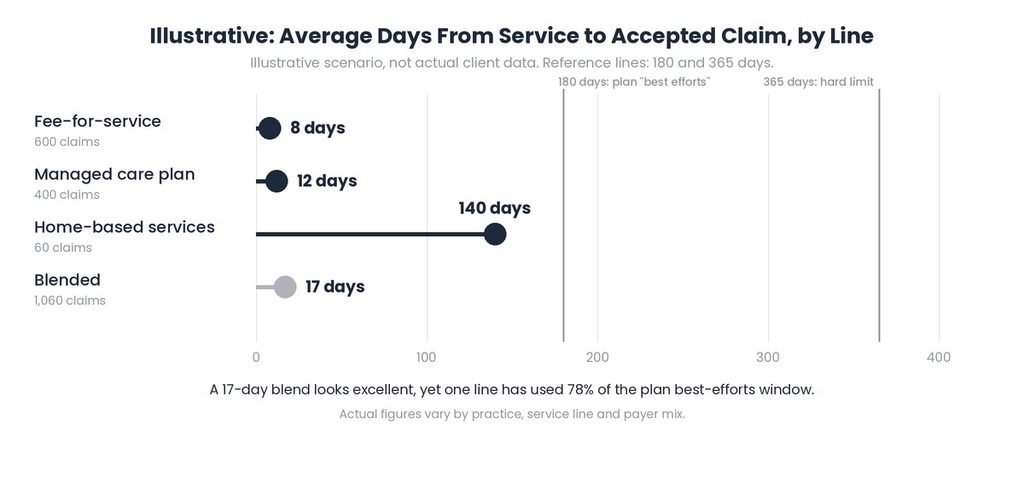
Formula: average days to accepted claim = total days from service to acceptance divided by claims. Illustrative scenario (not an actual client record): 600 fee-for-service claims average 8 days, 400 managed care claims average 12 days, and 60 home-based services claims average 140 days. Total days are 18,000 across 1,060 claims, so the blend is 17.0 days.
A 17-day blend looks excellent, yet the home-based line averages 140 days, which is 38.4 percent of the 365-day limit and 77.8 percent of a 180-day plan target. Do this when any sub-group runs past a quarter of the window: report days to acceptance by line and payer, and fix the slow line first.
How Should You Compare Your Washington Results Fairly?
Compare like with like: fee-for-service against fee-for-service, and each managed care plan against its own window. A practice with mostly office visits and one with mostly home-based services will have different lags, so a single benchmark misleads.
Treat one missed number as a signal to investigate, not a verdict. If one line passes 25 percent of its window in a single month, check staffing or a new service line first. If it stays there for two months, treat it as a process problem and review it against your written deadline checklist.
How Long Until a Deadline Program Pays Off?
Planning ranges, not guarantees: most practices see the worklist change within two to four weeks of adding deadline sorting, measurable write-off improvement in roughly two to three months, and consistent payer-by-payer compliance in four to six months. Results depend on claim volume, staffing and payer mix.
Which Washington Filing Myths Cost the Most?
- Myth: 365 days is the only Washington limit. Reality: Medicare crossovers run six months from Medicare processing, and managed care plans set their own windows.
- Myth: transmitting a claim meets the deadline. Reality: the rule requires a TCN assigned by the agency. Confirm acceptance within three business days of each batch.
- Myth: a denial resets the clock. Reality: resubmission, modification and adjustment are allowed up to 24 months, but only when the original had a timely TCN.
- Myth: you can bill the patient when HCA denies. Reality: the rule bars billing the client or estate when the denial results from billing incorrectly.
- Myth: one deadline covers every payer. In billing audits, a common pattern is a default 365-day setting that is wrong for plans with earlier targets and for Medicare crossovers. Store the rule by payer.
Quick Summary of Washington Filing Targets
- Initial claim: TCN assigned within 365 calendar days of service, or of the hearing, court or delayed-certification date.
- Resubmit, modify or adjust: within 24 months, only if the original had a timely TCN.
- Medicare paid: within six months of the Medicare processing date; Medicare denied: 365 days.
- Managed care: follow each plan; Coordinated Care publishes 180-day best efforts and a 365-day hard stop.
- Practical targets: 7 days or fewer to an accepted claim, a 30-day internal stop date and a write-off rate near 0 percent with investigation above 0.5 percent.
Washington Medicaid Filing Self-Assessment
Answer yes or no for your current Washington process, using the numbers in this guide as the standard. Count the yes answers, then use the three-tier scoring guide below the list.
- Does every Washington claim have a TCN confirmed within 7 days of service?
- Do you set the deadline from the right start date, including hearing, court and certification dates?
- Is every open claim reviewed at least 30 days before its deadline?
- Do you track the six-month Medicare clock separately from the 365-day clock?
- Are denials reworked within the same quarter, and always inside 24 months?
- Do you hold the plan’s own window for every managed care payer in your system?
- Is your days-to-accepted-claim average reported by line and payer?
- Is your timely filing write-off rate under 0.5 percent by payer?
- Do you keep eligibility and certification letters for any exception request?
- Do you review your payer windows at every contract renewal?
Scoring: 9 to 10 yes answers means your process is strong; keep the annual review. 6 to 8 means you have gaps; fix the lowest-numbered no answers first. 0 to 5 means late-filing losses are likely; start with questions 1, 3 and 4 this month.
When Should a Washington Practice Consider Outside Billing Support?
Outside support makes sense when the in-house process has reached a limit that more effort will not fix, for example when the same TCN or crossover errors return after retraining. Five signals usually show it:
- Claims are marked “sent” but nobody confirms a TCN.
- Timely filing write-offs stay above 0.5 percent for two months in a row.
- Medicare crossover claims miss the six-month date.
- The practice added managed care plans and deadlines now differ by payer.
- Billing staff turnover keeps resetting your process knowledge.
When you evaluate vendors, look for written deadline tracking by payer, TCN-level acceptance reporting, a US-based team, clear contract terms with no hidden fees, and medical billing support that includes follow-up on denials.
EON MED SOLUTIONS is one example. The company delivers end-to-end billing, coding, credentialing, denial management and compliance support through a US-based team with transparent reporting. Its process reads each payer’s rules, stores the window by payer and reports monthly. Results vary by practice. To see how the work is organized, review our medical billing and RCM services.
Final Thoughts
The Medicaid Washington timely filing limit is easy to state and easy to misapply: 365 days for a TCN, 24 months to fix a timely claim, and a separate six-month clock after Medicare pays. Most losses come from using the wrong clock, not from slow billing alone.
Firm published standards in this guide are the 365-day initial rule, the 24-month resubmission ceiling, the six-month Medicare clock and the 15-month drug window in the state code. The 180-day best-efforts target is one plan’s published guidance. The 7-day, 30-day and 0.5 percent figures are practical targets, and the payer comparison and Example 4 are illustrative.
So the natural next question is which of your open Washington claims are closest to a deadline today. If you want a second set of eyes on that list, see EON MED SOLUTIONS billing and RCM services and start with a payer-level deadline review.
Frequently Asked Questions
What is the timely filing limit for Washington Medicaid?
Washington Apple Health fee-for-service claims must be submitted and assigned a TCN within 365 calendar days of the date of service. Timely claims can be resubmitted, modified or adjusted for up to 24 months. Medicare crossovers follow a six-month clock, and managed care plans set their own windows.
What is a good days-to-accepted-claim target for Washington Medicaid?
A commonly cited practical target is 7 days or fewer from service to an accepted claim. No Washington agency mandates it. Compare like with like by reporting the lag by line and payer, because a blended average can hide a slow service line.
What is a good timely filing write-off rate?
A practical target is near 0 percent, with investigation above 0.5 percent of billed charges. This is an industry convention, not a Washington or CMS standard. Report it by payer each month, since a low blended rate can sit on top of one plan with a much higher loss rate.
How long do you have to bill Washington Medicaid after Medicare pays?
The state code requires HCA to receive the claim within six months of Medicare’s processing date. If Medicare denies the claim, the normal 365-day limit applies instead. Track the Medicare processing date on each claim, because the six-month clock can end before the 365-day date.
Does a denied Washington Medicaid claim get a new 365 days?
No. A claim with a timely TCN can be resubmitted, modified or adjusted for up to 24 months from the date of service, but the original 365-day limit does not restart. After 24 months, HCA does not accept any claim for that service.
Can a Washington provider bill the client after a timely billing denial?
The state code states that when a provider fails to bill correctly and the agency denies payment, the provider cannot bill the client or the client’s estate. Review the denial first, since a retroactive certification or other extenuating circumstance may qualify the claim for an extension.
Sources and Methodology
(a) Published standards and definitions from named bodies. Washington Administrative Code 182-502-0150, Timely billing (code archive 2024 edition; last amended 2015); Washington State Health Care Authority, ProviderOne Billing and Resource Guide; HCA managed care onboarding guide for community behavioral health services (undated); recent HCA rule filings WSR 25-18-049, 25-19-010 and 26-07-061 (checked for amendments to the timely billing rule). Published plan guidance: Coordinated Care of Washington provider quick reference guide (circa 2025).
(b) Named benchmarking data providers. None used in this article.
(c) Practical or illustrative targets from general industry sources. The 7-day lag, 30-day internal stop date, three-business-day acceptance check and 0.5 percent write-off trigger are commonly reported internal benchmarks. Example 4 and the plan comparison are illustrative.
(d) Survey or study data. None used in this article.
Methodology: research reflects publicly available information as of October 2026. Current manuals for four of the five Apple Health plans were not verified. Rules and contracts change, and results vary by practice, so confirm every date against the current WAC, the HCA billing guide or the plan manual before relying on it. This guide is general information, not legal advice.


