

Aetna Timely Filing Limit Guide by Product, State and Claim
The Aetna timely filing limit is the period Aetna allows for a claim to reach it after the date of service, and that period depends on your contract, the member’s product and the state where the plan is regulated. Aetna’s public provider manual does not print one national number for every claim. This guide explains where each Aetna deadline comes from, how state law and plan funding change it, how long you have to dispute a decision, and what to do when a claim comes back denied as late.
| Key takeaways For participating providers, the claim submission period in the signed Aetna agreement is the first place to look.Some states set their own window for fully insured plans; Aetna’s New York supplement, for example, lists 120 days after the date of service.Aetna allows 180 calendar days to request reconsideration and 60 calendar days to appeal after a reconsideration decision.Aetna Better Health (Medicaid) plans follow state manuals; Illinois uses 180 days from the date of service for claims. |
Aetna Timely Filing Limit by Product Line
The Aetna timely filing limit changes with the product line, so the first question is which Aetna product the member carries, not how many days a cheat sheet lists.
| Aetna product | What sets the filing window | Example of a published figure |
| Commercial, participating | Your Aetna agreement, plus state law for fully insured plans | New York fully insured: 120 days after the date of service |
| Commercial, not participating | Aetna’s standard policy and any stricter state rule | Check the current provider manual and state supplement |
| Medicare Advantage | Your agreement if contracted; Aetna Medicare rules if not | Non-contracted appeal: 65 days when reconsideration does not apply |
| Aetna Better Health (Medicaid) | The state Medicaid program and that plan’s manual | Illinois: 180 days from the date of service |
| Original Medicare, for comparison | Federal regulation | 1 calendar year after the date of service |
Many billing references quote 90 days for participating commercial claims. Treat that as a common contract term, not a published national rule, until you read it in your own agreement. The Original Medicare figure comes from the federal filing regulation at 42 CFR 424.44, and it does not bind Aetna plans. Because late filing is one of the most avoidable denials, it belongs inside your claim denial prevention and recovery work rather than in a separate spreadsheet nobody owns.
Where Does the Aetna Filing Window Come From?
An Aetna filing window comes from one of four places: your agreement, a state law, Aetna’s standard policy for providers without a contract, or a product manual such as an Aetna Better Health state manual.
Aetna’s provider manual describes a clean claim as one received in a timely manner, which ties every payment promise back to the filing date. The manual is updated during the year, and the current edition is marked June 2026. Check the edition date whenever you rely on a manual page.
In contract reviews, a common pattern is a practice that signed an Aetna agreement years ago and never reread the claims section. The office calendars whatever its software defaults to, while the contract or a later amendment says something else. Ten minutes with the agreement removes the guesswork.
Questions to answer before you calendar an Aetna claim
- Is the member in a commercial, Medicare Advantage or Aetna Better Health product?
- Is the plan fully insured or self-funded by an employer?
- Is your practice participating under this product, or billing as out of network?
- Which state regulates the plan, and does Aetna’s state supplement list a claim submission period for it?
- What start event applies: date of service, discharge date, or a primary payer’s decision for secondary claims?

In short, the diagram reads from the contract down to the product manual, with a reminder that a stricter state rule can override contract terms on fully insured plans.
When Do State Laws Change an Aetna Deadline?
State laws change an Aetna deadline when the plan is fully insured and the state sets its own claim submission or prompt-pay rules. Aetna lists these rules state by state in its Provider Manual State Supplement.
New York is a clear example. The supplement says providers must first submit claims within 120 days after the date of service. It also says a claim denied only for late filing can be reconsidered, but not when it was submitted 365 days or more after the service. Our Aetna New York claim deadline guide walks through that ladder in detail.
Other states have their own rules, and our state guides cover the ones we have researched:
Texas. The Aetna Texas filing rules guide explains how Texas law treats claims from preferred providers on fully insured plans. It also covers the related prompt-pay rules.
California. The Aetna California claim submission guide covers California’s managed care claim rules. It shows how they interact with Aetna HMO and traditional plan terms.
Florida. The Aetna Florida filing window guide separates the Medicaid plan’s published windows from commercial and Medicare Advantage terms. It also notes the state’s statutory floor for fully insured plans.
Self-funded employer plans are different. The employer funds the claims and Aetna administers the plan, so federal ERISA rules generally apply instead of state insurance law. For those members, the plan document and your Aetna agreement set the window.

How Long Do You Have to Dispute an Aetna Claim Decision?
Aetna allows 180 calendar days from the initial claim decision to request a claim reconsideration, and 60 calendar days from the reconsideration decision to file an appeal.
The Aetna provider disputes and appeals overview also covers decisions that skip reconsideration, such as medical necessity denials. For those, you can appeal within 180 days for commercial and Medicare claims, or 65 days for Medicare non-contracted providers. A claim must be in finalized status before you can dispute it.
| Step | Window | Clock starts |
| Reconsideration | 180 calendar days | Initial claim decision |
| Appeal after reconsideration | 60 calendar days | Reconsideration decision |
| Appeal when reconsideration does not apply | 180 days (commercial and Medicare) | Claim decision |
| Medicare non-contracted appeal | 65 days | Claim decision |
| Claim-payment dispute, fully insured default | 180 days, unless a state exception applies | Varies by state rule |
Worked example: an initial decision dated March 3, 2026 gives a reconsideration deadline of March 3 + 180 days = August 30, 2026. If the reconsideration decision arrives on September 15, 2026, the appeal must be filed by September 15 + 60 days = November 14, 2026. For how these clocks differ from the filing limit itself, read our comparison of the claim filing limit versus the appeal filing limit.

Rejected, Corrected and Secondary Aetna Claims
Rejected and corrected and secondary Aetna claims each need a different action, and mixing them up is how a fixable claim turns into a late one.
Claims Rejected
A rejected claim never made it into Aetna’s processing system. Aetna’s quick reference guide tells providers to review vendor rejection reports and correct rejected claims electronically through the vendor. Until the corrected claim is accepted, the original filing window keeps running.
Corrected claims
A corrected claim changes a claim Aetna already processed. Aetna lets providers send voided or corrected professional claims through its provider website. The window for corrections depends on the product; in Aetna Better Health of Illinois, for example, the manual applies the same 180-day limit to initial and corrected claims. Our guide to corrected claim filing windows compares how other payers handle the same step.
Secondary claims
When Aetna pays second, the clock usually starts with the primary payer’s decision rather than the date of service. On its Aetna Better Health of Illinois claims page, the plan requires secondary claims within 90 calendar days of the primary payer’s final determination. Commercial secondary windows come from your agreement. See our overview of secondary claim deadlines for the general rules.
What Should You Do With an Aetna CO-29 Denial?
An Aetna CO-29 denial means the claim reached Aetna after its filing window, and it can only be overturned when you can prove the claim was received on time or that the delay was outside your control.
- Confirm the product, funding type and controlling window before you assume the denial is wrong.
- Pull payer-side proof, such as the clearinghouse acceptance report showing Aetna accepted the claim and the date.
- If the claim was late because of another payer or retroactive eligibility, gather the primary EOB (explanation of benefits) or eligibility record with dates.
- Submit a reconsideration within 180 days of the denial, with the proof attached and a one-paragraph summary of the dates.
- If the reconsideration is upheld, appeal within 60 days of that decision.
In denial reviews, a frequent finding is that teams appeal with a printout from their own billing software. Aetna usually needs proof that it, or its clearinghouse, received the claim. Our checklist of acceptable timely filing proof lists stronger options, and our CO-29 denial code explainer covers the code across payers.
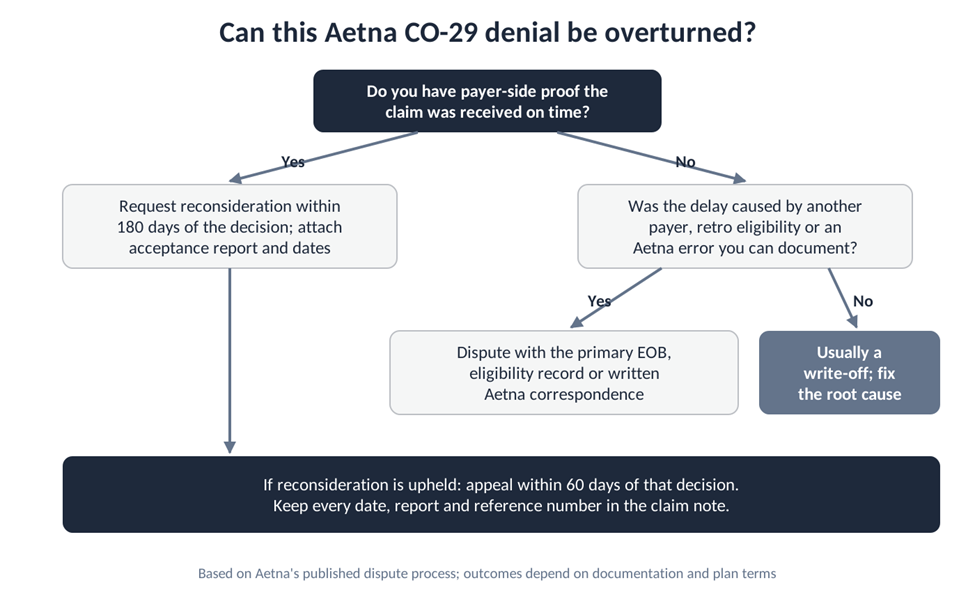
In short, payer-side proof leads to reconsideration; a documented outside cause leads to a dispute; neither usually means a write-off and a process fix.
How Do You Build an Aetna Deadline Worksheet?
An Aetna deadline worksheet lists each open claim with its controlling window and start event, then sorts by days left so the shortest deadlines are worked first.
Formula
- Filing deadline = start event (date of service, discharge or primary payer decision) + days in the controlling rule
- Days left = filing deadline minus today
Walkthrough: a New York fully insured claim with a January 10, 2026 date of service gives January 10 + 120 days = May 10, 2026. The 365-day outer limit for reconsidering an untimely denial falls on January 10, 2027. An Aetna Better Health of Illinois visit on February 2, 2026 gives February 2 + 180 days = August 1, 2026.
Sample (fictional data)
| Claim reference | Aetna product | Start event | Window | Deadline | Days left on Nov 2, 2026 |
| B-2201 | Commercial, New York fully insured | Service Sep 8, 2026 | 120 days | Jan 6, 2027 | 65 |
| B-2240 | Medicare Advantage, contracted | Service Aug 20, 2026 | 180 days | Feb 16, 2027 | 106 |
| B-2275 | Aetna Better Health of Illinois, secondary | Primary decision Sep 10, 2026 | 90 days | Dec 9, 2026 | 37 |
The 180-day Medicare Advantage window is a fictional contract term. Replace every window with the figure from your own agreement, state supplement or plan manual.
Illustrative scenario (not an actual client record)
A multi-specialty group bills an Aetna member as primary, but the member actually has another plan as primary. The other payer pays 70 days later, and the group sends Aetna a secondary claim the same week. Because the team logged the primary payment date, it could show the secondary claim arrived well inside the 90-day window that applied. Without that date in the claim note, the secondary claim would have looked late.
Track your worksheet the same way our step-by-step deadline tracking guide describes, and escalate any unaccepted claim with fewer than 15 days left. That 15-day trigger is a practical internal target, not an Aetna rule.
Signs Your Aetna Claims Need Outside Support
Outside support is worth considering when the rules are clear but late filings still slip through. Watch for these signals:
- Aetna CO-29 denials appear in more than one month of remittances
- Nobody can name the Aetna agreement and product terms for each location
- Secondary claims wait on primary payments with no date logged
- Reconsiderations are filed without payer-side proof
EON Med Solutions is one example of a partner that delivers billing, coding, credentialing, denial management and reporting end to end, through a US-based team with transparent reporting. Its medical billing service covers claim submission, rejection work and payer follow-up. Results vary by practice, payer mix and contract terms.
Aetna Filing Deadline FAQ
What is the timely filing limit for Aetna claims?
For participating providers, the limit is the claim submission period in your Aetna agreement, and a state law can set or protect it for fully insured plans. Aetna’s New York supplement lists 120 days after the date of service. Aetna Better Health plans follow state manuals, such as 180 days in Illinois.
Is the Aetna timely filing limit 90 days?
Ninety days is a common figure in billing references and in many contracts, but Aetna’s public provider manual does not publish it as one national rule. Check the claims section of your agreement and the state supplement before you calendar 90 days for every Aetna claim.
How long do I have to appeal an Aetna timely filing denial?
You have 180 calendar days from the claim decision to request reconsideration. If Aetna upholds the denial, you have 60 calendar days from the reconsideration decision to appeal. Attach payer-side proof of on-time receipt, because a timely filing denial is rarely reversed without it.
Does Aetna follow the Medicare one-year rule for Medicare Advantage claims?
Not automatically. Original Medicare uses 1 calendar year from the date of service, but Aetna Medicare Advantage claims follow your contract when you are contracted. Non-contracted providers follow Aetna’s Medicare rules, including a 65-day appeal window when reconsideration does not apply. See our Medicare 12-month filing rule guide.
What is a good timely filing denial rate for Aetna claims?
No payer or industry body publishes a required timely filing denial rate. As a practical goal, it should stay near zero, because late filing comes from process gaps such as unworked rejections or missing eligibility checks. Any repeat CO-29 on Aetna claims is a signal to review rejection and tracking workflows.
Expert Opinion
From our work on Aetna accounts, the Aetna timely filing limit is rarely the problem on its own; the problem is not knowing which document governs the claim in front of you. The firm published standards in this guide are Aetna’s 180-day reconsideration and 60-day appeal windows, the New York 120-day rule in Aetna’s state supplement, the Illinois Medicaid plan’s 180-day limit and Original Medicare’s one-year rule under federal regulation.
Everything else is practical or illustrative. The 90-day figure is a common contract term, not a published national rule, and the 15-day escalation trigger is an internal working target. When a contract, a state rule and a cheat sheet disagree, the document you can show a reviewer wins.
The natural next question is whether your team could name the controlling window for every open Aetna claim today. If that would take more than a few minutes, the EON Med Solutions Billing & RCM Team can walk through it with you; you can talk with our team whenever it suits you.
Sources: Aetna Provider Disputes and Appeals Overview, Aetna Provider Manual (June 2026) and State Supplement (July 2026), Aetna quick reference guide for health care professionals (August 2026), Aetna Better Health of Illinois claims page, and 42 CFR 424.44. ERISA is described in general terms only. This article is general billing information, not legal advice. Results vary by practice, and figures reflect information available at the time of research.


