
Insurance Eligibility Verification Before Every Visit
Insurance eligibility verification is the front-desk check that confirms a patient’s coverage is active, the practice is in network and the visit’s benefits are known before care is delivered. Done well, it prevents coverage denials and tells the patient what they owe at check-in. This guide covers what to check, when to check it, how to read an electronic response, payer differences and the errors that slip through. It fits within our revenue cycle management coverage.
| Key takeaways Eligibility confirms coverage is active; benefits verification confirms what the plan pays for this service.Check every visit, not just new patients, because coverage changes without notice.The X12 270/271 transaction returns coverage dates, cost sharing and other coverage in seconds.Medicare, Medicare Advantage, Medicaid and commercial plans each need a slightly different check.A deductible-and-coinsurance estimate lets staff collect accurately at check-in. |
What Is the Difference Between Eligibility and Benefits Verification?
Eligibility verification confirms that a patient has active coverage with a payer on the date of service. Benefits verification goes further and confirms what that plan covers for the planned service: cost sharing, limits, authorization rules and network status.
Both matter. An active plan can still deny a visit when the provider is out of network, the service needs prior authorization or another plan is primary. Front-end checks are the first step in the full revenue cycle workflow, and errors here travel through every step after it.
What Does Insurance Eligibility Verification Cover Before a Visit?
Staff should confirm active coverage dates, the correct payer and plan, the subscriber details, network status, cost sharing, authorization or referral rules and any other coverage. Each item maps to a common denial reason.
| Item to check | Why it matters |
| Coverage active on the date of service | Inactive coverage leads to a coverage-terminated denial |
| Payer, plan and payer ID | A wrong payer ID sends the claim to the wrong place |
| Member ID, name and date of birth match the card | Mismatches cause front-end rejections |
| Subscriber and patient relationship | Dependents billed as subscribers get rejected |
| Network status for the rendering provider | Out-of-network status changes payment and patient cost |
| Deductible remaining, copay and coinsurance | Sets the amount to collect at check-in |
| Prior authorization or referral needs | Missing authorizations are a leading avoidable denial |
| Other coverage and primary payer | Wrong order of benefits delays both claims |
Ask for the card at every visit and scan both sides. Ask directly about other coverage, because patients often forget a spouse’s plan. When two plans apply, our guide to handling secondary insurance claims covers the billing order.
When Should a Practice Check Eligibility?
A practice should check eligibility for every scheduled visit, ideally two to three days ahead and again on the day of service for new patients and visits at the start of a month. That timing is a practice convention, not a payer rule, but it leaves time to fix problems before the patient arrives.
Coverage changes most often at the start of a year, when employers switch plans, and at the start of a month, when some Medicaid eligibility updates. In billing audits, a common pattern is a January spike in coverage-terminated denials from patients who changed jobs or plans over the holidays.

How Do You Read a 271 Eligibility Response?
A 271 is the electronic eligibility response a payer returns to a 270 request under the HIPAA X12 standards. Read it for coverage status and dates first, then network status, cost sharing, authorization notes and any other coverage the payer reports.
Most practice management systems and clearinghouses send the 270 and show the 271 as a summary screen. Requests usually ask for general plan coverage or a specific service type, such as an office visit. Responses vary by payer, so when a key benefit is missing, call the payer and record the representative’s name and a reference number.
Electronic checks are the norm now. The CAQH Index 2025 executive report shows eligibility and benefit verification among the most automated administrative transactions, and it finds manual transactions cost providers more than electronic ones.

How Do Medicare, Medicaid and Commercial Checks Differ?
Medicare, Medicaid and commercial plans all support electronic eligibility checks, but each needs slightly different data and returns different details.
| Payer type | What to check | Watch for |
| Traditional Medicare | Part B entitlement, deductible met, other coverage | Medicare Advantage enrollment, which moves billing to the plan |
| Medicare Advantage | The plan’s own eligibility and network rules | Referral and authorization rules that differ from Medicare |
| Medicaid | State eligibility system and managed care plan assignment | Monthly eligibility changes and plan reassignment |
| Commercial | Plan type, network and cost sharing | Employer plan changes, often in January |
For Medicare, CMS runs the HIPAA Eligibility Transaction System (HETS), which returns real-time 271 responses to approved submitters; most practices reach it through their clearinghouse or MAC portal. The check needs the patient’s Medicare Beneficiary Identifier (MBI), and recent changes to MBI lookup access are covered in our post on the Medicare MBI lookup tool.
How Do You Turn Eligibility Data Into a Patient Estimate?
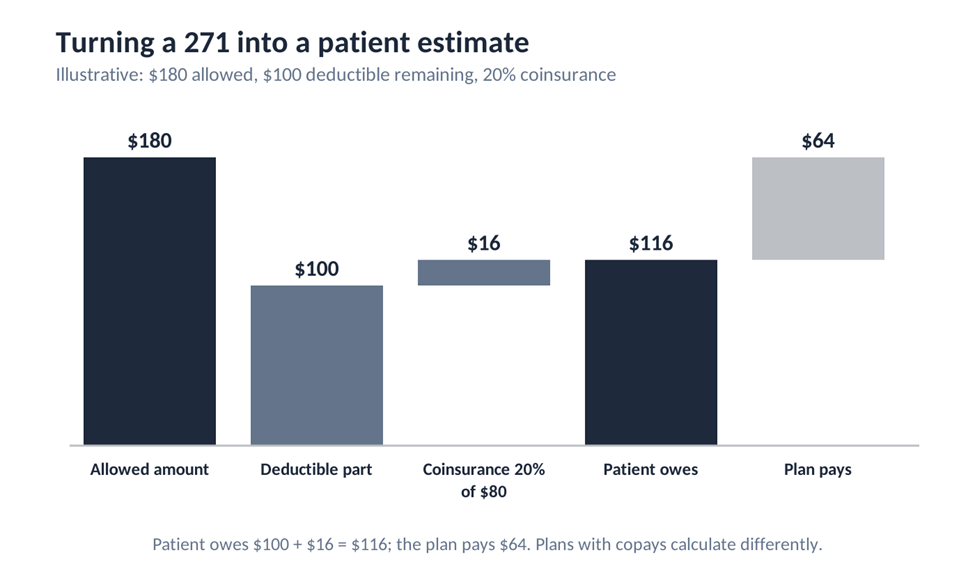
Turn eligibility data into a patient estimate by applying the remaining deductible first, then coinsurance to the rest of the allowed amount, or the copay when the plan uses one. Collecting that amount at check-in reduces balances sent to statements.
Formula: patient estimate = deductible portion + (coinsurance rate × (allowed amount − deductible portion)), where the deductible portion is the smaller of the remaining deductible and the allowed amount.
Illustrative scenario (not an actual client record)
- A returning patient’s 271 shows $100 of the deductible remaining and 20% coinsurance for office visits.
- The practice’s expected allowed amount for the visit is $180.
- Deductible portion: $100. Remaining allowed amount: $180 − $100 = $80.
- Coinsurance: 20% × $80 = $16. Patient estimate: $100 + $16 = $116; the plan pays about $64.
Present the figure as an estimate, because claims processed in between can change the deductible. Balances that remain after payment move to billing, as our guide to patient statement generation explains.
Which Eligibility Errors Cause Denials, and How Do You Fix Them?
The eligibility errors that cause the most denials are outdated insurance on file, typos in member data, missed other coverage and skipped authorization checks. Each has a simple front-desk fix.
- Old card on file: rescan the card at every visit and re-run the check.
- Name or birth date mismatch: copy details exactly as the payer lists them in the 271.
- Missed Medicare Advantage enrollment: bill the plan, not traditional Medicare, when the 271 shows MA enrollment.
- Unreported second plan: ask about other coverage on every intake form.
- Authorization not checked: flag services that need it at scheduling, not at check-out.
Our team often sees practices check only new patients. Established patients then carry outdated coverage for months, and the denials arrive in a cluster. Many of those claims never reach the payer at all; our post on reducing claim rejection rates covers that side.
Outside help can make sense when the front desk keeps hitting the same limits. Signals include:
- Coverage-terminated denials appear every month.
- Staff skip checks for established patients on busy days.
- Patients dispute balances they were not told about.
- No one reviews eligibility denials for patterns.
EON Med Solutions is one example of a partner that handles billing, coding, credentialing, denial management and reporting end to end through a US-based team with transparent reporting. The work includes pre-visit eligibility checks and denial trend reviews; results vary by practice. Learn how our medical billing services are set up.
Frequently Asked Questions
How long does insurance eligibility verification take?
An electronic 270/271 check through a practice management system or clearinghouse usually returns in seconds. Benefits that the 271 does not show, such as specific procedure coverage, may need a payer portal or phone call, which can take longer. Batch checks two to three days ahead keep check-in fast.
Should eligibility be checked for established patients?
Yes. Established patients change jobs, plans and Medicaid status without telling the practice. Checking every visit catches those changes before the claim goes out. Skipping established patients is one of the most common reasons coverage denials keep returning.
What is a 270/271 transaction?
The 270 is the standard electronic eligibility request, and the 271 is the payer’s response. Both are HIPAA standard X12 transactions. The response shows coverage status, dates, cost sharing and other details the payer returns for the requested service type.
Does eligibility verification guarantee payment?
No. Eligibility confirms coverage at the time of the check, but payers can still deny for coding, medical necessity, authorization or later coverage changes. Verification lowers the risk of coverage-related denials; it does not replace correct coding and documentation.
Who should check eligibility in a small practice?
Usually front-desk or scheduling staff, with a billing team member reviewing exceptions. The key is a written routine: who runs the batch check, who handles missing benefits and who calls patients about problems before the visit.
Expert Opinion
From the EON Med Solutions Billing & RCM Team: insurance eligibility verification is the cheapest point in the revenue cycle to stop a denial. A two-minute check before the visit saves far more work than an appeal after it.
The firm standards here are the HIPAA 270/271 transactions and Medicare’s HETS system. The two-to-three-day timing, the January pattern and the $180 estimate are practical, illustrative guidance, and cost sharing always depends on each patient’s plan.
The natural next question is how many of your current denials trace back to the front desk. If you would like that reviewed, reach our billing team here.
Sources: CMS HIPAA Eligibility Transaction System (HETS) page; CAQH Index 2025 executive report. Results vary by practice, and figures reflect information available at the time of research.