

CAQH Re-Attestation Guide for Busy Practices
CAQH re-attestation is the step where a provider reviews, updates and confirms their CAQH ProView profile so health plans can rely on it. Most plans expect it every 120 days, and a lapsed profile can stall credentialing and recredentialing. This guide covers the deadline, what happens when it is missed, the five re-attestation steps, the documents that expire in between and a tracking routine for groups. It supports our provider credentialing service content.
| Key takeaways Plans that use CAQH ProView generally require re-attestation every 120 days; Illinois practitioners follow a 180-day cycle.A lapsed attestation can block recredentialing, which NCQA requires every three years.Each re-attestation is a full review: data, documents, plan authorizations and disclosure questions.Medicare does not use CAQH; Medicare enrollment lives in PECOS.A shared tracker with a day-90 reminder prevents most lapses in group practices. |
How Often Is CAQH Re-Attestation Required?
CAQH re-attestation is generally required every 120 days for every provider with a CAQH ProView profile. Payers repeat the rule in their own provider materials; Priority Health’s provider manual notice, for example, reminds practices to re-attest every 120 days.
One state differs. The BCBSIL ProView quick reference notes a 180-day cycle for practitioners in Illinois. CAQH also sends a notice when attestation is due, but reminders go to the email on the profile, which is often an old or personal address.
Re-attestation is not the same as recredentialing. Recredentialing is the plan’s own review of a provider, and NCQA’s credentialing standards require it every three years. Plans pull CAQH data for that review, so a stale profile can hold it up. For the wider renewal calendar, see our guide to managing credentialing renewals without service gaps.
What Happens If a Provider Misses the Deadline?
When a provider misses the deadline, the profile is no longer attested, and plans may stop treating its data as current. The practical effect is delay: credentialing files sit open, and recredentialing can fail.
Payers state the risk plainly. Priority Health warns that a provider who has not re-attested may not be recredentialed and could have the contract terminated. A provider who falls out of network then sees claims deny or process at out-of-network rates, which pushes the problem into claim denial management.
Directory accuracy adds a second risk. Under the No Surprises Act, plans must confirm directory information at least every 90 days. Premera’s No Surprises Act provider notice explains that providers not verified within 180 days are removed from its online directory until the data is confirmed.
In credentialing audits, a common pattern is a lapsed profile discovered only when a new plan application stalls. By then the provider may already be seeing that plan’s members.
How Do You Re-Attest a CAQH ProView Profile?
To re-attest, sign in to CAQH ProView, review every profile section, upload current documents, confirm plan authorizations and complete the attestation questions. The whole process usually takes less time when the profile was kept current between cycles.
- Sign in with the provider’s login or the practice’s delegated account, and open the re-attestation prompt.
- Review each section: practice locations, hours, specialties, hospital privileges, work history and education.
- Upload any document that has expired or will expire soon, such as the license or malpractice face sheet.
- On the authorization page, allow every plan the practice bills to view the profile.
- Answer the disclosure questions honestly, attest, and save the confirmation with the next due date.
Do the authorization step every time when the practice has joined a new network. A plan that cannot see the profile cannot use it, and BCBSIL’s guide tells providers to ask a missing plan to add them to its roster.

Which Documents Expire Between Attestations?
The documents most likely to expire between attestations are the state license, malpractice insurance face sheet, DEA registration and board certification. An expired upload is one of the most common reasons a profile stays incomplete after attestation.
BCBSIL’s guide lists the usual supporting documents: CV, medical license, DEA certificate, controlled substance certificate, IRS Form W-9, malpractice face sheet and a summary of any malpractice cases. Our provider credentialing document checklist covers the full set for initial applications.
| Document | Typical renewal pattern | When to update ProView |
| State license | Set by each state board | As soon as the renewal is issued |
| DEA registration | Every three years | On renewal or any address change |
| Malpractice face sheet | Usually each policy year | On every renewal, before the old one ends |
| Board certification | Set by each specialty board | On recertification |
| IRS Form W-9 | No fixed expiry | When the TIN or legal name changes |
Upload a renewal when it arrives rather than waiting for the next 120-day prompt. A plan reviewing the profile in between sees whatever is on file that day.

How Can a Group Practice Track CAQH Deadlines?
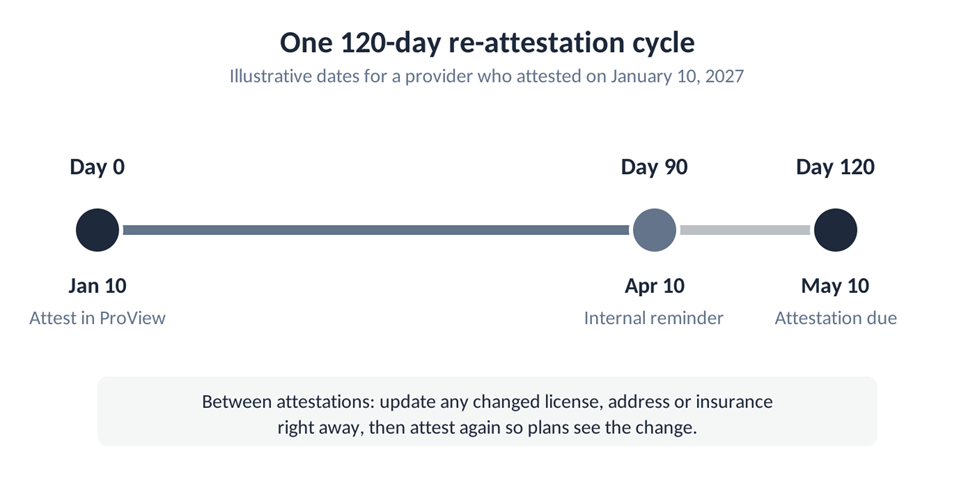
A group practice tracks CAQH deadlines best with one shared tracker that lists each provider’s last attestation date, next due date and expiring documents, plus a reminder at day 90.
Illustrative scenario (not an actual client record)
- An eight-provider family practice attested all profiles on different dates.
- The office manager adds each date to a shared tracker and sets a reminder 90 days later.
- One provider attested on January 10, 2027, so the reminder fires April 10 and the deadline is May 10.
- At each reminder, staff check expiring documents first, then re-attest within the week.
Our team often sees reminders tied to one staff member’s inbox. When that person leaves, every profile drifts. Use a shared mailbox for the CAQH email on file when the group allows it, and keep login access documented. For the steps that slow first-time applications, read how to avoid provider credentialing delays.
Medicare is separate. Medicare does not use CAQH, so Medicare enrollment is maintained and revalidated in PECOS. Medicaid programs and Medicare Advantage plans vary; check each plan’s provider manual for whether it pulls CAQH data. New plan enrollments also take time, as our payer enrollment timeline guide shows.
Some practices outgrow manual tracking. Signals that outside help may be worth a look:
- Profiles have lapsed more than once in the past year.
- No one owns CAQH logins after a staff change.
- Plans report missing documents during recredentialing.
- New providers start seeing patients before their profiles are authorized for every plan.
EON Med Solutions is one example of a partner that handles credentialing alongside billing, coding, denial management and reporting through a US-based team with transparent reporting. The work centers on keeping profiles, documents and plan authorizations current; results vary by practice. Browse our full range of practice services.
Frequently Asked Questions
Is CAQH ProView free for providers?
Yes. Providers do not pay to create, maintain or attest a CAQH ProView profile. Participating health plans fund the system and use the data for credentialing and directories. A practice may still pay a vendor for help managing profiles, but CAQH itself does not charge the provider for using ProView.
Can office staff re-attest for a provider?
Office staff can manage profile data through delegated practice access, but attestation is the provider’s statement that the information is true. Practices should keep provider sign-off documented and avoid sharing one login across people. The plan relies on the attestation as if the provider made it personally.
Does re-attestation restart credentialing?
No. Re-attestation only confirms the profile data is current. Credentialing and recredentialing are separate reviews done by each health plan. A current attestation simply lets those reviews move without waiting for updated information from the provider.
What should I update right away, not at the next cycle?
Update ProView as soon as a practice location, phone number, license, malpractice policy or tax ID changes. Plans may review the profile at any time, and directory checks happen more often than 120 days. Attest again after making the change so plans see the new data.
How do I find a provider’s CAQH ID?
The CAQH Provider ID appears on the ProView profile and in CAQH’s welcome email. Many plans also list it on credentialing correspondence. Store it in the practice’s credentialing tracker with the login owner, since plans ask for it on most applications.
Expert Opinion
From the EON Med Solutions Billing & RCM Team: CAQH re-attestation is a small task that protects large revenue. The practices that avoid lapses treat it as a calendar item owned by the office, not a reminder email owned by the provider.
The firm rules here come from published sources: the 120-day cycle in payer manuals, Illinois’ 180-day cycle, NCQA’s three-year recredentialing rule and the No Surprises Act’s 90-day directory checks for plans. The day-90 reminder and the eight-provider tracker are practical, illustrative routines, not requirements.
The natural next question is whether every profile in your group is current today. If you would like help checking, contact our credentialing team.
Sources: Priority Health provider manual notice; BCBSIL CAQH ProView quick reference; NCQA credentialing standards blog; Premera No Surprises Act provider notice. Results vary by practice, and figures reflect information available at the time of research.


