
Prior Authorization Denial: Prevent It, Then Appeal It
A prior authorization denial is a payer’s refusal to pay because a required approval was missing, invalid or did not match the service billed, or because the plan judged the service not medically necessary. Most of these denials are preventable at scheduling. This guide explains the denial types and reason codes, the 2026 CMS decision deadlines, a prevention routine, appeal steps and a sample appeal letter. It belongs to our denial management services coverage.
| Key takeaways Authorization denials split into two types: process denials and medical necessity denials.Since January 1, 2026, Medicare Advantage, Medicaid and CHIP plans must decide standard requests within 7 calendar days and expedited ones within 72 hours.Those payers must also give a specific reason for every prior authorization denial.Medicare Advantage reconsiderations must be requested within 65 calendar days of the notice.Prevention works best at scheduling, before the service and before the claim goes out. |
What Causes a Prior Authorization Denial?
A prior authorization denial has one of two causes: a process failure, where no valid approval matched the claim, or a medical necessity decision, where the plan reviewed the request and refused it. Each type needs a different response, so classify the denial before acting.
Read the Claim Adjustment Reason Code (CARC) on the electronic remittance advice (ERA). The full code set sits on the X12 external code lists page. The codes below are the ones most tied to authorizations.
| Reason code | Meaning in plain words | Usual type |
| CARC 197 | Precertification, authorization or notification was absent | Process |
| CARC 15 | Authorization number missing, invalid or not for this service or provider | Process |
| CARC 198 | Authorized limits were exceeded, such as visits or units | Process |
| CARC 50 | Service not deemed medically necessary by the payer | Medical necessity |
Process denials are the larger and more fixable group. Common triggers include a service performed at a different site than approved, more units than authorized, an expired approval date or a different rendering provider than the one on the request.
What Federal Rules Changed in 2026?
In 2026, federal rules began requiring faster and clearer prior authorization decisions from many government program plans. The CMS Interoperability and Prior Authorization final rule fact sheet sets 72 hours for expedited requests and 7 calendar days for standard requests from January 1, 2026.
The rule covers Medicare Advantage organizations, Medicaid and CHIP fee-for-service programs and their managed care plans, and Qualified Health Plan issuers on the federal Exchanges, although the decision deadlines do not apply to the Exchange plans. Impacted payers must also give a specific reason for each denial, post prior authorization metrics publicly each year and build a Prior Authorization API from January 1, 2027. Drug authorizations are excluded.
Traditional Medicare also added prior authorization for selected services through the WISeR model, which runs from 2026 in Arizona, New Jersey, Ohio, Oklahoma, Texas and Washington. Commercial plans follow state law and their contracts. For how automation is changing requests, see our post on AI in prior authorization.

How Can a Practice Stop These Denials Early?
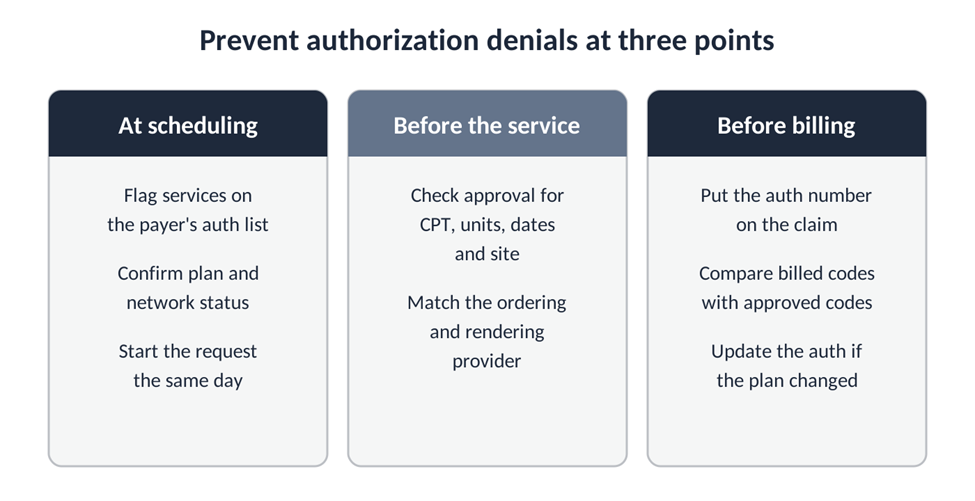
A practice prevents prior authorization denials by checking requirements at scheduling, confirming the approval matches the planned service before it happens and comparing the claim with the approval before billing.
- At scheduling: look up the payer’s current authorization list for the planned CPT codes and start the request the same day.
- Keep an authorization log with the approval number, approved codes, units, dates, site and rendering provider.
- Before the service: confirm the approval is still valid and that the plan, site and provider match.
- When the plan changes in the room, such as an added procedure, request an update before or right after the service as the payer allows.
- Before billing: put the approval number on the claim and compare billed codes and units with the approval.
In billing audits, a common pattern is a valid approval attached to the wrong provider or site. The service was approved, but the claim did not match it, so the denial looks like a missing authorization.
Authorization terms also belong in payer contracts. When one plan’s rules cause repeated trouble, raise turnaround and retro-authorization terms during renewal, as our payer contract negotiation guide explains.
How Do You Appeal a Prior Authorization Denial?
To appeal a prior authorization denial, confirm the exact reason, fix any process error first, request a peer-to-peer review for medical necessity cases and then file a written appeal with clinical records before the payer’s deadline.
- Read the denial reason and CARC, and pull the authorization log entry.
- If the approval existed, correct the claim with the right number, dates or provider and resubmit.
- If no approval exists, ask whether the plan allows retroactive authorization and within what window.
- For medical necessity denials, request a peer-to-peer call between the ordering physician and the plan’s reviewer.
- File a written appeal with notes, test results and the guideline the service meets, and log the deadline.
For Medicare Advantage, the CMS Part C reconsideration page gives 65 calendar days from the notice to request reconsideration. Plans must decide within 30 days for standard pre-service requests, 60 days for payment requests and 72 hours for expedited ones. Medicaid and commercial plans set their own windows, and our guide on timely filing versus appeal filing limits shows why the two clocks differ.
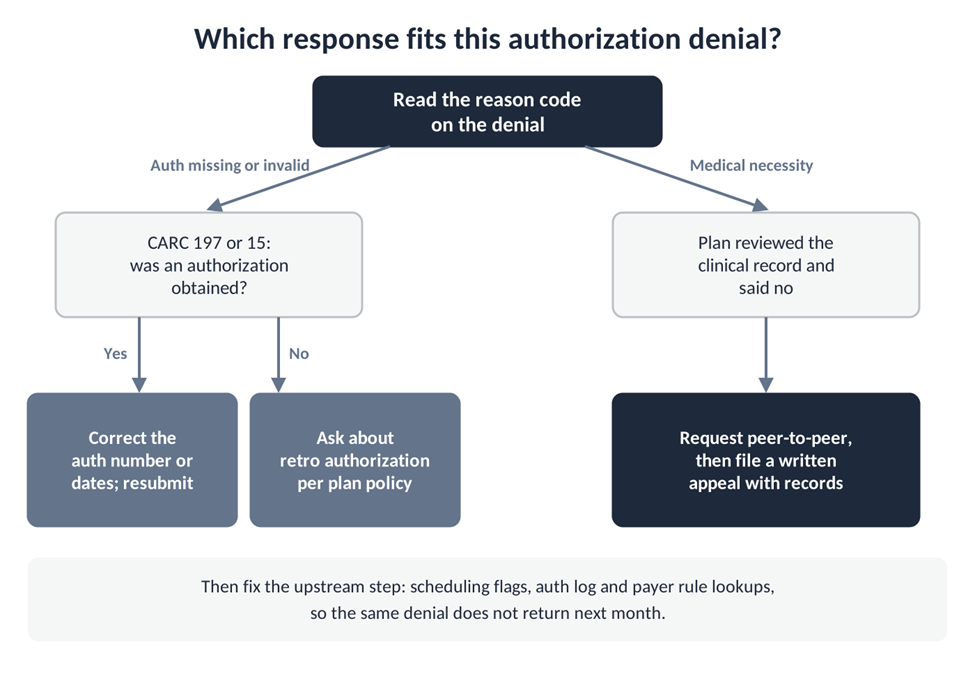
Summary of the flowchart: correct and resubmit when an approval existed, ask about retro authorization when it did not, and use peer-to-peer plus a written appeal for medical necessity denials.
What Should the Appeal Letter Say?
A strong appeal letter names the patient, claim and denial reason, states why the service met the plan’s criteria and points to the attached clinical evidence. Keep it to one page and let the records carry the detail.
Sample (fictional data)
To: Appeals Department, Lakeside Health Plan Medicare Advantage
Re: Request for reconsideration, member Jordan Ellis, member ID LHP-55102, claim 2027-0412-889
Service: lumbar MRI, CPT 72148, date of service March 3, 2027. Denial reason: not medically necessary.
Our patient has had low back pain with progressive left leg weakness for eight weeks. Six weeks of physical therapy and anti-inflammatory medication did not improve symptoms. The exam on February 24, 2027 showed new weakness in left ankle dorsiflexion, a neurological finding that the plan’s imaging guideline lists as a reason for MRI.
We ask the plan to reverse the denial. Attached are the office notes from February 3 and February 24, the physical therapy discharge summary and the ordering physician’s statement.
Sincerely, Dr. Morgan Hale, ordering physician, Brookside Family Medicine
Change the plan, member, claim, dates, findings and attachments to match your own case. Cite the plan’s own guideline by name when you have it.
Some practices hit the limits of in-house handling. Signals that outside help may be worth considering:
- Authorization denials rise even though staff are working harder.
- Appeal deadlines are missed because no one tracks them.
- The authorization log lives in personal notes or email.
- Peer-to-peer requests are rarely made.
EON Med Solutions is one example of a partner that handles billing, coding, credentialing, denial management and reporting end to end through a US-based team with transparent reporting. The work covers authorization tracking, denial classification and appeals; results vary by practice. Browse our practice services overview.
Frequently Asked Questions
Can you get a prior authorization after the service?
Sometimes. Many plans allow retroactive authorization in limited cases, such as emergencies or eligibility found after the visit, but the window and conditions vary by plan. Check the provider manual or call the plan quickly, because retro requests filed late are usually refused.
What is a peer-to-peer review?
A peer-to-peer review is a phone conversation between the ordering physician and the plan’s clinical reviewer about a denied or pending request. It gives the physician a chance to explain details the records may not show. Request it promptly, because plans often limit when it can happen.
Does a prior authorization guarantee payment?
No. An approval confirms medical necessity for the approved service under the plan’s rules, but the claim can still deny for eligibility changes, coding mismatches, units above the approval or timely filing. Compare each claim with its approval before billing.
How long does a payer have to decide a prior authorization request?
Since January 1, 2026, Medicare Advantage, Medicaid and CHIP plans must decide within 72 hours for expedited requests and 7 calendar days for standard ones, excluding drugs. Commercial plans follow state law and contract terms, which vary.
What is a good prior authorization denial rate?
No federal agency publishes a target. Many practices track authorization denials as a share of all denials and aim to see them fall month over month; that is an internal convention. Compare by payer, because one plan’s new authorization list can drive most of the change. Our denial management strategies cover tracking.
Expert Opinion
From the EON Med Solutions Billing & RCM Team: a prior authorization denial is usually a matching problem, not a clinical one. The approval existed or could have, but the code, units, date, site or provider on the claim did not line up with it.
The firm rules here come from CMS: the 72-hour and 7-day decision limits from January 1, 2026, the specific denial reason requirement, the WISeR model states and the 65-day Medicare Advantage reconsideration window. The sample letter is fictional, and commercial and Medicaid timelines vary by plan and state. For the wider denial picture, our complete denial management guide ties these steps together.
The natural next question is how many of your current denials are authorization-related. If you want that breakdown, contact our denial management team.
Sources: CMS Interoperability and Prior Authorization final rule fact sheet; CMS Medicare Advantage Part C reconsideration page; X12 external code lists; Congressional Research Service overview of the WISeR model. Results vary by practice, and figures reflect information available at the time of research.


