
Claim Status Inquiry: Checking Claims Without Guesswork
A claim status inquiry is a request to a payer asking where a submitted claim stands, answered with a status such as received, pending, paid or denied. Practices send it by portal, phone or the electronic 276 transaction, and the payer replies with a 277. This guide covers the four ways to check, when to check, what each status means, and what to do next for each result.
Key Numbers for Medicare Status Checks
| Item | What the CMS materials say |
| Editing window | Up to 3 days after receipt; do not resubmit during this time |
| Earliest payment-status check | 14 days for electronic claims, 29 days for paper claims |
| 276/277 response time | A 277 may take up to 24 hours |
| Standard | HHS adopted version 5010 of the X12 276/277 in January 2009 |
| Payer duty | Health plans must offer real-time online claim status under federal operating rules |
These figures come from the CMS booklet on checking Medicare claim status (April 2023) and the CMS Health Care Claims Status page. Other payers set their own timing in their provider manuals, so confirm each one.
How Do You Check Claim Status?
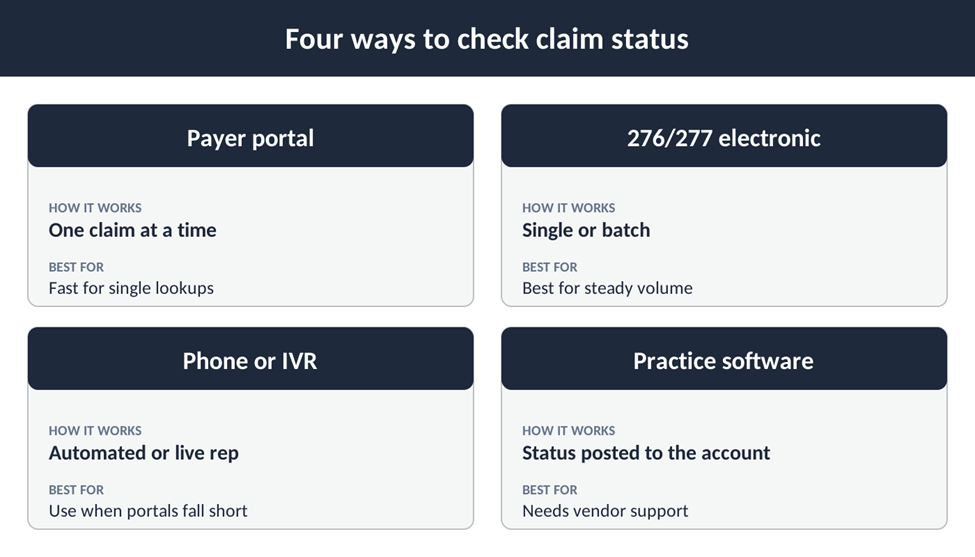
Providers can check status by payer portal, the electronic 276/277, phone or interactive voice response (IVR), or through practice software that posts the answer automatically. The CMS claim status page says the electronic 276/277 process is recommended, and the MLN booklet calls the contractor’s secure portal the fastest way to check an individual claim.
| Method | Best for | Watch out for |
| Payer portal | Single claims and quick lookups | Manual entry; slow for large volumes |
| 276/277 electronic | Steady volume and batches | Needs support from your software or clearinghouse |
| Phone or IVR | Gaps the portal cannot answer | Hold time and no audit trail unless you note the call |
| Practice software | Posting status to the patient account | Depends on vendor and payer support |
When Should You Check Claim Status?
Check after the payer has had time to enter the claim and before the claim ages into trouble. For Medicare, the MLN booklet says editing can take up to 3 days, and a claim that fails editing gets no tracking number, so check the remittance instead.
For payment status on a clean claim, the booklet advises waiting at least 14 days for electronic claims and 29 days for paper claims. A practical routine for other payers is a first look within a week to confirm receipt, a second check around two to three weeks, and escalation at 30 days. That cadence is a working target, not a payer rule, so adjust it to each payer’s published timing.
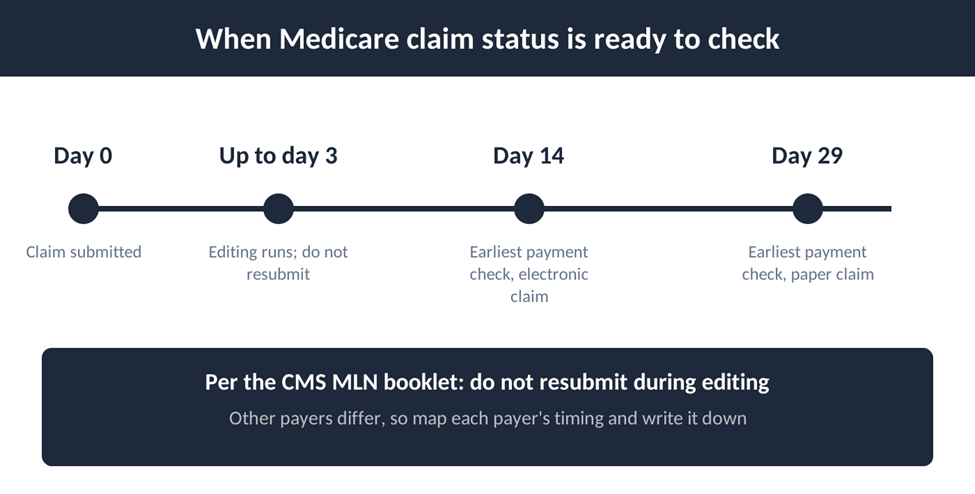
Never resubmit a claim while it is still being edited or processed. A duplicate usually returns a duplicate-claim denial, a problem our CO-18 guide explains. For deadlines that limit how long you can keep waiting, see how to track timely filing deadlines.
What Do Claim Status Categories Mean?
Each 277 response carries a status category code, and the category tells you whether to wait, fix or work the claim. The X12 maintenance site publishes the full list in its claim status category codes, and the table below covers the ones practices see most.
| Code | X12 meaning | What to do |
| A1 | Claim received; does not mean accepted for adjudication | Wait, then check again |
| A2 | Accepted into the adjudication system | Wait for the payer decision |
| A3 | Rejected; not entered into the adjudication system | Correct and resend the same day |
| A4 | Cannot be found in the adjudication system | Confirm transmission and resend if absent |
| P2 | Pending payer review | Watch the claim and prepare supporting records |
| P3 | Pending; payer is waiting for information it requested from the provider | Send the requested item immediately |
| F1 | Finalized; paid | Post from the remittance |
| F2 | Finalized; denied | Move to denial follow-up |
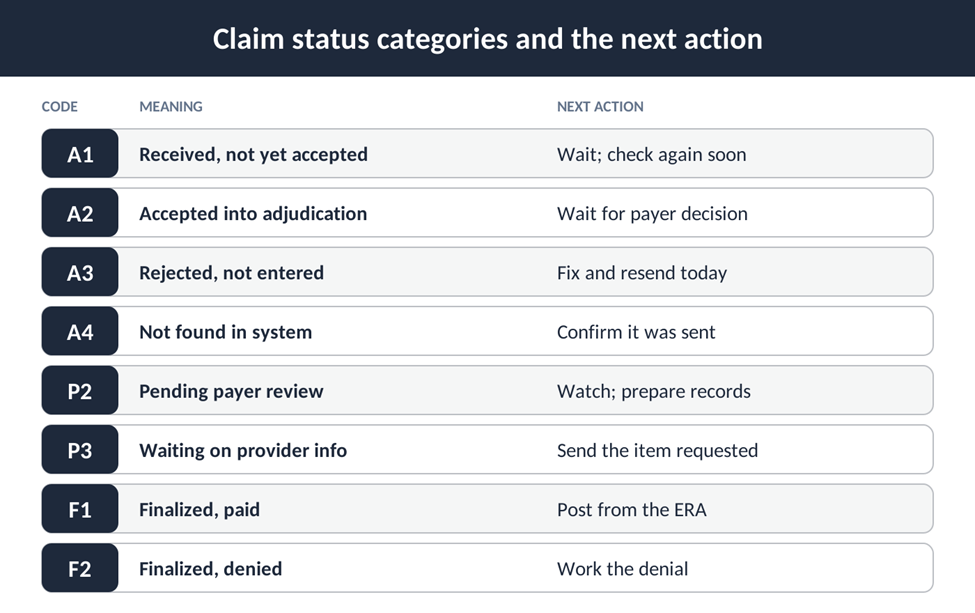
An A3 result is a rejection, so send it to front-end staff and fix it the same day; our post on reducing claim rejection rate covers prevention. A P3 result is the one most often missed, because the payer is waiting on you and the clock keeps running.
How Much Staff Time Can Electronic Status Checks Save?
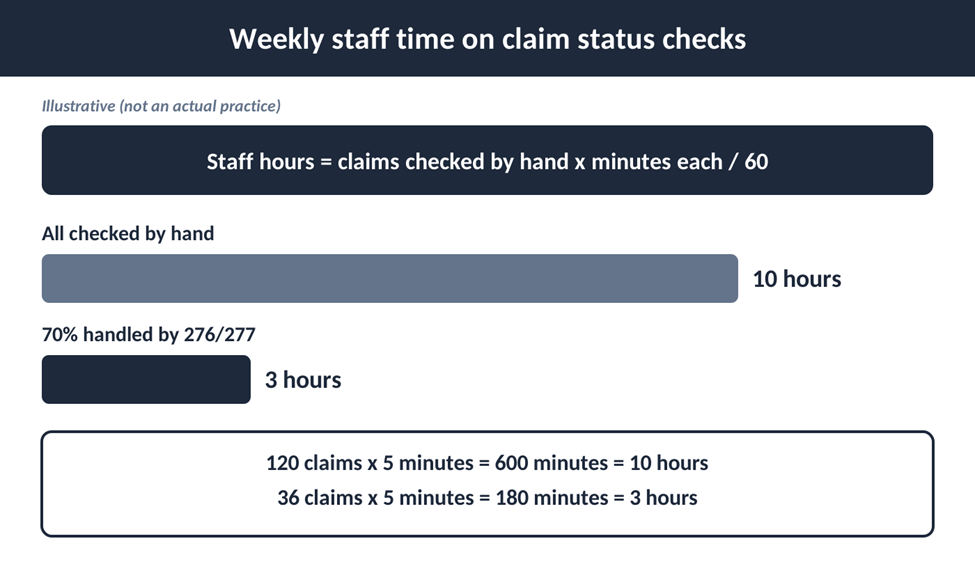
Time saved equals the number of claims you no longer check by hand multiplied by the minutes each check takes. The formula is staff hours = claims checked by hand x minutes each / 60.
Illustrative scenario (not an actual client record): a practice checks 120 claims a week by hand at 5 minutes each, which is 600 minutes or 10 hours. If a 276/277 feed handles 70% of them, 36 claims remain, so 36 x 5 = 180 minutes or 3 hours. Your numbers will differ, so time a typical week before you decide.
A Daily Routine for Working Claim Status
Work status in the same order every day so nothing ages unseen. Do this when your list of open claims is more than a few days old.
- Pull claims with no remittance past each payer’s expected processing time.
- Run the 276 for those claims, or check the portal for payers without electronic support.
- Sort results by category: rejections first, then requests for information, then denials.
- Record the status, date and next action on the claim.
- Escalate anything unchanged after 30 days to the payer’s provider representative.
This routine sits inside broader accounts receivable management, and it supports efforts to lower A/R days, covered in our A/R days reduction strategies. For multi-payer lists, the method in our post on tracking unpaid claims across payers pairs well with it.
Status Check Mistakes That Cost Money
- Resubmitting too soon. Wait out the editing window, then check status first.
- Reading A1 as accepted. X12 says receipt does not mean the claim was accepted for adjudication.
- Ignoring P3. Assign one person to respond to payer information requests the same day.
- Calling without notes. Record the date, representative and reference number of every call.
In billing audits, a common pattern is a status list that nobody owns: claims sit in pending until the filing or appeal window closes. Our team also often sees practices check only claims they already suspect, which leaves silent rejections unseen. Payer rules vary, so see our guide to payer-specific claim submission rules when a payer behaves differently.
When Claim Follow-Up Needs More Hands
It may be time for outside support when these signs continue:
- Claims older than 30 days with no known status
- Rejections discovered only on the remittance
- Staff spending hours a week on portal lookups
- No record of who checked which claim and when
- Pending claims nearing filing deadlines
EON Med Solutions is one example of a US-based team that delivers billing, coding, credentialing, denial management and reporting end to end, with transparent reporting. Its process is to check open claims on a set schedule, route each result by category and report aging by payer. Results vary by practice. The full list of services shows how claim follow-up fits the rest of the cycle.
Frequently Asked Questions
What is a claim status inquiry?
A claim status inquiry is a request to a payer for the current status of a submitted claim. It can be a portal lookup, a phone call or the electronic 276 transaction, which returns a 277 response. It reports status only and does not change the claim.
What is the difference between a 276 and a 277?
The 276 is the claim status request your system sends, and the 277 is the payer’s response. HHS adopted version 5010 of this X12 pair as the HIPAA standard for claim status. A 277 can also be an acknowledgment of a claim, depending on the context.
How long should you wait before checking claim status?
For Medicare, the MLN booklet says editing can take up to 3 days and advises waiting at least 14 days for electronic claims and 29 days for paper claims before checking payment status. Other payers vary, so follow each payer’s provider manual.
What does a pending claim status mean?
Pending means the claim is in the adjudication system but not finalized. X12 defines pending categories for claims in process, under payer review, or waiting for information requested from the provider or patient. Check the status code to see who must act next.
Does a status check change or resubmit a claim?
No. A claim status inquiry only reads the status, so it cannot correct or resubmit a claim. If the result shows a rejection or a request for information, you must send a corrected claim or the requested item separately.
Expert Opinion
From the EON Med Solutions Billing & RCM Team: a claim status inquiry is the habit that keeps A/R honest. Checking the right claims on a set schedule, and acting on each category the same day, prevents most of the silent aging that turns into write-offs.
The timing figures, the 276/277 standard and the status category meanings are published by CMS and X12 and are cited above. The 30-day escalation point, the week-one and week-three checks and the staff-time example are practical or illustrative targets, not payer requirements. Each payer’s provider manual controls its own timing.
The natural next question is how many of your claims are older than 30 days with no known status. If you want help finding out and working them, contact our team to talk it through.
Sources: CMS MLN booklet on checking Medicare claim status (April 2023); CMS claim status request and response page; CMS Health Care Claims Status page; X12 claim status category codes. Results vary by practice, and figures reflect information available at the time of research. This article is general information, not legal advice.