

Credentialing vs Enrollment: Which Step Holds Up Your Billing?
Credentialing verifies that a clinician is qualified, and enrollment registers the clinician and practice with a payer so claims can be paid. Contracting, the third step, sets the terms. Practices lose revenue when they treat the three as one task and start seeing patients before the billing date exists. This guide separates the steps, shows the right order, and works through what a late Medicare application can cost.
| Key takeaways Credentialing answers whether you are qualified; enrollment answers whether the payer can pay you.An approved credentialing file does not mean you are enrolled, contracted or ready to bill.Medicare’s effective date is tied to when your application is received, so file early.Payers use these words differently, so confirm each payer’s process in its provider manual. |
What Is the Difference Between Credentialing and Enrollment?
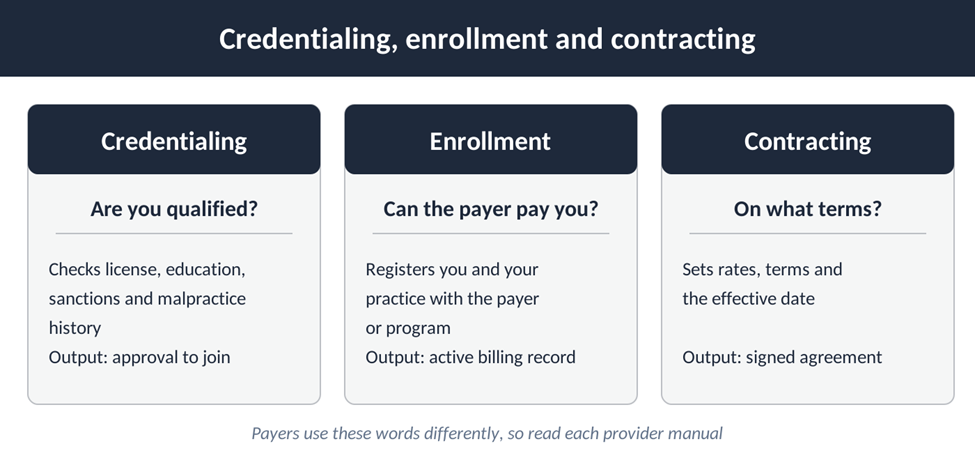
Credentialing is verification of a practitioner’s background, while enrollment is registration with a payer or program so it can pay claims. A clinician can be credentialed and still be unable to bill if the enrollment or contract is incomplete.
| Step | Question it answers | Typical output |
| Credentialing | Is this clinician qualified? | Approval to join a network or facility |
| Enrollment | Can this payer process and pay claims for the clinician and practice? | An active billing record and payer IDs |
| Contracting | On what terms will the practice be paid? | A signed agreement with rates and an effective date |
Payers and vendors do not use these terms uniformly. Some call the whole onboarding process credentialing, so read the payer’s provider manual and ask which step you are in. For rate and term negotiation, see our guide to payer contract negotiation tips.
What Does Credentialing Check?
Credentialing reviews a practitioner’s qualifications, including license, medical education, sanctions history and prior malpractice cases. NCQA, the quality organization whose standards many health plans follow, describes this in its overview of credentialing standards, and notes that it requires recredentialing every three years.
Most practices support credentialing by keeping documents current and the CAQH profile attested on time. Our checklist of documents required for provider credentialing lists what to gather, and the CAQH re-attestation guide explains the renewal cycle. If you are launching a new practice, credentialing support for solo practitioners covers the starting steps.
What Does Enrollment Add?
Enrollment connects a verified clinician to a payer’s billing system and produces the identifiers claims need. It is specific to each payer or program, so a clinician needs it separately for Medicare, Medicaid and every commercial plan.
For Medicare, First Coast Service Options, a Medicare contractor, explains in its guide to determining your Medicare effective date that the effective date of billing privileges is generally the later of the filing date or the date the provider began furnishing services at the location. The same page says the retrospective billing date can be up to 30 days before the contractor receives the enrollment package. Medicare also requires periodic revalidation, covered in our Medicare revalidation and PECOS guide.
Medicaid and commercial payers set their own effective-date rules in the state program or the contract, so confirm them before you schedule that payer’s patients. For timing estimates, see our post on the average timeline for payer enrollment.
In What Order Should You Do the Steps?
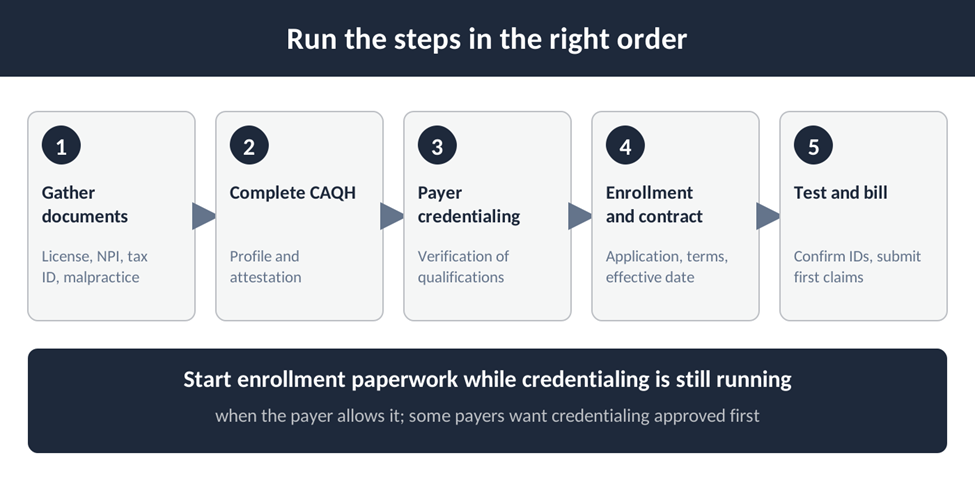
Gather documents first, then complete CAQH, then move through payer credentialing and enrollment, starting enrollment paperwork early where the payer allows. Some payers want credentialing approved before they accept an enrollment application, so follow each payer’s manual.
- Collect license, NPI, tax ID, malpractice coverage and practice details.
- Complete and attest the CAQH profile.
- Submit payer credentialing and track each application by payer.
- File enrollment and contract paperwork as early as the payer allows.
- Confirm the effective date in writing, test claim setup, then schedule that payer’s patients.
To prevent stalls, see our guide on how to avoid delays in provider credentialing.
What Does a Late Medicare Application Cost?
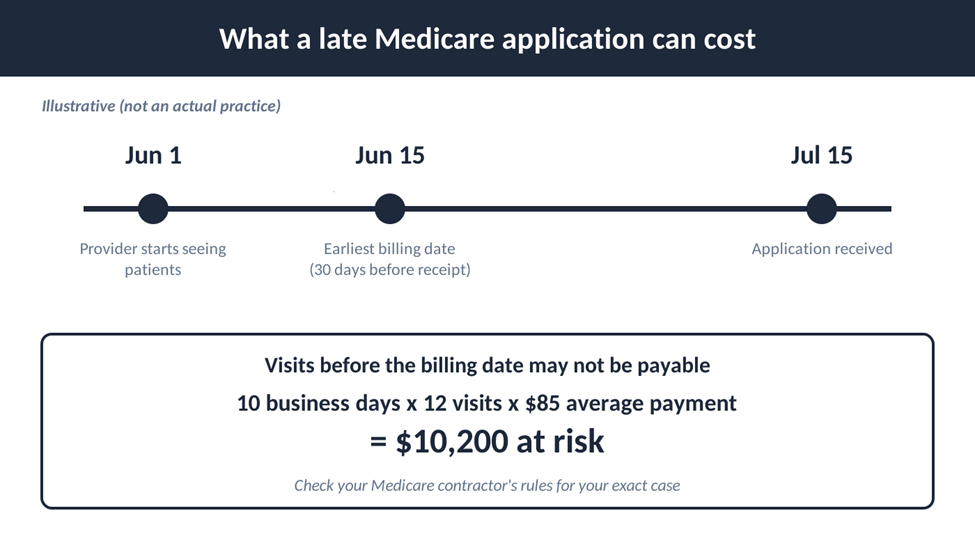
A late application costs the visits that fall before the earliest billing date. The formula is business days before the date x visits per day x average payment per visit.
Illustrative scenario (not an actual client record): a clinician starts seeing Medicare patients on June 1, but the application is received July 15. If the earliest billing date is 30 days before receipt, that is June 15, so visits from June 1 to June 14 may not be payable. Counting 10 business days at 12 visits a day and an $85 average payment, the exposure is 10 x 12 x $85 = $10,200. Your contractor decides the actual effective date, so check its rules for your case.
Mistakes That Delay Billing
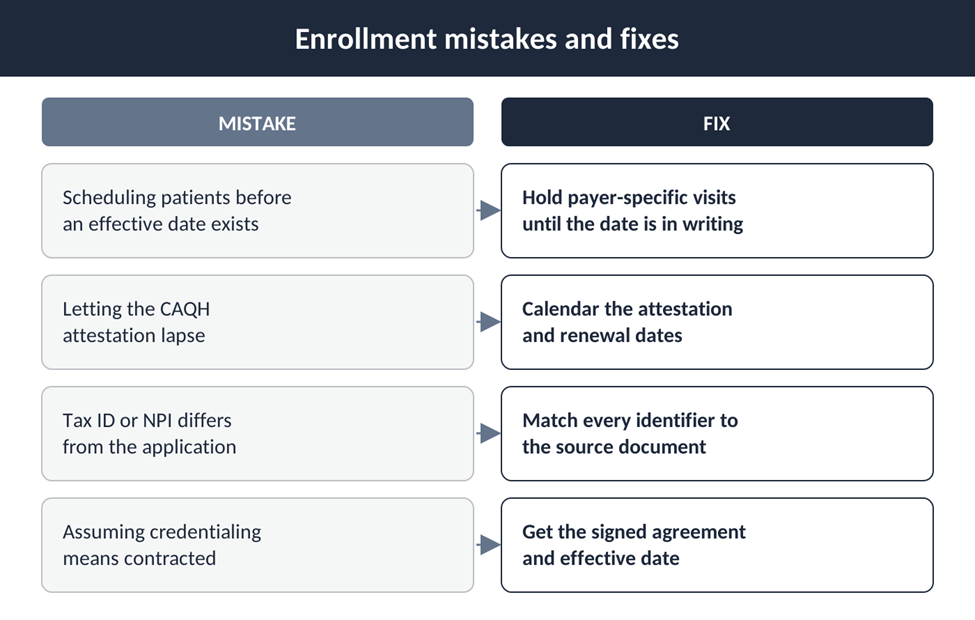
Four mistakes cause most delays, and each has a simple control:
- Scheduling patients too early. Hold that payer’s visits until the effective date is confirmed in writing.
- Letting CAQH lapse. Calendar attestation and renewal dates for each clinician.
- Mismatched identifiers. Make the tax ID, NPI and practice address match the source documents on every application.
- Assuming credentialed means contracted. Get the signed agreement and effective date.
In billing audits, a common pattern is a new provider whose credentialing file was approved weeks ago, while the enrollment paperwork never left the front desk. Our team also often sees a mismatched suite number on one application stall an approval for weeks.
When Onboarding Needs Dedicated Help
Extra support is worth considering when these signs appear:
- New clinicians waiting months for a billing date
- Applications with no owner or status log
- CAQH attestations missed more than once
- Claims denied for provider not enrolled
- Several payer portals with no single tracker
EON Med Solutions is one example of a US-based team that delivers billing, coding, credentialing, denial management and reporting end to end, with transparent reporting. Its process is to track each payer application by status and confirm the effective date before scheduling begins. Results vary by practice. See its credentialing services for how that works.
Frequently Asked Questions
Is credentialing the same as enrollment?
No. Credentialing verifies a clinician’s qualifications, while enrollment registers the clinician and practice with a payer so claims can be paid. Some payers use the words loosely, so check each payer’s manual. Both are usually needed before a practice can bill that payer.
Do you need to be credentialed before you enroll?
It depends on the payer. Many payers want credentialing approved before or alongside an enrollment application, and others combine the two. Medicare uses its own enrollment application. Follow each payer’s manual, and start paperwork as early as it allows.
How long does credentialing take compared with enrollment?
Timing varies by payer, state and application quality, and no single figure applies everywhere. Vendors publish ranges that differ widely, so ask each payer for its current processing time and track it. Our timeline post discusses typical enrollment waits.
Can you bill a payer before your enrollment is approved?
Generally not for that payer. Billing before an effective date can leave services unpaid, and Medicare ties its effective date to when it receives the application, with a limited retrospective window. Confirm the effective date in writing before scheduling.
What is the difference between credentialing and contracting?
Credentialing verifies qualifications, and contracting sets the payment terms, including rates and the effective date. A clinician can pass credentialing and still have no signed agreement. Confirm both steps are complete before treating that payer’s members as in network.
Expert Opinion
From the EON Med Solutions Billing & RCM Team: credentialing vs enrollment is a sequencing question. Credentialing proves the clinician is qualified, but revenue starts only when enrollment, contract and effective date line up for each payer.
The NCQA three-year recredentialing cycle and the Medicare effective-date and 30-day retrospective rules come from the NCQA and Medicare contractor pages named above. The order of steps, the scheduling hold and the dollar example are practical or illustrative guidance, not payer requirements. Each payer’s manual and your contract control the final answer.
The natural next question is which of your payers still lack a confirmed effective date. If you want help sorting that out, contact our team to talk through your onboarding list.
Sources: NCQA credentialing standards overview; First Coast Service Options guide to determining your Medicare effective date. Results vary by practice, and figures reflect information available at the time of research. This article is general information, not legal advice.


