

Medicare Revalidation in PECOS: A Practice Guide
Medicare revalidation is the required renewal of a provider’s or supplier’s Medicare enrollment, done every five years for most providers and every three years for durable medical equipment (DMEPOS) suppliers. A missed revalidation can lead to a payment hold or deactivated billing privileges. This guide covers how to find a due date, when to file, the PECOS steps, what lateness costs and how groups keep track. It supports our credentialing and enrollment services coverage.
| Key takeaways Most providers revalidate every five years; DMEPOS suppliers every three years.CMS posts due dates seven months ahead and expects filing within three months of the due date.Late revalidation can trigger a payment hold or deactivation, with no extensions.Services furnished while billing privileges are deactivated are not paid.Revalidation is separate from reporting changes, which have their own 30- and 90-day deadlines. |
How Often Is Medicare Revalidation Required?
Medicare revalidation is required every five years for most providers and suppliers, and every three years for DMEPOS suppliers. CMS can also ask for an off-cycle revalidation at any time.
The CMS revalidation page sets out both cycles and states that CMS grants no exemptions or extensions. Each enrollment revalidates on its own date, so a physician, the group they reassign to and any other enrollment they hold can all fall due at different times.
How Do You Find a Revalidation Due Date?
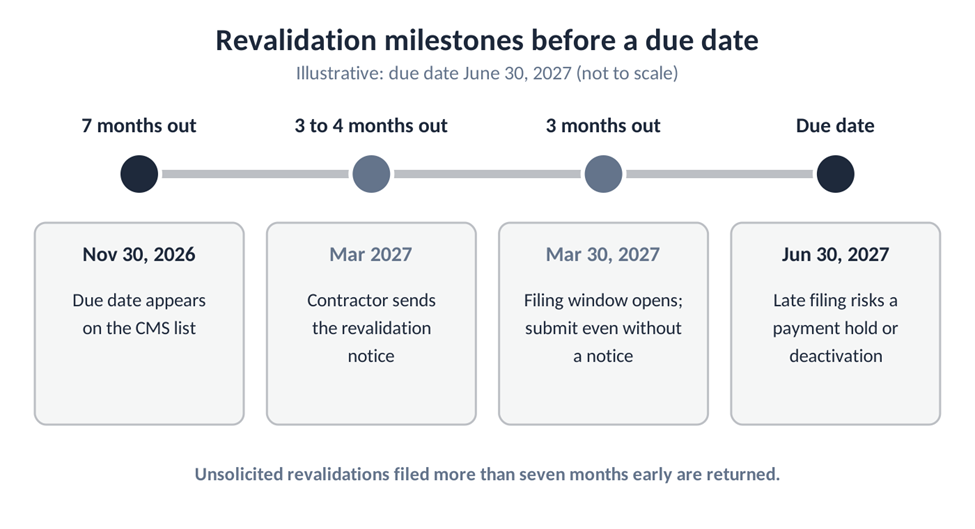
Find a revalidation due date on the Medicare Revalidation List, a CMS lookup that shows due dates by provider. CMS posts each date seven months ahead; a provider whose date is not yet set shows a to-be-determined status instead of a date.
Do not wait for the notice alone. The contractor sends a revalidation letter by email or mail about three to four months before the due date, but CMS states that each provider is responsible for tracking the date. Notices often go to an old correspondence address, which is a common reason a practice learns about a deadline late.
| Milestone | Timing | What to do |
| Due date posted | Seven months before the due date | Add it to the tracker |
| Notice sent | About three to four months before | Confirm the request matches the tracker |
| Filing window | Within three months of the due date | Submit, even without a notice |
| Too early | More than seven months out with no notice | Wait; unsolicited filings are returned |
Some contractors set their own response window once they send a request. First Coast’s revalidation guidance asks for the application within 60 days of its request letter, so read each notice for its own deadline.
How Do You Revalidate in PECOS?
Revalidate in PECOS, the Provider Enrollment, Chain, and Ownership System, by reviewing the enrollment record, updating anything that changed, uploading documents and signing electronically. CMS recommends PECOS over the paper CMS-855 forms because it is faster and paperless.
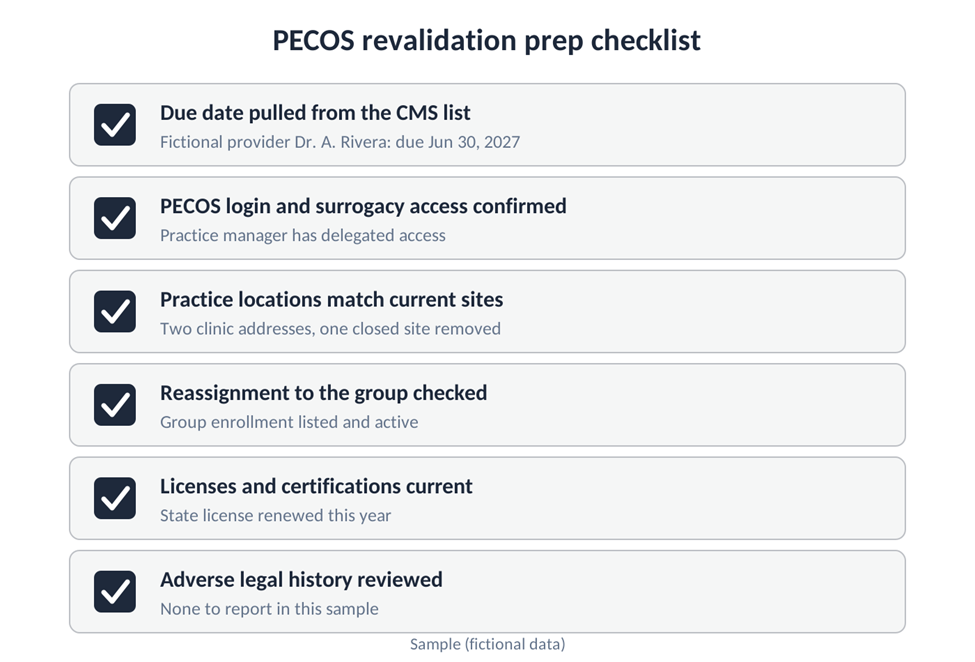
- Sign in to PECOS with the provider’s account or a surrogate account the provider has approved.
- Open the enrollment that is due and choose the revalidation option.
- Review every section: practice locations, specialties, licenses, reassignments and adverse legal history.
- Upload supporting documents the system requests.
- Have the provider or authorized official sign electronically, then submit.
- Save the tracking number and watch the application status until approval.
When the paper route is used, mark the revalidation box on the CMS-855 and include the coversheet from the contractor’s request letter. Individual physicians and nonphysician practitioners do not pay an application fee; institutional providers pay a fee that CMS sets each year.
In enrollment audits, a common pattern is a revalidation filed with a closed practice location still listed. The contractor then sends a development request, and the clock keeps running. Clean the record before you file.
What Happens If Revalidation Is Late?
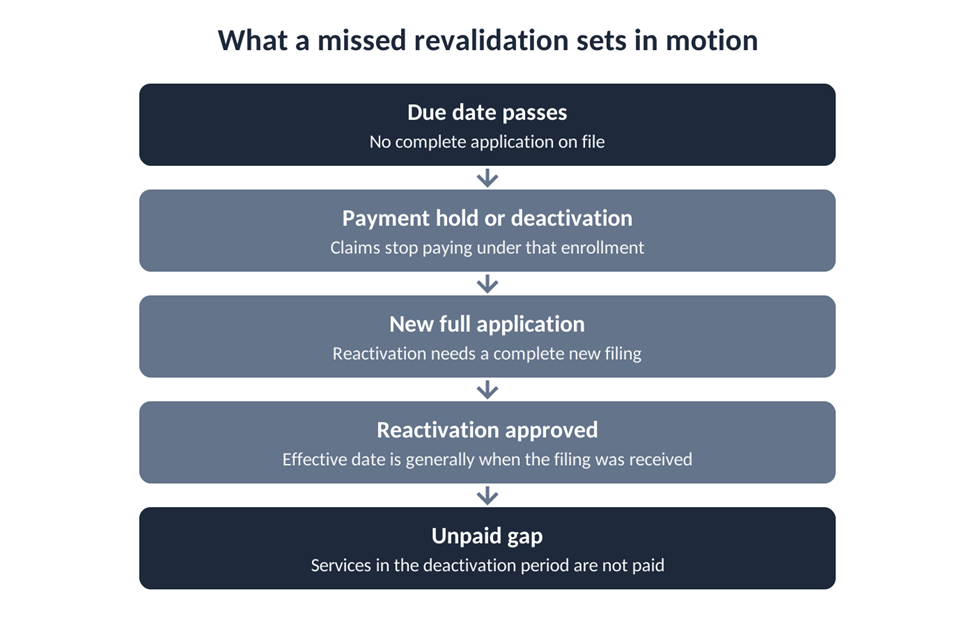
A late Medicare revalidation can lead to a hold on Medicare payments or deactivation of billing privileges. Reactivation then requires a complete new enrollment application, and Medicare does not pay for services furnished during the deactivation period.
Under the deactivation rules in 42 CFR 424.540, the reactivated enrollment is generally effective from the date the contractor receives the reactivation application that it later approves. Every day before that filing is a day of care the practice cannot bill to Medicare.
Formula: revenue at risk = average daily Medicare payments × days without billing privileges.
Illustrative scenario (not an actual client record)
- A two-physician practice receives about $28,000 a month from Medicare.
- Average daily Medicare payments: $28,000 ÷ 30 = about $933.
- The group misses its due date and is deactivated for 42 days before reactivation takes effect.
- Revenue at risk: $933 × 42 = about $39,200 in Medicare services that cannot be paid.
Watch remittances closely when a due date passes. A sudden run of Medicare rejections across one enrollment is often the first sign, and our guide to tracking unpaid claims across payers shows how to spot it early. The cash impact is covered in our post on faster claim turnaround and cash flow.
Is Revalidation the Same as Reporting Changes?
No. Revalidation is the scheduled renewal, while change reporting is ongoing. Physicians and nonphysician practitioners must report a change of ownership, an adverse legal action or a practice location change within 30 days, and most other changes within 90 days.
Report changes when they happen rather than saving them for the revalidation. A practice location that changed two years ago and was never reported can turn a routine revalidation into a long development cycle. Other payers run their own cycles too: state Medicaid programs revalidate enrollment on their own schedules, and commercial plans rely on credentialing data such as a current CAQH ProView profile.
How Can a Group Track Every Revalidation Date?
A group tracks revalidation best with one tracker that lists every enrollment it holds: the group itself and each individual provider, with due date, contractor, PECOS access owner and status.
- Check the CMS list monthly for every NPI the group bills under.
- Set an internal reminder at the start of the three-month filing window.
- Keep surrogate access in PECOS current when staff change.
- Confirm the correspondence and special payment addresses on file each year.
Our team often sees new providers added to a group without anyone recording their individual due dates. Solo physicians face the same risk with no office manager to catch it, which our guide to credentialing support for solo practitioners covers. Broader renewal planning sits in our post on credentialing renewals without service gaps.
Some practices reach the point where outside help makes sense. Common signals:
- A revalidation notice arrived after the due date had already passed.
- No one knows who holds PECOS access for each provider.
- Medicare rejections appear without a clear cause.
- Several providers fall due in the same quarter.
EON Med Solutions is one example of a partner that handles credentialing and enrollment alongside billing, coding, denial management and reporting through a US-based team with transparent reporting. The work centers on tracking due dates, keeping PECOS records clean and watching remittances for early warning signs; results vary by practice. See the full list of EON Med Solutions services.
Frequently Asked Questions
Can I revalidate before receiving a notice?
Yes, when the due date is within three months. CMS asks providers to submit in that window even if no notice arrived. If the due date is more than seven months away and no notice was sent, the contractor returns the application, so wait until the window opens.
Does a group revalidate separately from its physicians?
Yes. The group enrollment and each individual provider enrollment have their own due dates. A physician who reassigns benefits to the group still revalidates their own enrollment, and the group revalidates its record. Track every enrollment in one place to avoid gaps.
Is there a fee for Medicare revalidation?
Individual physicians and nonphysician practitioners do not pay an application fee. Institutional providers, such as clinics that enroll as institutions, pay a fee that CMS updates each calendar year. Check the current amount in PECOS before submitting an institutional revalidation.
Can CMS extend a revalidation deadline?
No. CMS states that it grants no exemptions or extensions for revalidation. The only safe approach is to file within the three-month window and answer any development request quickly, because a delayed response can still lead to deactivation.
What does it mean when the list shows no due date?
A to-be-determined status means CMS has not yet set a due date for that enrollment. It does not mean the provider is overdue. Check the list again monthly, since dates are posted about seven months before they fall due, and respond to any off-cycle request from the contractor.
Expert Opinion
From the EON Med Solutions Billing & RCM Team: Medicare revalidation rarely fails because the form is hard. It fails because nobody owned the due date, the notice went to an old address or the record carried changes that were never reported.
The firm rules here come from CMS: the five-year and three-year cycles, the seven-month posting, the three-month filing window, no extensions and no payment during deactivation. The $28,000 practice and the 42-day gap are illustrative, and actual exposure depends on each practice’s Medicare volume.
The natural next question is when your own enrollments fall due. If you would like help building that tracker, get in touch with our enrollment team.
Sources: CMS Revalidations (Renewing Your Enrollment) page; First Coast Service Options revalidation guidance; 42 CFR 424.540 on deactivation. Results vary by practice, and figures reflect information available at the time of research.


