

How Physician Assistant Billing Works Under Medicare and Beyond
Physician assistant billing is the process of choosing the correct rendering provider, NPI and payment path for every service a physician assistant (PA) furnishes. Under Medicare, most PA services are paid at 85% of the physician fee schedule, but incident-to and split/shared rules can change both the billing NPI and the payment. This guide, part of our medical billing resources for practices, explains each path, shows the math, compares payer types and lists the setup steps that keep PA claims clean.
| Key takeaways Since January 1, 2022, PAs can bill Medicare directly under their own NPI or reassign payment to an employer.Services billed under the PA’s NPI are paid at 85% of the physician fee schedule amount.Incident-to billing under the physician’s NPI is allowed only in the office setting when strict conditions are met.Facility split/shared visits carry modifier FS and are billed by whoever performed the substantive portion.Medicaid and commercial payers set their own PA rules, so each contract decides the rendering provider. |
The figures most billers need for PA claims fit in one short table. The percentages are Medicare rules; the conversion factors come from the CMS CY 2027 final rule fact sheet.
| Item | Medicare figure | What it means |
| Service under PA’s own NPI | 85% of fee schedule | Allowed amount is 85% of the physician rate |
| Medicare share after deductible | 80% of allowed | Patient owes 20% coinsurance |
| Incident-to under physician NPI | 100% of fee schedule | Only when every incident-to condition is met |
| PA as assistant at surgery | 85% of 16% | About 13.6% of the surgeon’s fee schedule amount |
| Conversion factor, non-APM | $33.40 (2026), $32.63 (2027) | Drives every fee schedule amount |
Can a Physician Assistant Bill Medicare Under Their Own NPI?
Yes. A physician assistant can bill Medicare directly under their own National Provider Identifier (NPI), the 10-digit number that identifies each provider on a claim. Before 2022, Medicare paid PA services only to the employer. The CMS physician assistant payment page now confirms that a PA may bill under their own NPI or let an employer or contractor bill through reassignment of benefits.
Two Medicare conditions still apply. PA services must be furnished under physician supervision, which a PA can meet through collaboration with physicians where state scope-of-practice law allows. Medicare also pays PA services only on assignment, so the PA cannot balance-bill the patient above the Medicare limit.
PA reimbursement in this direct path is 85% of the amount a physician would receive for the same code. That rate is the default whenever no other billing path applies.
Which Physician Assistant Billing Path Fits Each Visit?
Each PA visit fits one of four Medicare billing paths: the PA’s own NPI, incident-to, split/shared, or assistant at surgery. The setting, the patient’s status and who did the work decide the path. Picking the wrong one turns a valid visit into an overpayment or a denial.
Billing under the PA’s own NPI
Use the PA’s own NPI when the PA starts a new plan of care, sees a new patient, or works without direct physician supervision. The claim lists the PA as rendering provider, and the group receives payment through reassignment. This path is the safest default when any incident-to element is uncertain.
Incident-to billing in the office
Incident-to billing lets an office claim go out under the supervising physician’s NPI at the full physician rate. It applies only outside the hospital and skilled nursing facility setting. The conditions sit in the Medicare Benefit Policy Manual, Chapter 15, and all of them must be true:
- The patient is established, and the physician personally performed the initial service and set the plan of care.
- The PA follows that plan and does not address a new problem or change the plan.
- Direct supervision is met: a physician of the group is in the office suite or, since 2026, available through real-time audio and video, never audio only.
- The PA is an employee, leased employee or independent contractor of the billing physician or group.
In billing audits, a common pattern is incident-to claims for visits where the PA treated a new complaint. Those visits belong under the PA’s NPI at 85%, even when the patient is established.
Split/shared visits in facilities
Split/shared visits are evaluation and management (E/M) visits in a hospital or other facility where a physician and a PA from the same group each perform part of the work. Medicare requires modifier FS on the claim. The Noridian split or shared services page explains that the practitioner who performs the substantive portion bills the visit.
Since 2024, the substantive portion means more than half of the total time or the substantive part of medical decision making (MDM). The record must name both practitioners, and the billing practitioner signs it. Split/shared rules never apply in the office, where incident-to rules govern instead.
PA as assistant at surgery
When a PA assists at surgery, Medicare pays 85% of 16% of the surgeon’s fee schedule amount. The claim carries modifier AS. Check the assistant-at-surgery indicator for the CPT code in the fee schedule before billing, because some procedures do not allow an assistant at all.
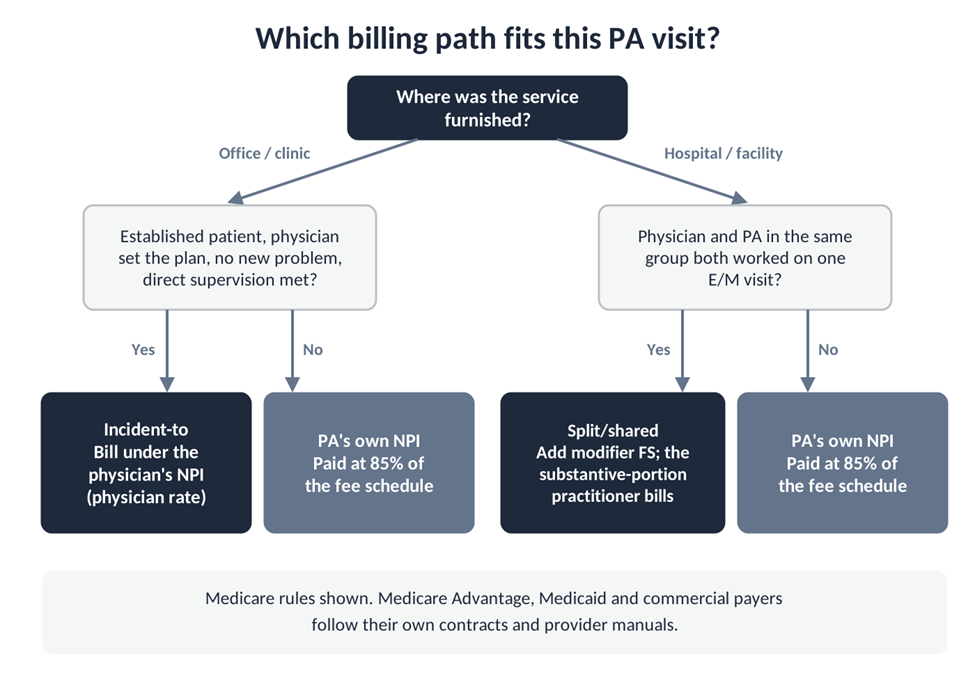
Summary of the flowchart: office visits go incident-to only when every condition is met, facility E/M visits shared with a physician go split/shared with modifier FS, and everything else bills under the PA’s NPI at 85%.
How Much Does Medicare Pay for PA Services?
Medicare pays PA services at 85% of the physician fee schedule amount, and then pays 80% of that allowed amount after the Part B deductible. The patient owes the remaining 20%. The formula and the example below use an illustrative visit amount, because actual rates depend on the code and the Medicare locality.
Formula: PA allowed amount = physician fee schedule amount × 0.85. Medicare payment = PA allowed amount × 0.80.
Illustrative scenario (not an actual client record)
- An established patient returns to a family practice for follow-up on a stable condition.
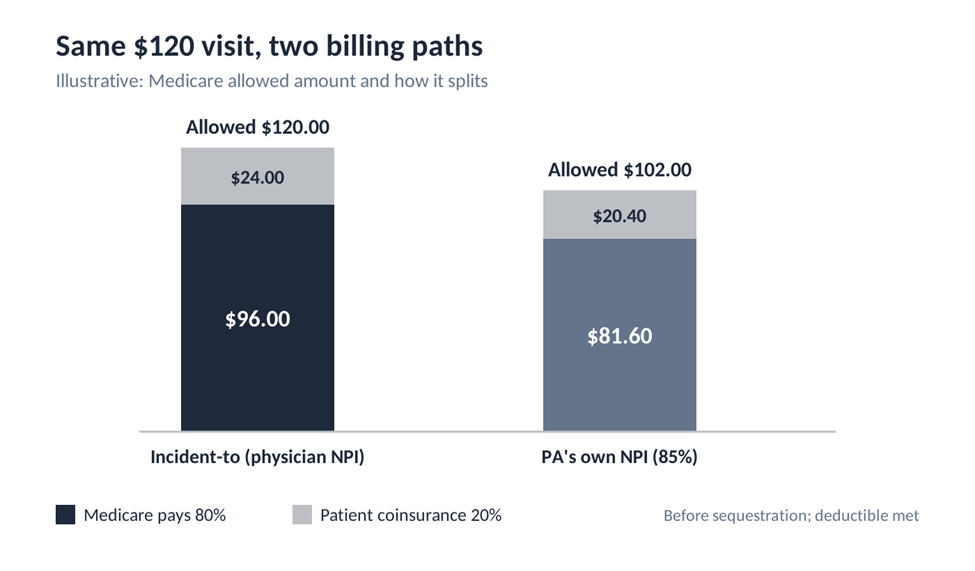
- The physician fee schedule amount for the office visit code is $120.00 in this example.
- Under the PA’s own NPI: $120.00 × 0.85 = $102.00 allowed. Medicare pays $102.00 × 0.80 = $81.60. Coinsurance is $20.40.
- Under valid incident-to: $120.00 allowed. Medicare pays $96.00. Coinsurance is $24.00.
- The gap is $18.00 in allowed amount per visit. Across 300 qualifying visits a month, that equals $5,400.
Those amounts come before payment adjustments such as sequestration. The gap is real, but incident-to is a compliance rule rather than a revenue tactic: billing incident-to without meeting it creates an overpayment.
How Do Medicaid and Commercial Payers Treat PA Claims?
Medicaid and commercial payers do not have to follow Medicare’s PA rules. Each payer sets its own rate, its own credentialing rule and its own view of incident-to in the contract or provider manual. The table shows the general pattern; actual policies vary by payer, plan and state.
| Payer type | Typical PA rate source | Billing NPI questions to answer |
| Medicare (traditional) | 85% of the physician fee schedule | Own NPI, incident-to or split/shared per CMS rules |
| Medicare Advantage | The plan’s provider contract | Whether the plan follows Medicare incident-to rules |
| Medicaid (fee-for-service and managed care) | State program or managed care contract | Whether the PA bills under own NPI or under a supervising physician |
| Commercial | The payer contract | Whether the payer credentials PAs and recognizes incident-to |
Check the payer’s provider manual before the first PA claim goes out. Many commercial payers credential PAs individually and expect them as rendering provider, so incident-to style billing under the physician can be treated as misrepresentation.
What Must Be Set Up Before a PA’s First Claim?
A PA needs an active NPI, payer enrollment, reassignment to the group and a supervision record before the first billable visit. Gaps in any of these steps cause rejections that are hard to recover later.
Sample (fictional data): PA onboarding billing checklist
- Confirm the PA’s individual NPI and taxonomy in the national provider registry.
- Enroll the PA in Medicare through PECOS and reassign benefits to the group.
- Start Medicaid and commercial enrollment on the same day as Medicare.
- Record the collaborating or supervising physician as state law requires.
- Load the PA in the practice management system with the correct rendering and billing NPIs.
- Hold PA claims for any payer whose enrollment is still pending.
Enrollment timing varies widely by payer, as our guide to how long insurance payer enrollment takes shows. Our team often sees a PA start seeing patients before commercial enrollment is final, which leaves claims sitting unbilled for weeks. Start enrollment as soon as the hire date is set.
A dedicated provider credentialing and enrollment service can track each payer file in parallel when a practice adds several PAs at once.
Which PA Billing Mistakes Trigger Denials or Audits?
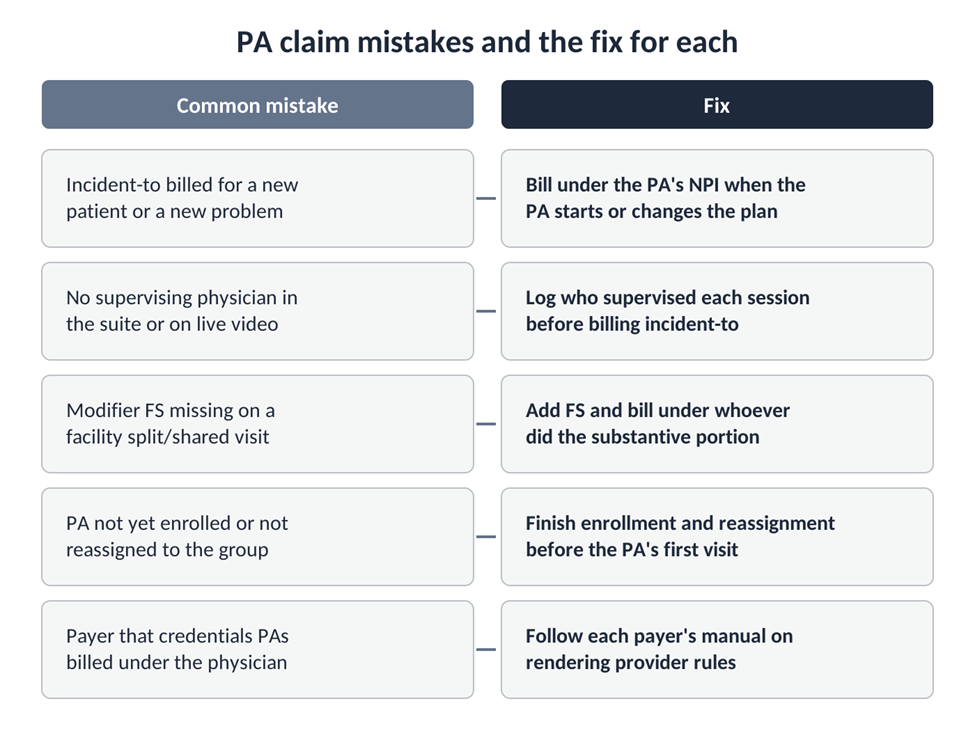
The costliest PA billing mistakes are incident-to claims that fail a condition, missing modifier FS, and claims for PAs who are not yet enrolled. Each one is preventable with a pre-billing check.
- Incident-to billed for a new patient or new problem: route the visit to the PA’s NPI.
- No documented supervision: keep a daily log of the supervising physician for each PA session.
- Modifier FS missing on facility visits: add a claim edit that flags shared facility E/M visits.
- Rendering provider mismatch with commercial payers: follow each payer’s PA rendering rules.
- PA notes signed only by the physician: make sure the record shows who performed each part.
Urgent care groups feel these errors fastest because PAs often staff full shifts; our revenue cycle guide for urgent care centers covers staffing-related billing risks. For broader prevention, see these proven ways to cut claim denials.
Outside help makes sense when the in-house team keeps hitting the same limits. Common signals include:
- Incident-to denials or payer audit letters on PA claims.
- PAs seeing patients while enrollment files are still open.
- No one consistently checking modifier FS on facility visits.
- Unclear rules for each commercial payer’s rendering provider.
In that situation, a billing partner such as EON Med Solutions is one example of end-to-end billing, coding, credentialing, denial management and reporting delivered by a US-based team with transparent reporting. The work covers path selection, claim edits and payer follow-up, and results vary by practice. Review the full list of medical billing and RCM services.
What Changes for PA Billing in 2027?
The core PA rules stay the same in 2027, but the fee schedule amounts behind them drop. The CMS CY 2027 Physician Fee Schedule final rule fact sheet sets the non-APM conversion factor at $32.63, down from $33.40, because a one-year 2.5% increase for 2026 ends.
The same rule turns the G2211 complexity add-on into modifier B1, which raises the E/M payment by 16%. PAs who bill office E/M visits should update their charge templates before January. CPT, HCPCS and ICD-10-CM code sets also change every year, so review PA superbills each fall. Correct E/M level selection still drives the base payment, as our physician medical coding guide explains.
Frequently Asked Questions
Can a physician assistant bill without a supervising physician?
Medicare requires PA services to be furnished under physician supervision, but a PA can meet that requirement through collaboration with physicians where state law allows. The state scope-of-practice rules decide what the collaboration must look like. Medicaid and commercial payers may add their own supervision terms in the contract.
Can a PA bill a new patient visit incident-to?
No. Incident-to requires the physician to perform the initial service and set the plan of care. A new patient visit, or a new problem for an established patient, must be billed under the PA’s own NPI. Medicare then pays 85% of the physician fee schedule amount for that visit.
Do physician assistants get paid less than physicians?
Under traditional Medicare, yes. Services billed under the PA’s NPI are paid at 85% of the physician fee schedule. Commercial and Medicaid rates depend on each contract or state program. Some payers pay a reduced percentage, while others use different rates, so check each fee schedule.
What is a good way to audit PA claims?
A practical approach is a small monthly or quarterly sample of PA claims checked for billing path, supervision and modifiers. Sample size is an internal convention, not a CMS rule. Focus extra review on incident-to claims and facility visits, because those carry the highest overpayment risk.
Does modifier FS apply in a physician office?
No. Modifier FS applies only to split/shared E/M visits in a facility setting, such as a hospital. In a physician office, shared work between a physician and a PA is billed either incident-to, when every condition is met, or under the PA’s own NPI at 85%.
Expert Opinion
From the EON Med Solutions Billing & RCM Team: physician assistant billing goes wrong when the path is chosen after the visit instead of before it. Practices that decide in advance which visits qualify for incident-to, which are split/shared and which default to the PA’s NPI avoid most of the denials and audit risk described above.
The firm published standards here are the Medicare rules: 85% for services under the PA’s NPI, 85% of 16% for assistant at surgery, modifier FS for facility split/shared visits, and the 2026 and 2027 conversion factors from CMS. The $120 visit, the 300-visit month and the audit sample are illustrative, and commercial and Medicaid rules vary by contract and state.
The natural next question is how your own PA claims hold up against these rules. If you want a second look at your PA billing setup, talk with our billing team.
Sources: CMS Physician Assistants payment page; Medicare Benefit Policy Manual, Chapter 15; Noridian Medicare split or shared services guidance; CMS CY 2027 Physician Fee Schedule final rule fact sheet. Results vary by practice, and figures reflect information available at the time of research. This article is general billing information, not legal advice.


