

CO-16 Denial Code: Meaning, Paired RARCs and the Right Fix
The CO-16 denial code means the claim or service line lacks information or has a submission or billing error, so the payer could not finish processing it. The CO group code makes the amount a provider adjustment, not a patient balance. This guide explains how to read CO-16 with its remark code, why Medicare treats many CO-16 claims as unprocessable rather than denied, which remark codes appear most often, and how to fix and prevent them.
| Key takeaways CARC 16 never tells you the exact problem on its own; the paired remark code does.On Medicare claims, CO-16 with MA130 or N704 marks an unprocessable claim with no appeal rights; you fix it and submit a new claim.Resubmission does not pause timely filing, so a Medicare correction still has to arrive within 1 calendar year of the date of service.Most CO-16 volume traces back to a few registration and provider-setup fields that can be checked before submission. |
What Does the CO-16 Denial Code Mean?
The CO-16 denial code combines group code CO, which means contractual obligation, with claim adjustment reason code (CARC) 16: the claim or service lacks information or has submission or billing errors. Because the group code is CO, the provider cannot bill the patient for the adjusted amount.
CARC 16 is deliberately broad, so payers attach a remittance advice remark code (RARC) that names the missing or invalid item. You find both codes on the ERA (electronic remittance advice), the 835 file, or on a paper remittance. Read them together every time. CO-16 belongs in your denial management workflow as a front-end data problem, not a coverage dispute.

Why Is a Medicare CO-16 Not a True Denial?
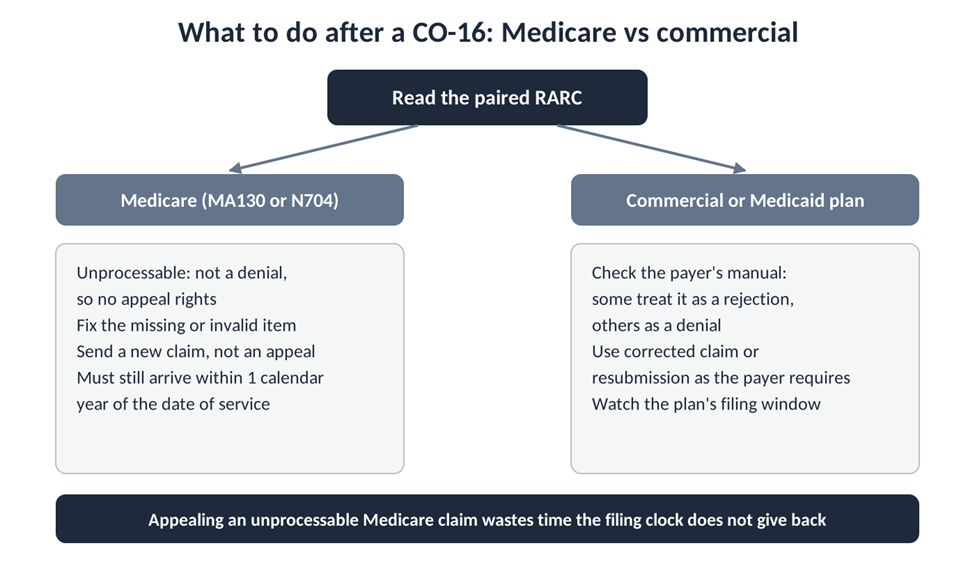
A Medicare CO-16 paired with remark code MA130 or N704 is an unprocessable claim, which Medicare does not treat as a denied claim, so it carries no appeal rights.
First Coast, a Medicare administrative contractor, explains that claims returned as unprocessable cannot be appealed and must be corrected and resubmitted. It points to the CMS Medicare Claims Processing Manual, Chapter 1, Section 80.3, as the governing guidance. If you file an appeal anyway, the contractor returns it and tells you to send a new claim.
The bigger risk is time. Resubmitting does not restart or pause the filing window, so the new claim still has to arrive within Medicare’s limit. Our guide to Medicare’s 12-month filing rule explains how that window is counted.
Medicare Secondary Payer claims follow the same logic. Noridian’s notice on MSP claims rejected with CARC 16 says these claims cannot be appealed by mail, fax or portal and must be sent again as new claims with the corrected information named in the remark code.
Commercial and Medicaid plans set their own rules. Some treat CO-16 as a rejection that needs a fresh claim, while others expect a corrected claim or a reconsideration. Check the payer’s provider manual before choosing a route, and do not assume Medicare’s no-appeal rule carries over.
Which Remark Codes Come With CO-16 Most Often?
The remark codes most often paired with CO-16 point to missing procedure codes, provider identifiers, patient identifiers and other-payer details. Noridian’s Medicare denial code resolution table lists these pairings with resolution notes.
| RARC | What is missing or invalid | What to correct |
| M51 | Procedure code missing, incomplete or invalid | CPT or HCPCS code valid for the service and date |
| N290 | Rendering provider primary identifier | Rendering NPI (National Provider Identifier) enrolled with the payer |
| N264 / N265 | Ordering provider name or identifier | Ordering provider name and NPI on the claim |
| MA04 | Primary payer identity or payment information on a Medicare secondary claim | Primary payer name, payment and adjustment data |
| N382 | Patient identifier, such as the Medicare Beneficiary Identifier | MBI or member ID exactly as shown on eligibility |
| MA120 | CLIA certification number | Valid CLIA certificate number for the testing site |
MA04 is a coordination-of-benefits problem rather than a coding one. When it shows up, our guide to handling secondary insurance claims correctly covers the primary payment details Medicare expects.
In denial audits, a common pattern is that CO-16 volume clusters around one or two fields, such as rendering NPI or patient ID, rather than spreading evenly. Sorting CO-16 lines by remark code usually shows the single setup gap behind most of them.

How to Fix a CO-16 Claim in Six Steps
Fixing a CO-16 claim means correcting the exact item the remark code names and sending the claim through the route the payer requires, before the filing window closes.
- Read the full remark code text on the ERA, not just the CARC.
- Pull the original claim and confirm the field named in the remark code, such as the NPI, MBI or procedure code.
- Correct the source data in your practice management system, not only on this claim, so the next claim goes out clean.
- For Medicare unprocessable claims, submit a new claim; do not appeal or send a reopening.
- For commercial plans, follow the payer’s rule for a corrected claim or a fresh submission, and include the original claim number when the payer asks for it.
- Log the resubmission date and check the next acknowledgment report to confirm the payer accepted it.
When the payer requires a corrected claim instead of a new one, the correction window can differ from the original filing window. Our overview of corrected claim deadlines by payer shows how those windows vary. If the fix arrives too late, the claim can come back as CO-29 instead; see our CO-29 timely filing denial guide.
How Do You Measure and Prevent CO-16 Denials?
You measure CO-16 denials as a share of all billed service lines, and you prevent them by checking the fields behind the most common remark codes before each claim leaves the office.
Formula
- CO-16 rate = CO-16 service lines in the period divided by total billed service lines in the period, times 100
Walkthrough: a clinic billing 1,520 service lines in a month with 38 CO-16 lines has a CO-16 rate of 38 / 1,520 x 100 = 2.5%. That figure is illustrative. No payer or industry body publishes a required CO-16 rate, so track your own trend month over month.
Illustrative scenario (not an actual client record)
A family practice adds a new physician and starts billing her visits right away. Within three weeks, a cluster of Medicare lines returns CO-16 with N290 because her NPI was not yet linked to the group’s enrollment. The billing lead holds her claims, finishes the enrollment link, then resubmits the batch as new claims well inside the filing window.
Prevention works best when each check has a trigger:
- Run eligibility and match the member ID or MBI when a patient is new or reports a coverage change.
- Confirm a rendering NPI is linked to the group before billing when a provider joins or moves locations.
- Capture ordering provider details at scheduling when the service is a lab, imaging or DME order.
- Hold Medicare secondary claims until the primary payment details are posted when a patient has other coverage.
These checks overlap with broader clean-claim work. Our guides to reducing claim rejection rates and clean claim rate improvement strategies show how to build them into front-end workflows.
In A/R reviews, a frequent finding is that CO-16 claims sit in the same queue as clinical denials and wait their turn. Because each one is a data fix with a running filing clock, working them in a separate daily queue usually shortens their turnaround.
When Is Outside Help Worth Considering?
Outside help is worth considering when CO-16 keeps returning even after the obvious fixes. Common signals include:
- The same remark code appears month after month
- New providers bill before their enrollment links are confirmed
- Staff appeal unprocessable Medicare claims instead of resubmitting them
- No one tracks CO-16 as a separate rate
EON Med Solutions is one example of a partner that handles billing, coding, credentialing, denial management and reporting end to end through a US-based team with transparent reporting. Its medical billing services include claim scrubbing, remittance review and resubmission tracking. Results vary by practice and payer mix.
CO-16 Questions Billers Ask
Can you appeal a CO-16 denial?
On Medicare claims marked unprocessable with MA130 or N704, no. Medicare does not treat them as denials, so they carry no appeal rights; you correct the item and submit a new claim. Commercial and Medicaid plans differ, and some do accept a corrected claim or reconsideration, so check the payer’s manual.
What is the difference between CO-16 and CO-29?
CO-16 means the claim is missing information or has a billing error, and it can usually be fixed and resubmitted. CO-29 means the claim reached the payer after the timely filing limit expired. A CO-16 that sits unworked too long can turn into a CO-29 when the corrected claim arrives late.
Does a CO-16 stop the timely filing clock?
No. A CO-16 return does not pause or reset the filing window. For Medicare, the corrected new claim still has to arrive within 1 calendar year of the date of service. Commercial plans apply their own contract or manual windows, so log every resubmission date.
Can a practice bill the patient for a CO-16 amount?
No. The CO group code means contractual obligation, so the adjusted amount is the provider’s responsibility under the payer agreement. Fix the claim and resubmit it rather than shifting the balance to the patient. Patient responsibility appears under the PR group code instead.
What is a good CO-16 rate?
No payer or industry body publishes a required CO-16 rate. As a practical goal, keep it low and falling, because nearly every CO-16 comes from data that can be checked before submission. A rising rate tied to one remark code usually points to a single setup or registration gap.
Expert Opinion
From our billing and RCM work, the CO-16 denial code is one of the most fixable codes on a remittance, provided the team reads the remark code before doing anything else. The firm published standards here are Medicare’s: unprocessable claims carry no appeal rights, must be resubmitted as new claims, and still face the one-year filing limit. The remark code meanings come from Medicare contractor guidance.
The 2.5% rate in this guide is illustrative, and the daily-queue approach is a practical working habit rather than a payer rule. Commercial plans write their own CO-16 procedures, so their manuals decide the route.
The natural next question is which remark code drives most of your CO-16 volume today. If you are not sure, the EON Med Solutions Billing & RCM Team can help you sort it out; you can contact our team when it suits you.
Sources: First Coast Service Options guidance on unprocessable claims, Noridian Medicare denial code resolution table, Noridian notice on MSP claims rejected with CARC 16, and the CMS Medicare Claims Processing Manual, Chapter 1, Section 80.3 (named, not linked). This article is general billing information, not legal advice. Results vary by practice, and figures reflect information available at the time of research.


