

CO-18 Denial Code: What a Duplicate Claim Denial Means
The CO-18 denial code means the payer believes the claim or service line is an exact duplicate of one it has already received. In most cases the original claim is still the one that matters, so the fix starts with finding it rather than sending another copy. This guide explains what CO-18 means, how to tell a true duplicate from a real repeat service, how to fix and appeal it, and how to measure and prevent duplicate denials.
| Key takeaways CARC 18 means exact duplicate claim or service; Medicare often reports it with group code OA rather than CO.Before resubmitting, check the original claim’s status; Noridian advises waiting at least 30 days from submission or remittance.When a service truly was repeated, modifiers 76, 77 or 91 tell the payer it is not a duplicate.Most duplicate denials come from resending claims that were still pending or that needed a corrected claim instead. |
What Does the CO-18 Denial Code Mean?
The CO-18 denial code pairs a group code with claim adjustment reason code (CARC) 18: exact duplicate claim or service. The payer matched the line to a claim it already has for the same patient, provider, date of service and procedure code.
On Medicare remittances, the same reason often appears as OA-18, where OA means other adjustment, rather than CO-18. Either way, the duplicate line does not pay, and the original claim decides what you are owed. Duplicate denials mostly come from follow-up habits, which is why they sit inside accounts receivable management more than coding.
A CO-18 is rarely a loss on its own. It becomes one when the team keeps resending copies instead of working the original, and the real problem on that original goes unfixed until the filing window closes.
Is It a True Duplicate or a Repeat Service?
A true duplicate is the same service billed twice, while a repeat service is a second, separate performance of the same service on the same date that needs a modifier to explain it.
| Situation | What it is | What to do |
| Claim resent while the original was pending | True duplicate | Stop; track the original until it finalizes |
| New copy sent to fix a denied claim | True duplicate | Use a corrected claim or reopening for the original |
| Procedure repeated by the same physician | Repeat service | Report modifier 76 with documentation |
| Procedure repeated by another physician | Repeat service | Report modifier 77 with documentation |
| Clinical lab test repeated the same day | Repeat service | Report modifier 91 when the repeat was needed for the patient |
Modifier meanings follow CPT definitions; payers may require a narrative or additional detail.
First Coast’s tips on avoiding duplicate claims ask for a short narrative in Item 19 when billing modifiers 76 and 77 on paper. They also note that refiling a claim to correct an earlier denial is a frequent cause of unnecessary duplicate denials.

How Do You Fix a CO-18 Denial?
You fix a CO-18 denial by checking what happened to the original claim and then working that claim, appealing only when the service truly was not a duplicate.
- Look up the original claim’s status in the payer portal and find its remittance.
- If the original paid, post the duplicate line as a zero-pay adjustment and stop.
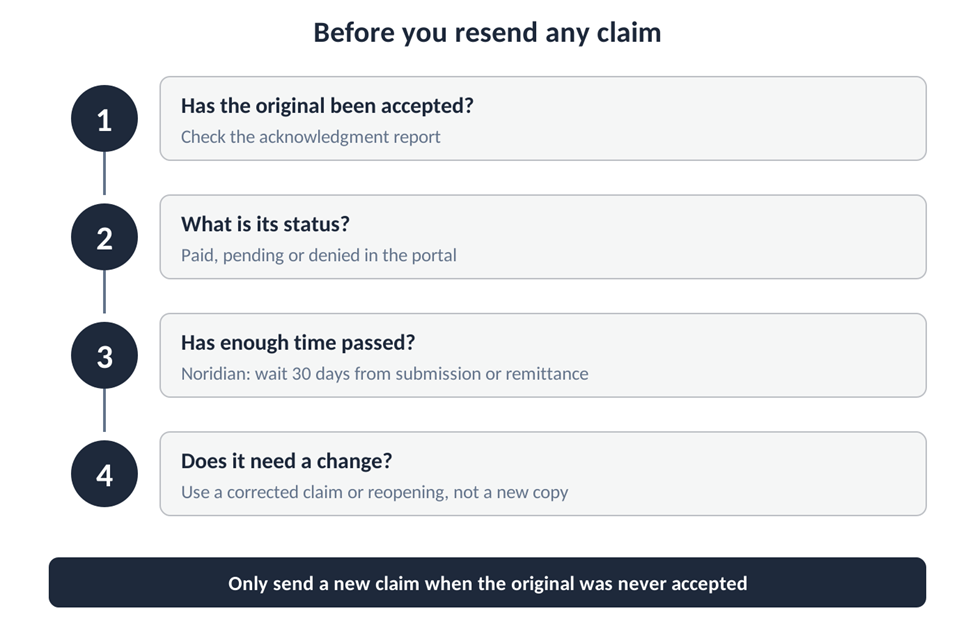
- If the original is still pending, wait. Noridian advises waiting at least 30 days from the first submission or the remittance date before resubmitting.
- If the original was denied, fix it with a corrected claim or reopening, as the payer allows, rather than a new copy.
- If the service really was repeated, send a corrected claim with modifier 76, 77 or 91, or appeal with records showing the separate service.
Noridian’s guidance on exact duplicate claims confirms that these denials carry appeal rights. When the services were not duplicates, you can request a redetermination and attach the documentation. Our guide to corrected claim deadlines by payer explains how long you have to fix a denied original.
In A/R reviews, a common pattern is a claim resent three or four times, with each copy denied as a duplicate. The original was denied for one fixable reason that nobody read. One look at the first remittance would have saved every later copy.
How Do You Measure and Prevent Duplicate Denials?
You measure duplicate denials as a share of claims submitted, and you prevent them by tracking every claim to a final status before anyone sends it again.
Formula
- Duplicate denial rate = claims denied with CARC 18 in the period divided by claims submitted in the period, times 100
Walkthrough: a practice that submits 1,350 claims in a month and receives 27 duplicate denials has a rate of 27 / 1,350 x 100 = 2.0%. The figure and the cause breakdown below are illustrative. No payer or industry body publishes a required duplicate rate.
Illustrative scenario (not an actual client record)
A billing assistant sees a Medicare claim still marked pending after ten days and sends it again to be safe. The original pays two weeks later, and the second copy returns as a duplicate. The practice now holds any resend until a claim has gone 30 days without a final status, and it checks the portal before every manual resubmission.
Prevention works best when each habit has a trigger:
- Check claim status in the portal before any manual resubmission.
- Wait at least 30 days from submission or remittance before resending, following Medicare contractor guidance, unless the claim was never accepted.
- Use a corrected claim or reopening when a denied claim needs a change.
- Put all lines for one date of service on a single claim when possible.
- Add modifier 76, 77 or 91 only when the record shows a true repeat.
These habits are part of a wider follow-up workflow. Our guides to tracking unpaid claims across payers and electronic claim submission tips cover the status checks and acknowledgment reports that stop most duplicates.
In claims audits, a frequent finding is that duplicate denials cluster on one or two staff members or one manual resubmission queue. Sorting CO-18 denials by who sent the copy usually points straight to the training gap.

When Is Outside Help Worth It?
Outside help is worth it when duplicate denials keep returning even after the team knows the rules. Signals include:
- The same claims are resent several times before anyone reads the first remittance
- Nobody owns claim status follow-up by payer
- Repeat lab and procedure services are billed without modifiers
- Duplicate denials are posted and closed without review
EON Med Solutions is one example of a partner that handles billing, coding, credentialing, denial management and reporting end to end through a US-based team with transparent reporting. Its medical billing service includes claim status follow-up and remittance review. Results vary by practice and payer mix.
CO-18 Questions Billing Staff Ask
Can a CO-18 denial be appealed?
Yes, when the service was not actually a duplicate. Noridian notes that Medicare duplicate denials carry appeal rights, so you can request a redetermination with documentation of the separate service. If the line truly duplicates a claim already on file, there is nothing to appeal; work the original claim instead.
What is the difference between CO-18 and OA-18?
Both use CARC 18, exact duplicate claim or service. The group code changes who the adjustment is assigned to: CO is contractual obligation and OA is other adjustment. Medicare remittances often show OA-18. Either way, do not bill the patient for the duplicate line.
How long should I wait before resubmitting a claim?
Noridian advises waiting at least 30 days from the first submission or the remittance date, and First Coast gives similar guidance. Commercial payers set their own processing timelines. Always check the claim’s status first, and resubmit only when the original was never accepted.
Does a CO-18 denial affect timely filing?
Indirectly, yes. A duplicate denial does not extend the filing window. If the original claim was denied for a fixable reason and the team keeps sending copies, the correction can arrive too late and come back as CO-29. Our CO-29 timely filing denial guide explains that risk.
What is a good duplicate denial rate?
No payer or industry body publishes a required rate. As a practical goal, keep it low and falling, since nearly every duplicate denial comes from a resubmission habit. Track the rate monthly and sort it by cause and by who sent the copy to find the fix.
Expert Opinion
From our billing and RCM work, the CO-18 denial code is a symptom of follow-up habits more than a payer problem. The firm published points in this guide are the CARC 18 definition, Medicare contractor guidance to wait 30 days and check status before resubmitting, appeal rights for services that were not duplicates, and the CPT meanings of modifiers 76, 77 and 91.
The 2.0% rate, the cause breakdown and the pending-claim scenario are illustrative, and sorting denials by who sent the copy is a practical habit rather than a payer rule. Commercial payers set their own resubmission rules, so their manuals decide the timing.
The natural next question is how many of your recent duplicate denials started with a claim that was still pending. If you would like help tracing that, the EON Med Solutions Billing & RCM Team is ready to look with you; you can get in touch with our team when it suits you.
Sources: Noridian Medicare guidance on exact duplicate claims, First Coast Service Options tips on avoiding duplicate claims, and CPT modifier definitions. This article is general billing information, not legal advice. Results vary by practice, and figures reflect information available at the time of research.


