UHC Timely Filing Limit Guide for UnitedHealthcare Claims
The UHC timely filing limit is the window UnitedHealthcare gives a provider to submit a claim, and for network providers that window is set in the Participation Agreement rather than by one national number. UnitedHealthcare’s own corrected-claim example uses 90 days from the date of service, but your contract, plan type and state can change the answer. This guide shows how to find the right UHC deadline for commercial, Medicare Advantage and Community Plan claims, how corrected claims and appeals are timed, and how to keep claims from aging into CO-29 denials.
| Key takeaways UnitedHealthcare directs network providers to their Participation Agreement for timely filing, so no single national number covers every plan.Under the commercial and Medicare Advantage guide, a corrected claim must arrive within the same window as the original, counted from the date of service, discharge or final outpatient visit.Reconsideration and appeal together must be finished within 12 months, not 12 months for each step.Community Plan (Medicaid) deadlines come from each state’s care provider manual and can be counted from the remittance date instead. |
UHC Timely Filing Limit at a Glance
The UHC timely filing limit for a network provider is whatever the signed Participation Agreement says, and the other UHC deadlines run on separate clocks. The table below gathers the published figures a billing team can actually rely on, along with the source type behind each one.
| Deadline | Published figure | Source type |
| Original claim, network provider | Set by the Participation Agreement; UHC’s own worked example uses 90 days | UHC provider guidance |
| Corrected claim (commercial and MA guide) | Same window as the original, counted from date of service, discharge or final outpatient visit | UHC provider guidance |
| Reconsideration plus appeal | 12 months to complete both steps | UHC provider guidance |
| Non-contracted MA payment dispute | 120 calendar days from the initial payment | UHC MA dispute guide (2025) |
| Non-contracted MA denial reconsideration | 60 calendar days from the remittance notification | UHC MA dispute guide (2025) |
| Community Plan example: Wisconsin corrected claim | 180 calendar days from the original remittance date | UHC Community Plan of Wisconsin reference guide (2025) |
| Original Medicare, for comparison | 1 calendar year after the date of service | Federal regulation |
These figures sit inside your broader denial prevention work, because a missed window is one of the few denials that usually cannot be fixed with better coding. If timely filing losses keep showing up, it is worth reviewing how your denial management services catch aging claims before the window closes.
Why Does UnitedHealthcare Point You to Your Contract?
UnitedHealthcare points providers to the contract because the same company runs commercial, Exchange, Medicare Advantage and Medicaid products with different rules. Its claims reconsideration and appeals page says timelines vary and refers providers to the Participation Agreement for timely filing.
The 2026 UnitedHealthcare Care Provider Administrative Guide also matters. UHC announced that it took effect on January 1, 2026 for newly contracted providers and on April 1, 2026 for providers already under contract. The same announcement flagged an update to timely filing requirements for corrected claims in Chapter 10. The guide is refreshed each year, so check the current edition when a new year starts.
In billing audits, a common pattern is a team that calendars 90 days for every UHC claim because a cheat sheet said so. Meanwhile, the signed agreement for one location carries a different period, or an amendment changed it years ago. The cheat sheet is not wrong about the example; it is wrong about your contract.
How to find the filing period in your agreement
- Pull the signed Participation Agreement and every amendment for each Tax ID and location you bill under.
- Search the claims or payment section for the claim submission period and write down the number of days.
- Record the start event: date of service, discharge date or final outpatient visit.
- Note any product carve-outs, such as Medicare Advantage or Community Plan attachments with their own terms.
- When the agreement is silent or unclear, ask your UHC network contact in writing and keep the reply with the contract file.
How Do Deadlines Differ by UHC Plan Type?
UHC deadlines differ by plan type because each product line answers to a different rulebook: the contract for commercial and contracted Medicare Advantage claims, UHC’s dispute rules for non-contracted Medicare Advantage, and state manuals for Community Plan claims.
| Plan family | What sets the filing window | What to check |
| Commercial or Exchange, participating | Participation Agreement | Agreement and amendments for the billing Tax ID |
| Commercial, not participating | Member plan terms and state rules | Member ID card, plan documents and your state’s prompt-pay rules |
| Medicare Advantage, contracted | Participation Agreement and the Medicare Advantage terms in it | MA attachment to the agreement |
| Medicare Advantage, non-contracted | UHC dispute rules for non-contracted providers | 120-day payment dispute and 60-day denial reconsideration windows |
| Community Plan (Medicaid) | State care provider manual and state Medicaid rules | Current manual for the state where the member is enrolled |
Original Medicare is a useful comparison but not the rule for UHC plans. Under the federal timely filing regulation at 42 CFR 424.44, Medicare claims must be filed within 1 calendar year after the date of service. Our guide to Medicare’s one-year filing rule covers its exceptions. Medicare Advantage, Medicaid and commercial plans set their own limits in the contract, state program or provider manual, so always read the manual that matches the member’s plan.
Community Plan claims deserve extra care, because state rules can change the start event as well as the length. In the UHC Community Plan of Wisconsin reference guide, for example, corrected claims and reconsiderations are counted from the original remittance date. For the wider picture,
see how Medicaid filing windows work across states.
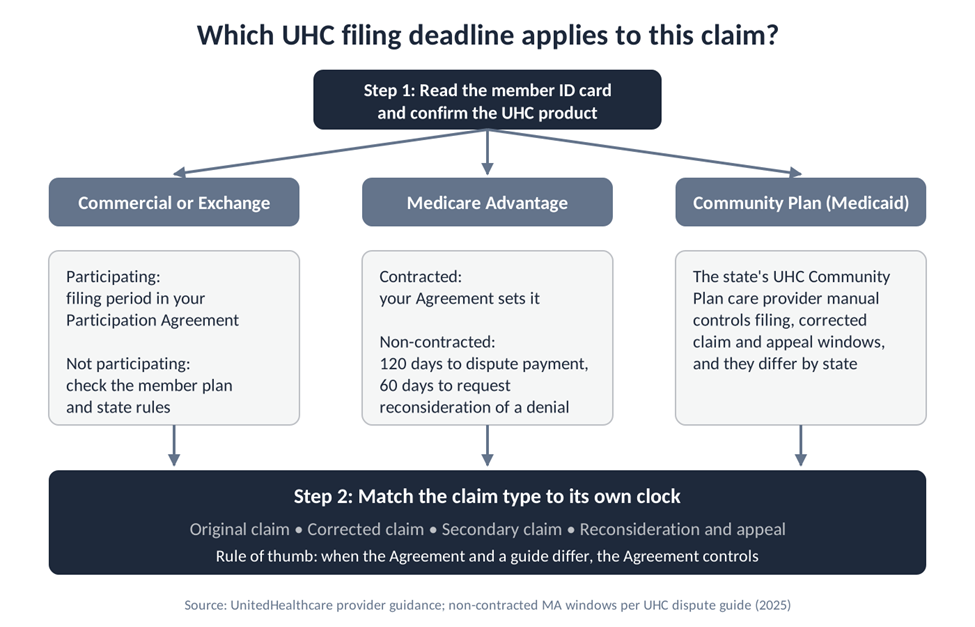
In short, the flowchart reads the member card first, picks the plan family second and then matches the claim type to its own deadline.
Which UHC Clock Applies to Corrected, Secondary and Appealed Claims?
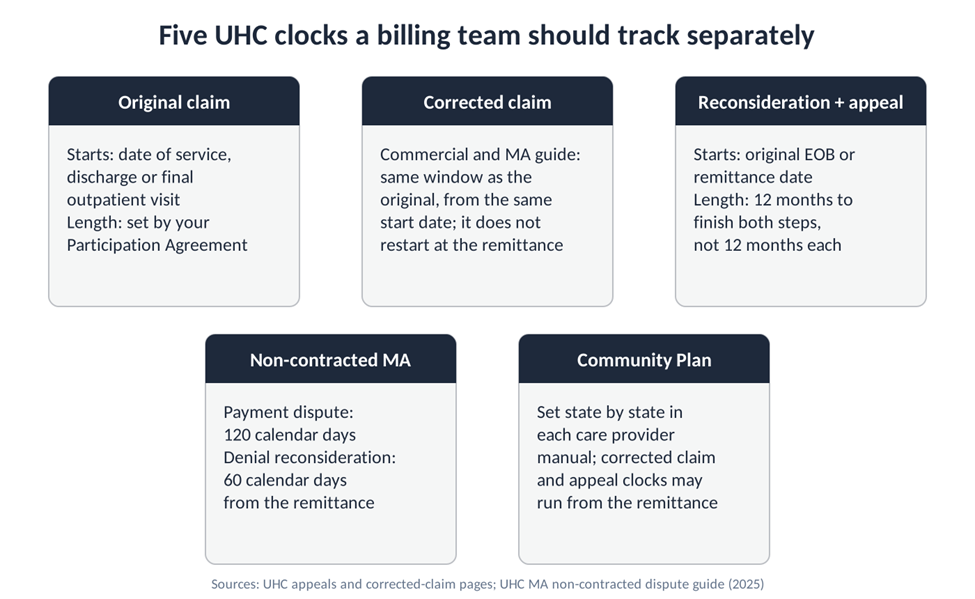
Each UHC claim type runs on its own clock, so a billing team should track the original claim, the corrected claim, the secondary claim and the dispute as separate dates.
Corrected claims
For commercial and Medicare Advantage claims, UHC expects corrected claims within the same required number of days after the date of service, discharge or final outpatient visit. The window does not restart when the remittance arrives. UHC’s corrected claim guidance gives the example of a May 1 service with 90 days allowed, which means corrections must be received by July 30.
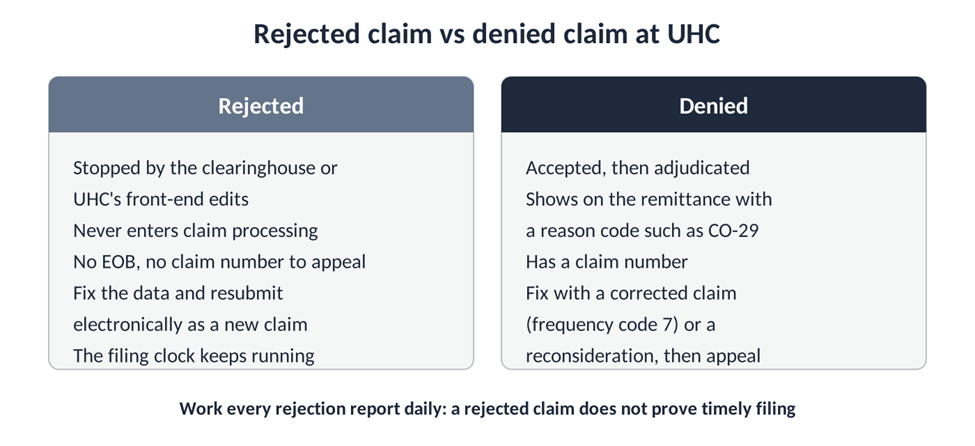
Submit the correction with frequency code 7 in loop 2300 (CLM05-3) or as the last digit of the institutional bill type, or in Box 22 on paper with the original claim number. Use a corrected claim when the original was accepted and needs a change; send a new claim when the original was rejected. Our overview of corrected claim deadlines across other payers shows how other carriers treat the same step.
Secondary claims
When UHC is the secondary payer, send the claim electronically in the HIPAA standard 837 version 5010 format with the primary payer’s payment details, and UHC does not need the paper EOB (explanation of benefits). Do not send a claim that Medicare already crossed over, which shows as remark code MA-18 on the Medicare remittance. The secondary claim deadline itself comes from your agreement or state manual. For the general mechanics, see our guide to filing limits for secondary claims.
Reconsideration and appeal
UHC uses a two-step claim reconsideration and appeal process, and both steps must be completed within 12 months. File a reconsideration first; if you still disagree, file an appeal. Most network providers must submit both digitally. Because the 12 months covers both steps, a slow reconsideration shortens the time left for the appeal. Our explainer on the difference between a filing limit and an appeal limit walks through why these clocks should never share one date.
How Do You Calculate a UHC Filing Deadline?
A UHC filing deadline equals the start event plus the number of days in your agreement, and the days remaining equal that deadline minus today’s date.
Formula
- Filing deadline = last date of service (or discharge or final outpatient visit) + filing days in the agreement
- Days remaining = filing deadline minus today
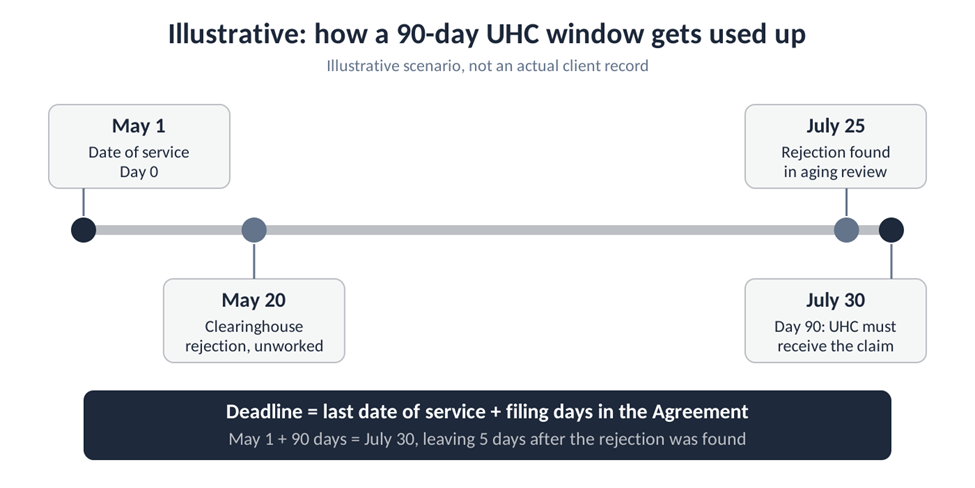
Walkthrough 1, outpatient: a visit on May 1 with a 90-day agreement gives May 1 + 90 days = July 30. Walkthrough-2, inpatient: a discharge on June 12 with the same 90-day term gives June 12 + 90 days = September 10. Walkthrough 3, dispute: a remittance dated March 10, 2026 gives a reconsideration and appeal path that must be finished by March 10, 2027.
Illustrative scenario (not an actual client record)
A family practice bills a commercial UHC visit dated May 1 under a 90-day agreement. The clearinghouse rejects the claim on May 20 for a subscriber ID mismatch, but nobody works the rejection report. The claim surfaces on July 25 during an aging review, five days before the July 30 deadline. The team fixes the ID, resubmits electronically and gets acceptance two days later. One more unworked week would have turned a data error into a write-off.
Sample (fictional data)
| Claim reference | UHC product | Last date of service | Filing days in agreement | Deadline | Days left on Nov 2, 2026 |
| A-1042 | Commercial PPO | Aug 14, 2026 | 90 | Nov 12, 2026 | 10 |
| A-1077 | Medicare Advantage, contracted | Jul 2, 2026 | 180 | Dec 29, 2026 | 57 |
| A-1103 | Community Plan | Sep 3, 2026 | 90 | Dec 2, 2026 | 30 |
Filing days here are fictional contract terms. Replace them with the periods in your own agreements and state manuals.
Sort a tracker like this by days left, not by date of service. Escalate any claim with fewer than 15 days left when it has not been accepted yet; 15 is a practical internal trigger, not a UHC rule.
What Causes UHC Timely Filing Denials, and How Do You Fix Them?
UHC timely filing denials happen when the claim arrives after the window closes, and they appear on the remittance as claim adjustment reason code 29, the time limit for filing has expired. Noridian’s CARC 29 guidance shows the same code description on Medicare claims. Our CO-29 denial code breakdown covers the code across payers.
| Cause | Fix now | Prevent next time |
| Clearinghouse or payer rejection never worked | Correct the data and resubmit electronically as a new claim | Work rejection reports every business day |
| Wrong payer or member ID at registration | Check eligibility, then resubmit to the right UHC product | Scan the card and run eligibility at every visit |
| Correction sent after the original window | Submit a reconsideration if you have proof the original was timely | Calendar corrections from the date of service, not the remittance |
| Primary payer slow, UHC secondary late | Send the secondary claim with primary payment data the day the primary remits | Track open primary claims with a secondary flag |
| Paper claim with no delivery proof | Gather any submission records and request reconsideration | Move UHC claims to electronic submission |
In A/R reviews, a frequent finding is that rejection reports are worked weekly while denials are worked daily. That ordering is backward for timely filing, because a rejected claim never reached UHC and its clock is still running quietly.
What if you filed on time and still got CO-29?
When you believe the claim was filed on time, request a reconsideration and attach proof of acceptance, such as the 277CA claim acknowledgment from your clearinghouse showing the payer accepted the claim and the date. A clearinghouse rejection does not count as proof, because the claim never entered UHC processing. Our checklist of documents that prove timely filing explains what payers usually accept.
UHC Timely Filing Rules in Specific States
State rules can add a second layer to the UHC contract, so these state guides go deeper where state law or a Community Plan manual changes the picture.
California. UHC California claim deadline guide explains how California’s state claim rules sit alongside UHC contract terms. It helps practices billing California commercial and Medicare Advantage members.
Texas. UHC Texas filing deadlines by plan type covers the Texas Insurance Code window for fully insured plans. It also separates those plans from self-funded and Medicare Advantage claims.
Florida. UHC Florida filing rules compares common contract terms with Florida’s statutory claim window. It shows why the shorter window should be calendared until the contract is confirmed.
New York. UHC New York claim deadlines walks through New York’s statutory filing rules. It also explains how UHC products in the state differ from similarly named state plans.
Illinois. UHC Illinois filing windows focuses on finding the contract clause, since UHC does not publish one Illinois figure. It also notes how Illinois Medicaid managed care fits in.
Pennsylvania. UHC Pennsylvania filing windows by product explains why commercial, Medicare Advantage and Community Plan claims in Pennsylvania can carry different windows.
When Should a Practice Get Help With UHC Claims?
Outside help makes sense when timely filing losses keep recurring even though the rules are known. Common signals include:
- CO-29 denials appear on UHC remittances more than once a quarter
- Rejection reports go unworked for more than a few days
- No one can say which Participation Agreement applies to each location
- Corrections and reconsiderations are tracked in email instead of a dated queue
EON Med Solutions is one example of a partner that handles billing, coding, credentialing, denial management and reporting end to end through a US-based team with transparent reporting. Its accounts receivable management service includes working aging claims and payer follow-up so deadlines are watched daily. Results vary by practice, payer mix and contract terms.
UHC Timely Filing Questions Billers Ask
What is the timely filing limit for UnitedHealthcare?
For network providers, the timely filing limit for UnitedHealthcare is the period written in the Participation Agreement. UHC’s own corrected-claim example uses 90 days from the date of service, but that is an example, not a universal rule. Medicare Advantage non-contracted providers and Community Plan claims follow separate dispute rules and state manuals.
Is the UHC timely filing limit 90 days or 180 days?
It can be either, or another number, because the contract sets it. Ninety days appears in UHC’s published example, while some agreements and state manuals use longer windows, such as 180 days for certain Community Plan corrections. Read your signed agreement and its amendments before calendaring any UHC claim.
Does a corrected claim get a new timely filing window with UHC?
No, not under the commercial and Medicare Advantage guide. UHC expects corrected claims within the same number of days after the date of service, discharge or final outpatient visit as the original. Some Community Plan states count corrections from the original remittance date, so check the state manual for Medicaid members.
How long do I have to appeal a UHC claim?
UHC gives network providers 12 months to complete both the reconsideration and the appeal, not 12 months for each step. Non-contracted Medicare Advantage providers have 60 calendar days from the remittance to request reconsideration of a denial and 120 days to dispute a payment amount.
What is a good timely filing denial rate for UHC claims?
No payer or industry body publishes a required timely filing denial rate. As a practical goal, it should sit close to zero, because these denials come from process gaps rather than clinical or coding questions. Any recurring CO-29 on UHC claims points to rejection work, eligibility or tracking problems worth fixing.
Expert Opinion
From our billing and RCM work, the UHC timely filing limit is less about memorizing a number and more about knowing which document controls each claim. The firm published standards in this guide are UHC’s own rules: corrected claims share the original window under the commercial and Medicare Advantage guide, reconsideration and appeal share one 12-month window, and non-contracted Medicare Advantage disputes run 120 and 60 days. Original Medicare’s one-year limit comes from federal regulation.
Everything else is practical. The 90-day figure is UHC’s example, not your contract, and the 15-day escalation trigger is an internal working target. Contract terms and state manuals change, so treat any number you have not read in your own agreement as unconfirmed.
The natural next question is whether your current workflow would catch a rejected UHC claim before day 85. If you are not sure, the EON Med Solutions Billing & RCM Team is happy to look at it with you; you can reach our team here.
Sources: UnitedHealthcare claims reconsideration and appeals page, UnitedHealthcare corrected claim guidance, UnitedHealthcare 2026 Administrative Guide announcement, UnitedHealthcare Medicare Advantage non-contracted provider dispute guide (2025), UnitedHealthcare Community Plan of Wisconsin claim time frames reference guide (2025), 42 CFR 424.44 and Noridian CARC 29 guidance. This article is general billing information, not legal advice. Results vary by practice, and figures reflect information available at the time of research.