

Cigna Timely Filing Limit: 90-Day Rule and Exceptions
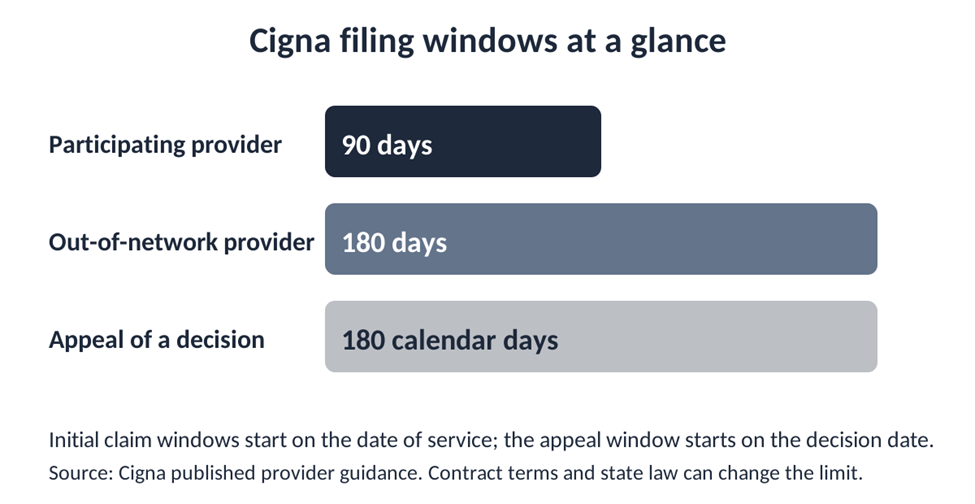
The Cigna timely filing limit is 90 days from the date of service for participating providers and 180 days for out-of-network providers, according to Cigna’s published guidance. Contract terms and state law can change that window, and secondary claims run from the primary payer’s processing date. This guide shows how the clock starts, which exceptions apply, how to calculate a real deadline, and what to do when Cigna denies a claim as untimely, a core step in denial management.
| Key takeaways Participating providers have 90 days from the date of service; out-of-network providers have 180 days, per Cigna’s published guidance.Provider agreements, state law and plan-specific terms can override the default window.Secondary claims are measured from the processing date on the primary payer’s EOB or EOP.Appeals must start in writing within 180 calendar days of the initial payment or denial decision. |
What Is the Cigna Timely Filing Limit?
Cigna requires participating providers to file claims within 90 days after the date of service, and it allows out-of-network providers 180 days. Cigna’s own When to File Your Claims guidance publishes both windows. For consecutive-day services, such as a hospital stay, the count starts on the last date of service.
| Situation | Window | Clock starts | Source type |
| Participating provider, initial claim | 90 days | Date of service (last date for consecutive-day services) | Published payer guidance |
| Out-of-network provider, initial claim | 180 days | Date of service (last date for consecutive-day services) | Published payer guidance |
| Secondary claim after a primary payer | The applicable limit above | Processing date on the primary payer’s EOB or EOP | Published payer guidance |
| Claim filed on time, then Cigna requests more information | Original filing date counts | Original submission | Published payer guidance |
| Appeal of a payment or denial decision | 180 calendar days | Date of the initial decision (or last payment adjustment) | Published payer appeal policy |
Source labels: published payer guidance means Cigna’s provider-facing pages, reviewed in October 2026. EOB is explanation of benefits; EOP is explanation of payment. Your provider agreement and state law can change these limits.
In billing audits, a common pattern is staff memorizing the 90-day figure and applying it to every Cigna claim, which hides contract and state exceptions that give more time. A deadline tracker that records the payer, plan type and clock start for each claim keeps both windows visible; the guide on how to track timely filing deadlines shows one way to build it.
Can a Contract or State Law Extend the Cigna Filing Window?
Yes. Cigna’s guidance states that state legislation and plan-specific language supersede its administrative guidelines, and it names two situations that allow more time: applicable law that requires a longer period, and a provider agreement that specifically allows additional time. Check both documents before you write off a claim that looks late by the 90-day count.
Extraordinary circumstances, such as a natural disaster, are a third exception, and Cigna may ask for evidence of the event. Cigna’s guidance also notes that participating-provider contracts prohibit billing the patient for claims denied for late filing, so a missed deadline becomes a practice write-off rather than a patient balance. Confirm exceptions before the deadline, not after the denial.
Do record any negotiated window in your tracker when your agreement allows more than 90 days, and attach the contract page that says so. In billing audits, a common pattern is a negotiated filing window that never reaches the billing system, so staff keep working to the default. The article on payer-specific claim submission rules covers how rules differ across plans.
How Do Corrected Claims, Resubmissions and Secondary Claims Fit the Clock?
A claim that Cigna asks you to resubmit keeps its original filing date, while a resubmission Cigna did not request is held to the normal limit unless it is an appeal. Cigna’s guidance says that when a claim was filed on time but Cigna requested more information, the original filing date counts. The pages reviewed do not set a separate deadline for a corrected claim, so file one inside the normal window; see corrected claim timely filing deadlines for payer examples.
Secondary claims use a different starting point. Cigna measures timely filing from the processing date shown on the primary carrier’s explanation of benefits, and you still file within the applicable limit. Keep the primary EOB attached and logged. The secondary claim filing rules guide walks through coordination of benefits timing.
How Do You Calculate a Cigna Timely Filing Deadline?
Count calendar days from the date of service, or from the last date of service for consecutive-day care, and mark day 90 for participating claims or day 180 for out-of-network claims. For a secondary claim, count from the processing date on the primary payer’s EOB or EOP instead. Put the result on the claim’s worklist the day the claim is created.
Formula: deadline = start date + limit. The start date is the date of service for a primary claim, or the primary payer’s processing date for a secondary claim. The limit is 90 or 180 days, unless your contract or state law gives more.
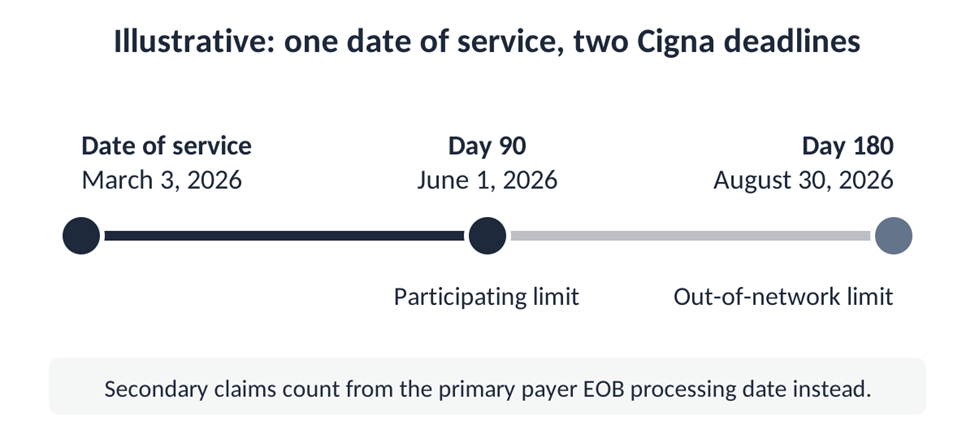
Illustrative scenario (not an actual client record): a participating provider sees a patient on March 3, 2026, so day 90 falls on June 1, 2026. If an out-of-network provider billed the same visit, day 180 falls on August 30, 2026. For a participating provider’s secondary claim, a primary EOB processed on July 14, 2026 puts day 90 on October 12, 2026.
| Illustrative scenario | Start date | Limit | Last day |
| Participating provider, primary claim | March 3, 2026 | 90 days | June 1, 2026 |
| Out-of-network provider, primary claim | March 3, 2026 | 180 days | August 30, 2026 |
| Participating provider, secondary claim | July 14, 2026 (primary EOB processed) | 90 days | October 12, 2026 |
Do set an internal submission target well before the deadline, such as 30 days after the date of service, when your staff has a backlog or your payer mix includes slow primary payers. That 30-day target is a practical planning figure, not a Cigna requirement.
What Should You Do When Cigna Denies a Claim as Untimely?
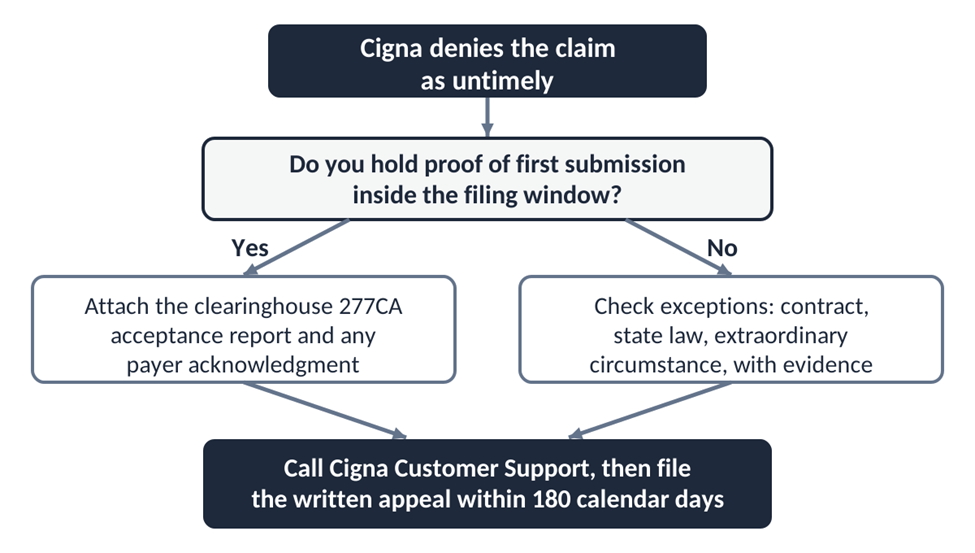
Confirm the original submission date first, then file a written appeal within 180 calendar days of the denial decision if the claim was filed on time or an exception applies. Cigna’s appeal policy for health care professionals states that the review must start in writing within 180 calendar days of the initial payment or denial decision, or of the last payment adjustment.
- Read the explanation of payment to confirm the denial reason and the decision date.
- Pull the clearinghouse acceptance report, known as a 277CA, and any payer acknowledgment that shows the first submission date.
- Check your provider agreement, state law and any extraordinary circumstance for extra time.
- Call Cigna Customer Support at the number on the member’s ID card, as Cigna’s appeal policy directs.
- If the claim stays denied, send the payment review form with a copy of the original claim, the explanation of payment and supporting documents before day 180.
An appeal window and a filing window are separate clocks, and missing one does not reset the other; the comparison of timely filing limit vs appeal filing limit shows how they differ. Do start the appeal packet the day the denial arrives, because gathering records late is a common reason appeals miss the window.
Which Mistakes Cause Cigna Timely Filing Denials?
Most Cigna timely filing denials trace to a few repeatable errors: counting from the wrong date, losing proof of the first submission, and applying one limit to every claim. The table pairs each mistake with its fix.
| Mistake | Why it hurts | Fix |
| Counting from charge entry or billing date | The clock starts at the date of service, so the real deadline is earlier | Calculate from the date of service on day one |
| Treating an upload as filed | A claim rejected at the clearinghouse or payer front end was never accepted | Review rejections daily and keep acceptance reports |
| Counting secondary claims from the date of service | Cigna measures from the primary payer’s processing date | Log the primary EOB date when it posts |
| Ignoring contract or state exceptions | Staff write off claims that had more time | Record negotiated windows with the source document |
| Letting a requested resubmission sit | Cigna keeps the original date only when it asked for the information | Answer payer requests promptly and keep the request |
In billing audits, a common pattern is front-end rejections going unread for days, so a claim that never reached Cigna is discovered only after the window closes. Daily rejection review fixes most of that, and the guide to reducing claim rejection rates covers the routine.
When Should a Practice Consider Outside Help With Cigna Deadlines?
A practice should consider outside help when timely filing write-offs repeat across payers, not just Cigna, and internal tracking has stopped catching them. Four signals suggest the in-house approach has hit its limits:
- Timely filing denials appear every month despite reminders.
- No one owns daily review of clearinghouse rejections.
- Secondary claims wait for primary payments with no tracked deadline.
- Negotiated filing windows are not recorded where billing staff can see them.
When evaluating outside support, look for payer-by-payer deadline tracking, saved proof of submission, appeal handling, and reporting you can read without a request. EON Med Solutions is one example: its US-based team delivers end-to-end billing, coding, credentialing, denial management and reporting with transparent reporting, and you can review the billing and denial management services it offers. Results vary by practice.
Cigna Filing Deadline Questions, Answered
What is the Cigna timely filing limit for participating providers?
Participating providers have 90 days after the date of service to file a claim with Cigna. For consecutive-day services such as a hospital stay, the count starts on the last date of service. A provider agreement or state law can allow more time, so check your contract before writing off a claim.
How long do out-of-network providers have to file with Cigna?
Cigna’s published guidance gives out-of-network providers 180 days after the date of service. The same rule for consecutive-day services applies, counting from the last date of service. State law and plan-specific language can supersede Cigna’s administrative guidelines, so confirm the rule that governs the member’s plan.
How long do you have to appeal a Cigna timely filing denial?
Cigna’s appeal policy for health care professionals says the review must start in writing within 180 calendar days of the initial payment or denial decision. If Cigna adjusted the payment, the 180 days run from the last payment adjustment. Contact Customer Support first, then send the payment review form.
When does the clock start for a Cigna secondary claim?
Cigna measures timely filing for coordination of benefits from the processing date shown on the primary carrier’s explanation of benefits or explanation of payment. File the secondary claim within the applicable limit from that date, and keep the primary EOB attached as proof of the starting point.
Expert Opinion
The Cigna timely filing limit is simple to state and easy to mismanage. The 90-day and 180-day windows and the 180-day appeal period come from Cigna’s published provider pages; the 30-day internal submission target in this guide is a practical planning figure, and the worked dates are illustrative. Contract language and state law can change the real number for your practice.
A tracker that records the clock start, the limit and the proof of submission for every claim does more to prevent denials than any single rule. Do the work at claim creation, not at denial, and review it weekly when claim volume is high.
The natural next question is how to keep every payer’s clock visible in one place. The EON Med Solutions team can walk through that setup on the contact page, or you can start with the services overview.
Sources: Cigna Healthcare provider guidance, When to File Your Claims, and Appeal Policy and Procedures for Health Care Professionals (reviewed October 2026). Results vary by contract, plan and state; figures reflect information available at the time of research. This article is general information, not legal advice.


