

Medicaid Virginia Timely Filing Limit: The 12-Month Rule, the 13-Month Resubmission Clock and Cardinal Care Plans (2026)
The Medicaid Virginia timely filing limit is 12 months from the date of service. Virginia regulation 12VAC30-95-10 requires the Department of Medical Assistance Services (DMAS) to receive each claim within that window. A denied claim must be resubmitted within 13 months of its initial denial. Two exceptions restart the clock.
Most Virginia billers know the 12-month number and miss everything attached to it. The regulation counts receipt, not mailing. It sets a second clock for denials, and Cardinal Care health plans publish their own rules. This guide walks through the Medicaid Virginia timely filing limit provision by provision, then covers the three clocks, plan differences, four calculations and a self-assessment checklist.
Virginia Medicaid deadlines in one table
| Metric | Practical target/range | Review frequency | Source type |
| Fee-for-service claim filing limit | 12 months from the date of service | Annually | A |
| Resubmission of a denied claim | Within 13 months of the initial denial | Per denial | A |
| Medicare-related claims | DMAS may pay within 6 months after Medicare disposition notice | Per claim | A |
| Third-party retraction or delayed eligibility | New 12-month period starts at the notice date | Per event | A |
| Cardinal Care health plans | 5 plans, each with its own manual | Each manual update | A |
| Anthem HealthKeepers Plus initial claims | 365 days from service (2024 notice); 12 months (2026 policy) | Each policy update | A |
| Humana Healthy Horizons corrected claims | 180 days from receipt of the explanation of payment | Each manual update | A |
| Claim submission turnaround | Within 30 days of service for 95% or more of claims | Weekly | C |
| Aging alerts for unpaid claims | 90, 180 and 270 days from service | Daily worklist | C |
Source types: A = published government or payer source (Virginia regulation, DMAS, health plan documents). B = named benchmarking data provider (none used). C = practical planning target from common industry practice. D = survey or study data (none used). Plan documents change, so confirm the current edition.
Read the regulation first: 12VAC30-95-10, provision by provision
Virginia’s timely filing rule sits in 12VAC30-95-10, titled “Timely claims filing,” and it requires providers to submit all claims to DMAS no later than 12 months from the date of service. The regulation derives from the Virginia Register, Volume 31, Issue 9, effective February 13, 2015. You can read the full text on the Virginia Administrative Code site.
Federal law sets the same ceiling. 42 CFR 447.45(d)(1) requires states to make providers submit claims within 12 months of the date of service. The Virginia rule therefore adds no extra time, but it adds mechanics that national blogs rarely mention.
| Provision | What it says | What it means for billing |
| A. Definition of “submit” | Actual, physical receipt by DMAS, documented in DMAS records | The claim counts only when DMAS receives it |
| B. The limit | All claims within 12 months of the date of service; late claims are denied | Build every deadline from the service date |
| C. Proof of receipt | The provider carries the burden; mailing or transmitting is not proof | Keep acknowledgments, and confirm receipt inside the 12 months |
| D. Medicare-related claims | DMAS may pay within 6 months after notice of the Medicare disposition, if Medicare was filed on time | Date-stamp every Medicare remittance |
| E. Exceptions | Third-party retraction and retroactive Medicaid eligibility restart the 12 months at the notice date | Keep the retraction letter or eligibility notice |
| F. Resubmission | Denied claims may be resubmitted with all documentation; no reconsideration after 13 months from the initial denial | Send every supporting document the first time |
| G. Final denial | A resubmitted claim that is denied again cannot be submitted again | You get one resubmission, so make it complete |
Source: 12VAC30-95-10, Virginia Administrative Code. The regulation governs claims submitted to DMAS; health plans follow their own contracts and manuals.
In billing audits, a common pattern is that practices treat a clearinghouse “accepted” message as proof of timely filing. Under subsection C, the burden of proof sits with the provider, so keep the payer-level acknowledgment and the remittance, not only the clearinghouse screen.
Three clocks run side by side
A Virginia Medicaid claim can sit under three clocks at once, and each starts from a different event. The standard clock runs 12 months from the date of service. The resubmission clock runs 13 months from the initial denial date. The exception clock restarts when a third-party retraction notice or a delayed eligibility notice arrives.
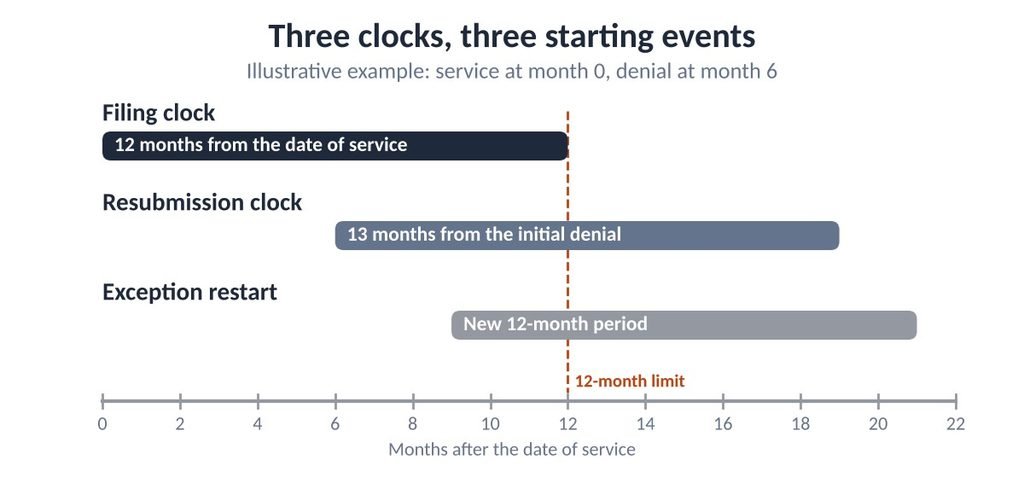
The 13-month rule matters most because it is easy to overlook. A provider manual chapter states that denied claims must be submitted and processed on or before 13 months from the date of the initial denied claim. That chapter, the DMAS Local Education Agency manual updated September 17, 2024, also requires a complete invoice and written documentation with the resubmission.
Electronic billers who need a timely filing waiver use the DMAS-3 Claim Attachment Form, according to the same chapter. Provider-type chapters differ, so read the chapter for your own provider type before you rely on that form, and ask DMAS provider support whether a waiver request fits your situation.
Find your deadline: situation by situation
The right deadline depends on what happened to the claim, so match your situation to the row below. Use the earliest date that applies, and confirm anything unusual with DMAS or your health plan before the window closes, not after a denial arrives.
| Situation | Clock that applies | Starts at |
| First submission of a fee-for-service claim | 12 months | Date of service |
| Claim denied for a fixable error | 13 months for resubmission, but the original must have been filed within 12 months of service | Initial denial date |
| Medicare paid first and a crossover is needed | DMAS may pay within 6 months after the Medicare notice, if Medicare was filed on time | Medicare disposition notice |
| Another payer retracted its payment | New 12-month period | Retraction notice date |
| Medicaid eligibility was determined late | New 12-month period | Date of the delayed-eligibility notice |
| Claim sent to a Cardinal Care plan | Plan manual or contract | Plan-defined date |
Source: 12VAC30-95-10 and the DMAS provider manual chapter cited above. Health plan rows depend on the plan’s own documents.
Virginia calls late eligibility decisions delayed eligibility, and the local department of social services issues the notice. That notice, not the original service date, restarts the clock. Keep the notice date on the account so billers can find it later, and compare the logic with our guide to secondary claim timely filing deadlines when another insurer is involved.
Four calculations to run before a claim ages out
Four short calculations turn the regulation into dates and rates. Run the first three on any claim older than 90 days, and the fourth every month. Each shows the formula first, then an illustrative scenario with real numbers that your team can copy into a spreadsheet.
Calculation 1: the 12-month deadline
Formula: deadline = date of service + 12 months, with DMAS receipt documented before that date.
Illustrative scenario (not an actual client record): a service is delivered on November 3, 2025, so the deadline is November 3, 2026. On October 16, 2026, 18 days remain. Because receipt must be documented by DMAS, a claim in this position should go out today, with a same-day check on the acknowledgment.
Calculation 2: the 13-month resubmission window
Formula: resubmission deadline = initial denial date + 13 months, and only if the original claim was filed within 12 months of service.
Illustrative scenario (not an actual client record): a claim filed on June 2, 2026, for a March 2026 service, is denied on August 12, 2026. The resubmission deadline is September 12, 2027. On October 16, 2026, roughly 11 months remain, but the corrected claim should still go out with every supporting document.
Calculation 3: the Medicare-related window
Formula: Medicare-related payment window = date of Medicare disposition notice + 6 months, if the Medicare claim was timely filed.
Illustrative scenario (not an actual client record): a service on February 10, 2025, passes its 12-month point on February 10, 2026. Medicare’s disposition notice arrived January 15, 2026, so the six-month window runs to July 15, 2026. DMAS “may” pay in that window, so file well ahead of it and keep the Medicare filing proof.
Calculation 4: the on-time submission rate
Formula: on-time rate = claims submitted within 30 days of service ÷ total claims × 100.
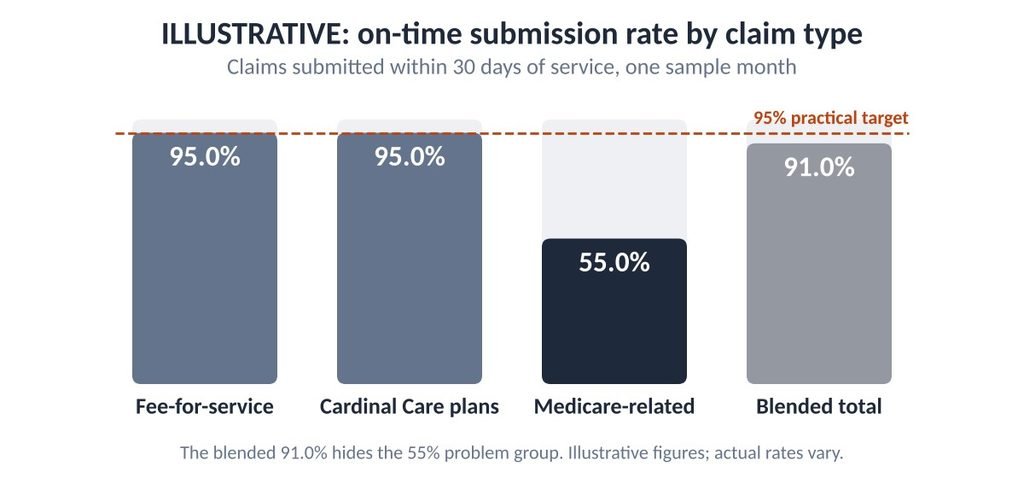
Illustrative scenario (not an actual client record): one month of Virginia Medicaid claims, split by claim type, shown next to the blended total that most dashboards report.
| Claim type (Illustrative) | Claims | Submitted within 30 days | On-time rate |
| Fee-for-service | 160 | 152 | 95.0% |
| Cardinal Care plans | 200 | 190 | 95.0% |
| Medicare-related claims | 40 | 22 | 55.0% |
| Blended total | 400 | 364 | 91.0% |
Illustrative figures; actual rates vary by practice, specialty and plan mix.
The blended 91.0% looks close to a 95% practical target. The Medicare-related line sits at 55%, and the combined number hides it. Review each claim type on its own whenever one group waits for another payer before it can bill.
Reading your numbers without fooling yourself
Compare like for like. Fee-for-service claims, Cardinal Care plan claims and Medicare-related claims each run on different rules, so each deserves its own row in your report. One missed benchmark is a signal to investigate, not a verdict on the billing operation.
When a rate falls below target, check three things first. Was the deadline built from the right date? Did the delay sit in registration, in coding or in waiting for another payer? Do the late claims share a trigger such as a Medicare remittance? A cluster of late claims usually traces to one cause, such as a staffing gap or a stalled eligibility batch.
Cardinal Care plans and fee-for-service follow different rulebooks
As of July 1, 2025, five managed care organizations (MCOs) serve Cardinal Care, Virginia’s Medicaid managed care program: Aetna Better Health of Virginia, Anthem HealthKeepers Plus, Humana Healthy Horizons of Virginia, Sentara Health Plans and UnitedHealthcare of the Mid-Atlantic. Each plan’s published claim rules apply to its members, not the DMAS regulation alone.
| Plan | Initial claims | Corrections and disputes | Source |
| Fee-for-service (DMAS) | 12 months from service | Resubmit within 13 months of denial | 12VAC30-95-10 |
| Anthem HealthKeepers Plus | 365 days from service | Corrected claims within 12 months of the original explanation of payment | Anthem provider news, Sept. 20, 2024 |
| Humana Healthy Horizons | 365 days from service | Corrected claims within 180 days of receiving the explanation of payment | Humana Virginia provider resource guide (undated) |
| Aetna Better Health of Virginia | 365 days from service or discharge | Corrected claims within 365 days from service | Aetna quick reference guide (undated) |
| UnitedHealthcare Community Plan | See Care Provider Manual, chapter 11 | Appeals within 30 days after final adjudication | UnitedHealthcare 2026 Virginia manual |
| Sentara Health Plans | Product guidelines; call Provider Customer Service | Not published on the page reviewed | Sentara provider site |
Anthem’s 2026 claims timely filing policy states 12 months, so confirm which wording applies to your contract. Document dates are those shown by each source; verify the current edition.
Twelve months and 365 days are nearly the same, and leap years can separate them by a day. When a plan says 365 days, count days; when the regulation says 12 months, count months. Use the earlier date if you cannot tell which wording governs your contract.
In billing audits, a common pattern is that practices keep one deadline for “Virginia Medicaid” and miss that a plan’s corrected-claim or dispute window is shorter than the original filing limit. Keep one row per plan in a deadline table, with the manual date beside it. Our guides on payer-specific claim submission rules and corrected claim deadlines show the method, and the Medicaid Florida timely filing guide and Medicaid Texas 95-day rule show how other states split fee-for-service and managed care.
When a claim is already past 12 months: the recovery path
A claim past 12 months is denied under the regulation unless one of the two exceptions applies, and a resubmission that misses the 13-month limit is not reconsidered. The recovery path below applies when a claim is late or at risk:
- Confirm the date of service and the DMAS or plan receipt date from the acknowledgment, not the billing date.
- Check whether a retraction notice or a delayed-eligibility notice restarts the 12 months, and note its date.
- For a denied claim, confirm the original was filed within 12 months and that the resubmission is inside 13 months of the initial denial.
- Assemble every supporting document, because DMAS requires all documentation at resubmission and allows no second resubmission after a final denial.
- Submit once, with the exception clearly noted, and track the response against the 30-day processing expectation the DMAS bulletin describes.
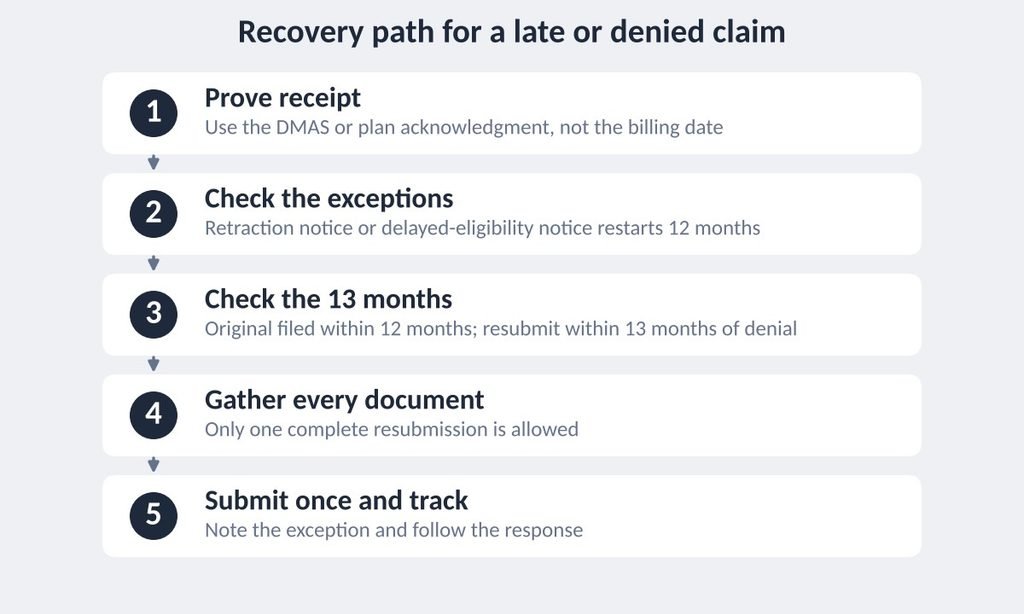
Subsection G makes the process unforgiving: a resubmitted claim that is denied again cannot be submitted again. A team facing a backlog may want help with denial management, and our explainer on timely filing versus appeal filing limits separates the two clocks.
Habits that keep Virginia Medicaid claims on time
A workable routine has six steps, each tied to a trigger such as a new plan, a Medicare remittance or a denial, and the list below puts them in the order most teams can adopt:
- Build a deadline table with one row for fee-for-service and one for each Cardinal Care plan you bill, with the document date beside each.
- Submit within 30 days of service as a practical target, and save the acknowledgment; the guide on clean claim rate improvement covers the common rejection causes.
- Flag unpaid claims at 90, 180 and 270 days from service using the method in tracking unpaid claims across payers.
- Date-stamp every Medicare remittance, retraction letter and eligibility notice on the day it arrives.
- Confirm DMAS or plan receipt within 30 days of submission, and rebill any claim with no response.
- Review denials monthly by claim type, and refer balances past 270 days to A/R management support when the in-house team cannot clear them.
Our walkthrough on how to track timely filing deadlines shows a spreadsheet layout you can adapt for Virginia. The Medicare 12-month rule guide helps when the same patient has both coverages.
How long until the routine shows results?
These are general planning ranges, not guarantees. A deadline table and daily worklist often reduce last-minute submissions within two to four weeks. Denial trends take longer to read. Three to six months of data is a reasonable horizon, and a full year shows whether exception claims are being worked on time.
Mistakes that turn good claims into late denials
- Treating a clearinghouse acceptance as proof of receipt. Keep the DMAS or plan acknowledgment.
- Missing the 13-month resubmission limit. Calendar it the day the denial posts.
- Resubmitting without all documentation. The regulation allows one complete resubmission.
- Ignoring the Medicare disposition date. Start the six-month window from the notice you received.
- Using one deadline for every Cardinal Care plan. Read each plan’s current manual.
- Trusting generic state tables. The two national guides reviewed omit Virginia entirely, so verify against the regulation.
Quick summary
- The Medicaid Virginia timely filing limit is 12 months from the date of service.
- DMAS counts documented receipt, not mailing, and the provider carries the proof.
- Denied claims must be resubmitted within 13 months of the initial denial, once.
- Retraction notices and delayed eligibility notices restart the 12 months.
- Five Cardinal Care plans publish their own rules, so keep one row per plan.
- A practical target is submission within 30 days of service for 95% or more of claims.
Self-assessment: is your Virginia Medicaid process safe?
Answer yes or no to each question below, then count your yes answers and compare the total with the scoring guide that follows the list of ten questions:
- Do you build deadlines from the date of service?
- Do you keep DMAS or plan acknowledgments, not only clearinghouse reports?
- Do 95% or more of claims go out within 30 days of service?
- Do you flag unpaid claims at 90, 180 and 270 days?
- Do you calendar the 13-month resubmission limit when a denial posts?
- Do you send every supporting document with a resubmission?
- Do you date-stamp Medicare remittances, retraction letters and eligibility notices?
- Do you keep a deadline row for each Cardinal Care plan you bill?
- Do you track on-time rates separately by claim type?
- Do you review late-filing denials monthly?
Scoring guide: 9 to 10 yes answers suggests a well-controlled process, so review it quarterly. 6 to 8 yes answers suggests gaps; fix the “no” items first, starting with questions 2 and 5. 0 to 5 yes answers suggests high exposure to late-filing denials and a good moment for an outside review.
When outside billing help makes sense
Outside support is worth considering when the in-house approach has reached its limits, and these five signals suggest that point has arrived for a Virginia Medicaid practice that bills fee-for-service or Cardinal Care claims:
- Resubmissions are denied for missing documents more than once a quarter.
- Nobody can state the 13-month resubmission date for a recent denial.
- Medicare remittances and eligibility notices are not date-stamped on arrival.
- Staff cannot name the filing window for each Cardinal Care plan the practice bills.
- Deadline tracking depends on one person’s spreadsheet.
Look for a billing partner that keeps a written deadline table by payer, retains acknowledgments, reports on-time rates by claim type and calendars every resubmission window for you. Transparent reporting and clear pricing matter as much as the deadlines.
EON MED SOLUTIONS is one example: a US-based team that delivers medical billing, coding, credentialing, denial management and A/R follow-up with transparent reporting and no hidden fees. Results vary by practice. You can review the EON MED SOLUTIONS billing, coding and RCM services to see how the work is organized.
Expert Opinion
The Medicaid Virginia timely filing limit looks like a single number, but the regulation makes it a set of rules about receipt, resubmission and restarts. The firm published standards in this guide are the 12-month limit in 12VAC30-95-10 and 42 CFR 447.45, the 13-month resubmission limit, the two exceptions, the six-month Medicare window and each plan’s published terms. The 30-day submission goal and the 90, 180 and 270 day alerts are practical targets.
The worked examples are illustrative scenarios, not client results. They show how to turn a rule into a date and how a blended rate can hide a 55% subgroup. Because DMAS and the plans update their documents, recheck the numbers each year.
The natural next question is which of your claim types has no calendar for resubmission today. If the answer is several, a team that works denials and receipts daily can help; start with EON MED SOLUTIONS’ billing and RCM services.
Frequently asked questions
What is the Medicaid Virginia timely filing limit?
Virginia requires fee-for-service claims to reach DMAS within 12 months of the date of service under 12VAC30-95-10. Late claims are denied unless a third-party retraction or delayed eligibility restarts the clock. Cardinal Care plans publish their own manuals, so confirm each plan’s current wording before you bill.
How long do I have to resubmit a denied Virginia Medicaid claim?
A denied claim must be resubmitted within 13 months of the initial denial, and the original claim must have been filed within 12 months of service. Resubmissions need all supporting documentation. A resubmitted claim that is denied again cannot be submitted again, so make the first resubmission complete.
What is a good claim submission turnaround for Virginia Medicaid?
A practical target is submitting most claims within a few business days, with 95% or more out within 30 days of service. This is an industry planning target, not a DMAS requirement. Early filing leaves most of the 12-month window in reserve for rejections and corrections.
What is a good on-time submission rate for Medicaid claims?
No published benchmark exists. A practical goal is 95% or more within 30 days of service, tracked separately for fee-for-service, each Cardinal Care plan and Medicare-related claims. When one group falls well below the blended rate, investigate that group’s trigger event first.
What is a good aging alert schedule for Virginia Medicaid claims?
Many practices flag unpaid claims at 90, 180 and 270 days from the date of service. This is a planning schedule, not a DMAS rule. The 270-day flag leaves about three months to resubmit or document an exception before the 12-month limit.
Do Cardinal Care plans use the same deadline as fee-for-service?
Not always. DMAS fee-for-service uses 12 months, while published plan documents vary: Anthem and Humana cite 365 days, and corrected-claim windows differ by plan. Each plan’s manual controls its own claims, so keep one dated row per plan and verify the current edition.
Sources and methodology
(a) Published standards and definitions from named bodies
- 12VAC30-95-10, Timely claims filing, Virginia Administrative Code (Register Vol. 31, Issue 9, effective February 13, 2015): Virginia Law.
- 42 CFR 447.45, Timely claims payment: Cornell Legal Information Institute.
- DMAS Provider Manual, Local Education Agency Chapter V, updated September 17, 2024, for the 13-month denied-claim rule and the DMAS-3 form.
- DMAS press release, July 1, 2025, for the five Cardinal Care managed care organizations.
- DMAS Medicaid bulletin on claims and appeals, last updated May 9, 2024.
- Anthem HealthKeepers Plus provider news, September 20, 2024: Anthem.
- Humana Healthy Horizons in Virginia provider resource guide (undated): Humana.
- Aetna Better Health of Virginia quick reference guide (undated), Anthem claims timely filing policy G-06050 (effective June 3, 2025) and the UnitedHealthcare 2026 Virginia Care Provider Manual.
(b) Named benchmarking data providers. None used in this article.
(c) Practical or illustrative targets from general industry sources
- National timely filing guides (MedCare MSO, Prospyr) were reviewed for how competitors present Medicaid. Neither gives a Virginia-specific rule, so this article relies on the regulation and DMAS documents.
- The 30-day submission goal, the 95% target and the 90, 180 and 270 day alerts are practical planning targets. All worked-example figures are illustrative.
(d) Survey or study data. None used in this article.
Methodology: the research reviewed the top results for the keyword, the Virginia Administrative Code, DMAS documents and five Cardinal Care plan documents in October 2026. Several plan documents carry no date, and some plan pages did not publish filing limits, so the article says so. Results vary by provider type and plan, and figures reflect information available at the time of research. Confirm every deadline against current DMAS and plan documents.


