

Medicaid Illinois Timely Filing Limit: The 180-Day Rule and Every Exception
The Medicaid Illinois timely filing limit is a state claim deadline that requires the Illinois Department of Healthcare and Family Services (HFS) to receive fee-for-service claims within 180 days of the date of service. The limit covers initial and resubmitted claims. Medicare crossover claims get 24 months, and managed care plans set deadlines in their contracts.
A claim for a March 3, 2026 office visit stops being payable by Illinois Medicaid around August 30, 2026, and a rejection in between does not buy extra time. The rule itself is short; the exceptions and plan variations are where claims get lost. This guide explains the Medicaid Illinois timely filing limit, every published exception, how managed care plans differ, and how to calculate your own deadlines. A self-assessment checklist near the end shows where your team stands.
What Are the Illinois Medicaid Filing Numbers Worth Memorizing?
Four numbers drive Illinois Medicaid filing: 180 days for fee-for-service claims, 24 months for Medicare crossovers, 12 months as the federal outer limit, and the plan-specific windows of each managed care organization. The table below separates published rules from practical internal targets, so you know which numbers are law and which are habits.
Key numbers cheat sheet
| Metric | Practical target / range | Review frequency | Source type |
| Fee-for-service claims (initial and resubmitted) | Received within 180 days of the date of service | Every claim | Published state standard ¹ |
| Medicare crossover or Medicare Advantage primary claims | Received within 24 months of the date of service | Every crossover | Published state standard ¹ |
| Federal ceiling for Medicaid claim submission | 12 months from the date of service | Reference only | Federal regulation ² |
| HealthChoice Illinois MCO initial claims | Commonly 180 days from service; confirm per plan | At each contract renewal | Plan manual ³ |
| Days to bill (service to submission) | 7 days or fewer | Weekly | Practical target ⁴ |
| Claim acceptance check after submission | Within 3 business days | Each batch | Practical target ⁴ |
| Open claims past day 120 without acceptance | Zero | Weekly | Practical target ⁴ |
| Timely filing write-off rate | Near 0%; investigate above 0.5% | Monthly | Practical target ⁴ |
¹ Published state standard: set by HFS rule or provider guidance (89 Ill. Adm. Code 140.20 and HFS timely filing notices). ² Federal regulation: 42 CFR 447.45. ³ Plan manual: set by each managed care organization and subject to change. ⁴ Practical target: an internal benchmark commonly used across billing operations, not a figure HFS, CMS or any professional body mandates. HFS’s Bureau of Long Term Care recommends a three-business-day follow-up for its providers; the same habit works for any claim type.
How Does the Medicaid Illinois Timely Filing Limit Work?
Illinois HFS pays a fee-for-service claim only if the claim arrives no later than 180 days after the service was provided, and that clock does not restart when a claim is rejected or rebilled. The rule applies to physicians, therapists, clinics, durable medical equipment suppliers and most other non-institutional providers.
Where the 180 days comes from?
The 180-day timely filing rule came from Public Act 97-0689, the SMART Act, for claims received on or after July 1, 2012. Before that change, Illinois allowed 12 months. The current rule sits in 89 Ill. Adm. Code 140.20, which HFS cites in its provider guidance. Federal law sets a looser floor: 42 CFR 447.45 requires state Medicaid agencies to demand claims within 12 months of service. Illinois simply chose a shorter window.
That two-layer design matters in practice. During the COVID-19 emergency, HFS suspended its 180-day edit but could not waive the federal one-year limit, because CMS denied the state’s waiver request. A state can relax its own rule; it cannot relax the federal one.
What counts as day zero?
For professional claims, day zero is the date of service. For hospital inpatient claims, HFS counts from the discharge date, and for hospital outpatient claims it counts from the through date of service. When you calculate, count forward 180 calendar days from that date. Because a claim must be received, not mailed or queued, treat the final week as unusable and set your internal stop date earlier.
Why a rejection does not reset the clock?
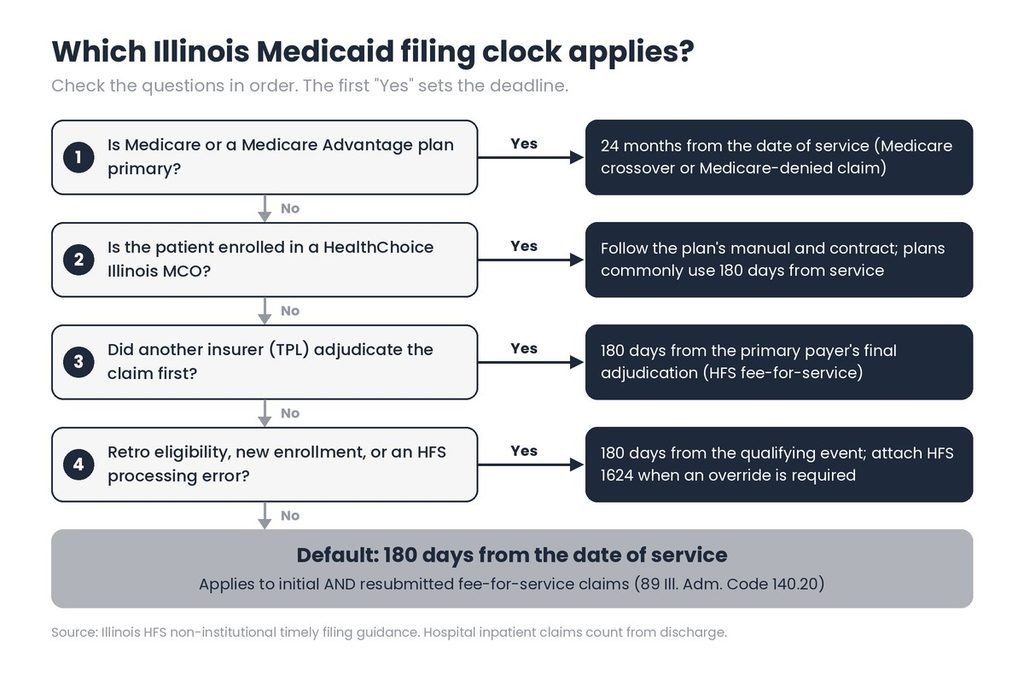
Claims that arrive after day 180 reject with the G55 rejection code, labeled “180 Day Timely Filing.” HFS states that rebilled claims and initial claims received more than 180 days after service will not be paid. Some commercial plans measure corrections from the original payment or denial date instead, so compare corrected claim timely filing limits payer by payer.
In billing audits, a common pattern is a rejected Illinois claim sitting in a clearinghouse queue that nobody owns. Each week of delay comes out of the same 180 days, so a claim rejected on day 40 and fixed on day 170 has almost no margin left.
Which Exceptions Give You More Than 180 Days?
HFS recognizes a short list of exceptions that start the clock later or extend it, and most of them require a paper claim with an HFS 1624 Override Request attached. The table summarizes the rules HFS publishes on its non-institutional timely filing page; institutional providers use the HFS 1624A version of the form.
Published HFS exceptions to the 180-day rule
| Situation | Deadline | Clock starts | Override form needed? |
| Medicare crossover (Medicare payable) | 2 years | Date of service | No; bill electronically or on HFS 3797 |
| Medicare-denied claim | 2 years | Date of service | Yes; attach EOMB and HFS 1624 |
| Medicare Advantage plan primary | 2 years | Date of service | Treated like Medicare (HFS Q&A) |
| Other insurance paid or denied first (TPL) | 180 days | Primary payer’s final adjudication | No; TPL fields calculate it |
| Primary insurer recoups payment | 180 days | Date of recoupment letter | Yes; attach letter and HFS 1624 |
| Spenddown / split bill | 180 days | Date on HFS 2432 | Yes; attach HFS 2432 and HFS 1624 |
| Retroactive patient eligibility | 180 days | HFS system update shown in MEDI | Yes; HFS 1624 |
| New enrollment, re-enrollment or specialty added | 180 days | Date recorded on provider file | Yes; HFS 1624 |
| HFS or intermediary processing error | 180 days | Date provider is notified of the error | Per HFS rebilling instructions |
| Void, then rebill as a new claim | 90 days | Void document control number (DCN) | Sometimes; HFS 1624 if required |
| Replacement claim (frequency code 7) | 12 months | Original paid voucher date | No; preferred method |
Source: Illinois HFS non-institutional timely filing guidance and Timely Filing Override Q&A (updated December 12, 2022). Providers operated by a local government unit in a county over 3,000,000 people that funds the federal share have 12 months instead of 180 days.
How Medicare crossover claims and TPL claims differ?
Medicare crossover claims get two full years because Medicare adjudicates first and often takes longer. Compare that with Medicare’s 12-month timely filing rule, which governs the primary claim itself. For commercial primaries, the third-party liability (TPL) rule gives 180 days from the primary payer’s final adjudication. HFS calculates that date from the TPL fields on the claim, so incomplete TPL coding is the usual reason these claims fail. Our guide to secondary claim timely filing rules covers the coordination steps in more detail.
Retroactive eligibility and new enrollment
For retroactive eligibility, the 180 days start from the date HFS updates the system, as displayed in the MEDI system when you verify eligibility for the date of service. For new providers, the clock starts on the date the enrollment or update was recorded on the HFS provider file, and the override must be requested within 180 days of the claim rejecting for that reason. Enrollment gaps are avoidable when provider credentialing and enrollment support runs ahead of a clinician’s start date.
Situations HFS says do not qualify
The HFS Timely Filing Override Q&A closes several doors. If you wait on a workers’ compensation or personal injury settlement instead of billing HFS, you cannot later request an override. If HFS shows outdated TPL and you wait for the patient to fix it, no override follows; you code the TPL fields and resubmit within the limit. A practitioner’s ER claim tied to a long inpatient stay still has 180 days from the ER date.
How Do HealthChoice Illinois MCO Deadlines Compare With Fee-for-Service?
Most HealthChoice Illinois MCOs publish a 180-day initial filing window, but their correction, coordination-of-benefits and dispute rules differ from HFS and from each other. For a patient enrolled in a HealthChoice Illinois plan, the plan manual decides your deadline, not the HFS rule.
Comparison table: Illinois Medicaid payers and their filing windows
| Payer | Initial claim window | Secondary, correction or dispute rule | Published in |
| Illinois Medicaid fee-for-service (HFS) | 180 days from service | TPL: 180 days after primary adjudication; rebills still 180 days from service | HFS guidance; 89 Ill. Adm. Code 140.20 |
| Aetna Better Health of Illinois | 180 calendar days from service | Corrected claims 180 days from service; COB 90 days from primary EOB | Plan bulletin, 2021 |
| Blue Cross Community Health Plans | 180 days from service or discharge | See current plan manual | BCBSIL provider notice, 2024 |
| CountyCare (Cook County) | 180 calendar days from service or discharge | Claim review form within 60 days of EOP | Plan quick reference guide |
| Meridian (Illinois Medicaid) | 180 days from service | Reconsiderations and disputes within 90 calendar days | Plan quick reference guide, 2024 |
| Molina Healthcare of Illinois | 180 days from service | Corrected claims within 180 days of original service | Plan tip sheet, 2018 |
| HFS crossover (Medicare or MA primary) | 24 months from service | Medicare-denied claims also 24 months | HFS guidance |
Plan rules change with contract amendments. Confirm the current provider manual or your participation agreement before relying on any plan figure.
The gap that hurts most is coordination of benefits. Under fee-for-service you get 180 days after the primary pays; under Aetna Better Health of Illinois, the 2021 bulletin gives 90 days from the primary EOB. Dispute windows are a separate clock again, which is why the difference between a filing limit and an appeal limit deserves its own column in any deadline tracker.
What changed for dual-eligible patients in 2026?
Illinois has moved its Medicare-Medicaid Alignment Initiative (MMAI) members into fully integrated dual eligible special needs plans, called FIDE SNPs. An April 10, 2026 HFS notice names Aetna Medicare FIDE, Humana Dual Fully Integrated, Molina Medicare Complete Care Plus and Wellcare Meridian Dual Align. If your old MMAI deadlines still sit in your billing system, replace them with each FIDE SNP’s current manual rules.
How Illinois compares with other states?
Illinois sits in the middle of state Medicaid programs. It is far tighter than the 12-month federal ceiling, but more forgiving than Texas Medicaid’s 95-day filing rule. Multi-state groups should store deadlines by payer and state rather than one company-wide default.
How Do You Calculate Illinois Medicaid Deadlines and Metrics? Worked Examples
You calculate an Illinois Medicaid deadline by adding 180 calendar days to the date that starts the clock, then subtracting an internal safety buffer. The same arithmetic, applied across your open claims, produces the three medical billing KPIs that predict timely filing losses before they happen; our list of medical billing KPIs to track puts them in context.
Example 1: A standard fee-for-service deadline
Formula: Deadline = clock-start date + 180 days. Illustrative scenario (not an actual client record): a family practice sees a fee-for-service Medicaid patient on March 3, 2026. Counting forward 180 days lands on August 30, 2026. Set the internal stop at August 23 or earlier, because the claim must be received and accepted, not simply sent.
Example 2: A rejected claim that gets resubmitted
Illustrative scenario (not an actual client record): a claim for a January 12, 2026 visit rejects on February 20 for a missing referring provider. The biller fixes it on June 22, which is day 161. The deadline is still July 11, 2026, so the claim is timely, but only 19 days remain if it rejects again.
Example 3: Crossover versus commercial primary
Illustrative scenario (not an actual client record): a dual-eligible patient seen April 15, 2026 has Medicare primary, so the crossover claim can reach HFS until April 2028. A different patient has commercial coverage that pays on September 14, 2026; the fee-for-service TPL deadline becomes March 13, 2027. If that patient were in Aetna Better Health of Illinois, the 90-day COB window would end December 13, 2026.
Metric 1: Days to bill
Formula: Days to bill = sum of (submission date − date of service) ÷ number of claims. Illustrative scenario (not an actual client record): the main clinic averages 4 days on 900 claims, a satellite office 6 days on 250 claims, and a behavioral health telehealth line 38 days on 50 claims. The blended result is 7,000 ÷ 1,200 = 5.8 days, which looks healthy. The telehealth line, however, burns 21% of its 180-day window before the first submission.
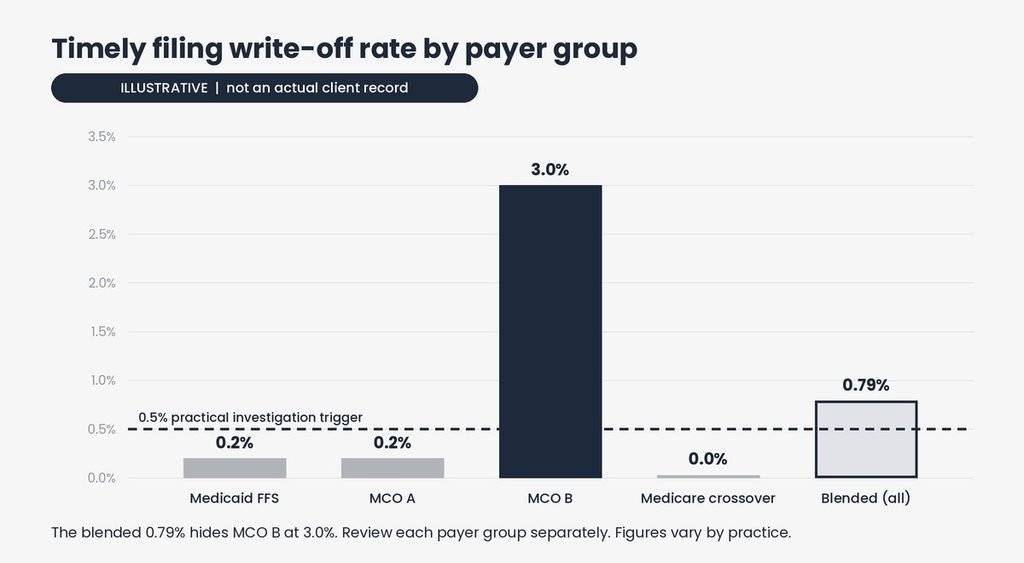
Metric 2: Timely filing write-off rate
Formula: Timely filing write-off rate = dollars written off for timely filing ÷ total charges, by payer group. Using illustrative figures, fee-for-service writes off $360 on $180,000 (0.2%), MCO A $520 on $260,000 (0.2%), MCO B $4,200 on $140,000 (3.0%), and crossovers nothing on $60,000. The blended rate is $5,080 ÷ $640,000 = 0.79%, which hides one plan losing fifteen times more than the others.
Metric 3: Red-zone share
Formula: Red-zone share = open claims past day 120 without an accepted status ÷ all open Medicaid claims. Illustrative scenario (not an actual client record): 46 of 1,150 open claims sit past day 120, a 4.0% share. At an average of $142 per claim, $6,532 has less than 60 days left. A practical target is zero, so this number should trigger a same-week work queue.
How Should You Read These Numbers Without Misjudging Your Team?
Compare like with like: fee-for-service against fee-for-service, one MCO against its own history, and one location against itself. Behavioral health, DME and hospital-based claims carry different documentation and coordination steps, so their days-to-bill will naturally run longer than a primary care clinic’s numbers.
One missed benchmark is a signal to investigate, not a verdict on staff. A single month with a 1% write-off rate may trace back to one enrollment gap or one payer system outage. Act when the same payer, location or provider misses two review cycles in a row, and record the root cause each time so trends are visible.
What Is the Step-by-Step Process for Filing On Time and Requesting an Override?
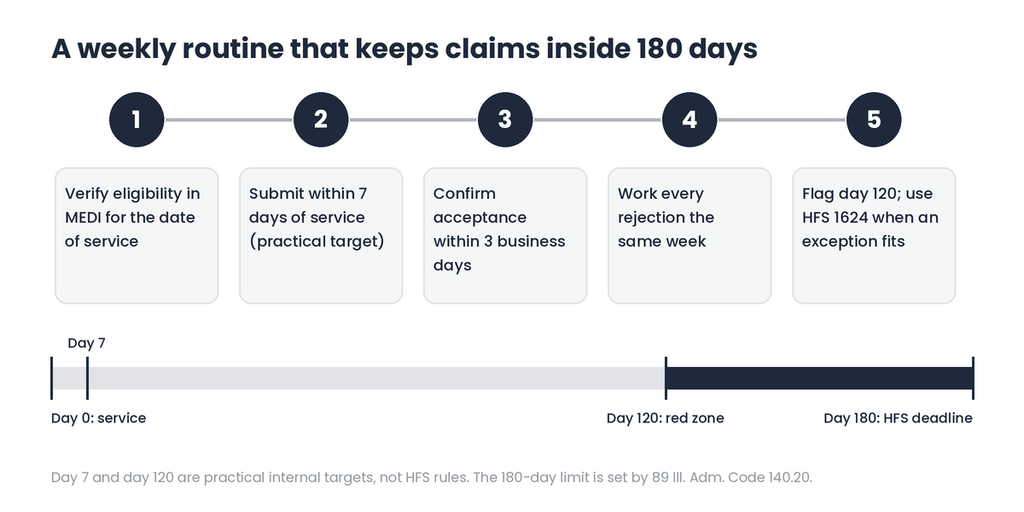
Staying inside the Illinois window takes seven repeatable steps, starting before the visit and ending with a documented override when an exception applies. Use this sequence when you are building or repairing a Medicaid billing workflow. Each step names the condition that triggers it, so a new biller can follow it without guessing.
- Verify eligibility in MEDI for the exact date of service, and record the managed care plan, TPL status and any spenddown before the patient leaves.
- Load the correct deadline into your system by payer: 180 days for fee-for-service, 24 months for crossovers, and each MCO’s contract window.
- Submit within seven days of service when documentation is complete, using clean electronic claims submission rather than paper wherever possible.
- Confirm acceptance within three business days through clearinghouse reports or MEDI claim status, and save every acceptance report.
- Work rejections the week they appear; a steady focus on reducing your claim rejection rate protects the 180-day window more than any appeal.
- Flag every unaccepted claim at day 120, and escalate it to a named owner with a fix-by date.
- When an exception applies, mail the original paper claim with Form HFS 1624 and supporting documents to HFS, Bureau of Professional and Ancillary Services, Attn: Billing Consultant, P.O. Box 19115, Springfield, Illinois 62794-9115.
Building proof of timely filing
Proof of timely filing is the evidence that a payer received your claim inside the window. Keep 999 and 277CA acceptance reports, MEDI submission confirmations, remittance advices and the document control number on every paper claim. For a void and rebill, keep the void DCN too, because HFS measures the 90-day rebill window from it. A timely filing deadline tracker ties these records to each claim.
A team observation from Medicaid reviews: retroactive eligibility dates are often recorded as the day the patient called, not the day HFS updated MEDI. That mismatch makes valid override requests look late. Print or save the MEDI eligibility screen showing the update date.
How Long Does It Take to Fix a Timely Filing Problem?
Most practices see partial improvement within 30 to 60 days of fixing their workflow, while full results usually take three to six months. The lag exists because claims from before the fix keep aging through the 180-day window. These ranges are general planning estimates, not guarantees, and they depend on claim volume, staffing and payer mix.
Partial results look like fewer new claims entering the day-120 red zone and a shorter days-to-bill figure. Full results look like a write-off rate near zero for every payer group across two consecutive quarters. If an enrollment or MCO contract issue is the root cause, add time for the plan or HFS to correct its records.
Which Timely Filing Mistakes Cost Illinois Practices the Most?
The costliest mistakes come from assuming the clock restarts, trusting one deadline for every plan, and failing to keep proof. Each one below is preventable when the condition that triggers it is caught early. Most trace back to a workflow gap rather than a coding gap, so the fixes are procedural.
- Treating a rejection as a fresh start. HFS measures resubmissions from the date of service, so fix rejected claims within days when the original was filed late in the window.
- Using one deadline for every Medicaid payer. Store the window per MCO and per state when you bill multiple plans, and update it when a contract renews.
- Waiting on a liability settlement. Bill HFS within the limit when the patient presents a Medicaid card, unless you accept the risk of never collecting from Medicaid.
- Leaving outdated TPL on file. Code the TPL status fields and resubmit when the patient confirms no other coverage, rather than waiting for a caseworker update.
- Skipping acceptance checks. Review acceptance reports within three business days when you submit in batches, because a claim that never reached HFS was never filed.
- Forgetting the override form. Attach HFS 1624 (or 1624A for institutional claims) whenever the exception table says an override is required.
In billing audits, a common pattern is a practice that tracks denials closely but never looks at rejections. Rejected claims never enter adjudication, so they do not appear on denial reports, and they quietly run out of time. Running a weekly rejection report beside the denial report closes that blind spot.
Quick Summary
- Illinois HFS must receive fee-for-service claims within 180 days of service; rebills count from the same date.
- Medicare crossover, Medicare-denied and Medicare Advantage primary claims have 24 months from service.
- TPL claims have 180 days after the primary payer’s final adjudication under fee-for-service rules.
- HealthChoice Illinois MCOs commonly use 180 days for initial claims, but correction, COB and dispute windows vary.
- Practical targets: 7 days or fewer to bill, acceptance confirmed within 3 business days, zero claims past day 120, and a write-off rate near zero.
Self-Assessment: Is Your Practice Inside the Illinois Window?
Answer yes or no to each question, then count your yes answers.
- Do you verify MEDI eligibility for the exact date of service at every Medicaid visit?
- Does your billing system store a separate filing deadline for each MCO and for fee-for-service?
- Is your average days to bill 7 days or fewer for every location, not just overall?
- Do you confirm claim acceptance within 3 business days of each submission batch?
- Does someone own the rejection queue, with rejections worked in the same week?
- Do you run a weekly list of unaccepted claims past day 120?
- Is your timely filing write-off rate below 0.5% for every payer group?
- Do you save acceptance reports and DCNs as proof of timely filing?
- Does your team know when to attach HFS 1624 and where to mail it?
- Have you replaced old MMAI deadlines with current FIDE SNP rules?
Scoring guide. 9–10 yes: your process is strong; keep monthly reviews. 6–8 yes: you have gaps that likely cost money each quarter; fix the “no” items within 60 days. 0–5 yes: timely filing losses are probably routine; treat the red-zone list as an urgent weekly task and consider outside review.
When Does It Make Sense to Bring In Professional Billing Support?
Outside support makes sense when deadline problems persist after you have tightened the workflow yourself. Run the self-assessment above for two consecutive months first, so the decision rests on a trend rather than one bad week. These signals suggest the in-house approach has reached its limits:
- G55 rejections or timely filing write-offs appear in two or more consecutive months.
- The day-120 red-zone list keeps growing despite overtime or extra staff hours.
- One location or MCO consistently runs days-to-bill above 14 days.
- Nobody on staff is confident about when an HFS 1624 override applies.
- Credentialing or enrollment gaps are delaying claims for new clinicians.
When you evaluate a billing partner, ask how they track deadlines by payer, how often they report rejections and aging, and whether you can see claim-level data without requesting it. Look for clear pricing, Illinois Medicaid and MCO experience, and a named contact. A partner with strong denial management service and A/R management processes should be able to show you its workflow before you sign.
EON MED SOLUTIONS is one example of that model. Its US-based team provides end-to-end billing, coding, credentialing, denial management and compliance support, with transparent reporting and no hidden fees. Results vary by practice, payer mix and starting point. You can review EON MED SOLUTIONS’ billing and RCM services to see how the process works.
Expert Opinion
Illinois gives practices less time than federal law requires, and it does not hand back days lost to rejections. The practices that rarely lose claims verify eligibility at the visit, submit within a week, confirm acceptance and treat day 120 as an alarm.
On sourcing: the 180-day rule, the 24-month crossover window, the exception deadlines and the HFS 1624 process are published HFS standards, and the 12-month ceiling is federal regulation. MCO windows come from plan publications and change with contracts. The 7-day, 3-day, day-120 and 0.5% figures are practical targets, and every scenario above is illustrative.
The Medicaid Illinois timely filing limit is simple on paper and unforgiving in practice. Your natural next question is how many of your own open claims are already past day 120. If you want help answering that, talk with the EON MED SOLUTIONS billing team.
Frequently Asked Questions
What is the Medicaid Illinois timely filing limit?
Illinois HFS must receive fee-for-service Medicaid claims within 180 days of the date of service, under 89 Ill. Adm. Code 140.20. The rule applies to initial and resubmitted claims. Medicare crossover claims have 24 months, and HealthChoice Illinois managed care plans set their own windows, commonly 180 days.
Does a rejected Illinois Medicaid claim get a new 180 days?
No. HFS counts 180 days from the date of service for both original and rebilled claims, so a rejection does not restart the clock. The exceptions are specific events, such as a void and rebill, which allows 90 days from the void DCN, or a documented HFS processing error.
What is the timely filing limit for Illinois Medicaid crossover claims?
Medicare crossover claims must reach HFS within two years of the date of service. HFS applies the same two-year window to Medicare-denied claims and to claims where a Medicare Advantage plan is primary. Medicare-denied claims need the EOMB and Form HFS 1624 attached to a paper claim.
What is a good days-to-bill target for Illinois Medicaid claims?
A practical target is 7 days or fewer from service to submission, measured by location and payer. This is an industry convention, not an HFS rule. At 7 days, a claim keeps about 96% of its 180-day window for fixing rejections, which is the real reason to bill fast.
What is a good timely filing write-off rate?
A good timely filing write-off rate is as close to zero as possible. Many billing teams treat anything above roughly 0.5% of charges in a payer group as a trigger for root-cause review. This is a practical target, not a published standard, so compare each payer against its own history.
How do I request a timely filing override from Illinois HFS?
Mail an original paper claim with Form HFS 1624 (HFS 1624A for institutional claims) and supporting documents to the HFS Bureau of Professional and Ancillary Services, P.O. Box 19115, Springfield, Illinois 62794-9115. Claims that do not qualify are processed and rejected so receipt is documented.
Sources and Methodology
(a) Published standards and definitions. Illinois HFS, Timely Filing Claim Submittal for Non-Institutional Providers (web guidance, accessed October 2026); HFS Provider Notices of July 23, 2012, March 22, 2013, March 19, 2021 and April 10, 2026; HFS Timely Filing Override Q&A (updated December 12, 2022); 89 Ill. Adm. Code 140.20; 42 CFR 447.45. MCO windows come from Aetna Better Health of Illinois (2021 bulletin), Blue Cross and Blue Shield of Illinois (October 2024 notice), CountyCare (quick reference guide), Meridian (2024 quick reference guide) and Molina Healthcare of Illinois (2018 tip sheet).
(b) Named benchmarking data providers. None used. This article does not cite proprietary benchmark data. (c) Practical or illustrative targets. Days to bill of 7 or fewer, a 3-business-day acceptance check, zero claims past day 120 and a 0.5% write-off investigation trigger are commonly reported across industry sources and internal billing practice; HFS’s long-term care guidance supports the 3-day follow-up habit. All scenarios and dollar figures are illustrative. (d) Survey or study data. None used.
Results vary by practice, specialty and payer mix. Figures reflect information available at the time of research in October 2026; HFS rules, MCO contracts and annual code sets can change, so confirm current guidance before billing.


