
E/M Coding Time vs MDM: Which Method Fits Each Visit?
E/M coding by time or MDM means choosing an office visit level from either the clinician’s total time on the date of the visit or the medical decision making (MDM) documented in the note. Either method is valid for each visit, so the right choice is the one the record supports. This guide covers both rules, the minutes for each code and a worked example, for practices that level visits in-house or with medical coding support.
| Key takeaways Office and outpatient visits can be leveled by MDM or by total time, chosen visit by visit.MDM needs two of three elements at a level; time needs that code’s minimum minutes on the date.Only the billing practitioner’s own time on the date of the visit counts.Medicare’s prolonged-service code starts later than the CPT add-on code. |
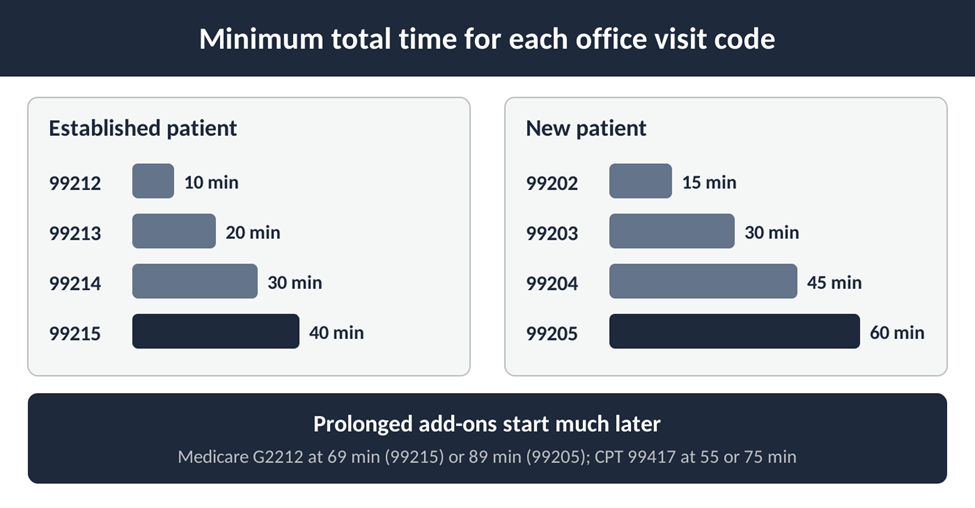
Key numbers: minimum total time by code
| Code | Patient | Minimum total time | Matching MDM level |
| 99202 | New | 15 minutes | Straightforward |
| 99203 | New | 30 minutes | Low |
| 99204 | New | 45 minutes | Moderate |
| 99205 | New | 60 minutes | High |
| 99212 | Established | 10 minutes | Straightforward |
| 99213 | Established | 20 minutes | Low |
| 99214 | Established | 30 minutes | Moderate |
| 99215 | Established | 40 minutes | High |
Minimums reflect CPT’s office visit descriptors since 2024. CPT is revised every year, so confirm the current descriptors for the year of service.
Should You Code by Time or by MDM?
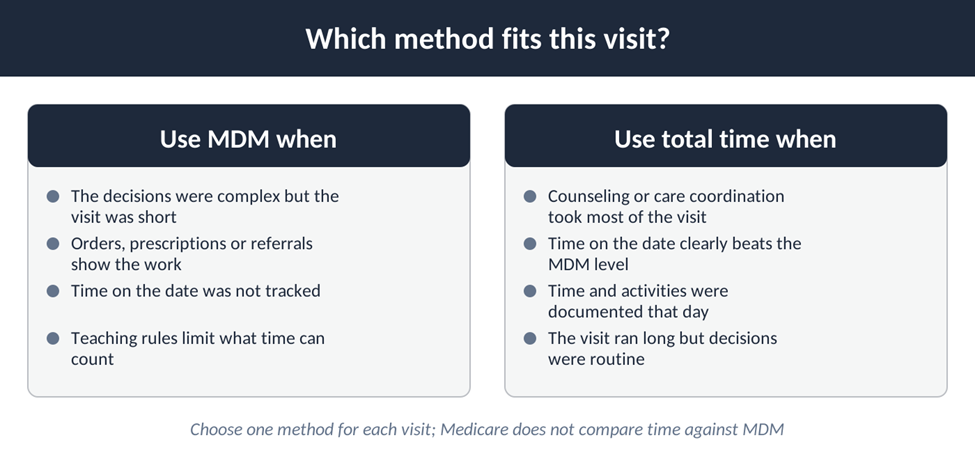
Choose the method the record supports at the higher level, because office and outpatient visits can be leveled either way. Noridian, a Medicare contractor, states in its Medicare E/M questions and answers that you can document using time or using MDM for each patient encounter. History and exam still belong in the note, but they are performed as medically appropriate and do not set the level, as the First Coast Service Options overview of office and outpatient E/M services explains.
This guide covers new-patient codes 99202-99205 and established-patient codes 99212-99215. Other settings, including emergency department and hospital care, follow their own rules. For the wider picture, see our complete guide to physician medical coding.
Use this order for each visit:
- Score the MDM from the note: problems, data and risk.
- Add the qualifying minutes on the date of the visit.
- Compare the two results and report the level whose documentation is complete.
How Does MDM Set the Level?
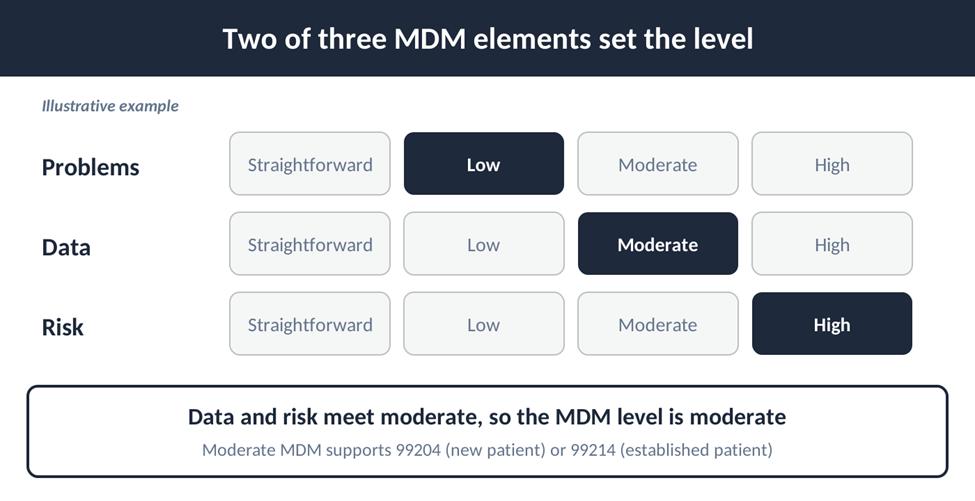
MDM sets the level when at least two of its three elements meet or exceed that level. Noridian’s example: low problems, moderate data and high risk produce moderate MDM, which supports 99204 or 99214. The table below summarizes the AMA CPT categories in plain terms; the CPT E/M guidelines hold the full definitions.
| MDM level | Problems addressed | Data reviewed and analyzed | Risk of management |
| Straightforward (99202, 99212) | One self-limited or minor problem | Minimal or none | Minimal |
| Low (99203, 99213) | Two or more minor problems, or one stable chronic illness, or one uncomplicated acute illness | Limited, such as two unique tests reviewed or an independent historian | Low, such as over-the-counter treatment |
| Moderate (99204, 99214) | Chronic illness that is worsening, or two or more stable chronic illnesses, or a new problem with uncertain prognosis | Moderate, such as three items, an independent test interpretation or a discussion with an outside clinician | Moderate, such as prescription drug management |
| High (99205, 99215) | Severe worsening of a chronic illness, or a threat to life or bodily function | Extensive, meeting two of the three data categories | High, such as a decision for hospitalization |
For code-set basics, see our CPT coding guide for providers. Medicare, Medicare Advantage, Medicaid and commercial payers can add their own documentation policies, so check each payer’s provider manual.
When Does a Long Visit Qualify for Prolonged Service Codes?
A visit qualifies once total time passes the add-on threshold, and Medicare’s threshold is later than CPT’s. CPT’s add-on 99417 counts each 15 minutes beyond the highest code’s minimum. For Medicare, the First Coast Service Options prolonged services page says to bill HCPCS G2212 instead of 99417, starting at 69 minutes with 99215 and 89 minutes with 99205.
| Base code | CPT add-on 99417 starts | Medicare G2212 starts |
| 99215 (established) | 55 minutes | 69 minutes |
| 99205 (new) | 75 minutes | 89 minutes |
Report an add-on only in full 15-minute units, and only when the payer accepts it. Commercial payers vary, so confirm which code your payer wants. Annual code changes can shift these rules, which our post on 2027 CPT code changes helps track, and our summary of CMS coding guidelines covers Medicare policy.
What Counts Toward Time, and What Does Not?
Only the billing practitioner’s own time on the date of the encounter counts, including face-to-face and non-face-to-face work. The contractor page lists reviewing records and tests, taking history, examining, counseling, ordering, communicating with other professionals, documenting and coordinating care.
| Counts | Does not count |
| Practitioner time reviewing records and results on the visit date | Clinical staff time |
| History, exam, counseling and education | Time on a separately reported procedure |
| Ordering tests, drugs or referrals | Travel and general teaching not tied to the patient |
| Care coordination and documenting the same day | Charting done on a later date |
Teaching physicians have an added limit: under the primary care exception, time cannot select the level and only MDM may be used, per Noridian. When time is used, document the total time, the significant activities and any services excluded from the total. The sample below shows the pattern.
| Sample (fictional data) Total time personally spent on the date of this encounter: 33 minutes. Activities: reviewed outside lab results and prior notes, obtained history, performed exam, counseled on diet and medication adherence, placed a follow-up lab order and completed documentation. No separately reported procedure and no teaching time are included. |
Change the minutes and activities to match the actual visit. A copied statement with the same total in every note is easy to spot and hard to defend.
Worked Example: 33 Minutes or Low MDM?
Add every qualifying minute on the date, then report the highest code whose minimum the total meets or exceeds. Total time = pre-visit review + visit time + same-day documentation.
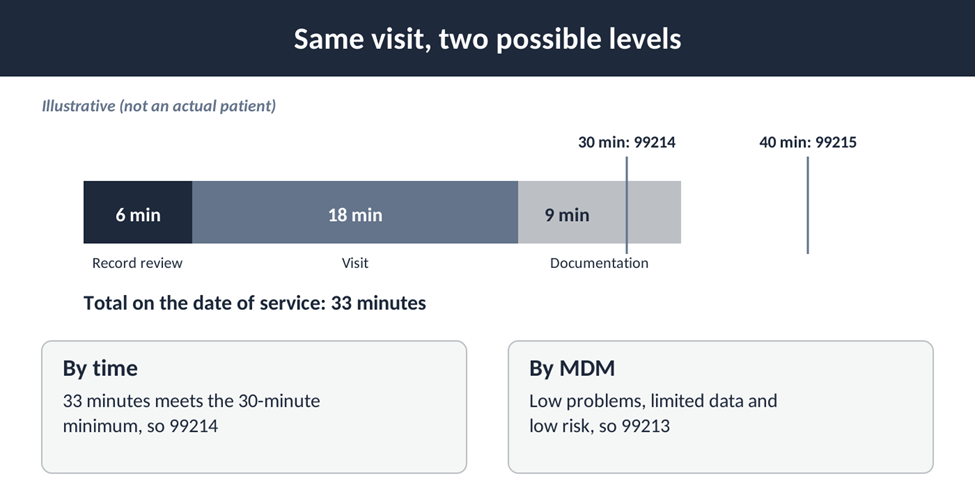
Illustrative scenario (not an actual client record): an established patient returns for a stable chronic condition. The clinician spends 6 minutes reviewing outside records, 18 minutes with the patient and 9 minutes documenting that afternoon. The total is 6 + 18 + 9 = 33 minutes. That meets the 30-minute minimum for 99214 but not the 40-minute minimum for 99215.
By MDM, the same visit scores one stable chronic illness (low problems), two reviewed tests (limited data) and over-the-counter treatment (low risk). That is low MDM, so 99213. Time supports the higher level here, and it holds only because the activities were documented. Had the 9 minutes of charting happened the next day, the total would drop to 24 minutes and 99213 would apply either way.
Mistakes That Put the Level at Risk
Most level problems come from documentation, and each has a simple fix:
- Counting staff time. Include only the billing practitioner’s minutes.
- Counting next-day charting. Finish the note on the date of service, or leave those minutes out.
- Cloned time statements. Write the actual total and the activities for each visit.
- Leaving procedure time in. Carve out any separately reported procedure before totaling.
- Choosing time by habit. When MDM clearly supports the level, document MDM instead.
In coding audits, a common pattern is a note that records only ‘time spent’ with no activities, which leaves reviewers nothing to support the minutes. Another frequent finding is a clinician who tracks the visit but never counts same-day record review, so a qualifying level goes unreported.
Levels that look out of line can draw payer record requests and denials, which our denial management guide addresses. Our medical coding accuracy tips cover review habits, and a monthly look at level mix by clinician in revenue cycle performance reporting shows drift early.
When E/M Level Review Needs Outside Help
Outside support is worth considering when these signs appear:
- Clinicians level similar visits differently
- Time statements look templated across notes
- Payers downcode visits or request records
- No one reviews E/M level mix by provider
- Coding backlogs delay charge entry
EON Med Solutions is one example of a US-based team that delivers billing, coding, credentialing, denial management and reporting end to end, with transparent reporting. Its process pairs coding review with documentation feedback and reporting on level trends. Results vary by practice. See its services for how that works.
Frequently Asked Questions
Can you use time and MDM on the same visit?
Pick one method for each encounter rather than blending both. Document whichever supports the level you report. Medicare contractors review the method documented and, per Noridian, do not compare time against MDM. If time is not documented, review falls back to MDM, so keep MDM details in the note.
Does time spent on a different day count?
No. When using time, count only the time the practitioner spends on the date of the encounter. Noridian states that charting done on a later date is excluded. If the note is finished the next day, either leave those minutes out or support the level with MDM instead.
Does staff time count toward the total?
No. Only the billing practitioner’s own time counts, and clinical staff time is excluded. Time spent on a separately reported procedure is also left out. With teaching physicians, only the teaching physician’s qualifying time counts, and primary care exception visits use MDM only.
Do history and exam still affect the level?
Not for office and outpatient visits. They are performed as medically appropriate, and their extent does not determine the code level. They still belong in the record, because they support medical necessity and the MDM score. Other settings can follow different rules, so confirm the code family.
When can I bill a prolonged service?
Add the service only after total time passes the add-on threshold, in full 15-minute units. For Medicare, G2212 starts at 69 minutes with 99215 and 89 minutes with 99205. CPT’s 99417 starts earlier, at 55 and 75 minutes. Your payer decides which code it accepts.
Expert Opinion
From the EON Med Solutions Billing & RCM Team: E/M coding time vs MDM is a documentation question more than a coding one. Both methods are valid, and the better choice is the one the note can defend line by line.
The two-of-three MDM rule, the per-code minimum minutes and the Medicare G2212 thresholds come from the published CPT descriptors and the Medicare contractor pages named above. The pre-visit habits, the 33-minute scenario and the review signals are practical or illustrative guidance, not payer requirements. Each payer’s manual controls the final answer.
The natural next question is whether your own notes would pass a level review today. If you want a second set of eyes on E/M levels, contact our team to talk through your coding workflow.
Sources: Noridian Healthcare Solutions E/M top provider questions and answers; First Coast Service Options pages on office and outpatient E/M services and prolonged physician services; AMA CPT E/M guidelines. Results vary by practice, and figures reflect information available at the time of research. This article is general information, not legal advice.