
Understanding HCPCS Codes in Medical Billing
HCPCS codes in medical billing identify the drugs, equipment, and supplies that a CPT code alone can’t describe, from durable medical equipment to non-oral chemotherapy drugs. Medicare and most other US payers require the correct code, modifier, and documentation before a claim pays correctly. This guide explains how the HCPCS code set is organize, how it differs from CPT, and the modifier and billing mistakes that most often trigger denials.
Key Takeaways
- HCPCS has two levels: Level I is CPT, maintained by the AMA; Level II is alphanumeric and maintained by CMS.
- Level II covers DMEPOS, ambulance transport, and non-oral drugs and biologics that CPT codes don’t describe.
- A modifier on a Level II code, such as NU, UE, or JW, changes what a payer allows, not just how the line reads.
- A Level II code existing on a claim doesn’t guarantee coverage; each payer sets its own rules for the item.
- Medicare, Medicaid, and commercial payers can apply different prior authorization and coverage rules to the same code.
What Is the HCPCS Code Set?
The Healthcare Common Procedure Coding System (HCPCS) is the standardize code set Medicare and most US payers use to bill procedures, supplies, equipment, and drugs, per CMS’s HCPCS overview. HCPCS has two levels. Level I is the CPT codes (Current Procedural Terminology) set, maintain by the AMA’s CPT code set overview, for procedures clinicians perform. Level II is a separate alphanumeric set, maintained by CMS, for products and services CPT codes don’t capture — one piece of a practice’s broader medical coding services. Billers usually say “CPT” for Level I and “HCPCS” for Level II, though both are part of the same system.
HCPCS Level I vs. Level II: What’s the Difference?
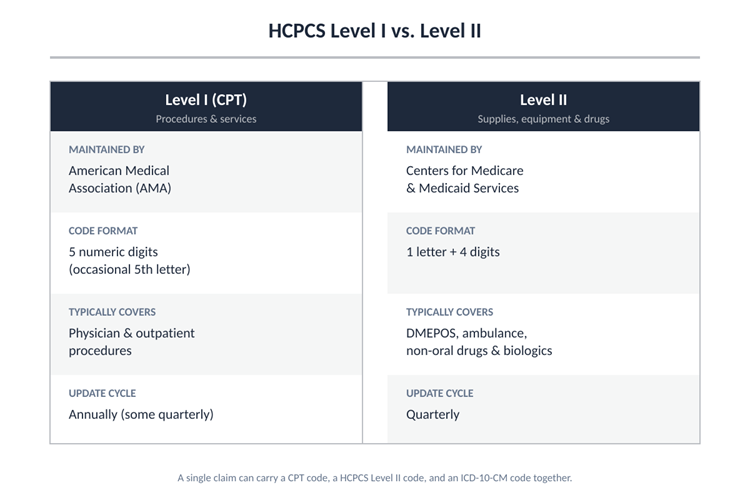
Level I is CPT; Level II is a separate alphanumeric set for products and services CPT codes don’t describe:
| HCPCS Level I (CPT) | HCPCS Level II | |
| Maintained by | American Medical Association (AMA) | Centers for Medicare & Medicaid Services (CMS) |
| Code format | 5 numeric digits (occasionally a 5th alpha character) | 1 letter followed by 4 digits |
| Typically covers | Physician and outpatient procedures and services | DMEPOS, ambulance transport, non-oral drugs and biologics, and other supplies |
| Update cycle | Annually, with some quarterly updates | Quarterly |
A single claim line can carry a CPT code for what the provider did, a HCPCS Level II code for what was use, and an ICD-10-CM diagnosis code for why. A full CPT coding guide helps a team see where Level I ends and Level II begins.
How HCPCS Level II Codes Are Organized by Chapter
Each Level II code’s first letter identifies its chapter, so a biller can often tell what a code covers before looking it up:
- DMEPOS (E codes) — wheelchairs, CPAP devices, and other durable medical equipment
- J codes — non-oral drugs and biologics, including chemotherapy
- G and Q codes — CMS procedures, screening services, and temporary codes pending a permanent one
- A and K codes — transportation and DME billed only through the DME Medicare Administrative Contractors
- S and T codes — commercial payers and state Medicaid programs; Medicare doesn’t pay these
Miscellaneous codes (“not otherwise classified”) let a supplier bill an FDA-approved item before the next quarterly update adds a permanent code; a biller should confirm with the payer that no specific code already exists first.
What a HCPCS Modifier Changes About Your Reimbursement
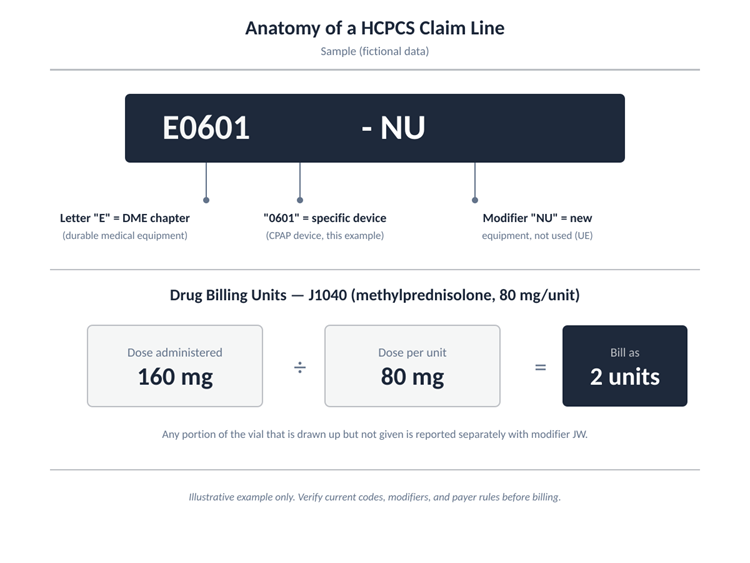
A two-character modifier added to a HCPCS Level II code tells the payer something that can change how much the claim pays, not just how the line reads. Common ones include NU (new equipment), UE (used), RR (rental), and JW (drug discarded).
Illustrative scenario (not an actual client record): A supplier bills HCPCS E0601 for a CPAP device. NU tells the payer the device is new; UE tells the payer it’s use, and most payers price the two differently under the DME fee schedule for that code and locality. Billing NU on a used unit, or leaving the modifier off, risks a payment that doesn’t match the payer’s allowed amount, which can surface later as an overpayment or underpayment finding rather than an upfront denial.
Drug claims use billing units instead: HCPCS J1040 reports methylprednisolone acetate in 80 mg units, so billed units equal total dose divided by dose per unit. A 160 mg dose is 160 ÷ 80 = 2 units; billing 1 or 4 units would mis-report what was given. Under CMS’s discard drug policy, any portion of a vial drawn up but not given is reported separately with modifier JW.
Common HCPCS Billing Mistakes and How to Prevent Them
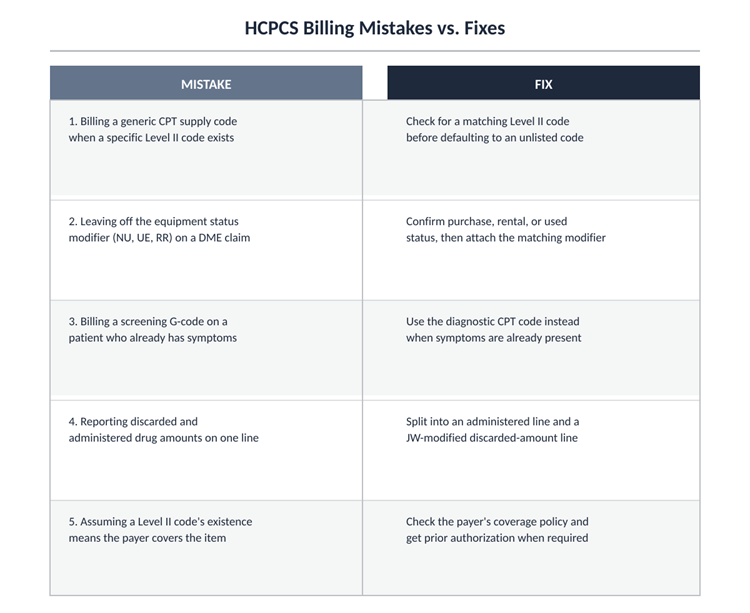
In coding audits, a common pattern is a clean CPT code pair with a missing or mismatched HCPCS modifier. Which denies or underpays an otherwise correct claim. Another: billing a HCPCS G-code screening on a symptomatic patient, which most payers treat as a medical necessity denial rather than a coding error.
- A generic CPT supply code when a Level II code exists. Check for a matching Level II code first.
- A missing status modifier (NU, UE, RR) on a DME claim. Confirm purchase, rental, or used status, and attach the matching modifier.
- A screening G-code billed on a symptomatic patient. Use the diagnostic CPT code instead, adding modifier PT when a screening converts mid-visit.
- Discarded and administered drug amounts on one line. Split into an administered-only line and a JW-modified discarded-amount line.
- Assuming a Level II code’s existence means it’s cover. Check the payer’s coverage policy and get prior authorization when required.
A practice is usually ready for outside coding support when modifier or coverage denials keep recurring. DME or drug claims pile up in an unfamiliar payer’s queue, a growing specialty mix adds unfamiliar code ranges, or staff. Turnover leaves gaps in Level II training. EON Med Solutions’ billing and coding services are one example: a US-based team handling billing, coding, credentialing, denial management, and reporting together. Results vary by practice and payer mix.
Frequently Asked Questions
What is the difference between CPT and HCPCS codes?
CPT codes are HCPCS Level I: five-digit codes maintained by the AMA for procedures clinicians perform. HCPCS Level II is a separate alphanumeric set maintained by CMS for products, supplies, equipment, and drugs. CPT codes don’t describe. Billers typically use “CPT” and “HCPCS” to mean Level I and Level II.
Who maintains HCPCS Level II codes, and how often do they change?
CMS maintains HCPCS Level II codes and updates them quarterly. CPT (Level I) codes are maintained separately by the AMA and generally update annually. Though some ranges get quarterly updates too.
Do all payers accept and pay for HCPCS Level II codes the same way?
No. Medicare publishes national coverage rules and a DMEPOS fee schedule by locality. But Medicare Advantage, Medicaid, and commercial payers each set their own coverage list, prior authorization rules, and fee schedule. In their own provider manual or state program, so a code existing doesn’t guarantee a specific payer covers it.
What does a modifier like NU, UE, or JW change on a claim?
These modifiers describe a status the payer prices differently. NU and UE tell the payer whether DME is new or used, which affects the allowed amount. JW reports a discarded drug amount separately, so the payer doesn’t pay for drug that wasn’t given.
What happens if a HCPCS code exists but a payer doesn’t cover the item?
The claim is typically denied as non-covered, regardless of how accurately it was coded. Checking the payer’s coverage policy and securing prior authorization when required, before the item is provided, is the only reliable way to confirm coverage ahead of billing.
Expert Opinion
HCPCS codes in medical billing exist because a CPT code alone can’t describe every drug, device, or supply a claim needs. The two-level structure, the Level II letter chapters, and the core modifier rules are published CMS and AMA standards, not internal guesses.
What varies by payer — coverage, prior authorization, and which code ranges a plan recognizes — is what a billing team has to track payer by payer, since those rules live in each payer’s policy, not the code set. The practical question isn’t just which code to use; it’s whether the modifier, documentation, and coverage policy line up before the claim goes out. Teams that want a closer look at how their HCPCS claims are performing can start with EON Med Solutions’ billing and coding services.
Sources: CMS HCPCS General Information and the AMA CPT code set overview, linked above. Figures and policy details reflect information available at the time of research; results and payer rules vary by practice and plan.