

BCBS Texas Timely Filing Limit: Which Deadline Applies to Your Claim?
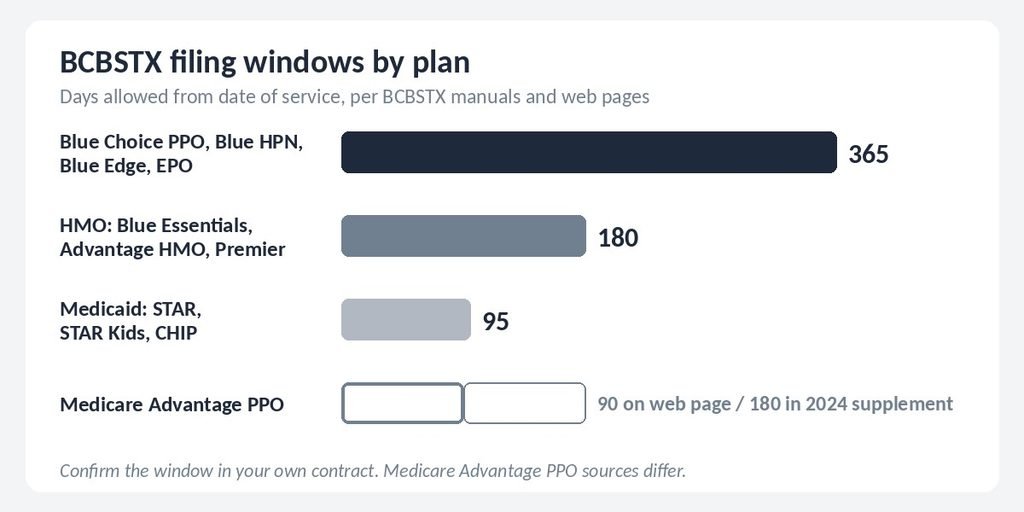
The BCBS Texas timely filing limit depends on the plan. Blue Cross and Blue Shield of Texas (BCBSTX) requires Blue Choice PPO claims within 365 days of the date of service and HMO claims within 180 days, according to BCBSTX provider manuals. Medicaid and CHIP claims must reach BCBSTX within 95 days. Individual provider contracts can change these windows.
Practices searching for the BCBS Texas timely filing limit usually find four different answers: 95, 120, 180 and 365 days. Each figure is correct for something, but only one governs a given claim. This guide shows which deadline applies by plan, how to calculate the last filing date, what proof BCBSTX accepts and how long a practice has to dispute a denial. A self-assessment checklist near the end shows where a billing process is exposed.
Which BCBSTX Filing Numbers Matter Most at a Glance?
| Metric | Practical target/range | Review frequency | Source type |
| Filing window: Blue Choice PPO, Blue HPN (High Performance Network), Blue Edge, EPO | 365 days from date of service | At contract renewal and each manual update | Published standard (A) |
| Filing window: HMO products (Blue Essentials, Blue Advantage HMO, Blue Premier) | 180 days from date of service | At contract renewal and each manual update | Published standard (A) |
| Filing window: Medicaid STAR, STAR Kids, CHIP | 95 days from date of service | Annually | Published standard (A) |
| Filing window: Blue Cross Medicare Advantage PPO | 90 days on BCBSTX’s web page; 180 days in the 2024 manual supplement | Each contract cycle | Published standard (A), sources differ |
| Texas statutory default for claim filing | 95 days, extendable by contract | When contracts change | Statute or rule (S) |
| Claim dispute window (commercial) | 180 days from EOP or PCS date | Monthly denial review | Published standard (A) |
| Returned-for-information claims | Resubmit within 90 days of BCBSTX’s mailing | Weekly | Published standard (A) |
| Internal submission target | Most claims filed within about 5 business days of service | Weekly | Practical target (P) |
| Internal alert point | Flag unbilled or unpaid claims at 50% of the window | Weekly | Practical target (P) |
Source labels: A = BCBSTX provider manual or provider web page. S = Texas Insurance Code or Texas Department of Insurance (TDI) rule. P = practical target commonly used in billing operations; BCBSTX does not require it. EOP = Explanation of Payment, PCS = Provider Claims Summary, and CHIP = Children’s Health Insurance Program.
What Is the BCBS Texas Timely Filing Limit for Each Plan?
BCBSTX sets the filing window by product line: 365 days for Blue Choice PPO and related networks, 180 days for HMO products, and 95 days for Medicaid and CHIP. The table below summarizes each window and where the clock starts. Confirm the product on the member’s ID card first, because two BCBSTX patients in the same waiting room can carry different deadlines.
| Plan or product | Filing window | Clock starts | Source |
| Blue Choice PPO, Blue HPN, Blue Edge, EPO | 365 days | Date of service (institutional: “Through” date on the UB-04 claim form) | BCBSTX PPO manual, updated December 2025 |
| HMO: Blue Essentials, Blue Advantage HMO, Blue Premier | 180 days | Date of service (institutional: “Through” date) | BCBSTX HMO manual, updated December 2025 |
| Blue Cross Medicare Advantage (PPO) | 90 days (web page) or 180 days (2024 supplement) | Date of service | BCBSTX; the two sources differ |
| Medicaid: STAR, STAR Kids, CHIP | 95 days | Date of service, or the other carrier’s notice when third-party liability applies | BCBSTX Medicaid claims page and provider training |
Blue Choice PPO, Blue HPN, Blue Edge and EPO: 365 days
The BCBSTX PPO provider manual states that claims must be submitted within 365 days of the date of service. It covers Blue Choice PPO, Blue High Performance Network, Blue Edge and EPO (exclusive provider organization) products. For professional claims, the period begins on the date of service unless the contract says otherwise. For institutional claims, it begins at the “Through” date in the UB-04 Statement Covers Period. Network providers may not bill the subscriber for claims filed late.
HMO products: 180 days
The BCBSTX HMO provider manual covers Blue Essentials, Blue Advantage HMO and Blue Premier. It sets a 180-day window from the date of service. In billing audits, a common pattern is a practice that built its tracking around the 365-day PPO figure and then let HMO claims age past day 180 because the report threshold never changed. Set a separate alert for HMO claims when both products share one work queue.
Blue Cross Medicare Advantage PPO: confirm 90 or 180 days
Sources conflict here. BCBSTX’s Medicare Advantage provider page states 90 days from the date of service. The Medicare Advantage manual supplement, updated October 2024, states 180 days unless the contract specifies otherwise. Plan around the 90-day date when your contract is silent, and ask BCBSTX Provider Customer Service for written confirmation before relying on the longer period.
Medicaid STAR, STAR Kids and CHIP: 95 days
BCBSTX’s Medicaid claims page says claims must reach BCBSTX within 95 days of the date of service, and services billed later are not eligible for reimbursement. Providers may not bill members for those claims. BCBSTX provider training adds that when third-party liability or coordination of benefits applies, the count starts from the other carrier’s notice. Our Texas Medicaid 95-day rule guide covers the state-level detail.
Why Do Online Guides Quote 95, 120, 180 and 365 Days?
The numbers differ because they measure different things: a Texas statutory default, three BCBSTX product windows and two separate review deadlines. Reading each figure against its source removes most of the confusion, and it shows which numbers a practice can safely ignore for its own payer mix.
Texas Insurance Code Sections 843.337 and 1301.102 require physicians and providers to file claims within 95 days of service, and both allow contract terms to extend that period. 28 Texas Administrative Code Section 21.2806 repeats the rule. The Texas Department of Insurance states in its Prompt Pay FAQ that the 95-day deadline applies regardless of contracting status, and only to providers licensed in Texas. BCBSTX’s 180-day and 365-day manual windows are longer than that default.
The 120-day figure shows up on at least one widely shared guide as a commercial appeal deadline. In BCBSTX’s own training material, 120 days belongs to Medicaid and CHIP claim reconsideration. The commercial claim dispute window on BCBSTX’s claim review page is 180 days, covered in the dispute section below.
Self-funded employer plans that BCBSTX administers are generally governed by federal ERISA (Employee Retirement Income Security Act) rules rather than Texas insurance law, so the plan document may set its own filing limit. Check the group’s plan details when eligibility shows a self-funded plan.
In billing audits, another common pattern is a Medicaid or HMO claim sitting in a PPO work queue, which quietly swaps a 95- or 180-day deadline for a 365-day assumption. Route claims by product at registration, not at billing time.
How Do You Calculate the Last Day to File a BCBSTX Claim?
The last filing date equals the clock start date plus the plan’s window, so a Blue Choice PPO professional claim for a March 10, 2026 visit is due by March 10, 2027. The formula is simple, but the clock start date changes by claim type, and that is where errors happen.
Formula: Last filing date = clock start date + filing window (in days). The clock start is the date of service for professional claims, the “Through” date for institutional claims, or the primary payer’s response date when a secondary claim follows that rule.
Step-by-step: set the deadline for every claim
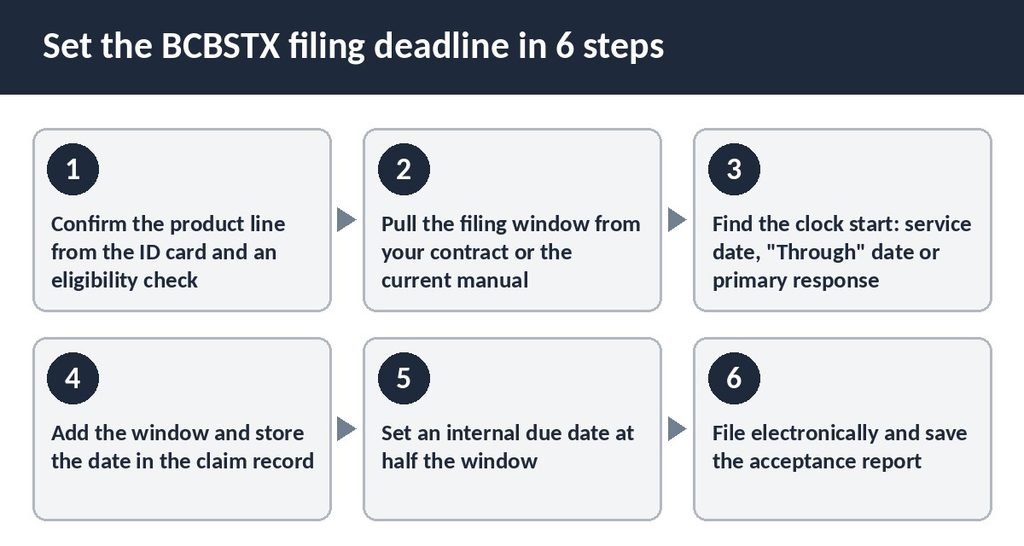
- Confirm the product line (PPO, HMO, Medicare Advantage or Medicaid/CHIP) from the ID card and an eligibility check before assigning a deadline.
- Pull the window from your BCBSTX contract, and use the contract figure when it differs from the manual.
- Identify the clock start date: date of service, “Through” date or primary payer response date.
- Add the window and store the result in the claim record, not in a separate spreadsheet that drifts.
- Set an internal due date at half the window, and follow a timely filing deadline tracking routine when volume is high.
- Submit electronically and save the acceptance report as proof of timely filing.
Worked example: three deadlines from one visit
Illustrative scenario (not an actual client record): a patient is seen on March 10, 2026. The table shows how the same date of service produces three different deadlines, and what remains as of October 3, 2026, which is 207 days later.
| Plan | Window | Last filing date | Status on October 3, 2026 |
| Medicaid/CHIP | 95 days | June 13, 2026 | Passed 112 days ago |
| HMO | 180 days | September 6, 2026 | Passed 27 days ago |
| Blue Choice PPO | 365 days | March 10, 2027 | 158 days remaining |
Actual dates depend on the member’s product and your contract. A practice that applies the PPO date to all three would miss two deadlines without seeing a warning, because the billing system would still show the claims as open and on time.
When Does the Clock Start for Secondary, Corrected and Returned Claims?
Secondary claims run from the primary payer’s response, corrected claims follow the standard filing deadline, and claims returned for more information carry their own 90-day clock. Each case has a different start date, and each is a common source of late-filing denials.
Secondary claims and coordination of benefits
When a member gives a practice the wrong insurance information, BCBSTX’s manuals require the other carrier’s Explanation of Benefits (EOB) and then allow the plan’s full window, 365 days for PPO or 180 days for HMO, counted from the other carrier’s response. For ordinary secondary claims, Texas rule 28 TAC Section 21.2806 says the 95-day statutory period does not start until the provider receives the primary payer’s payment or denial notice. Check your contract for the longer contractual period. Our secondary claim filing deadline guide explains the mechanics.
Illustrative scenario (not an actual client record): a primary payer’s EOB is dated January 20, 2026. Under a 365-day PPO window counted from that response, the last date is January 20, 2027. Under a 180-day HMO window, it is July 19, 2026.
Corrected claims
BCBSTX’s PPO manual says corrected claims must use the appropriate bill type and meet the filing deadline listed in the manual or in the subscriber’s contract. Paper corrections need a Corrected Claim Form. The manual does not say a correction restarts the clock, so plan as if it does not. In billing audits, a common pattern is a corrected claim sent weeks after a rejection on the assumption of a fresh 365 days. For a payer-by-payer view, see our corrected claim deadline guide.
Claims returned for more information
When BCBSTX returns a claim for additional information, resubmit it within 90 days. The 90 days begin on the date BCBSTX mails the request, and the claim goes back with the letter or an Additional Information Form. Put returned-claim letters in a dated queue that someone reviews weekly, because the 90-day period is separate from the original filing window.
How Does the BCBSTX Window Compare With Medicare, Medicaid and Other Payers?
BCBSTX’s PPO window is longer than Texas Medicaid’s 95 days and roughly matches the 12-month rule for Original Medicare, so a mixed payer panel needs a separate deadline for each payer. Treating all payers alike is the most common structural cause of missed windows.
| Payer or product | Filing window | Source type |
| BCBSTX Blue Choice PPO and related | 365 days | BCBSTX PPO manual |
| BCBSTX HMO products | 180 days | BCBSTX HMO manual |
| BCBSTX Medicaid and CHIP | 95 days | BCBSTX Medicaid page |
| BCBSTX Medicare Advantage PPO | 90 or 180 days; confirm in contract | BCBSTX page and manual supplement |
| Original Medicare | 12 months from date of service | Federal rule, 42 CFR 424.44 |
For federal detail, read our Original Medicare 12-month rule explainer. For another large Texas commercial payer, see the Aetna Texas timely filing guide. Payer rules also shift at the claim form level, which our payer-specific submission rules guide covers. Practices that cannot keep per-payer calendars current often hand this work to a medical billing partner with a maintained payer rules library.
What Proof of Timely Filing Does BCBSTX Accept?
BCBSTX’s claim review page lists seven acceptable forms of proof, and an electronic acceptance report is the strongest for most practices. Proof matters only after a late-filing denial, but it has to exist before then.
- A TDI mail log.
- A certified mail receipt, accepted only together with a TDI mail log.
- An Availity Electronic Batch (EBR) Response Report.
- The same documentation showing the claim went to the wrong BCBSTX division.
- BCBSTX documentation that the claim was incomplete.
- BCBSTX documentation requesting additional information.
- The primary carrier’s EOB showing the claim was filed with the primary carrier on time.
Save the EBR with each batch when you file electronically. Keep a TDI mail log when you file on paper, because a certified mail receipt alone does not qualify. Our electronic claim submission tips cover acceptance reports in more detail. The full list sits on the BCBSTX claim review process page.
How Long Do You Have to Dispute a BCBSTX Timely Filing Denial?
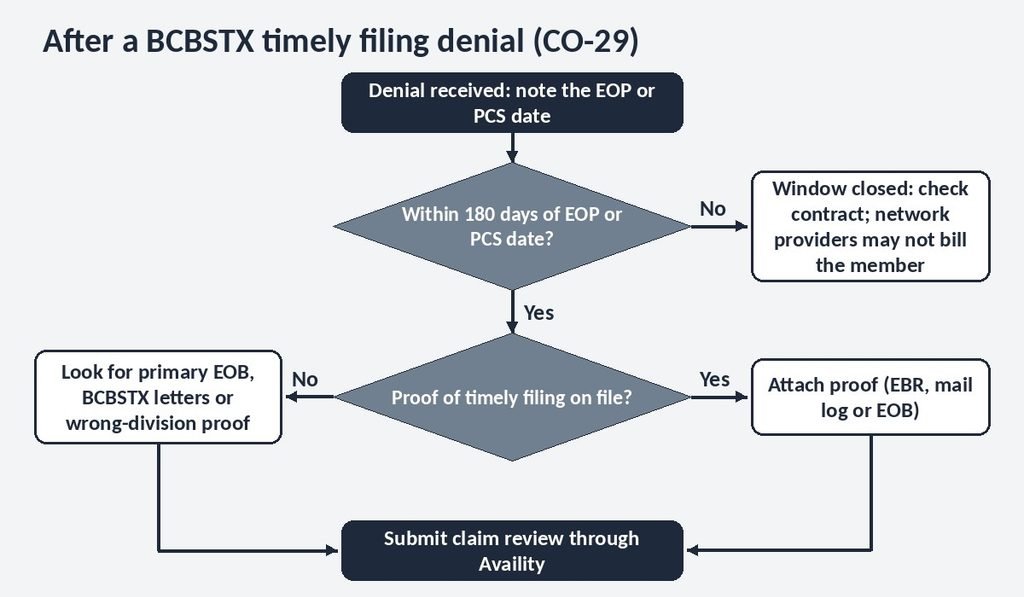
For commercial claims, a claim dispute must be requested within 180 days of the check date, EOP date or Provider Claims Summary (PCS) date, according to BCBSTX’s claim review page. The dispute deadline runs from the payment document, not from the date of service.
BCBSTX completes the first claim review within 45 days of receiving the request and offers a second review if the result is unsatisfactory. Electronic claim reconsideration through Availity is preferred over fax or mail because supporting documents can be uploaded and tracked. A timely filing denial usually appears with claim adjustment reason code 29, “the time limit for filing has expired,” under group code CO. Network providers may not bill the member for these denials under the BCBSTX manuals.
Illustrative scenario (not an actual client record): an EOP is dated August 15, 2026. Adding 180 days gives February 11, 2027 as the last day to request a first claim review. Many practices set an internal date about 30 days earlier, here January 12, 2027, to leave time to gather proof of timely filing.
Appeals and filing deadlines are separate clocks, as our timely filing versus appeal limit comparison explains. Missing the dispute window can turn a recoverable denial into a permanent write-off. When denials stack up faster than staff can review them, denial management support shortens the queue and keeps each dispute date visible.
How Can a Blended Average Hide a Timely Filing Problem?
A blended days-to-submit average can look healthy while one plan group uses most of its window, so each plan group needs its own measure. The metric to track is the percentage of the filing window used, calculated separately for every plan group a practice bills.
Formula: Percent of window used = average days from service to submission ÷ filing window. Blended average = sum of (claims × average days) ÷ total claims.
Illustrative scenario (not an actual client record): a practice submits 1,000 BCBSTX claims in a month across three plan groups. Actual figures vary by practice.
| Plan group | Claims | Avg. days to submit | Window | Percent of window used |
| Blue Choice PPO | 700 | 9 | 365 | 2.5% |
| HMO | 200 | 14 | 180 | 7.8% |
| Medicaid/CHIP | 100 | 61 | 95 | 64.2% |
| Blended | 1,000 | 15.2 | n/a | n/a |
The blended figure is (700 × 9 + 200 × 14 + 100 × 61) ÷ 1,000 = 15.2 days, which looks fine. The Medicaid/CHIP group, however, uses 64.2% of a 95-day window, so one slow batch pushes claims past the limit. In billing audits, a common pattern is a monthly report that shows only the blended average. A plan-level view from reporting and analytics support exposes the problem.
How to use these numbers correctly?
Compare like for like: judge HMO claims against the 180-day window and Medicaid claims against 95 days, never against one shared number. One group above 50% of its window is a signal to investigate the cause, such as a slow charge-entry step or a missing authorization, not a verdict on the team. Do this review monthly when volume is steady and weekly when a new plan group starts.
How Fast Can a Practice Fix Timely Filing Problems?
Most practices can see partial improvement within two to three months and fuller results within three to six months. These are general planning ranges, not guarantees, and they vary with claim volume, staffing, the size of the denial backlog and how quickly payer-specific deadlines are built into daily work.
- Plan-specific deadlines and alerts in the billing system: roughly 2 to 4 weeks.
- Clearing a backlog of unbilled claims: roughly 30 to 60 days, starting with the oldest dates of service.
- Fewer late-filing denials in monthly reports: partial results often appear in 2 to 3 months.
- Stable, repeatable performance across all plan groups: commonly 3 to 6 months.
Which Mistakes Cause BCBSTX Timely Filing Denials?
Most late-filing denials trace back to a handful of process errors, all of them preventable with the right checks at registration, charge entry and submission. Each mistake below comes with the condition that triggers the fix.
- Using one number for every Blue plan. Assign the deadline by product at registration when a practice sees PPO, HMO and Medicaid patients.
- Starting the clock on the wrong date. Use the “Through” date for institutional claims and the primary payer’s response date when a secondary rule applies.
- Assuming a correction resets the clock. Treat the original deadline as the limit when the manual or contract is silent.
- Trusting “sent” status. Save the payer acceptance report when a clearinghouse shows a claim as submitted.
- Mailing paper claims without a TDI mail log. Keep the log when electronic filing is not possible.
- Letting returned-claim letters sit. Work every request within the 90-day window.
Quick Summary
- The BCBS Texas timely filing limit is 365 days for Blue Choice PPO and related networks and 180 days for HMO products, per BCBSTX manuals.
- Medicaid and CHIP claims use a 95-day window, which also matches the Texas statutory default.
- Medicare Advantage PPO sources conflict at 90 and 180 days, so confirm in the contract.
- Commercial claim disputes must be requested within 180 days of the EOP or PCS date.
- A practical internal target is filing within about 5 business days of service and flagging claims at 50% of the window.
- Track percent of window used by plan group, because blended averages hide risk.
How Exposed Is Your Practice to Timely Filing Denials?
Answer yes or no to each question.
- Do you confirm each patient’s BCBSTX product line before billing?
- Does your system assign a separate filing deadline for PPO, HMO, Medicare Advantage and Medicaid/CHIP?
- Is Medicaid/CHIP tracked at 95 days and HMO at 180 days?
- Are most claims filed within about 5 business days of service?
- Do you flag unbilled or unpaid claims at 50% of the window?
- Do you save the Availity EBR or other acceptance report for every batch?
- Do you work BCBSTX returned-claim requests within 90 days?
- Do you review average days to submit by plan group, not only as a blended number?
- Do you calendar the 180-day dispute window from each EOP or PCS date?
- Have you checked your BCBSTX contract for any filing term that differs from the manual?
Scoring guide: 9 to 10 yes answers means the process is well controlled; keep the monthly review going. 6 to 8 yes answers means there are gaps; fix each “no” within 30 days. 5 or fewer yes answers means high exposure; review the claims backlog now and consider outside support.
When Should a Practice Bring in Outside Billing Support?
Outside support makes sense when in-house tracking has stopped keeping pace with the payer mix and the cost of missed windows is higher than the cost of fixing the process. Five signals usually show up first:
- Timely filing denials recur month after month despite reminders.
- Staff cannot list unbilled claims by plan group on demand.
- Billing coverage drops when one biller is out.
- The payer mix has grown to include HMO, Medicaid and Medicare Advantage with different windows.
- Accounts receivable aged beyond 90 days keeps growing; see our A/R management service.
When comparing partners, look for plan-level reporting, a named contact, a maintained payer rules library, written escalation steps and a US-based team that can speak to BCBSTX processes. Ask how deadlines are assigned, who monitors them and how proof of timely filing is stored.
EON MED SOLUTIONS is one example. The team provides end-to-end billing, coding, credentialing, denial management and compliance support through a US-based team with transparent reporting and no hidden fees. Results vary by practice. Review EON MED SOLUTIONS’ billing and RCM services to see how that process works.
Expert Opinion
The BCBS Texas timely filing limit is not a single number. It is a set of windows tied to the plan, the claim type and the contract, with a Texas statutory default of 95 days sitting underneath. Getting the product right at registration solves most of the problem.
The firm, published standards in this guide are the 365-day PPO window, the 180-day HMO window, the 95-day Medicaid/CHIP window and the 180-day dispute window, all from BCBSTX documents, plus the Texas 95-day statute. The 5-business-day target, the 50% alert point and the improvement timeframes are practical planning targets, and the worked examples are illustrative.
The natural next question is which BCBSTX plan each of your patients actually has and how many claims sit close to the edge today. Talk with EON MED SOLUTIONS about a timely filing and billing review to find out.
Frequently Asked Questions
What is the BCBS Texas timely filing limit for PPO claims?
Blue Choice PPO, Blue High Performance Network, Blue Edge and EPO claims must be submitted within 365 days of the date of service, according to the BCBSTX PPO provider manual updated December 2025. Institutional claims count from the “Through” date. Your contract may set a different period, so confirm it before relying on the manual.
What is the BCBS Texas timely filing limit for HMO claims?
BCBSTX HMO products, including Blue Essentials, Blue Advantage HMO and Blue Premier, require claims within 180 days of the date of service. Claims filed after that date are not eligible for reimbursement, and network providers may not bill the member for them. Check your contract for any different filing term.
What is a good internal filing target for BCBSTX claims?
A common practical target is submitting most claims within about 5 business days of service, with an alert when any claim reaches 50% of its filing window. These are industry conventions, not BCBSTX requirements. Track the percentage of window used by plan group so a short Medicaid window is not hidden by PPO volume.
What is a good timely filing denial rate?
No standards body publishes a target for timely filing denials. Because late filing is largely preventable, many practices treat any recurring denial as a process failure and aim for zero. Review the count monthly by plan group, and investigate when one group’s average submission time exceeds half its window.
Can you bill the patient if BCBSTX denies a claim for timely filing?
Not for network providers. The BCBSTX PPO and HMO manuals state that network providers may not seek payment from the member for claims submitted after the filing deadline. BCBSTX Medicaid and CHIP claims carry the same restriction. Review your contract before adjusting the balance, and appeal when proof of timely filing exists.
How long do you have to appeal a BCBSTX denial?
For commercial claims, a first claim review must be requested within 180 days of the check date, EOP date or Provider Claims Summary date. BCBSTX provider training lists 120 days for Medicaid and CHIP claim reconsideration. Start from the payment document date, not the date of service, and use Availity when possible.
Sources and Methodology
(a) Published standards and definitions from named bodies
- Blue Cross and Blue Shield of Texas, Blue Choice PPO and Blue High Performance Network Provider Manual, Section F(a), Filing Claims, updated December 19, 2025.
- Blue Cross and Blue Shield of Texas, HMO Provider Manual (Blue Essentials, Blue Advantage HMO, Blue Premier), Section F(a), updated December 2025.
- Blue Cross and Blue Shield of Texas, Blue Cross Medicare Advantage (PPO) provider page and Provider Manual Supplement, updated October 15, 2024.
- Blue Cross and Blue Shield of Texas, Medicaid claims page and Claims Billing Provider Training for STAR, STAR Kids and CHIP.
- Blue Cross and Blue Shield of Texas, Claim Review Process page (claim dispute and proof of timely filing).
- Texas Insurance Code Sections 843.337 and 1301.102; 28 Texas Administrative Code Section 21.2806; Texas Department of Insurance Prompt Pay FAQ.
- 42 CFR 424.44 (Original Medicare filing limit); X12 Claim Adjustment Reason Code 29.
(b) Named benchmarking data providers
- None used. No benchmark data provider publishes a timely filing denial rate for BCBSTX that this article relies on.
(c) Practical or illustrative targets from general industry practice
- The 5-business-day filing target, 50% alert point, improvement timeframes and every worked example are practical or illustrative figures, not BCBSTX or government requirements.
(d) Survey or study data
- None used.
Methodology. Research was completed in October 2026. Third-party billing guides from MuniHealth, MedSolERCM, Pabau, A3 Medical Billing and Clark Street Health were compared against BCBSTX and Texas primary documents. Where they conflicted, the primary document governed, and unresolved differences, such as Medicare Advantage at 90 versus 180 days, are stated in the text. Results vary by contract, plan and claim type. Figures reflect information available at the time of research; confirm current terms in your contract and the latest BCBSTX provider manual.


