

Medicaid New York Timely Filing Limit: The 90-Day Rule and Its Exceptions
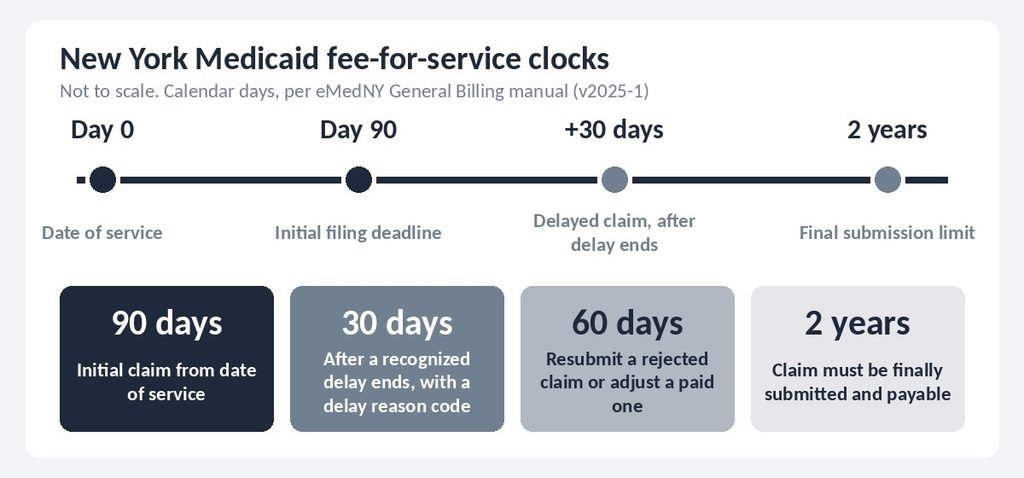
The Medicaid New York timely filing limit is 90 days from the date of service for fee-for-service claims, under 18 NYCRR 540.6. Claims delay by circumstances outside the provider’s control must be file within 30 days after the delay ends, and every claim must be finally submit and payable within two years. Managed care plans set windows by contract.
Practices that bill New York Medicaid often find that one question has several answers: 90 days, 60 days, 30 days, 120 days or two years. Each number is real, but each applies to a different situation. This guide explains which clock governs fee-for-service and managed care claims, when a delay reason code protects a late claim, and how to calculate a deadline for a specific claim. A self-assessment checklist near the end shows where a billing process leaks revenue.
New York Medicaid Filing Numbers: Quick Reference
| Metric | Practical target/range | Review frequency | Source type |
| Initial claim, fee-for-service | 90 calendar days from date of service | At each manual update | Published standard (A) |
| Claim delayed by a recognized reason | 30 days after the delay ends (most delay reasons) | Monthly delay-code review | Published standard (A) |
| Rejected or denied claim resubmission, or adjustment of a paid claim | 60 days from notification | Weekly rejection queue | Published standard (A) |
| Final submission limit | 2 years from date of service, and payable | Quarterly aged-claim review | Published standard (A) |
| Two-year waiver review request | 60 days from the remittance date | When a two-year denial arrives | Published standard (A) |
| Managed care window agreed by contract | Not less than 90 days (Medicaid managed care) | At contract renewal | Regulation (R) |
| Internal submission target | Most claims filed within about 10 days of service | Weekly | Practical target (P) |
| Internal alert point | Flag unbilled claims at 50% of the window, about day 45 | Weekly | Practical target (P) |
Source labels: A = eMedNY provider manual or New York State Department of Health (DOH) guidance. R = New York regulation or Insurance Law, including 18 NYCRR 540.6 and Insurance Law Section 3224-a. P = practical target commonly used in billing operations; New York Medicaid does not require it.
What Is the Medicaid New York Timely Filing Limit?
Fee-for-service Medicaid claims in New York must be initially submit within 90 days of the date of service, according to the eMedNY General Billing manual (version 2025-1, June 2025). Claims that miss the window are not “valid and enforceable” unless a recognized delay applies. The federal ceiling under 42 CFR 447.45 is 12 months, and New York chose a much shorter period.
Fee-for-service claims: 90 calendar days
The 90-day rule comes from 18 NYCRR 540.6(a) and is enforce by the eMedNY claim system through automate edits. The eMedNY quick-reference form states that the 30-day, 60-day and 90-day periods are calendar days, not business days. Count from the date of service, and file well before the last day when a clearinghouse or paper mailing adds transit time.
Home care agencies: a narrow exception
Certified home health agencies, long term home health care programs and licensed home care services agencies have up to 12 months to obtain a physician’s signature on orders. These providers cannot bill until the signed order exists, so they must submit within 30 days of the signed order date and report no delay reason code. The exception applies only to those agency types, not to other providers.
Does New York Medicaid Managed Care Use the Same 90 Days?
Not always. Medicaid managed care plans set filing windows in provider contracts, and New York Insurance Law Section 3224-a(g) allows a Medicaid managed care plan and a provider to agree on a period of not less than 90 days. The Department of Financial Services (DFS) guidance on health plan contracts describes the 120-day default for other health claims and that 90-day floor for Medicaid managed care and Child Health Plus.
Plan manuals show the range. The Fidelis Care provider manual (version 26.1, June 2026) requires electronic claims within 90 calendar days of service. EmblemHealth’s timely filing policy applies 120 days for participating providers unless the participation agreement says otherwise, and lists 15 months for non-participating providers on Medicaid and Child Health Plus claims.
In billing audits, a common pattern is a practice that tracks every New York Medicaid claim against one 90-day date, even though a plan contract allows 120 days, or the reverse: a practice that assumes plans are more generous than fee-for-service and loses claims at day 90. Pull the window from each plan’s contract and current manual when onboarding a new managed care plan, and record it in the billing system.
A related trap involves recoupments. When a managed care plan pays a claim and later recoups the payment because of retroactive disenrollment, the provider may need to bill fee-for-service Medicaid. The eMedNY manual treats that case under delay reason 11, with a 60-day clock from the notification.
Which Delay Reasons Let a Claim Go Past 90 Days?
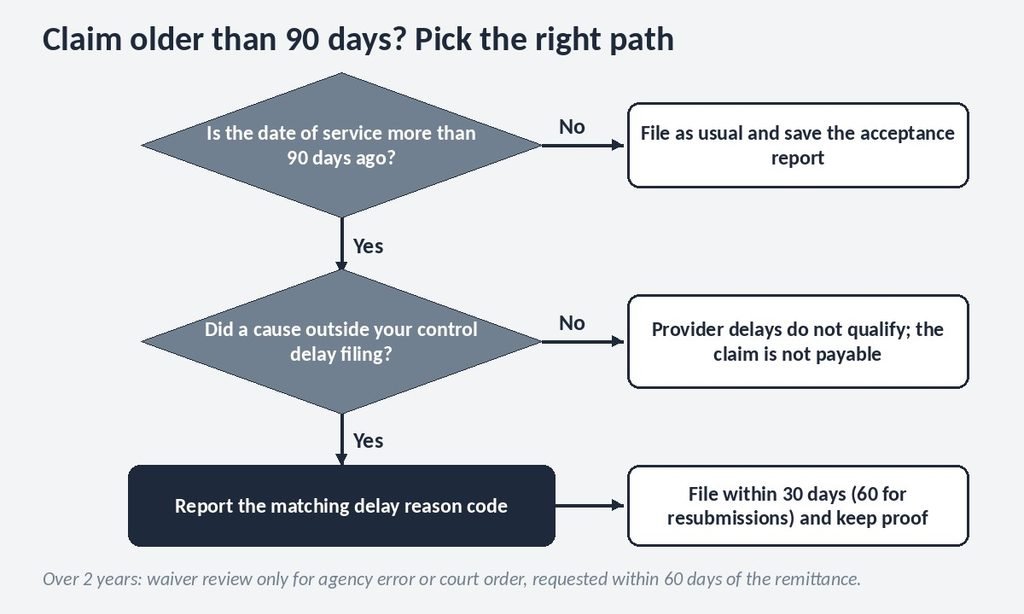
eMedNY accepts a short list of numeric delay reason codes for claims older than 90 days, and most require submission within 30 days after the delay ends. HIPAA requires a code on any claim submitted beyond the filing limit, and providers must keep documentation of the delay available on request.
| Code | Situation | Clock |
| 1 | Proof of eligibility unknown or unavailable on the service date | 30 days from notice of eligibility |
| 2 | Litigation | 30 days from when submission came within the provider’s control |
| 3 | Authorization delay caused by a State administrative delay | 30 days from notification |
| 4 | Delay in certifying the provider, such as an enrollment or specialty change | 30 days from notification |
| 7 | Third party processing delay by Medicare or another insurer | 30 days from when submission came within the provider’s control |
| 8 | Delay in eligibility determination; coverage backdated or changed | 30 days from notice of eligibility |
| 9 | Resubmission after a rejection or denial unrelated to timeliness | 60 days from notification; not valid for adjustments |
| 10 | Administrative delay in the prior approval process | 30 days from notification |
| 11 | Limited cases, such as adjusting a paid claim or audit-directed replacement | Generally 60 days from notification |
| 15 | Natural disaster after a State Disaster Emergency declaration in the provider’s county | 30 days from when submission came within the provider’s control |
Code 5 applies only to paper claims on non-standard forms, and electronic claims using it deny. Code 6, delay in delivery of custom-made appliances, is not accept and the claim denies. Provider-side delays, such as slow charge entry or missing documentation, do not qualify, according to the eMedNY delayed-claims FAQ.
Code 4 deserves attention for new practices and new clinicians. When enrollment approval is back-date or a specialty code is add late, the 30 days run from the notification. A reliable provider credentialing and enrollment process keeps enrollment dates ahead of billing dates and reduces the need for this code.
Illustration
In billing audits, another common pattern is a retroactive eligibility notice that reaches the front desk but not the biller, so the 30-day clock expires unseen. Log the notice date in the claim record when any eligibility change is discover after the visit. Paper claims over 90 days also need the scannable eMedNY Delay Reason Code Form, one form per claim.
How Do You Work Out the Deadline for a Specific Claim?
The deadline equals the date of service plus 90 calendar days for fee-for-service claims, or plus the plan’s contract window for manage care, so a fee-for-service visit on August 12, 2026 must be file by November 10, 2026. The arithmetic is easy. The harder part is knowing which clock applies and what starts it.
Formula: Last filing date = clock start date + window in calendar days. The clock start is the date of service for original claims, the notification date for rejected claims and delay reasons, and the primary payer’s adjudication date when a third party delayed submission.
Step-by-step: set the deadline before the claim is billed
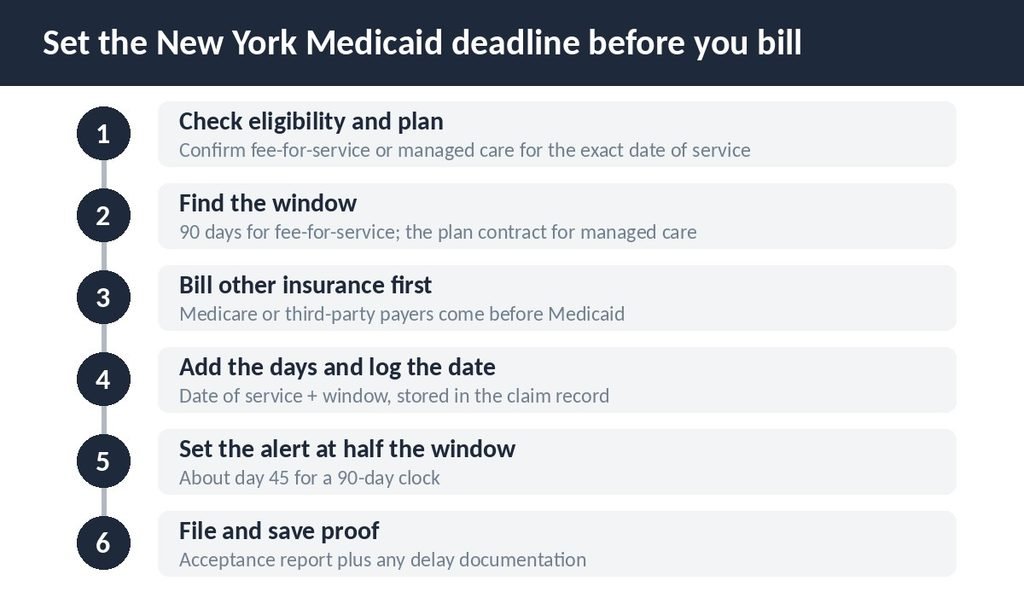
- Check eligibility and plan assignment for the exact date of service, because fee-for-service and managed care windows differ.
- Pull the window from the eMedNY manual for fee-for-service, or from the plan contract for managed care.
- Bill Medicare or other insurance first when the member has other coverage, because New York regulation requires that order.
- Add the window to the date of service and store the result in the claim record.
- Set an internal alert at half the window, and use a timely filing tracking routine when volume is high.
- File electronically and save the acceptance report, plus any delay documentation.
Worked examples: four clocks, four dates
Illustrative scenario (not an actual client record): the table shows four separate clocks, each calculated as of October 3, 2026. Actual dates depend on the claim, the plan and the notification date on the remittance.
| Clock | Formula | Example input | Last date | Days left on Oct. 3, 2026 |
| Initial fee-for-service claim | Date of service + 90 days | Service August 12, 2026 | November 10, 2026 | 38 |
| Delay reason 8 (eligibility) | Eligibility notice + 30 days | Notice September 14, 2026 | October 14, 2026 | 11 |
| Rejected claim resubmission | Remittance notice + 60 days | Remittance August 20, 2026 | October 19, 2026 | 16 |
| Two-year final submission | Date of service + 2 years | Service January 10, 2025 | January 10, 2027 | 99 |
A practice that tracks only the 90-day date would see the eligibility claim as a late claim, when in fact a valid 30-day delay clock is running and expires in 11 days. The practical lesson is to store each clock as its own field in the claim record, with its own start date, so that no deadline depends on someone remembering it.
What Happens When a Claim Passes the Two-Year Line?
Claims over two years old are considered only when the provider can document that the delay came from an error by the Department, a local social services district or another State agent, or when a court ordered payment. The eMedNY manual states that every claim must be finally submitted and payable within two years of the date of service.
Such claims deny automatically with edit 01292, claim adjustment reason code (CARC) 29 and claim status code 187. A provider who believes the denial is wrong can request a review within 60 days of the remittance date, with a cover letter, the remittance showing the edit 01292 denial and supporting evidence such as a fair hearing decision or proof of agency error. Requests that arrive late or without documents are not considered.
The two-year rule changes how to correct paid claims. Use an adjustment, not a void, when a paid claim needs correction. A voided claim that is resubmitted is treated as a new claim, faces every timeliness edit again and does not qualify for the two-year waiver, because the void is not agency error. In billing audits, a common pattern is a biller voiding and rebilling a claim at month 23 and losing it to this rule.
How Do Medicare Crossover and Other Insurance Change the Clock?
When a member has Medicare or other insurance, New York regulation requires billing that payer first, and delay reason 7 protects Medicaid claims delayed by the primary payer’s processing. The 30 days then run from when submission came within the provider’s control, usually the primary payer’s adjudication date. Paper claims must include the primary payer’s explanation of benefits.
Payer differences matter on mixed panels, because a single practice may bill fee-for-service Medicaid, several managed care plans, Medicare and commercial carriers in one week. The table compares the main clocks a New York practice meets, and each one needs its own calendar entry.
| Payer or product | Filing window | Source type |
| New York Medicaid fee-for-service | 90 days from date of service | eMedNY manual (A) |
| New York Medicaid managed care | Set by plan contract; not less than 90 days when agreed | Insurance Law 3224-a(g) (R) and plan manuals |
| Original Medicare | 12 months from date of service | Federal rule, 42 CFR 424.44 |
| Medicare Advantage | Plan-specific; confirm in the contract | Plan contract |
| New York commercial plans | 120 days unless the contract is more favorable to the provider | Insurance Law 3224-a(g) (R) |
Original Medicare’s longer window is explained in our 12-month Medicare filing rule guide, and the sequencing of primary and secondary submissions is covered in our secondary claim filing deadline guide. For comparison, other states use different numbers. See the Texas Medicaid 95-day rule, the Florida Medicaid filing limits and the Medi-Cal filing rules. Practices that bill several states often use a medical billing partner to keep those calendars separate.
What Does a Timely Filing Denial Look Like on the Remittance?
A late original claim returns claim adjustment reason code 29, “the time limit for filing has expired,” with a claim status code such as 187 or 188 depending on claim type, according to DOH’s 2018 timely billing guide. The related edits include 00068 for original claims, 00658 for inpatient claims and 01007 for institutional claims.
The same guide states that the Department and its fiscal agent do not accept requests for exceptions to the 90-day rule. The route to payment is the correct delay reason code at submission, not a plea afterward. Delay reason 9 also becomes unavailable once a claim has denied for timeliness, so a claim rejected for a data error needs correcting inside 60 days.
For managed care denials, follow the plan’s dispute process, which has its own deadline. Our comparison of filing and appeal limits separates the two clocks. A corrected claim deadline guide and our advice on reducing claim rejections cover the 60-day resubmission clock. When denials outpace staff capacity, denial management support keeps every dispute date visible.
Why Can a Healthy Average Hide a Slow Medicaid Queue?
A blended days-to-submit average can look comfortable while one payer group uses most of its window, so each group needs its own measure. The metric to track is the percentage of the filing window used, calculated separately for every payer group a practice bills.
Formula: Percent of window used = average days from service to submission ÷ filing window. Blended average = sum of (claims × average days) ÷ total claims.
Illustrative scenario (not an actual client record): a practice submits 1,000 Medicaid claims in a month across three groups. Actual figures vary by practice.
| Payer group | Claims | Avg. days to submit | Window (days) | Percent of window used |
| Managed care plan A (90-day contract) | 600 | 18 | 90 | 20.0% |
| Managed care plan B (120-day contract) | 250 | 24 | 120 | 20.0% |
| Fee-for-service | 150 | 71 | 90 | 78.9% |
| Blended | 1,000 | 27.5 | n/a | n/a |
The blended figure is (600 × 18 + 250 × 24 + 150 × 71) ÷ 1,000 = 27.45, about 27.5 days, which looks safe against a 90-day rule. The fee-for-service group, however, uses 78.9% of its window, so a single slow week pushes claims past day 90. In billing audits, a common pattern is a monthly report showing only the blended average. A payer-level view, with each group measured against its own window, exposes the problem.
How to use these numbers correctly
Compare like for like: judge fee-for-service claims against 90 days and each plan against its own contract window. One group above 50% of its window is a signal to investigate, such as slow charge entry or missing eligibility checks, not a verdict on the team. Review monthly when volume is steady, and weekly when a new plan or service line starts.
How Long Does It Take to Get Medicaid Filing Under Control?
Most practices see partial improvement within two to three months and fuller results within three to six months. These are general planning ranges, not guarantees, and they vary with claim volume, staffing, backlog size and how quickly payer windows are built into daily work.
- Payer-specific deadlines and alerts built into the billing system: roughly 2 to 4 weeks.
- Clearing unbilled claims, starting with the oldest dates of service: roughly 30 to 60 days.
- Fewer timeliness denials in monthly reports: partial results often appear in 2 to 3 months.
- Stable performance across fee-for-service and every managed care plan: commonly 3 to 6 months.
Where Do New York Medicaid Claims Go Wrong on Timing?
Most timing failures come from a few repeatable process errors, all of them preventable with checks at registration, charge entry and submission. Each fix below is tied to the condition that triggers it, so staff know when to act.
- Treating every Medicaid payer alike. Assign deadlines by payer when a practice sees fee-for-service and several managed care plans.
- Using a provider-side delay as a reason. Do not use a delay code for slow billing; provider delays do not qualify.
- Missing the 30-day clock. Log the notification date when eligibility, enrollment or third-party information changes after the visit.
- Voiding instead of adjusting. Use an adjustment for a paid claim when correction is needed.
- Ignoring the 60-day rejection clock. Work rejected and denied claims weekly.
- Relying on a “sent” status. Save the acceptance report when a clearinghouse shows a claim as submitted.
Quick Summary
- The Medicaid New York timely filing limit is 90 calendar days from the date of service for fee-for-service claims.
- A claim delayed by a recognized reason must be filed within 30 days after the delay ends; resubmissions follow a 60-day clock.
- Every claim must be finally submitted and payable within two years, with narrow waiver review.
- Managed care windows come from the plan contract, with a 90-day floor when agreed under Insurance Law.
- A practical internal target is filing within about 10 days of service and alerting at 50% of the window.
- Track percent of window used by payer group, because blended averages hide risk.
Self-Assessment: Is Your Process Safe From the 90-Day Rule?
Answer yes or no to each question below, then use the scoring guide to see how exposed your current process is to late-filing write-offs.
- Do you verify eligibility and plan assignment for the date of service before billing?
- Does your system hold a separate filing window for fee-for-service and each managed care plan?
- Have you confirmed each plan’s window from its current contract or manual?
- Are most claims filed within about 10 days of service?
- Do you flag unbilled claims at 50% of the window?
- Do you log eligibility, enrollment and third-party notification dates in the claim record?
- Do you work rejected and denied claims within the 60-day clock?
- Do you use adjustments rather than voids for paid claims?
- Do you save an acceptance report for every submission?
- Do you review average days to submit by payer group, not only as a blended number?
Scoring guide: 9 to 10 yes answers means the process is well controlled; keep the monthly review going. 6 to 8 yes answers means there are gaps; fix each “no” within 30 days. 5 or fewer yes answers means high exposure; review the claim backlog now and consider outside support.
Signs Your Practice Has Outgrown In-House Medicaid Billing
In-house billing reaches its limit when payer rules multiply faster than staff can track them. Five signals usually appear first:
- Timeliness denials recur despite reminders.
- Staff cannot list unbilled claims by payer on demand.
- Eligibility or enrollment changes reach the biller after the 30-day clock has expired.
- The payer mix now includes fee-for-service Medicaid and several managed care plans.
- Accounts receivable aged beyond 90 days keeps growing; our A/R management service addresses that backlog.
When comparing outside partners, look for payer-level reporting, a named contact, a maintained payer rules library, written escalation steps and a US-based team familiar with New York Medicaid. Ask how deadlines are assigned, who monitors them and how delay documentation is stored.
EON MED SOLUTIONS is one example. The team provides end-to-end billing, coding, credentialing, denial management and compliance support through a US-based team with transparent reporting and no hidden fees. Results vary by practice. Review EON MED SOLUTIONS’ billing and RCM services to see how that process works.
Expert Opinion
The Medicaid New York timely filing limit is a family of clocks, not one number. The 90-day rule opens the door, delay reasons extend it for narrow situations, resubmissions run 60 days, and two years closes it. Managed care adds plan contracts on top.
Firm, published standards in this guide are the 90-day, 30-day, 60-day and two-year periods from DOH and eMedNY, plus the 90-day floor in Insurance Law. Plan windows come from named manuals and vary by contract. The 10-day target, the 50% alert and the improvement timeframes are practical targets, and every worked example is illustrative.
The natural next question is which of your Medicaid claims are closest to a deadline today, and which payer clock each one is running. Talk with EON MED SOLUTIONS about a Medicaid timely filing review to find out.
Frequently Asked Questions
What is the timely filing limit for New York Medicaid?
Fee-for-service New York Medicaid claims must be submitted within 90 calendar days of the date of service under 18 NYCRR 540.6. Claims delayed by a recognized reason need a delay reason code and filing within 30 days after the delay ends. Managed care plans set their own windows by contract.
Can you submit a New York Medicaid claim after 90 days?
Yes, but only when a recognized delay reason applies, such as eligibility determined after the visit or a third-party processing delay. The claim must carry the matching numeric delay reason code and be filed within 30 days after the delay ends. Provider-side delays, like slow billing, do not qualify.
How long do you have to resubmit a rejected New York Medicaid claim?
A claim returned for data errors, or denied, must be corrected and resubmitted within 60 days of the notification date. Paid claims needing correction must be adjusted within 60 days as well. Claims not correctly resubmitted in that period, or still unpayable after the second resubmission, are not valid or enforceable.
What is a good internal filing target for Medicaid claims?
A common practical target is filing most Medicaid claims within about 10 days of service, with an alert at 50% of the payer’s window. These are industry conventions, not Medicaid requirements. Track the percentage of window used by payer group so a fee-for-service backlog stays visible beside faster managed care claims.
What is a good timely filing denial rate?
No standards body publishes a target for Medicaid timely filing denials. Because late filing is largely preventable, many practices treat any recurring denial as a process failure. Review denial counts monthly by payer group, and investigate when average submission time passes half of that group’s filing window.
Can you bill a patient if Medicaid denies a claim for timely filing?
Generally no. EmblemHealth’s policy states participating practitioners may not bill patients for late-submission denials, and New York Medicaid providers certify that fee-schedule payment is accepted as payment in full. Confirm the rule in your contract or with compliance counsel before billing any member.
Sources and Methodology
(a) Published standards and definitions from named bodies
- New York State Medicaid Program, Information for All Providers: General Billing, version 2025-1, June 9, 2025 (eMedNY).
- eMedNY, FOD 7001: Submitting Claims over 90 Days from Date of Service, and the eMedNY delayed-claims FAQ.
- New York State Department of Health, Guide to Timely Billing, August 9, 2018, including 18 NYCRR 540.6(a).
- New York Insurance Law Section 3224-a(g), as described in New York Department of Financial Services health plan contract guidance.
- Fidelis Care Provider Manual, version 26.1, June 1, 2026; EmblemHealth, Claims Submission – Timely Filing policy (reviewed 2024).
- 42 CFR 447.45 (state Medicaid claim filing) and 42 CFR 424.44 (Original Medicare filing limit); X12 Claim Adjustment Reason Code 29.
(b) Named benchmarking data providers
- None used. No benchmark provider publishes a New York Medicaid timely filing denial rate that this article relies on.
(c) Practical or illustrative targets from general industry practice
- The 10-day filing target, 50% alert point, improvement timeframes and every worked example are practical or illustrative figures, not Medicaid requirements.
(d) Survey or study data
- None used.
Methodology. Research was completed in October 2026. Third-party billing guides from ClaimMax RCM, Transcure, GenMediTech, MedStates and MediBillRCM were compared against eMedNY, DOH, DFS and plan documents. Where they conflicted, the primary document governed, and unresolved differences, such as plan-by-plan managed care windows, are stated in the text. Results vary by claim type, payer and contract. Figures reflect information available at the time of research; confirm current terms in the latest eMedNY manual and each plan’s contract.


