
Claim Adjustment Group Codes: Who Owes the Balance?
Claim adjustment group codes are the two-letter codes on a remittance advice that say who is financially responsible for each amount a payer did not pay. Four are active on current electronic remits: CO, PR, OA and PI. This guide explains what each code means, how to read it with the reason code beside it, when a balance can go to the patient, and which CO denials are worth reworking. It also points to our detailed guides on the CO codes practices see most.
| Key takeaways CO is the provider’s amount, PR is the patient’s, and OA and PI need a closer look at the reason code.Bill a patient only for amounts marked PR; CMS applies that rule to Medicare beneficiaries.CO does not always mean write-off: CO-45 is contractual, but CO-16, CO-97 and CO-197 are often fixable denials.Every remit line should balance: billed charge equals payment plus all adjustments.CR is retired for the 835 version used today, so four group codes cover daily posting work. |
What Are Claim Adjustment Group Codes on a Remittance?
A claim adjustment group code is a two-letter prefix that assigns financial responsibility for an adjusted amount on a remittance advice. It always travels with a claim adjustment reason code, or CARC, which explains why the amount was adjusted. CO-45, for example, is one group code (CO) plus one reason code (45).
X12, the standards body behind the 835 electronic remittance advice (ERA), maintains the list. The X12 claim adjustment reason code list names five group codes and notes that CR is not to be used with version 5010 and later. CMS states that all Medicare ERAs use the 835 version 5010 format, so four codes matter in daily work.
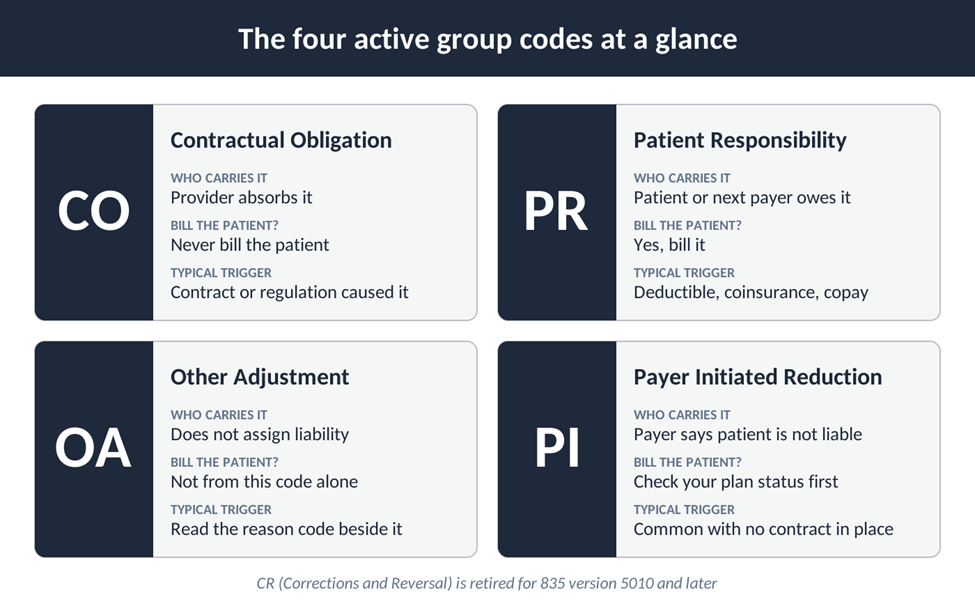
| Code | Name | Who carries the amount | Can the patient be billed? |
| CO | Contractual Obligation | The provider, as a write-off or as a denial to rework | No |
| PR | Patient Responsibility | The patient, or a secondary payer on the patient’s behalf | Yes |
| OA | Other Adjustment | Not assigned by the group code; the reason code decides | Not on the group code alone |
| PI | Payer Initiated Reduction | The payer has decided the patient is not liable, often where no contract exists | Not before checking plan and contract status |
| CR | Corrections and Reversal | Retired for 835 version 5010 and later | Not applicable |
Group codes matter because they drive the next action. A write-off, a patient statement, a secondary claim and an appeal all start from the same two letters, which is why they sit at the center of any denial management process.
How Do CO, PR, OA and PI Change Who Pays?
Each group code moves the unpaid amount to a different party: CO to the provider, PR to the patient, PI to a payer decision, and OA to whatever the reason code describes. The differences below decide whether you adjust, bill or appeal.
CO: Contractual Obligation
The Medicare Claims Processing Manual, Chapter 22 describes CO as an adjustment caused by a contractual agreement between payer and payee or by a regulatory requirement. These amounts are a provider write-off and are not billed to the patient. CO does not mean final, though. CO-45 is a true contractual obligation write-off, while CO-16 or CO-197 is a denial you can often correct.
PR: Patient Responsibility
PR marks an amount that may be billed to the patient or insured. The most common patient responsibility pairings are PR-1 (deductible), PR-2 (coinsurance) and PR-3 (copayment). The CMS Health Care Payment and Remittance Advice page states that Medicare beneficiaries may be billed only when PR is used with the adjustment. Bill a PR amount to the secondary payer first when the patient has other coverage.
OA: Other Adjustment
OA applies when no other group code fits, so it does not show who is liable on its own. X12 limits some reason codes to OA. CARC 23, the impact of a prior payer’s adjudication, is one. CARC 18, exact duplicate claim, is another, except where state workers’ compensation rules require CO. OA-23 appears on secondary remits, so pair it with the primary explanation of benefits (EOB) when handling secondary insurance claims.
PI: Payer Initiated Reduction
PI signals a reduction the payer started, where the payer has decided the patient is not responsible but no contract with the provider supports a CO adjustment. In a published X12 interpretation on group codes for noncontracted providers, X12 recommends PI for that scenario and advises payers to avoid OA outside a few defined situations. Check your network status with the plan before you write off or appeal a PI amount.
CR: Corrections and Reversal
CR once flagged corrections and reversals of an earlier decision. X12 has retired it for current 835 versions, so a corrected claim now shows as a reversal of the original entry followed by the reprocessed claim. When CR appears on a paper remit or an older payer system, confirm the meaning in that payer’s provider manual.
Reading the Group Code, Reason Code and Remark Code Together
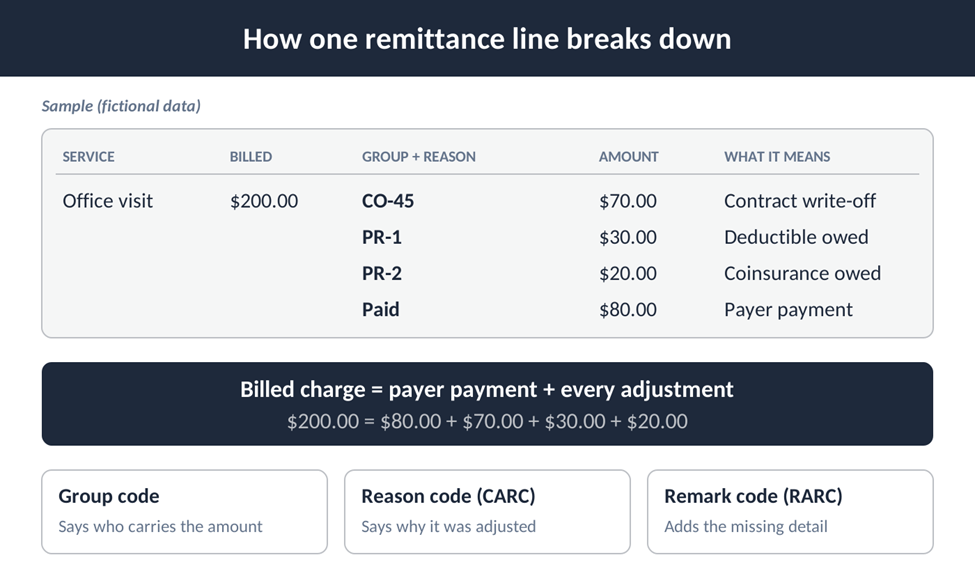
A remittance line is fully explained only when the group code, the CARC and any remark code are read as one statement. The group code says who carries the amount, the CARC says why, and the remittance advice remark code (RARC) adds detail the CARC cannot hold. Some CARCs, including 16 and 96, require at least one of these remark codes.
Every line must balance, which gives you a quick check during payment posting:
Billed charge = payer payment + sum of all adjustment amounts
Illustrative scenario (not an actual client record): an in-network commercial plan processes a two-line office claim.
| Service line | Billed | Group and reason code | Amount | Posting action |
| Office visit | $200.00 | CO-45 | $70.00 | Write off under the contract |
| PR-1 | $30.00 | Bill the patient’s deductible | ||
| PR-2 | $20.00 | Bill the patient’s coinsurance | ||
| Payment | $80.00 | Post the payment | ||
| Venipuncture | $15.00 | CO-97 | $15.00 | Review bundling before writing off |
Line one balances: $200.00 = $80.00 + $70.00 + $30.00 + $20.00. The patient owes $50.00, not the $120.00 the payer left unpaid. Line two paid nothing, yet no part of the $15.00 can move to the patient because the group code is CO.
Compare the CO-45 amount with your fee schedule before you accept it. When the allowed amount is lower than the contract rate, the line is an underpayment, and our guide on how to identify claim underpayments shows the check. For posting sequence and batch controls, see the walkthrough on posting insurance payments accurately.
Which Group Code Applies? The Order Payers Follow
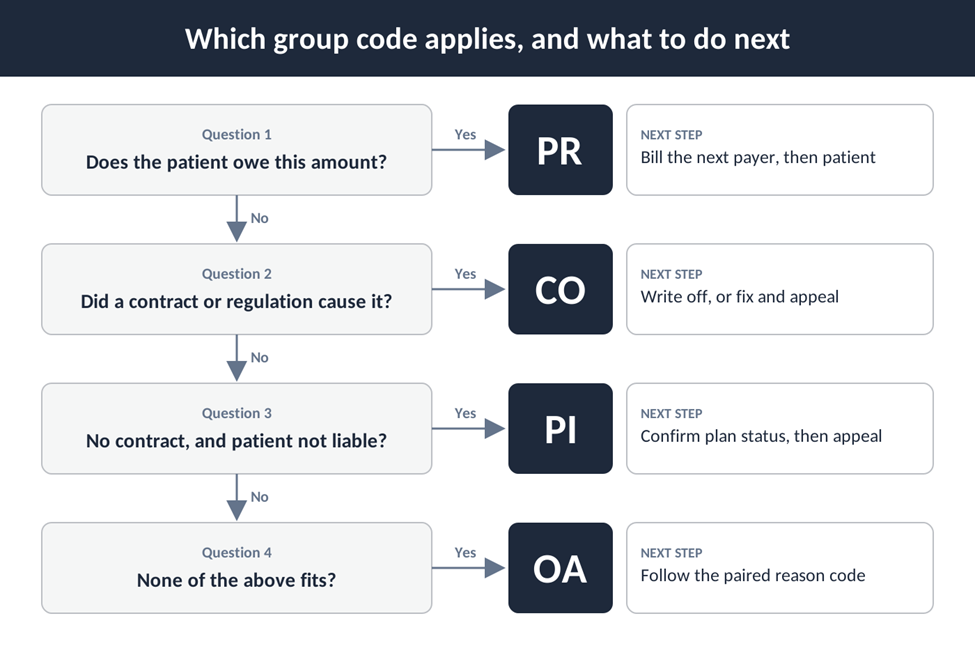
Payers are expected to test patient liability first, so PR is considered before CO. X12’s published interpretation on coinsurance and group code CO sets that order under the 835 guide: when the patient owes any part of an adjustment, PR applies; when a contract or regulation removes the patient’s liability, CO applies. PI and OA cover what remains.
The table turns that order into posting actions. The flowchart after it shows the same sequence: patient liability, then contract or regulation, then payer-initiated reductions, then other adjustments.
| What the remit shows | Typical situation | Do this |
| CO with CARC 45 | Allowed amount is below the billed charge | Write off after confirming the contract rate |
| CO with a denial reason | The line paid zero for a fixable reason | Correct and resubmit, or appeal within the payer’s deadline |
| PR | Deductible, coinsurance, copay, or a non-covered service the patient accepted | Bill the secondary payer when one exists, then the patient |
| OA | Prior payer impact or an exact duplicate | Match to the earlier remit; do not create a new write-off |
| PI | Payer reduction with no contract in place | Confirm network status, then appeal or adjust under your policy |
In posting audits, a common pattern is an auto-posting rule that writes off every CO line. That rule quietly closes CO-16 and CO-197 denials that a corrected claim or an appeal could have recovered. Limit automatic write-offs to CO-45 when your system allows rules by reason code.
The CO Denial Codes Practices See Most
Six CO denial codes come up again and again in small-practice work queues, and each needs a different fix. The summaries below point to a full guide for each one.
CO-16: missing information or billing error
CO-16 means the claim lacks information or contains a submission error. The remark code names the missing item, so the usual fix is a corrected claim, not an appeal. Our CO-16 denial code guide covers the remark codes behind it.
CO-18: exact duplicate
CARC 18 flags an exact duplicate claim or service. X12 directs payers to use it with OA except where workers’ compensation rules require CO, so it often arrives as OA-18. Check claim status before resubmitting; the CO-18 duplicate claim guide explains how.
CO-29: filing limit expired
CO-29 means the time limit for filing has expired. An in-network provider cannot bill the patient, so recovery depends on showing the claim went out on time. See the guide to CO-29 timely filing denials for the evidence payers accept.
CO-50: not medically necessary
CO-50 is a medical necessity denial. For Medicare, liability can shift to PR only when the beneficiary accepted financial responsibility in advance, which is the purpose of an Advance Beneficiary Notice. The CO-50 medical necessity guide covers both paths.
CO-97: included in another service
CO-97 means the payment is included in another service that was already adjudicated. Review bundling edits and modifier use before you write it off. The CO-97 bundling denial guide walks through that review.
CO-197: authorization absent
CO-197 means precertification, authorization or notification was absent. Some payers allow a retroactive authorization or an appeal with records. Start with the CO-197 authorization denial guide.
Do Medicare, Medicaid and Commercial Payers Use Group Codes the Same Way?
The codes are identical across payers because the 835 is the national HIPAA standard for electronic remittance, but the liability rules behind them differ by payer. Medicare’s rule is the plainest; other payers set theirs in the contract, state program or provider manual.
| Payer type | How group codes work | What to check |
| Medicare | Contractors must report a group code with every reason code. Beneficiaries may be billed only for PR amounts. | The remit itself; never bill a CO amount |
| Medicare Advantage | Private plans apply their own contract terms and provider manual. | Your plan contract for CO and PI amounts |
| Medicaid | Each state program sets its own billing limits and code usage. | The state provider manual before billing any member balance |
| Commercial | The participation agreement controls CO; out-of-network claims may show PI or PR. | Network status and the member’s benefits |
Reason codes and remark codes are updated periodically by their maintainers, and payer policies change through the year. Refresh your posting rules when your clearinghouse or a payer announces code changes.
Posting Mistakes That Put the Wrong Balance on a Patient Statement
The costliest group code errors are posting errors, because they either bill a patient for money the patient does not owe or erase money a payer still owes. Five show up most often, and each has a simple control.
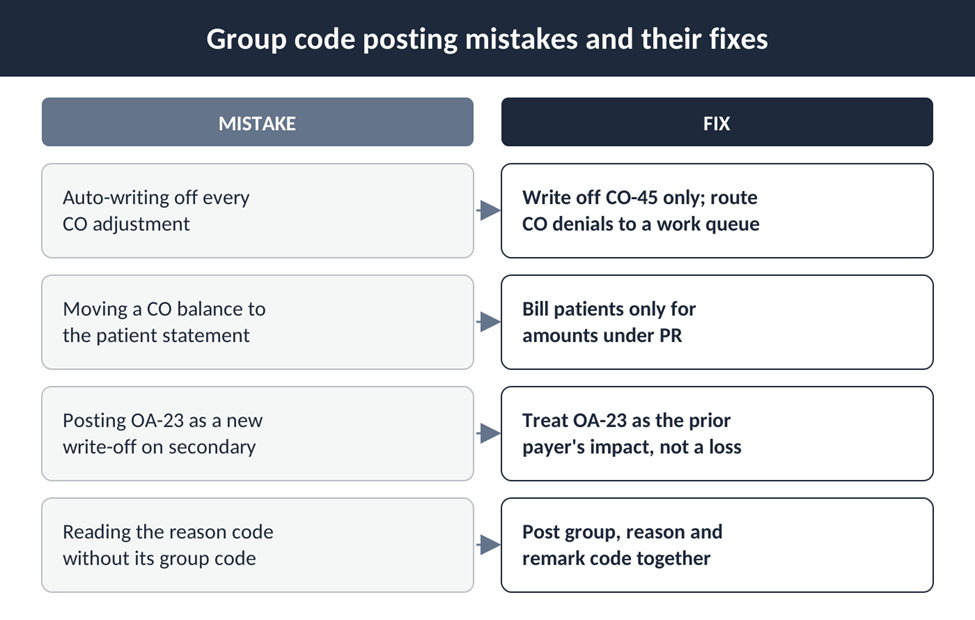
- Writing off every CO line. Limit automatic write-offs to CO-45, and route every other CO reason code to a denial work queue.
- Moving a CO balance to the patient. Send a statement only when the amount carries PR. Noridian, a Medicare contractor, warns its suppliers that billing a beneficiary for charges not marked PR can bring penalties.
- Posting OA-23 as a new write-off. On a secondary remit it reflects what the primary already paid or adjusted, so posting it again double-counts the adjustment.
- Skipping the remark code. When CARC 16 or 96 appears, read the RARC before you decide between a corrected claim and an appeal.
- Treating PR as final when a secondary exists. Bill the secondary payer first, then send the patient only what remains.
Our team often sees patient billing complaints trace back to one habit: a biller reads the reason code number and skips the two letters in front of it. PR-96 and CO-96 share a reason, a non-covered charge, yet only one of them can go on a statement.
When Group Code Work Outgrows the Front Office
Outside help makes sense when the same warning signs keep repeating. Watch for these:
- CO denials written off without anyone reviewing the reason code
- Patient refunds for balances that should never have been billed
- Secondary claims that stall after the primary pays
- ERAs left unposted for more than a few days
- No report that shows adjustments by group code and reason code
EON Med Solutions is one example of a US-based team that handles billing, coding, credentialing, denial management and reporting end to end, with transparent reporting. The process is consistent: post each remit by group and reason code, queue the fixable denials, and report adjustments by category. Results vary by practice. The full list of billing and RCM services shows what is covered.
Frequently Asked Questions
What does CO mean on an EOB or remittance advice?
CO stands for Contractual Obligation. The payer adjusted the amount because of a contract or a regulatory requirement, and the provider carries it. A CO amount is not billed to the patient. CO-45 is a routine write-off, while CO paired with a denial reason may still be corrected or appealed.
Can a provider bill the patient for a CO-45 adjustment?
No. CO-45 is the gap between the billed charge and the allowed amount under a contract or fee schedule, and it belongs to the provider. X12 allows reason code 45 with PR when the patient is liable for the excess, so the group code decides. Bill only PR amounts.
What is the difference between PR-1, PR-2 and PR-3?
All three are patient responsibility amounts. PR-1 is the deductible, PR-2 is coinsurance and PR-3 is the copayment. Each can be billed to the patient, or to a secondary payer first when one exists. Compare PR-3 with the copay collected at check-in before you send a statement.
What does OA-23 mean on a secondary claim?
OA-23 reports the impact of a prior payer’s adjudication, including its payments and adjustments. X12 permits reason code 23 only with group code OA. The amount is not a new write-off; it explains why the secondary paid less than the billed charge. Match it to the primary remittance when posting.
Is a PI adjustment appealable?
Often, yes. PI means the payer initiated the reduction and decided the patient is not responsible, usually where no contract supports a CO adjustment. Appeal when the reduction conflicts with the plan’s published policy or your records support payment. Confirm your network status and the payer’s appeal deadline first.
Expert Opinion
From the EON Med Solutions Billing & RCM Team: claim adjustment group codes are the fastest read on any remit. Two letters tell you whether to write off, bill, appeal or look back at a prior payer, and skipping them sits behind many of the posting errors described above.
The definitions in this guide are firm published standards. The group code meanings come from X12 and the Medicare Claims Processing Manual, and the reason code usage notes come from the X12 code list. The dollar figures in the worked example are illustrative, and the next-step table reflects practical working rules, not payer mandates. Your contracts and each payer’s manual control the final answer.
The natural next question is which of your past CO adjustments were never true write-offs. If a second set of eyes on that would help, contact our team to talk through how your remits are being posted.


