

BCBS Timely Filing Limit: How to Find Your Plan’s Deadline
The BCBS timely filing limit is not one number, because each Blue Cross Blue Shield company sets its own filing deadline through its provider manual and contract. Published examples run from 180 days at Blue Cross and Blue Shield of Illinois to 365 days for Blue Cross and Blue Shield of Texas PPO network providers. This guide shows how to find the right deadline for each plan, when the clock starts, how out-of-area claims work, and what to do when a claim is late, all within wider medical billing workflows.
| Key takeaways Blue plans are separate companies, so filing windows differ by plan, product and provider status.Published examples include 180 days (Illinois PPO), 365 days (Texas PPO) and 180 or 365 days (Rhode Island).Start dates differ for outpatient, inpatient, secondary and returned claims.Plans in this guide state that providers cannot bill the member for a claim denied as late. |
Is There a Single BCBS Timely Filing Limit?
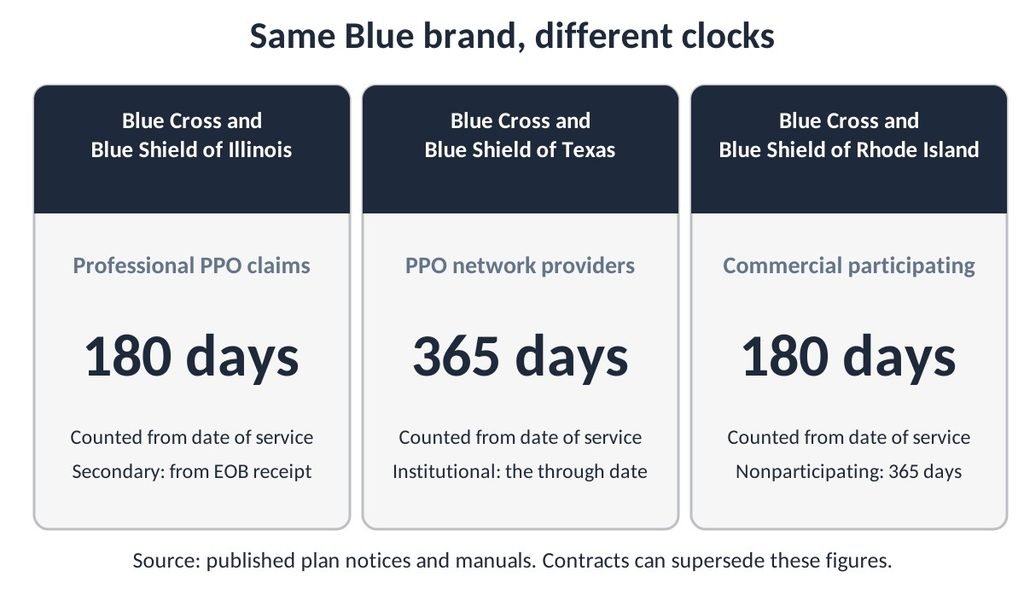
No single BCBS timely filing limit exists, because every Blue plan publishes its own window and contracts can change it. The table lists three examples from plan sources.
| Plan | Filing limit | Clock starts | Source |
| Blue Cross and Blue Shield of Illinois, professional PPO network | 180 days | Date of service; inpatient from discharge or transfer; secondary from receipt of the primary EOB | Provider notice, October 2024 |
| Blue Cross and Blue Shield of Texas, PPO network | 365 days | Date of service; institutional claims from the through date | PPO provider manual |
| Blue Cross and Blue Shield of Rhode Island, commercial participating | 180 days (365 for nonparticipating and out-of-service-area claims) | Date of service; inpatient from discharge; secondary from the primary payer processing date | Posted timely filing policy |
Examples only. Contracts and employer groups can differ, so confirm the limit for the plan on the member’s card.
Illinois shows that one company can run more than one clock. Its provider notice on timely filing sets 180 days for professional PPO claims and says some employer groups have different time frames, so the number on the member’s ID card settles the question.
Texas adds exceptions inside the same manual. The Blue Cross and Blue Shield of Texas PPO provider manual gives 365 days, asks for a claim returned for more information to be resubmitted within 90 days of the plan’s mailing date, and allows 365 days from receipt of another carrier’s EOB when the member supplied wrong insurance information.
Rhode Island’s posted timely filing policy separates participating from nonparticipating providers and states that contracts may differ and supersede it. Check the posting date on any policy before you rely on it.
Why Do Websites Quote 90, 180 and 365 Days for Blue Plans?
Websites quote different numbers because they mix plans, products and provider types into one answer. A figure for a Blue HMO product, a PPO network, a Medicare Advantage plan or a nonparticipating provider can all differ inside one Blue company.
In billing audits, a common pattern is staff applying an HMO number to PPO claims from the same Blue company. Do confirm four items before trusting any number: the plan name, the product, the provider status and the date of the source.
How Do the State Guides Fit Together?
The state guides below go deeper than this overview. Use them when a claim belongs to that state’s Blue plans.
Texas. The BCBS Texas timely filing guide compares PPO-type networks at 365 days with HMO products at 180 days, and covers corrected, secondary and returned claims plus disputes.
Florida. The BCBS Florida filing guide explains the 180-day participating window, how the provider agreement controls, and how Florida law can shorten the practical deadline.
California. The BCBS California filing guide separates Anthem Blue Cross from Blue Shield of California, which use different windows under California rules.
Pennsylvania. The BCBS Pennsylvania filing guide separates Highmark, Independence and Capital Blue Cross, with 365 days at the first two and 180 days at Capital for professional claims.
Which Blue Plan Sets the Deadline for Out-of-Area Members?
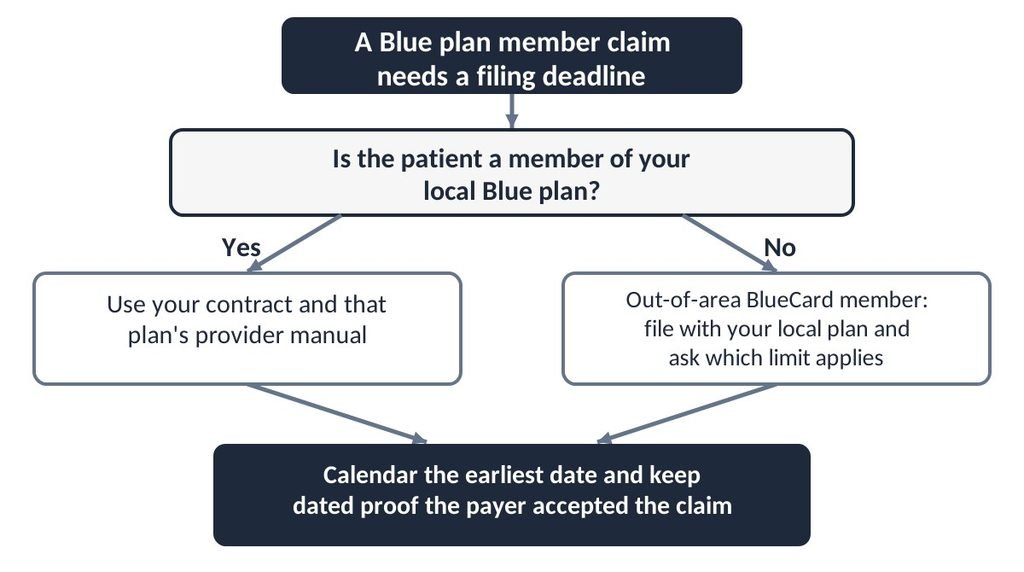
Providers file out-of-area member claims with their local Blue plan, and the local plan is the contact for claims and problem resolution. The Highmark BlueCard frequently asked questions states this but does not say whose filing limit governs, so ask your local plan which limit applies before you rely on any number.
When Medicare is primary and a Blue plan is secondary, the FAQ says to file with the Medicare contractor first. In that case, track the primary claim date and the secondary start date separately.
When Does the Blue Plan Filing Clock Start?
The clock usually starts on the date of service for outpatient and professional claims and on the discharge date for inpatient stays. Secondary and returned claims follow their own start rules.

Illinois counts a secondary claim from the provider’s receipt of the primary EOB, while Rhode Island counts from the date the primary insurer processed the claim, which must appear on the EOB. In billing audits, a common pattern is counting from the EOB mailing date instead of the date the plan names, which can cost days that matter on a tight window.
How Do You Calculate the Last Day to File a Blue Claim?
Add the plan’s limit in days to the start date, and the result is the last day to file. The formula is: last day = start date + limit days.
Illustrative example: A visit happens on March 9, 2026. Under a 180-day plan, the last day is September 5, 2026. Under a 365-day plan, the last day is March 9, 2027. The same visit carries deadlines 185 days apart, which is why the plan check comes before billing.
For a secondary claim under a plan that counts from receipt of the primary EOB, a primary EOB received April 15, 2026 gives a last day of October 12, 2026 on a 180-day limit. A practical target (not a plan rule) is to submit clean claims within days of service and flag any unaccepted claim at half the window.
A shared calendar helps here, as explained in the guide to tracking timely filing deadlines.
What Happens When a Blue Claim Is Late?
A late Blue claim is denied, and the plans in this guide say the provider may not bill the member for the amount. The Illinois notice, the Texas manual and the Rhode Island policy each state this.
Recovery depends on the plan. Texas lets a provider submit a claim review request when it believes a denial for lateness was an error. Rhode Island requires filing limit appeals within 60 days of the original explanation of payment date. Appeal windows run separately from filing windows, as the guide to filing limit versus appeal limit explains.
Rhode Island also treats a denied claim as needing a new claim with correct information, so confirm how your plan handles corrections, using the guide to corrected claim filing windows as a starting point. In billing audits, a common pattern is practices checking for proof of submission only after the denial arrives, when acceptance reports are hardest to find.
Which Mistakes Cause Blue Plan Timely Filing Denials?
| Mistake | Fix |
| Using one Blue plan’s number for another | Look up the plan on the member card each time |
| Applying an HMO limit to PPO claims | Confirm the product before setting the deadline |
| Counting a secondary claim from the service date | Use the primary EOB date the plan names |
| Relying on an old policy posting | Check the date on the manual or notice |
| No dated proof of submission | Save acceptance reports at submission time |
When Should a Practice Get Help With Blue Plan Deadlines?
A practice should consider help when deadlines vary across many Blue plans and nobody owns the calendar. Four signals suggest the in-house approach has reached its limit:
- Staff quote filing limits from memory or from websites.
- Late-filing denials appear from more than one Blue plan.
- Proof of submission cannot be found when a denial arrives.
- No one reviews unaccepted claims before the window closes.
EON Med Solutions is one example of end-to-end billing, coding, credentialing, denial management and reporting delivered by a US-based team with transparent reporting, as described on its services page. Results vary by practice.
BCBS Timely Filing Questions, Answered
What is the BCBS timely filing limit?
There is no single BCBS timely filing limit. Each Blue plan sets its own window in its provider manual and contract, and published examples include 180 days for Illinois PPO claims and 365 days for Texas PPO network providers. Check the plan on the member’s card.
Is the BCBS timely filing limit 180 or 365 days?
It depends on the plan, product and provider status. Illinois lists 180 days for professional PPO claims, Texas lists 365 days for PPO network providers, and Rhode Island lists 180 days for participating and 365 for nonparticipating. Confirm the limit for your plan in its current manual.
Does the limit change for out-of-area BlueCard members?
Providers file out-of-area member claims with the local Blue plan, which handles claims and problem resolution. The Highmark BlueCard FAQ does not state whose filing limit governs, so ask your local plan which limit applies to each out-of-area claim before relying on a number.
Can you bill the patient if BCBS denies a claim as late?
The Illinois notice, the Texas PPO manual and the Rhode Island policy each state that the provider may not bill the member for a claim denied for late filing. Other plans and contracts may differ, so read your own agreement before sending a statement.
How do you appeal a BCBS timely filing denial?
Start by finding proof that the plan accepted the claim inside the window, then follow your plan’s appeal route and deadline. Texas offers a claim review request, and Rhode Island requires filing limit appeals within 60 days of the original explanation of payment date.
Expert Opinion
The most useful habit with Blue plans is to treat the BCBS timely filing limit as a lookup, not a memory. The plan examples and the rule that members cannot be billed come from published plan sources. The 180-day and 365-day dates in the calculation, and the half-window alert, are illustrative or practical targets, and your contract controls.
Do record the plan, product and start date on every claim, keep dated acceptance reports, and review unaccepted claims before the window closes. When a limit is unclear, ask the plan in writing and file on the earlier date rather than the later one.
The natural next question is which of your Blue plans carry the tightest window right now. The EON Med Solutions team can review that with you, and you can see how it works on the services overview.
Sources: Blue Cross and Blue Shield of Illinois provider notice (October 28, 2024); Blue Cross and Blue Shield of Texas PPO provider manual; Blue Cross and Blue Shield of Rhode Island timely filing policy; Highmark BlueCard frequently asked questions (reviewed October 2026). Results vary by plan, product and contract; figures reflect information available at the time of research. This article is general information, not legal advice.


