
CO-197 Denial Code: Why Authorization Denials Happen
The CO-197 denial code means the payer found no precertification, authorization, notification or pre-treatment approval for a service that needed one. The CO group code makes the amount a provider write-off unless the denial is overturned. This guide explains how CO-197 differs from related authorization codes, why it happens, how to fix it when an approval existed and when it did not, and which front-end checks prevent it.
| Key takeaways CO-197 means no valid authorization was found; CO-198 means an approval was exceeded, and CO-15 points to a problem with the authorization number.When an approval existed, the fix is usually a corrected claim carrying the authorization number.When no approval was obtained, recovery depends on the payer’s retro authorization rules or an appeal.On Medicare outpatient prior authorization services, related claims such as anesthesia and physician services can be denied too. |
What Does the CO-197 Denial Code Mean?
The CO-197 denial code pairs group code CO, contractual obligation, with claim adjustment reason code (CARC) 197: precertification, authorization, notification or pre-treatment absent. The payer is saying it has no record of the approval it required for that service, provider or date.
CO-197 sits inside the larger prior authorization process, and it is one of the denials that a strong denial management process tries to stop before the claim is ever built. Because the group code is CO, the practice cannot shift the balance to the patient while the denial stands.
Payers may pair CARC 197 with a remittance advice remark code (RARC). In Noridian’s Medicare DME guidance on reason code 197 with remark code N210, for example, N210 signals that the decision can be appealed. The guidance lists two common causes: the prior authorization tracking number was left off the claim, or a bypass modifier was missing on a line that needed one.
Is It CO-197, CO-198 or CO-15?
CO-197 means no authorization was found, CO-198 means an approval exists but the billed units or dates go beyond it, and CO-15 means the authorization number is missing, invalid or does not apply to the billed service or provider.
| Code | What the payer is saying | Usual first step |
| CO-197 | No valid authorization was found for this service | Locate the approval, or check retro authorization and appeal options |
| CO-198 | An approval exists, but the billed units, visits or dates exceed it | Request an extension or update for the extra units |
| CO-15 | The authorization number is missing, invalid or does not match the service or provider | Correct the number on the claim and resubmit |
Descriptions are paraphrased. Read the full reason and remark code text on your remittance before acting.

Why Do CO-197 Denials Happen?
CO-197 denials happen when the authorization was never requested, was obtained but not reported on the claim, or no longer matches what was actually performed.
- No request was made because the front desk did not check the payer’s authorization list for the code.
- The approval was not on the claim, so the payer could not tie the claim to it.
- The service changed on the day, such as a different CPT code, an added level of service or a new site of care.
- The rendering provider or facility differs from the one named on the approval.
- The patient changed plans, and the approval belongs to the previous payer.
- The approval expired before the date of service.
In denial audits, a common pattern is that the approval existed all along but sat in a fax inbox or portal screenshot nobody linked to the claim. Those are the easiest CO-197 denials to recover, and the most frustrating to lose.
Payer rules are not uniform. Each payer publishes its own authorization list and claim rules, which our guide to payer-specific claim submission rules helps you track.
How Do You Fix a CO-197 Denial?
You fix a CO-197 denial by reporting a valid authorization on a corrected claim when one existed, or by using the payer’s retro authorization or appeal route when one did not.
When an approval existed
- Find the approval letter or portal record and its number.
- Confirm that the code, units, dates, rendering provider and site on the approval match the claim.
- Add the number to the claim. On electronic claims it is reported in the prior authorization REF segment (qualifier G1) in loop 2300 or 2400; Noridian’s DME guidance also names Item 23 on the paper CMS-1500.
- Send a corrected claim or a new claim, as the payer requires, and log the date.
When no approval was obtained
- Check the payer’s manual to see whether retro authorization is allowed for this service and how quickly it must be requested.
- If it is allowed, request it with the clinical notes, then rebill with the new number.
- If it is not allowed, file an appeal when the records show urgency or another exception the payer recognizes.
- If neither applies, the balance is usually written off under the contract; record the root cause so it does not repeat.
Medicare has its own rules for some programs. For hospital outpatient department services under prior authorization, First Coast explains that claims sent without a prior authorization decision are denied, after which normal appeal rights apply. Related anesthesia, physician and facility claims for that outpatient service are not paid either. A non-affirmed prior authorization request is not itself appealable, but it can be resubmitted before the claim is filed.
Appeals have their own clock, separate from claim filing. Our comparison of the claim filing limit and the appeal filing limit explains why both dates belong on the claim note.

What Changed for Prior Authorization in 2026?
The main 2026 change is the CMS Interoperability and Prior Authorization Final Rule, which requires impacted payers to send prior authorization decisions faster and to give a specific reason when they deny a request.
According to the CMS announcement of the final rule, impacted payers include Medicare Advantage plans, Medicaid and CHIP programs and managed care plans, and marketplace issuers. Most requirements begin in 2026. Decisions are due within 72 hours for expedited requests and seven calendar days for standard requests, though marketplace issuers are excluded from those timeframes.
Faster decisions help, but they do not remove CO-197 risk, because the denial usually comes from what happens after the approval. Our article on how AI is changing prior authorization covers the electronic request tools payers and practices are adopting.
How Do You Prevent CO-197 Denials?
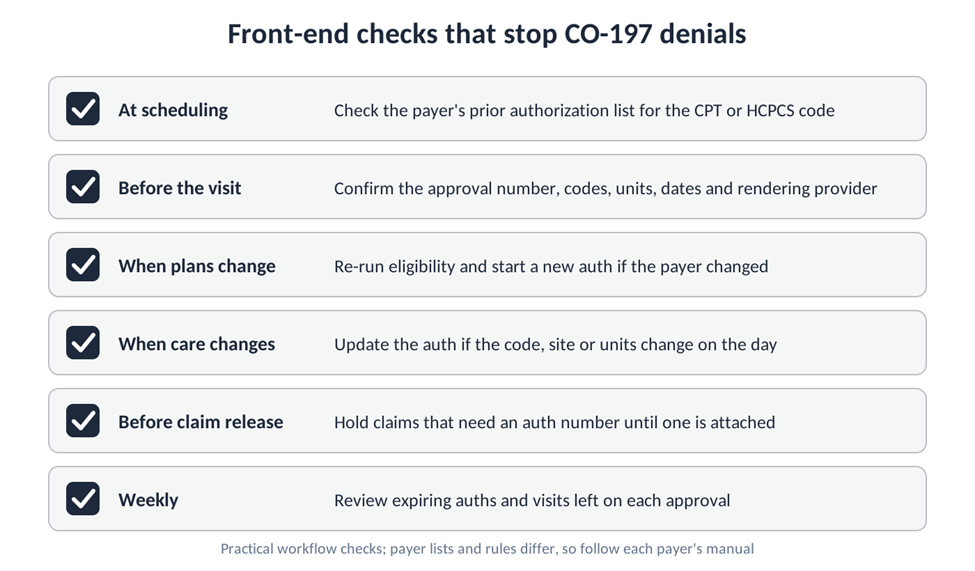
You prevent CO-197 denials by checking authorization at scheduling, confirming it before the visit, updating it when care changes, and holding claims that need a number until one is attached.
Formula
- Authorization match rate = claims requiring authorization that carry a valid matching approval, divided by all claims requiring authorization, times 100
Walkthrough: if 430 claims in a month required authorization and 412 carried a valid, matching approval, the match rate is 412 / 430 x 100 = 95.8%. The 18 gaps are your CO-197 risk list for the month. These numbers are illustrative; no payer publishes a required match rate.
Illustrative scenario (not an actual client record)
An imaging center obtains approval for a lumbar spine MRI without contrast. The radiologist adds contrast after reviewing the first images, so a different CPT code is billed. Nobody updates the approval, and the claim returns CO-197. The team now flags any same-day code change for an authorization update before the claim is released.
In A/R reviews, a frequent finding is that CO-197 denials concentrate in two or three service lines, such as imaging or therapy visits. Building checks there first usually covers most of the exposure. For a broader prevention plan, see our guide on how to reduce claim denials.
When Should a Practice Bring In Outside Help?
Outside help is worth considering when authorization denials keep returning despite a checklist. Signals include:
- CO-197 appears on the same service line month after month
- Approvals are stored in inboxes rather than linked to scheduled visits
- Same-day code changes go out without an authorization update
- Nobody tracks retro authorization deadlines by payer
EON Med Solutions is one example of a partner that handles billing, coding, credentialing, denial management and reporting end to end through a US-based team with transparent reporting. Its revenue cycle management services connect front-end checks with claim follow-up. Results vary by practice, specialty and payer mix.
CO-197 Questions From Billing Teams
Can a CO-197 denial be appealed?
Often, yes, but the route depends on the payer and the cause. If an approval existed, a corrected claim with the number usually resolves it without an appeal. If none was obtained, an appeal can work when records show urgency or a payer-recognized exception. Medicare remark code N210 signals that appeal rights apply.
Can we bill the patient for a CO-197 denial?
Not while the CO group code applies. CO means contractual obligation, so the provider generally absorbs the amount under the payer agreement. Before billing a patient for any authorization-related balance, check the contract and the plan’s member rules, which can differ by product and state.
What is retro authorization?
Retro authorization is an approval requested after the service was performed. Some payers allow it for specific services or situations, often within a short window, while others do not allow it at all. When a payer permits it, request it promptly with clinical notes, then rebill with the new number.
Does a CO-197 denial affect related claims?
It can. Under Medicare’s hospital outpatient prior authorization program, anesthesia, physician and facility claims tied to a service that was not paid are also not paid. Commercial plans may handle related claims differently, so check whether linked services need their own approval.
What is a good authorization match rate?
No payer or industry body publishes a required authorization match rate. As a practical goal, aim for every claim that needs approval to carry a valid, matching number before release. Track the rate monthly by service line, and treat any recurring gap as a workflow problem to fix.
Expert Opinion
From our billing and RCM work, the CO-197 denial code is less about whether an approval was obtained and more. About whether the approval followed the patient all the way to the claim. The firm published standards in this guide are the CARC 197 definition. Medicare contractor guidance on tracking numbers and outpatient prior authorization, and the 72-hour and seven-day. Decision timeframes in the 2026 CMS rule.
The 95.8% match rate and the scenario are illustrative, and the checklist reflects practical workflow habits rather than payer rules. Retro authorization and appeal options differ by payer, so each payer’s manual decides the route.
The natural next question is which of your service lines produces most of your authorization denials. If you would like a second set of eyes on that, the EON Med Solutions Billing & RCM Team can help; you can get in touch with our team whenever it is convenient.
Sources: Noridian Medicare guidance on reason code 197 with remark code N210, First Coast Service Options guidance on the hospital outpatient department prior authorization program, and the CMS announcement of the Interoperability and Prior Authorization Final Rule. This article is general billing information, not legal advice. Results vary by practice, and figures reflect information available at the time of research.