

Proof of Timely Filing: What Counts and How to Keep It
Proof of timely filing is the record showing that a payer received an accepted claim before its filing deadline. Clearinghouse acknowledgment reports, payer receipt records and dated remittances can all serve, but an upload confirmation from your own system usually does not. This guide explains what counts, how the TA1, 999 and 277CA acknowledgments work, what Medicare and Cigna say about filing dates, and how to build a proof packet before a denial arrives, a core habit in A/R management.
| Key takeaways Proof must show the payer accepted the claim, not only that your office sent it.Electronic claims produce three acknowledgments: TA1 for the envelope, 999 for the file and 277CA for each claim, per CMS guidance.Medicare contractor guidance counts paper claims by receipt date, not postmark, and treats returned claims as needing correction and resubmission.Cigna keeps the original filing date when it requests more information on a claim filed on time. |
What Counts as Proof of Timely Filing?
Proof of timely filing is any dated record showing that the payer accepted your claim before the deadline, and the most reliable records come from the clearinghouse and the payer rather than from your own billing system. The table ranks common records by practical weight.
| Record | What it shows | Where to find it | Practical weight |
| 277CA claim acknowledgment | The claim passed front-end edits; accepted claims carry a claim number | Clearinghouse or payer EDI report | Strong |
| 999 implementation acknowledgment | The file passed format checks, not the claim itself | Clearinghouse | Supporting |
| Payer portal receipt or claim status page | The payer has the claim on file, with a date | Payer portal | Strong when dated |
| Dated remittance or explanation of benefits from the first submission | The payer processed the claim | Remittance advice or EOB | Strong |
| Certified mail receipt for a paper claim | Delivery date to the payer | Postal record | Supporting |
| Billing system submission log | Your own send date | Practice management system | Weak on its own |
Practical weight is a planning judgment, not a payer rule. Payers decide what they accept, so read the provider manual for the proof format your contract names. EOB is explanation of benefits.
In billing audits, a common pattern is a proof packet built only from the practice’s own submission log, which shows when staff sent the claim but not whether anyone accepted it. Do add a clearinghouse or payer record to every claim file when the payer’s deadline is 90 days or less, because short windows leave little room to rebuild evidence later.
How Do TA1, 999 and 277CA Acknowledgments Work?
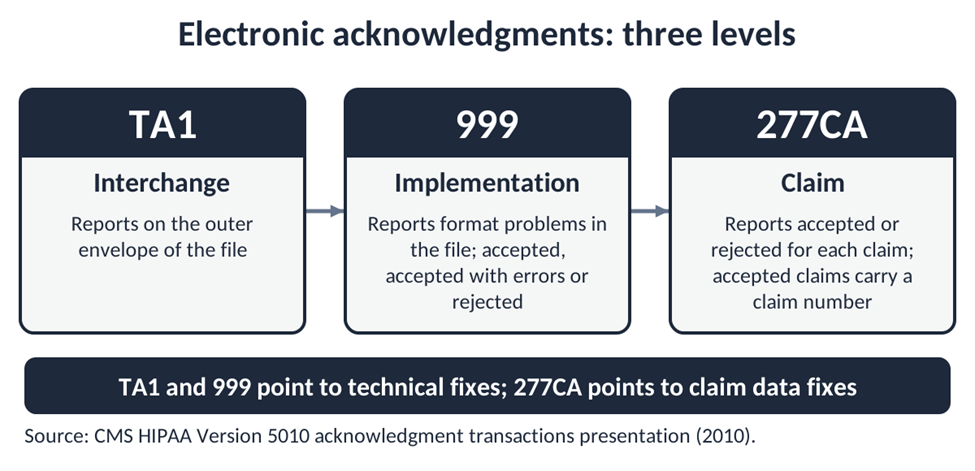
Three acknowledgments confirm an electronic claim at three levels: TA1 for the envelope, 999 for the file’s format, and 277CA for each individual claim. A CMS presentation on HIPAA 5010 acknowledgment transactions describes the 277CA as the report on whether each claim was accepted or rejected, and it says an accepted claim’s 277CA contains the claim number.
TA1 and 999 problems are technical and belong with software staff, while 277CA problems are data errors for billing staff to correct. The Medicare contractor CGS explains that if a 999 rejects the file, no 277CA is produced, and that the process can take from one hour up to 48 hours. Do review acknowledgments within 48 hours of submission when you bill electronically.
In billing audits, a common pattern is acknowledgments reviewed at the file level only, so a rejected claim inside an accepted file sits unnoticed until the deadline passes. Reading the 277CA claim by claim closes that gap.
What Filing Date Does Medicare Accept?
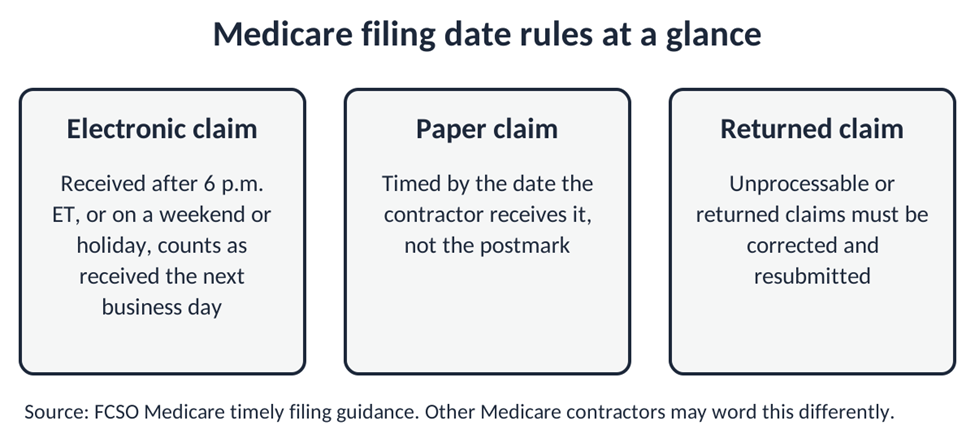
Medicare contractors count a claim as filed on the date they receive it in a processable form, so returned or unprocessable claims do not protect the deadline. FCSO’s timely filing guidance states that claims must be filed no later than 12 months, or one calendar year, after the date of service, and that claims returned as unprocessable must be corrected and resubmitted.
The same guidance says electronic claims received after 6 p.m. ET, or on a weekend or holiday, count as received the next business day, and paper claims are timed by the contractor’s receipt date rather than the mailing postmark. Illustrative scenario (not an actual client record): if the last day of the window is a Friday, a claim transmitted at 7:30 p.m. ET that evening counts as received the following Monday, which falls after the window. The Medicare 12-month rule guide covers the full clock.
What Proof Works With Commercial Payers Like Cigna?
Commercial payers set their own proof rules, and Cigna’s published guidance ties timely filing to the date of original submission when Cigna later requests more information. According to Cigna’s When to File Your Claims page, a claim filed on time keeps its original filing date if Cigna asks for more information, while a resubmission Cigna did not request is subject to the normal limit.
For secondary claims, Cigna measures timely filing from the processing date on the primary carrier’s explanation of benefits, so the dated primary EOB is part of your proof. Do keep it attached to the secondary claim file. The guide to secondary claim filing rules explains the coordination of benefits timing.
How Do You Build a Proof Packet Before a Denial Arrives?
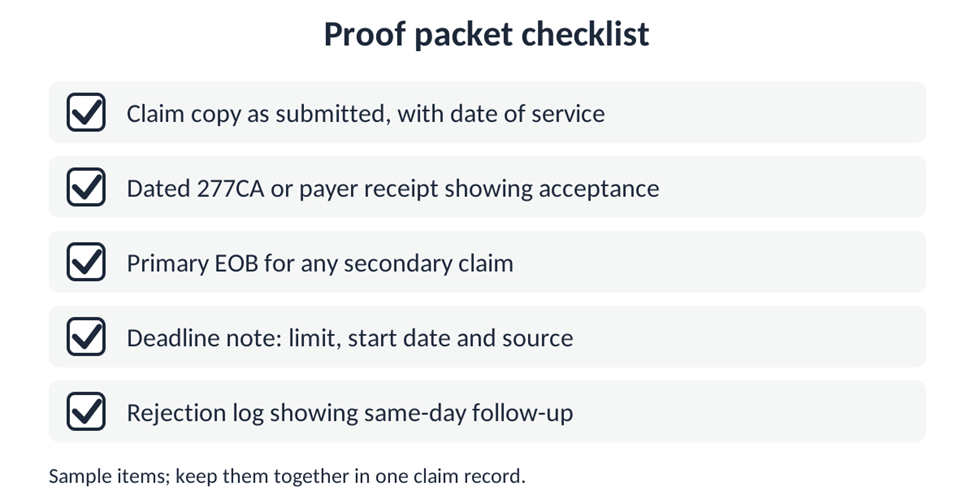
Build the packet at submission time by saving the acknowledgment, the claim copy and the deadline calculation in one claim record. Waiting until a denial arrives means searching clearinghouse portals for reports that may have aged out.
- Save the 277CA, or the payer receipt, showing the acceptance date.
- Save a copy of the claim as submitted, including the date of service.
- For a secondary claim, save the dated primary EOB.
- Log the deadline, the limit and the source, such as the contract or provider manual.
- Work every rejection the same day it appears.
- Keep records at least as long as your contracts and state law require; the guide on how to track timely filing deadlines shows a tracker that holds them.
Illustrative scenario (not an actual client record): a payer denies a claim with CARC 29, the adjustment reason code that indicates the filing time limit has expired. The practice’s packet holds a 277CA dated March 9, 2026 for a March 3, 2026 date of service, so the claim was accepted on day 6 of a 90-day window that ended June 1, 2026. That dated acknowledgment is the core of the appeal.
| Sample (fictional data): packet item | Date | What it proves |
| Claim copy as submitted | March 3, 2026 (date of service) | Date of service and billed lines |
| 277CA acknowledgment, accepted | March 9, 2026 | Acceptance on day 6 |
| Deadline note | March 3, 2026 | Day 90 falls on June 1, 2026 |
| Payer denial with CARC 29 | August 4, 2026 | The denial being appealed |
Filing and appeal windows run separately, as the comparison of timely filing limit vs appeal filing limit explains, so start the appeal packet the day the denial arrives.
When Should a Practice Consider Outside Help With Filing Records?
A practice should consider outside help when it cannot produce proof on request and denials for late filing keep reaching the write-off pile. Four signals suggest the in-house approach has hit its limits:
- Acknowledgments live in one staff member’s clearinghouse login.
- Rejections sit unread for days.
- Appeals fail because dated records cannot be found.
- Payers report claims as not received, and no record answers them.
When evaluating outside support, look for saved acknowledgments by claim, daily rejection review, appeal handling and reports you can read without asking. EON Med Solutions is one example: its US-based team delivers end-to-end billing, coding, credentialing, denial management and reporting with transparent reporting, as described on its services page. Results vary by practice.
Proof of Timely Filing Questions, Answered
What is proof of timely filing?
Proof of timely filing is a dated record showing that the payer received and accepted a claim before its filing deadline. Common examples are a 277CA claim acknowledgment, a payer portal receipt and a dated remittance from the first submission. Payers decide which records they accept.
Does a clearinghouse confirmation count as proof?
It can, when the record shows the claim was accepted, such as a 277CA with a claim number, rather than only that a file was sent. A 999 shows the file passed format checks but not that each claim was accepted. Check your contract for the proof format a payer requires.
What is a 277CA?
A 277CA is the claim acknowledgment that reports the status of each individual claim as accepted or rejected after the payer’s front-end edits. CMS describes it as replacing varied contractor error reports, and an accepted claim’s 277CA contains the claim number you can use for status inquiries.
Does a rejected claim count as filed on time?
Under Medicare contractor guidance, a claim returned as unprocessable must be corrected and resubmitted, so the rejected submission does not protect the deadline. Other payers set their own rules. Cigna, for example, keeps the original date only when it requested more information on a claim filed on time.
How long should you keep proof of filing?
Keep acknowledgments at least as long as the longest filing and appeal window in your contracts, and longer where state law or contract retention terms require. Payers and states differ, so confirm retention requirements in each contract and keep records tied to the claim.
Expert Opinion
Proof of timely filing is built at submission, not at denial. The TA1, 999 and 277CA hierarchy comes from CMS guidance, the Medicare receipt-date rules come from FCSO’s published guidance, and the Cigna rule comes from its provider page. The practical weight ranking, the 48-hour review habit and the sample packet are planning tools rather than published payer requirements.
Do make the packet part of the claim record so that every claim leaves evidence automatically, and review rejections the same day when volume is high. A practice that can answer a late-filing denial with a dated acknowledgment usually spends far less time arguing about whether the claim arrived.
The natural next question is how to make every claim leave a packet without adding steps for staff. The EON Med Solutions team can talk through that setup on the contact page, or you can review the services overview first.
Sources: CMS HIPAA Version 5010 acknowledgment transactions presentation (2010); CGS Medicare EDI questions; FCSO Medicare timely filing guidance; Cigna Healthcare When to File Your Claims (reviewed October 2026). Results vary by payer and contract; figures reflect information available at the time of research. This article is general information, not legal advice.


