

CO-29 Denial Code: What an Expired Filing Limit Means
The CO-29 denial code means the payer decided that a claim arrived after its filing deadline. CO is the group code that makes the provider financially responsible, and 29 is the X12 reason code, worded “The time limit for filing has expired.” This guide explains how to read the code on a remittance, which proof can reverse it, when a waiver is realistic, and whether the patient can be billed, all part of sound denial management.
| Key takeaways CO-29 combines group code CO (provider liable) with reason code 29 (filing limit expired).The best defense is dated proof that the payer accepted the original claim inside the window.The appeal deadline is a separate clock from the filing limit.Medicare beneficiaries can be billed only when the adjustment carries group code PR, so CO-29 is a write-off unless an appeal succeeds. |
What Does the CO-29 Denial Code Mean?
CO-29 means the payer treats the claim as late under its filing limit and holds the provider responsible for the unpaid amount. Each part of the code does a separate job.
| Part | Value | What it tells you |
| Group code | CO | Contractual obligation: responsibility for the adjustment sits with the provider |
| Reason code (CARC) | 29 | The time limit for filing has expired |
| Remark code (RARC) | Varies | Optional detail, such as an alert that a written appeal is allowed within required time limits |
A claim adjustment reason code (CARC) explains why a payment was adjusted, and a remittance advice remark code (RARC) can add detail. X12 publishes the official claim adjustment reason code list, where code 29 has been in effect since 1995.
How Do You Read CO-29 on a Remittance?
Read the group code first, then the reason code, then any remark code. The remittance advice arrives as an electronic remittance advice (ERA, the 835 file) or a paper explanation of benefits (EOB), and it shows these codes beside the paid amount.
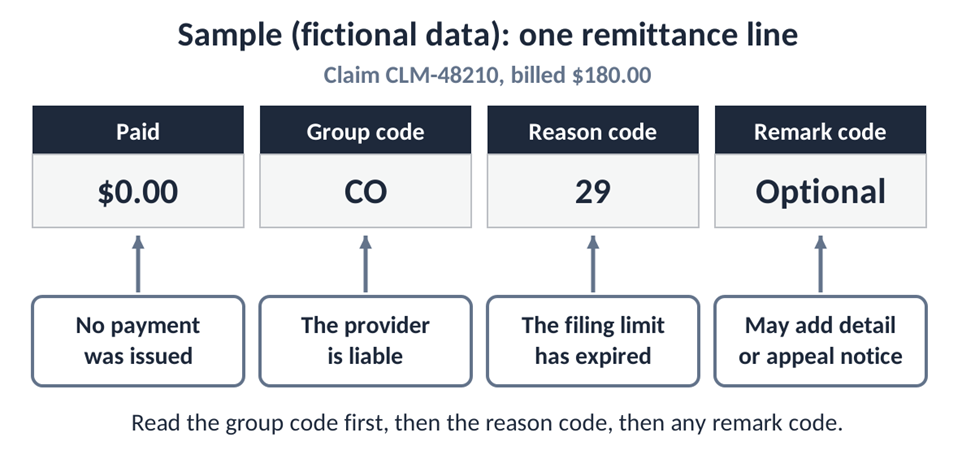
A zero payment with group code CO and reason 29 tells the biller that the payer applied its filing rule, not that the service was uncovered. Read the remark code before choosing a response, because it can point to an appeal notice.
What Causes a CO-29 Denial?
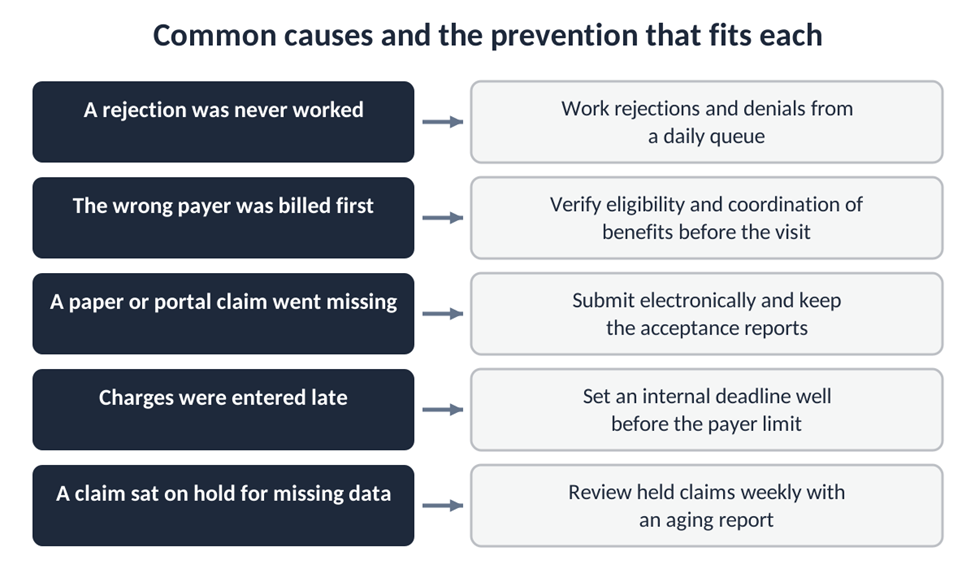
Most CO-29 denials trace to a handful of workflow breaks rather than to one big mistake. The table lists the usual patterns.
| Cause | How it shows up |
| Late first submission | The first claim date falls after the payer limit |
| Rejection never corrected | A clearinghouse or payer rejection sat unworked until the window closed |
| Wrong payer billed first | An eligibility or coordination of benefits change surfaced weeks later |
| Corrected claim sent late | The payer counts the new submission date, not the original |
| No acceptance on file | The claim left the office but no report shows the payer received it |
In billing audits, a common pattern is a claim rejected at the clearinghouse in the first week and never opened again. A rejection is not an acceptance, so the practice holds no proof. Corrected claims often follow their own clock, covered in the guide to corrected claim deadlines by payer.
What Should You Do First When CO-29 Arrives?
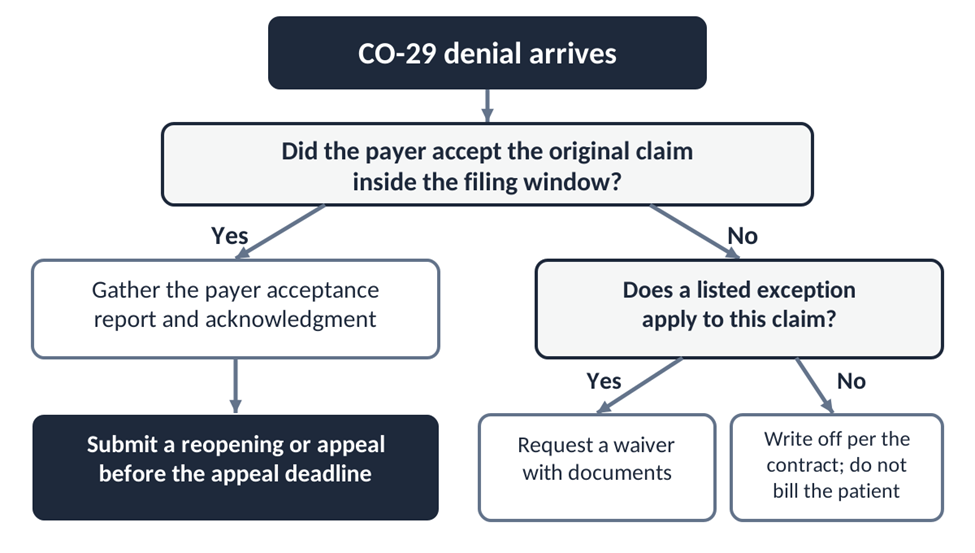
Start by checking whether the claim was truly late, because a CO-29 denial is sometimes wrong. Work these steps in order:
- Find the date of service, the first submission date and the filing limit in your payer contract or provider manual.
- Count the days between the date of service and the first submission, and compare the result with the limit.
- When the first submission was inside the limit, pull proof that the payer accepted it: the clearinghouse acceptance report, the payer acknowledgment and any status response.
- Send a reopening or appeal with that proof before the appeal deadline.
- Track the claim until payment or a final denial.
The formula is simple: days elapsed equals the first submission date minus the date of service, and the claim is late only when days elapsed exceeds the limit. Building the habit of tracking timely filing deadlines makes step 1 a two-minute check.
What Does a CO-29 Appeal Look Like in Practice?
Illustrative scenario (not an actual client record): A family clinic sees a patient on January 12, 2026. The plan has a 180-day filing limit, so day 180 is July 11, 2026. Staff send the claim on February 20, but the clearinghouse rejects it for a missing field and nobody notices. Staff resend a corrected claim on August 5, which is day 205, 25 days past the limit, and the payer denies it with CO-29.
Because the February submission was rejected rather than accepted, the clinic holds no proof of timely filing, so an appeal would have little support. Had the payer accepted it on February 20, the acceptance report would anchor the appeal. If 40 claims a year follow this pattern at an average allowed amount of $120, the loss is 40 x $120 = $4,800 a year (illustrative figures).
A waiver is a separate route that works only for listed reasons. CMS training on exceptions for late filing shows that Medicare recognizes four narrow exceptions, so check your payer’s list before requesting one.
Can You Bill the Patient After a CO-29 Denial?
For Medicare, no: CMS says providers may bill a beneficiary for an unpaid amount only when the adjustment carries group code PR, and CO-29 carries CO. The CMS page on health care payment and remittance advice explains how the group codes assign responsibility. Commercial plans and Medicaid follow the provider contract or state program rules, so read your agreement before sending a statement.
How Is CO-29 Different From Similar Denial Codes?
CO-29 is the only code in this group about the clock; the others concern data, duplicates or the wrong payer. A slow fix of any of them can still end in CO-29.
| Code | X12 wording | Usual next step |
| 16 | Claim/service lacks information or has submission/billing error(s) | Correct the data and resubmit inside the limit |
| 18 | Exact duplicate claim/service | Check the original claim status before resending |
| 22 | This care may be covered by another payer per coordination of benefits | Update coverage and bill the right payer |
| 109 | Claim/service not covered by this payer/contractor; send to the correct payer | Bill the right payer within its limit |
| 29 | The time limit for filing has expired | Prove timely filing or request an exception |
Illustrative selection of codes; wording is from the X12 list and payers may add their own remark text.
How Do You Stop CO-29 Denials Before They Start?
Prevent CO-29 by working every rejection within days and setting an internal deadline well before the payer limit. When a payer allows 90 days, a practical target is to submit clean claims within a few days of the visit and review anything still unaccepted by day 30.
In billing audits, a common pattern is that staff track the filing limit but not the appeal window, so a denial that could have been won is challenged too late. The two clocks differ, as the comparison of filing limit versus appeal limit explains. Cutting the rejections that start the problem is covered in reducing claim rejection rates.
When Does In-House Handling Stop Working for CO-29 Denials?
In-house handling stops working when the same causes keep returning and nobody owns the follow-up. Four signals suggest it is time to look at outside support:
- Rejections sit unworked for more than a week.
- Acceptance reports cannot be found when an appeal is drafted.
- No one tracks payer filing limits or appeal windows.
- CO-29 write-offs appear on the monthly report more than once.
EON Med Solutions is one example of end-to-end billing, coding, credentialing, denial management and reporting delivered by a US-based team with transparent reporting, as described on its services page. Results vary by practice.
CO-29 Denial Code Questions, Answered
What does CO-29 mean on an EOB?
CO-29 means the payer denied the claim because the filing time limit expired. CO is the group code assigning responsibility to the provider, and 29 is the reason code worded “The time limit for filing has expired.” Check the remark code and your contract for the exact deadline.
Is CO-29 the same as a timely filing denial?
In practice, yes. CARC 29 is the standard reason code payers use when a claim misses the filing limit. Some payers add their own wording on the remittance, so compare the date of service, the first submission date and the limit in your contract to confirm.
Can a CO-29 denial be appealed?
Yes, when the claim was actually filed inside the window. Send the clearinghouse acceptance report, the payer acknowledgment and any status response with your appeal. Without proof of timely filing or a listed exception, an appeal has little support. Send it before the payer’s separate appeal deadline passes.
How long do you have to appeal a CO-29 denial?
The appeal deadline is set by the payer and runs separately from the filing limit. It usually starts on the date of the remittance or denial notice. Check the notice and your provider manual the day the denial arrives, then calendar the date.
Can the patient be billed after CO-29?
Not for Medicare, where CMS says a beneficiary can be billed only when the adjustment carries group code PR. For commercial plans and Medicaid, the provider contract or state program rules control, so review your agreement and the payer’s manual before sending any patient statement for the denied amount.
Expert Opinion
A CO-29 denial is rarely a coding problem; it is a tracking problem that shows up months later. The code wording and the CMS group code rule are published standards. The 180-day limit, the dates and the $4,800 loss in this guide are illustrative, and your payer contract sets the real numbers.
Treat the CO-29 denial code as a prompt to check dates first, gather acceptance proof second and appeal third. When the proof does not exist, write the claim off promptly and fix the rejection workflow that caused it, so the same gap does not repeat next month.
The natural next question is which of your open claims are closest to their payer limit right now. The EON Med Solutions team can help you review that through the contact page, or you can start with the services overview.
Sources: X12 Claim Adjustment Reason Code list; CMS Health Care Payment and Remittance Advice page; CMS Medicare Billing training, Exceptions for Late Filing (reviewed October 2026). Results vary by payer, plan and contract; figures reflect information available at the time of research. This article is general information, not legal advice.


