

UHC Illinois Timely Filing Limit: Why Your Contract, Not Illinois Law, Sets the Number
The UHC Illinois timely filing limit is the contract-defined deadline for UnitedHealthcare to receive a claim after the date of service, discharge or final outpatient visit. UnitedHealthcare publishes no single Illinois number; the participation agreement sets the window, and the payer’s own claims example uses 90 days.
Search for a UHC Illinois filing deadline and most pages hand over one number that may not match your agreement. This guide shows which UnitedHealthcare products you can bill in Illinois, what is published and what is contractual, how corrected, rejected and secondary claims behave, and how Illinois Medicaid fits in. A self-assessment checklist near the end shows how safe your current process is.
Which Numbers Matter When Billing UHC in Illinois?
Five kinds of numbers matter: the contract window, the corrected-claim rule, the Illinois payment-timing statute, the Illinois Medicaid secondary clock and your own internal targets. Only some of them are published; the table labels each one by who sets it.
Key numbers cheat sheet
| Metric | Practical target / range | Review frequency | Source type |
| Commercial claims, participating provider | Set by your participation agreement; UHC’s own claims example uses 90 days | Each contract renewal | Payer guidance ¹ |
| Commercial claims, nonparticipating provider | Commonly reported at up to 180 days; confirm for the product | Annually | Industry sources ² |
| Medicare Advantage, noncontracted provider | Commonly reported at 365 days from the through date | Annually | Industry sources ² |
| Corrected or replacement claim | Same window as the original claim, counted from the original service date | Every correction | Payer guidance ¹ |
| Illinois insurer payment speed | 30 days after proof of loss, with 9 percent interest if late; this is not a filing deadline | Reference only | State statute ³ |
| Illinois Medicaid (HFS) as secondary | 180 days after the primary payer’s final adjudication; Medicare crossovers get 2 years | Every dual claim | State agency ⁴ |
| Days to first submission | 7 days or fewer | Weekly | Practical target ⁵ |
| Share of window used at first submission | Under 25 percent | Monthly | Practical target ⁵ |
| Internal stop date for open claims | 30 days before the payer deadline | Weekly | Practical target ⁵ |
¹ Payer guidance: UnitedHealthcare provider pages that tell providers to follow the Participation Agreement. ² Industry sources: commonly reported figures from third-party summaries of UnitedHealthcare materials, not a number UnitedHealthcare states for Illinois. ³ State statute: Illinois Insurance Code section 368a (215 ILCS 5/368a), as summarized by the Illinois Chiropractic Society. ⁴ State agency: Illinois Department of Healthcare and Family Services (HFS). ⁵ Practical target: an internal benchmark commonly reported across billing operations, not mandated by UnitedHealthcare, CMS or any professional body.
Is There a Single UHC Illinois Timely Filing Limit?
No. UnitedHealthcare tells providers to take the filing deadline from their own participation agreement, and the same payer can run different windows for commercial, exchange and Medicare Advantage members in one Illinois practice. A flat “90 days” printed on a billing cheat sheet is a starting hypothesis, not a rule.
UnitedHealthcare’s claims guidance says the agreement requires submitting all claim information, including corrections, within a set number of days after the date of service, discharge or final outpatient visit. It then points providers to their claim correction guidance and their contracting contact for the exact number. Its worked example uses 90 days, which explains why that figure travels so widely.
UHC products you may see in Illinois
Illustrative comparison: UHC product and filing-window source
| Product on the card | Filing window | Who sets it | Published in |
| Commercial (employer group), participating | Number in your agreement; UHC example uses 90 days | Participation Agreement | UHC claims guidance |
| Commercial, nonparticipating | Commonly reported at up to 180 days | Product terms and state rules | Industry summaries |
| Individual Exchange plans (Illinois listed in UHC Administrative Guide) | Number in your agreement or exchange supplement | Participation Agreement | UHC 2026 Administrative Guide |
| Medicare Advantage, contracted | Number in your agreement; do not assume 365 days | Participation Agreement | UHC claims guidance |
| Medicare Advantage, noncontracted | Commonly reported at 365 days from the through date | UHC noncontracted dispute notice | Industry summaries |
| UHC Community Plan or Medicaid card | Not a HealthChoice Illinois plan in the state’s June 2026 awards; verify the product | State or plan manual | Illinois award release |
Illustrative: figures marked “commonly reported” come from third-party summaries and may not match your contract. Confirm every window against your agreement and the current UnitedHealthcare provider materials before relying on it.
Where UHC Medicaid fits in Illinois?
On June 15, 2026, Illinois announced that six organizations won HealthChoice Illinois contracts: Aetna Better Health of Illinois, Blue Cross and Blue Shield of Illinois, Humana, Meridian, Molina and CountyCare in Cook County. The state’s award release does not list UnitedHealthcare. Trade press reported that current contracts run through December 31, 2026.
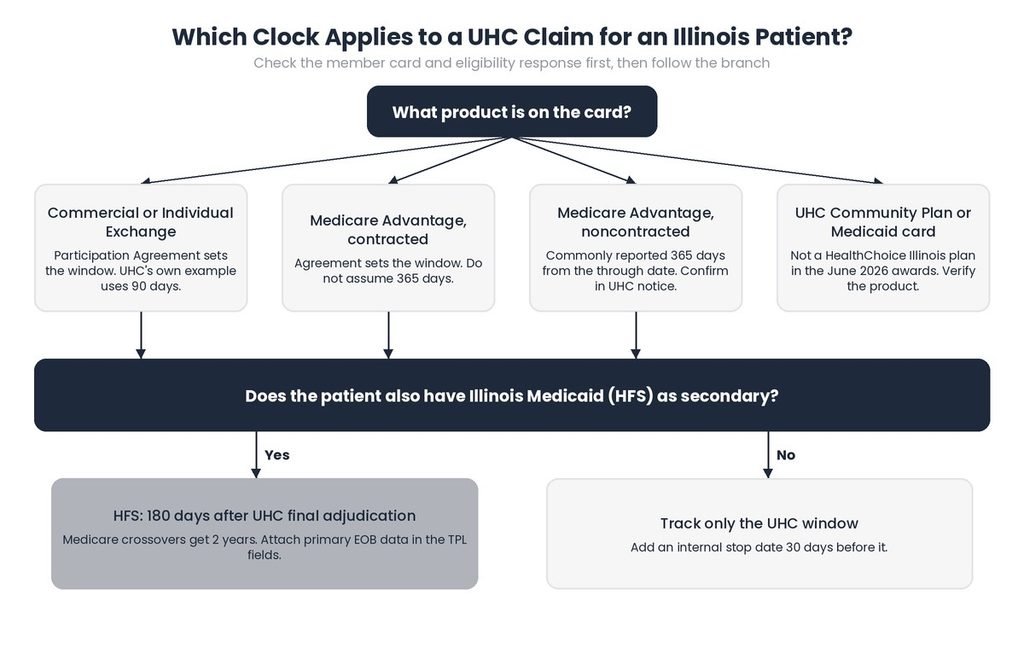
Do this when a UHC card shows up on an Illinois patient: read the product name and the eligibility response before choosing a deadline. A Medicare Advantage or commercial plan follows its agreement, while a true Medicaid managed care plan follows the state manual. Compare how UHC California timely filing works, since a regional supplement can change the answer.
Does Illinois Law Set a Filing Deadline for UHC Claims?
Not in any source reviewed for this guide. Illinois Insurance Code section 368a governs how fast insurers pay, not how fast providers must file, so the filing window stays contractual. Citing state law to UnitedHealthcare for a late claim rarely works unless the agreement or product supplement itself points to it.
The statute, as summarized by the Illinois Chiropractic Society, requires payment within 30 days after receipt of due written proof of loss, with 9 percent annual interest on late payment. Insurers must also tell the insured or provider within 30 days when a claim lacks documentation. Use these clocks to chase slow payment, and use the contract to protect your own filing date.
Illinois’s own Medicaid rule is a different animal. HFS gives most non-institutional fee-for-service claims 180 days from the date of service, and HFS timely filing guidance applies when Medicaid is the payer or secondary. Our broader guide to payer-specific claim submission rules explains why one state never means one clock, and the difference between filing and appeal limits explains the separate dispute clock.
How Do You Find the Real UHC Deadline in Your Contract?
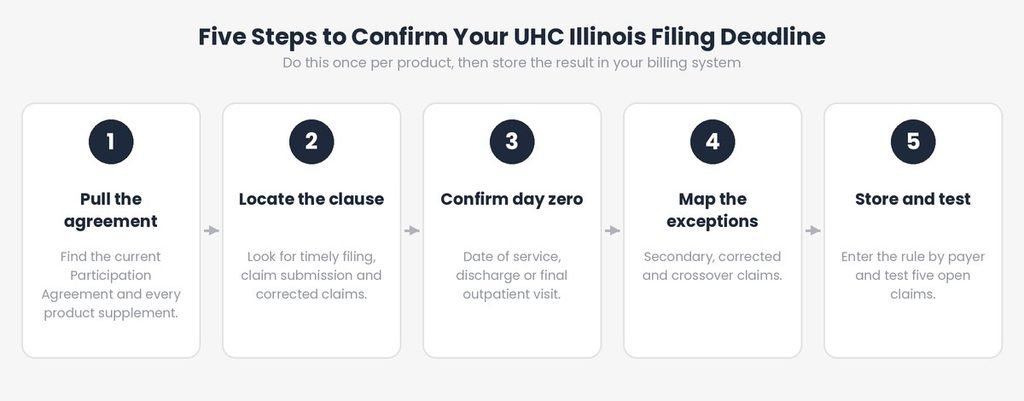
You find it by reading the agreement, not by searching the web. The process takes about an hour per product the first time, and the result belongs in your billing system by payer. If the contract is missing, request it before the next claim batch, because a deadline you cannot cite is a deadline you cannot defend.
- Pull the current Participation Agreement and every product, state or exchange supplement attached to it.
- Search for the timely filing, claim submission and corrected-claim clauses, plus any definition of “clean claim”.
- Confirm day zero: date of service for professional claims, discharge for inpatient stays, final visit for outpatient series.
- Map the exceptions: secondary claims, corrected claims, Medicare crossovers and any notice requirement after a denial.
- Enter the rule by payer and product, then test it on five open claims to confirm the system shows the right date.
If you are new to the plan, check how long payer enrollment usually takes before scheduling UHC patients. Claims for dates before your effective date can fail on timing no matter which window applies.
Do Corrected, Rejected and Secondary UHC Claims Get Extra Time?
Generally no. UnitedHealthcare states that corrected claims fall under the same filing window as the original, so a correction does not buy a new period. Rejected claims never enter UnitedHealthcare’s system, which means a rejection also stops the clock from helping you.
Corrected and replacement claims
UnitedHealthcare’s own example makes the arithmetic clear: with a last service date of May 1 and a 90-day agreement, all claim information, including corrections, must arrive by July 30. An ERA does not restart the count. Send corrections as an 837 replacement claim with frequency code 7 when possible, and compare corrected claim limits by payer across your book.
Rejections versus denials
A rejection happens before adjudication and a denial happens after it. UnitedHealthcare’s EDI guidance says rejected claims “do not enter the payer’s claim processing system” and that finding, correcting and resubmitting them avoids timely filing delays. A claim denied for lateness often carries CARC 29, the code for an expired filing limit. Our guide to reducing claim rejection rates covers the front-end edits.
Confirming acceptance, not just transmission
In billing audits, a common pattern is a claim marked “sent” by the practice system that the payer never accepted. UnitedHealthcare’s EDI quick tips say an acknowledgement is returned once a claim is accepted and that claims failing edits are not acknowledged. Check acceptance within three business days of each batch, using your electronic claims submission routine.
Secondary claims and Medicare crossovers
For secondary claims, UnitedHealthcare’s agreement controls, and the clock may start from the primary payer’s action. Its EDI guidance suggests allowing 15 to 20 days to receive a Medicare EOB, plus 15 to 30 days for a crossover to process. Our summary of secondary claim timely filing rules and the Medicare 12-month rule help set the sequence.
What Happens When UHC Is Primary and Illinois Medicaid Is Secondary?
The UHC deadline controls the primary claim, and HFS then gives 180 days after the primary payer’s final adjudication to submit the secondary claim. The two clocks run separately, so a slow secondary claim can still be late even when the UHC claim was timely.
HFS also gives Medicare crossover claims two years from the date of service. HFS’s published Q&A addresses Medicare Advantage as primary in that context, so confirm the current wording on the HFS page before billing a dual-eligible patient. Do this when a patient has UHC Medicare Advantage and Medicaid: complete the third-party liability (TPL) fields from the UHC explanation of payment, because HFS calculates the secondary date from them.
In billing audits, a common pattern is a practice that tracks the UHC date carefully and the secondary date not at all. Add the HFS 180-day date to the claim the day UHC finalizes payment, not when the secondary is first worked.
How Do You Calculate UHC Deadlines and Billing Speed? Four Worked Examples
You calculate a deadline by adding the contract window to day zero, then judge process health by how much of that window your team uses before the first submission. The examples below use real calendar arithmetic with an assumed 90-day agreement; your window may differ. Our guide to tracking timely filing deadlines shows where these ratios sit in a weekly dashboard.
Example 1: A standard commercial deadline
Formula: deadline = day zero + window days. Illustrative scenario (not an actual client record): a commercial patient is seen on July 10, 2026, and the agreement allows 90 days. July 10 plus 90 days is October 8, 2026. An internal stop date 30 days earlier is September 8, 2026.
Example 2: A corrected claim
Formula: correction deadline = original day zero + window days. Using UnitedHealthcare’s published example, a May 1, 2026 last date of service plus 90 days is July 30, 2026. A correction submitted on July 31 is late, even if the original claim was paid in June.
Example 3: Share of the window used, and the blended-average trap
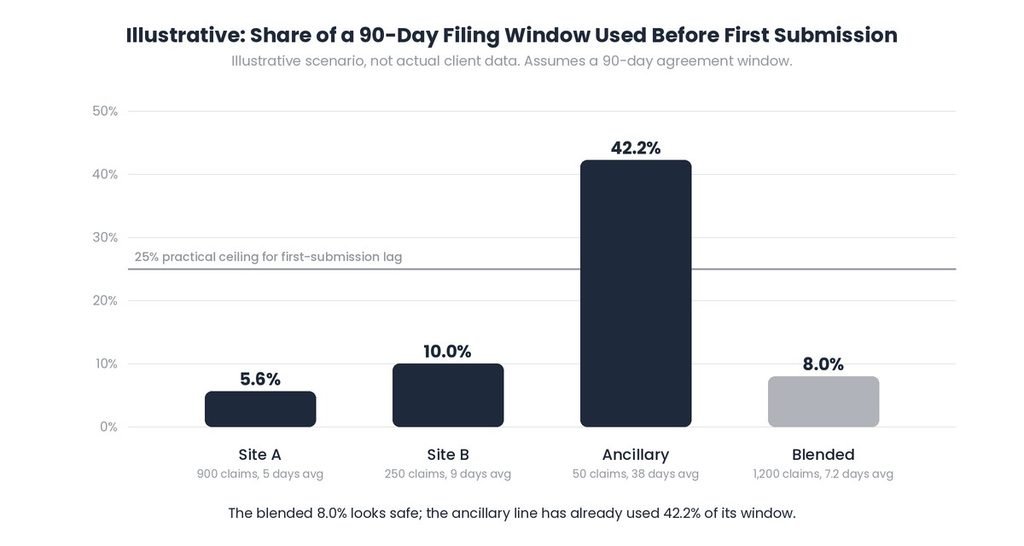
Formula: share of window used = average days to first submission divided by window days. Illustrative scenario (not an actual client record): 900 claims at Site A average 5 days, 250 at Site B average 9 days, and 50 ancillary claims average 38 days. Total days are 8,650 across 1,200 claims, so the blend is 7.2 days, or 8.0 percent of a 90-day window.
The blend looks comfortable, yet the ancillary line has used 42.2 percent of its window before any rejection can occur. Do this when any sub-group passes the 25 percent ceiling: report days to first submission by site and service line, then fix the slow line first.
Example 4: The Illinois Medicaid secondary date
Formula: HFS secondary deadline = UHC final adjudication date + 180 days. Illustrative scenario (not an actual client record): UHC finalizes payment on July 22, 2026. Adding 180 days gives January 18, 2027. Setting a 30-day stop date puts the working deadline at December 19, 2026.
How Should You Compare Your UHC Results Fairly?
Compare each product against its own window: a commercial claim with 90 days and a Medicare Advantage claim with 365 days are not the same risk at the same lag. Normalize lag as a share of the window, as in Example 3, so products with different contracts sit on one scale.
Treat one missed benchmark as a signal to investigate, not a verdict. If one site passes 25 percent for a single month, look at staffing or a new service line first. If the same site passes it for two months, treat it as a process problem.
How Long Until a Deadline Process Starts Paying Off?
Planning ranges, not guarantees: most practices see the rejected-claim queue change within two to four weeks of adding payer-level deadlines, measurable write-off improvement in roughly two to three months, and consistent product-by-product compliance in four to six months. Results depend on volume, staffing and payer mix.
Which UHC Filing Mistakes Cost Illinois Practices the Most?
Common mistakes and the fix for each
| Mistake | Why it costs money | Fix |
| Using one number for every UHC product | A window valid for one product can end weeks before another | Store the rule by product |
| Quoting Illinois law to a late claim | Section 368a covers payment speed, not filing | Cite the agreement clause |
| Assuming a UHC card means Medicaid | UHC was not named in the June 2026 HealthChoice awards | Verify the product at eligibility |
| Treating a correction as a fresh start | The original window still governs corrections | Correct within days of the denial |
| Marking claims “sent” without acceptance | Rejected claims never reach UHC | Confirm acceptance in three business days |
| Tracking only the primary date on dual patients | HFS gives a separate 180 days from UHC adjudication | Set the HFS date at payment posting |
Fixes are practical suggestions; apply them when the described condition shows up in your own claim data.
Quick Summary of UHC Illinois Filing Targets
- No single UHC Illinois number exists; the participation agreement sets the window, and UHC’s own example uses 90 days.
- Corrected claims use the original window, counted from the original service date.
- Illinois law sets payment speed, 30 days with 9 percent interest, not a filing deadline.
- HFS secondary claims get 180 days after the primary payer’s final adjudication; crossovers get 2 years.
- Practical targets: first submission within 7 days, under 25 percent of the window used, and an internal stop date 30 days before the deadline.
UHC Illinois Filing Self-Assessment
Answer yes or no for your current process, using the numbers in this guide as the standard. Count the yes answers, then use the three-tier scoring guide below.
- Have you read the filing clause in every UHC participation agreement and supplement you hold?
- Is each UHC product stored with its own deadline rule in your billing system?
- Do you verify the product name on every UHC card at eligibility, not just the payer name?
- Is your average days to first submission 7 or fewer, reported by site and service line?
- Is the share of window used at first submission under 25 percent for every service line?
- Do you confirm UHC acceptance within three business days of each batch?
- Is every open UHC claim reviewed at least 30 days before its deadline?
- Do corrections go out within days of a denial, as frequency code 7 claims?
- Do you set the HFS 180-day secondary date when UHC payment posts?
- Do you review the filing rule for each product at every contract renewal?
Scoring: 9 to 10 yes answers means your process is strong; keep the annual contract review. 6 to 8 means you have gaps; fix the lowest-numbered no answers first. 0 to 5 means late-filing losses are likely; start with questions 1, 2 and 3 this week.
When Should an Illinois Practice Consider Outside Billing Support?
Outside support makes sense when the in-house process has reached a limit that more effort will not fix, for example when the same contract questions return after each staff change. Five signals usually show it:
- Nobody on staff has read the UHC agreement, and the deadline in use comes from a cheat sheet.
- Timely filing write-offs stay above 0.5 percent for two months in a row.
- Dual-eligible claims miss the HFS secondary date.
- One service line consistently uses more than a quarter of its window before first submission.
- Staff turnover keeps resetting your knowledge of each payer.
When you evaluate vendors, look for written deadline tracking by payer and product, payer-level reporting, a US-based team, clear contract terms with no hidden fees, and medical billing support that includes follow-up on denials, not only submission.
EON MED SOLUTIONS is one example. The company delivers end-to-end billing, coding, credentialing, denial management and compliance support through a US-based team with transparent reporting. Its process starts with reading your payer agreements and storing each window by product, followed by monthly reporting by payer. Results vary by practice. To see how the work is organized, review our medical billing and RCM services.
Expert Opinion
The UHC Illinois timely filing limit is not a number to memorize; it is a clause to locate. Once you know it for each product, the rest is arithmetic: add the window to day zero, subtract a safety margin, and sort your work queue by the result.
Firm facts in this guide are that UnitedHealthcare directs providers to their agreement, that corrections fall under the original window, that Illinois section 368a governs payment speed, and that HFS gives 180 days after primary adjudication for Medicaid secondary claims. The 90-day example, the commonly reported 180-day and 365-day figures, and the 7-day, 25 percent and 30-day targets are examples or practical conventions, not guarantees.
So the natural next question is which UHC products your practice bills and whether each has a stored, verified deadline. If you want a second set of eyes on that list, see EON MED SOLUTIONS billing and RCM services and start with a payer-level deadline review.
Frequently Asked Questions
What is the timely filing limit for UHC in Illinois?
UnitedHealthcare publishes no single Illinois limit. The window comes from your participation agreement and product, and UnitedHealthcare’s own claims example uses 90 days. Nonparticipating and Medicare Advantage noncontracted windows are commonly reported at up to 180 and 365 days respectively; confirm each in writing.
What is a good days-to-first-submission target for UHC claims?
A commonly cited practical target is 7 days or fewer from service to first submission. No payer mandates it. Compare like with like by reporting the lag by site and service line, because a blended average can hide a slow ancillary line.
What is a good share of the filing window to use before first submission?
A practical ceiling is under 25 percent of the contract window. For a 90-day agreement, that is about 22 days. This is an internal convention, not a payer rule, and it leaves most of the window for rejections, corrections and follow-up.
Do corrected claims get a new filing period with UHC?
No. UnitedHealthcare says corrected claims fall under the same filing requirement as the original, counted from the date of service, discharge or final outpatient visit. An ERA does not restart the clock. Submit replacement claims with frequency code 7 as soon as the error is found.
Does UnitedHealthcare offer a Medicaid plan in Illinois?
UnitedHealthcare was not among the six organizations Illinois named in its June 2026 HealthChoice Illinois awards. A UHC card on an Illinois patient is more likely commercial, exchange or Medicare Advantage. Verify the product name at eligibility, then apply that product’s window.
How long does a practice have to bill Illinois Medicaid after UHC pays?
HFS requires claims within 180 days after the primary payer’s final adjudication, which in this case is UnitedHealthcare’s. Medicare crossover claims have two years from the date of service. Complete the third-party liability fields from the explanation of payment so HFS calculates the date correctly.
Sources and Methodology
(a) Published standards and definitions from named bodies. UnitedHealthcare provider guidance on claim corrections and timely filing (UHCprovider.com, claims and billing pages); UnitedHealthcare EDI quick tips for claims; UnitedHealthcare 2026 Administrative Guide (directs providers to the Participation Agreement); Illinois Department of Healthcare and Family Services, non-institutional timely filing guidance; State of Illinois HealthChoice Illinois contract announcement (June 15, 2026); Illinois Insurance Code section 368a (215 ILCS 5/368a), as summarized by the Illinois Chiropractic Society; Becker’s Payer reporting on contract timing (June 2026).
(b) Named benchmarking data providers. None used in this article.
(c) Practical or illustrative targets from general industry sources. The 90-day window used in examples, the 7-day first-submission target, the 25 percent window ceiling, the 30-day stop date, the three-business-day acceptance check and the 0.5 percent write-off trigger are illustrative or commonly reported internal benchmarks. Third-party summaries of UnitedHealthcare materials, including Appealant and MedSole RCM (2026), were used for the commonly reported 180-day and 365-day figures.
(d) Survey or study data. None used in this article.
Methodology: research reflects publicly available information as of October 2026. UnitedHealthcare did not publish an Illinois-specific number in any source reviewed. Contracts and policies change, and results vary by practice, so confirm every date against your agreement before relying on it. This guide is general information, not legal advice.


