

BCBS Florida Timely Filing Limit: What Florida Blue Providers Need to Know in 2026?
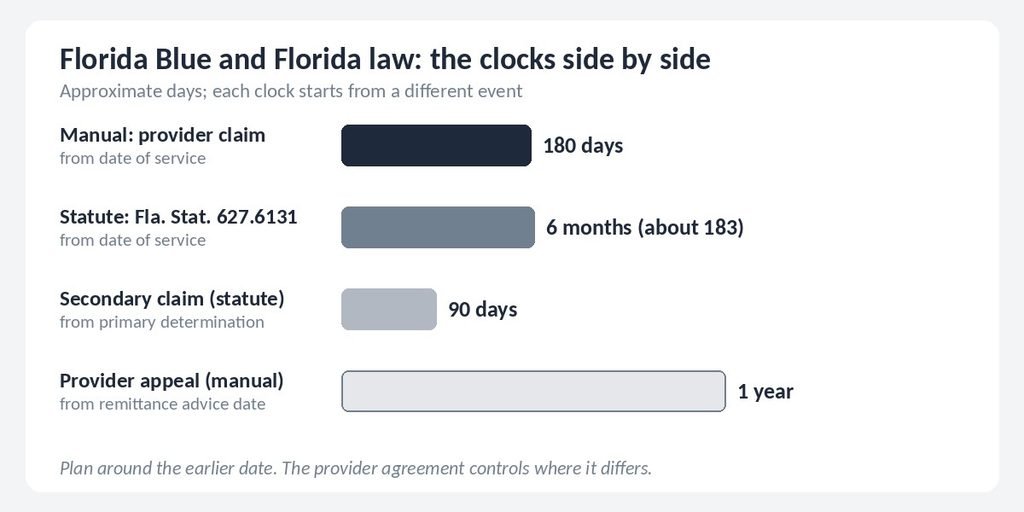
The BCBS Florida timely filing limit, administered by Florida Blue, is set by each provider agreement, and the Florida Blue provider manual states 180 days from the date of service. Florida law separately requires claims within six months. Secondary claims, corrected claims and appeals follow different clocks, and appeals are allowed one year from the remittance date.
Practices that bill Florida Blue often meet conflicting numbers: 180 days, six months, 365 days and one year. Each figure belongs to a different rule, and only one of them usually controls a given claim. This guide separates the contract, manual and statute, shows how to calculate a deadline, explains proof of timely filing and covers appeals. A self-assessment checklist near the end shows where a billing process may be exposed.
Florida Blue Filing Windows at a Glance
| Metric | Practical target/range | Review frequency | Source type |
| Participating provider claim filing | Per the provider agreement; manual states 180 days from date of service | At contract renewal and each manual update | Plan manual (M) |
| Florida statutory filing period | 6 months from date of service or discharge, once the correct insurer is known | When contracts or Florida law change | Statute (S) |
| Secondary claim, statutory period | 90 days after the primary insurer’s final determination | Weekly secondary queue | Statute (S) |
| Supplemental claim for added diagnoses | Within 180 days of the original E&M service | Monthly | Plan manual (M) |
| Resubmission waiting period | Allow 15 days (electronic) or 30 days (paper) before resubmitting | Weekly | Plan manual (M) |
| Provider appeal, commercial | 1 year from remittance advice date | Monthly denial review | Plan manual (M) |
| Medicare Advantage appeal, non-participating provider | 60 calendar days from remittance advice date | Weekly | Plan manual (M) |
| Internal submission target | Most claims filed within about 10 days of service | Weekly | Practical target (P) |
| Internal alert point | Flag unbilled claims at 50% of the window, about day 90 | Weekly | Practical target (P) |
Source labels: M = Florida Blue Manual for Physicians and Providers. S = Florida Statutes Section 627.6131, with a parallel HMO provision in Section 641.3155. P = practical target commonly used in billing operations; Florida Blue does not require it.
How Long Does Florida Blue Give Providers to File a Claim?
Florida Blue tells participating providers to file within the time stated in their participating provider agreement, and its provider manual states a 180-day limit counted from the date of service. The manual adds that Florida law requires filing within 180 days after the date of service and receipt of the patient’s insurer information, when that law applies to the benefit agreement.
The Florida Blue provider manual on claim submission repeats the figure in its reminders: all claim submissions carry a 180-day timely filing limit, and supplemental claims for added diagnoses must reach Florida Blue within 180 days of the original evaluation and management (E&M) service. The contract comes first, so a negotiated term can differ from the manual default.
Contract first, manual second
Pull the participating provider agreement before relying on any published number, because the manual defers to it. Practices that joined through a group or IPA may operate under the group’s terms without knowing them. Confirm the controlling term when a new contract or amendment is signed, and record it in the billing system next to the payer.
Institutional and professional claims
For professional claims, count from the date of service. Florida’s statute counts outpatient claims from the date of service and inpatient claims from discharge, so a facility should anchor tracking to the discharge date for inpatient stays. Use a calendar-day count, and file well before the final day when mail or a clearinghouse adds time.
Why Does the BCBS Florida Timely Filing Limit Appear as 180 and 365 Days Online?
The numbers differ because they measure different things: a 180-day manual limit for provider claims, a one-year appeal window and a one-year window for member-filed claims. Several third-party guides blend them into a single “365 days” figure that the Florida Blue manual does not state for provider claims.
Florida Blue’s member claim form says members must file within one year of the date of service when a claim is not submitted by their provider, such as an out-of-network claim. That one-year rule applies to a member filing paper claims, not to a participating provider billing through Availity. The one-year provider period in the manual belongs to appeals, counted from the remittance advice date.
Other online sources list 180 days without qualification, and some reference sites list 90 to 180 days for commercial plans. In billing audits, a common pattern is a practice that adopted a 365-day figure from a comparison chart and then lost claims to a 180-day contract term. Use the manual and your contract as the first references, and treat every chart as a prompt to verify.
The practical rule is simple: plan around the shorter number when sources conflict. Do this when a payer’s window cannot be confirmed in writing, and ask Florida Blue Provider Contact Center or your network manager for confirmation before treating a longer period as safe.
How Does Florida Law Change the Filing Deadline?
Florida Statutes Section 627.6131 requires claims to be mailed or electronically transferred to the primary insurer within six months after discharge or the date of service, and after the provider has the correct insurer name and address. It also sets a 90-day period for secondary claims and says the section cannot be waived by contract.
The Florida statute on payment of claims applies to major medical health insurance policies issued by insurers, including PPO and exclusive provider organization policies. A parallel statute, Section 641.3155, covers health maintenance organizations. Self-funded employer plans administered by an insurer generally fall outside these statutes, so the plan document may set its own limits.
Under the statute, a claim is considered submitted on the date it is electronically transferred or mailed, and considered received when it arrives at the insurer’s designated location. An insurer must acknowledge an electronic claim within 24 hours after the start of the next business day. Failure to pay or deny within 120 days of receipt of an electronic claim creates an uncontestable obligation to pay.
Six months and 180 days are close but not identical. A claim for an April 20, 2026 service reaches the six-month mark on October 20, 2026, while the manual’s 180-day count ends October 17, 2026. Track the earlier date. Do this for every Florida Blue claim, since the three-day gap is exactly where late files fall.
How Do You Set a Florida Blue Filing Deadline Before Billing?
The deadline equals the clock start date plus the applicable window in calendar days, so an April 20, 2026 service under a 180-day rule must be filed by October 17, 2026. The formula is easy, but the right clock start and the right window vary by claim type.
Formula: Last filing date = clock start date + window in calendar days. The clock starts on the date of service for professional claims, on discharge for inpatient claims, on the date the provider receives the insurer’s name and address when that comes later, and on the primary insurer’s final determination for a statutory secondary claim.
Step-by-step: lock in the date at registration
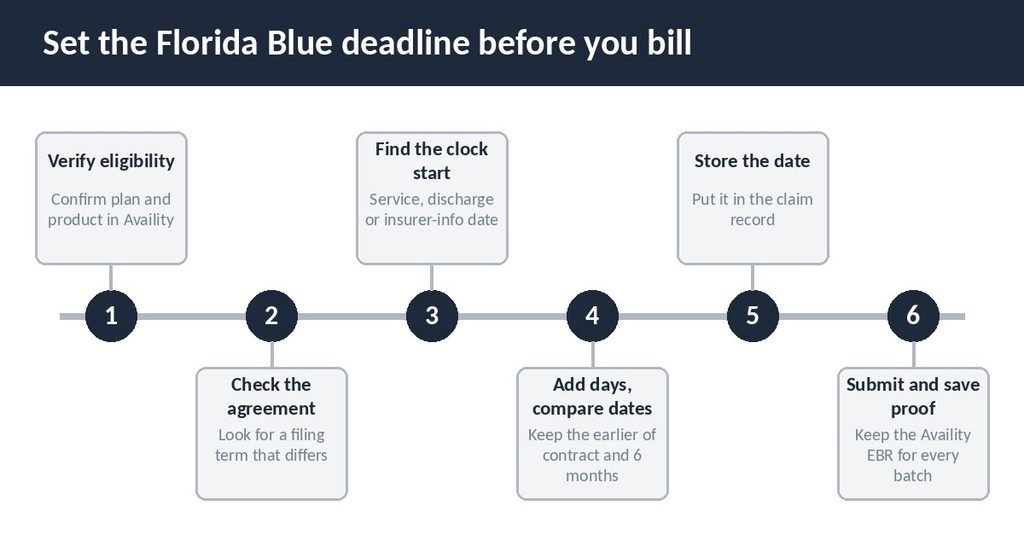
- Verify eligibility through Availity and confirm the plan, since PPO, HMO and BlueMedicare can follow different rules.
- Check the provider agreement for a filing term that differs from the manual.
- Identify the clock start: service date, discharge date, date insurer information was received, or the primary insurer’s determination.
- Add the window, compare it with the six-month statutory date and keep the earlier one.
- Store the date in the claim record, and use a timely filing tracking routine when volume is high.
- Submit through Availity and save the acceptance report for every batch.
Worked examples: four dates from real-world situations
Illustrative scenario (not an actual client record): the table shows four clocks as of October 3, 2026. Actual dates depend on the member’s plan, your contract and the notice dates.
| Situation | Formula | Last date | Days left on Oct. 3, 2026 |
| Service April 20, 2026, 180-day manual limit | Date of service + 180 days | October 17, 2026 | 14 |
| Same service, six-month statutory date | Date of service + 6 months | October 20, 2026 | 17 |
| Service August 12, 2026, 180-day manual limit | Date of service + 180 days | February 8, 2027 | 128 |
| Service March 2, 2026; correct Florida Blue information received July 15, 2026 | Information date + 180 days | January 11, 2027 | 100 |
The last row applies only when the manual’s reference to receipt of the insurer’s name and address fits the claim. Keep the dated eligibility message, referral or patient letter that shows when the information arrived. Without it, assume the service date starts the clock.
What Counts as Proof That a Florida Blue Claim Was Filed?
An Availity acceptance record, such as the electronic batch report (EBR) and clearinghouse acknowledgment, is the practical proof that a claim reached Florida Blue’s system. The manual notes that Availity does not forward a claim that fails HIPAA or payer edits, and the EBR shows which claims failed.
Florida Blue’s manual tells providers to avoid duplicates by waiting before resubmitting: 15 days for electronic claims and 30 days for paper claims. That waiting period sits inside the filing window, so a claim that disappeared on day 170 is already in trouble. Check the EBR within two business days of each submission, and resubmit immediately when the report shows a rejection.
A claim that is returned or rejected before processing is not a corrected claim. The manual says a returned claim must be submitted as a new claim, because no original exists in the system. A corrected claim is for a claim that has already finalized, and it should wait until the remittance advice arrives, carry the original claim number and use frequency code 7 for replacement.
In billing audits, a common pattern is a corrected claim sent before the original finalizes, which denies as a duplicate and burns weeks of the filing window. Wait for the remittance advice when the original claim is still pending. Our corrected claim deadline guide covers the general rules, and our electronic claim submission tips cover acceptance reports in detail.
Missing data causes many returns. Florida Blue’s manual lists a required service facility location for hospital and facility-based professional claims, a taxonomy code, a billing address that is a street address and a TIN that matches the provider agreement. A practice that reviews ways to reduce claim rejections protects both the clean claim rate and the filing deadline.
How Do Secondary Claims, Auto Accidents and Medicare Crossover Change the Clock?
Secondary claims carry the statute’s 90-day period from the primary insurer’s final determination, auto accident claims usually go to the auto carrier first, and Medicare crossover claims follow the Medicare payer’s release. Each situation needs its own date, because the primary payer’s timing can push the claim past the manual’s 180 days.
Florida Blue’s manual says that when it is the secondary carrier, the provider files after the primary insurance finishes processing and attaches the other carrier’s remittance advice. For auto accidents, the auto carrier pays as primary until personal injury protection (PIP) benefits are exhausted, and then Florida Blue becomes primary up to policy limits. The claim needs the auto carrier EOB, the exhaustion letter, a signed and dated statement if there is no PIP coverage, and a PIP worksheet when available.
Illustrative scenario (not an actual client record):
A service on March 10, 2026 was billed first to another carrier. That carrier’s final determination arrived on August 25, 2026. The statutory secondary period ends November 23, 2026, even though the 180-day count from the service date ended September 6, 2026. Use the later statutory date only when the secondary rule applies, and confirm it in the contract.
A participating provider may not hold claims in favor of collecting from a settlement in a third-party liability case, according to the manual, and doing so is balance billing and a breach of contract. For Medicare supplement crossovers from other Blue plans, the manual asks providers to allow 45 days from the Medicare payment date before inquiring. Our secondary claim filing deadline guide explains sequencing across payers.
Payer differences matter on mixed panels, because one Florida practice may bill Florida Blue, Original Medicare, Medicare Advantage and Medicaid in the same week. The table compares the main clocks, and each one needs its own calendar entry in the billing system.
Table
| Payer or product | Filing or appeal window | Source type |
| Florida Blue commercial (PPO, HMO) | Per agreement; manual states 180 days; statute states 6 months | Plan manual (M), statute (S) |
| Florida Blue provider appeal | 1 year from remittance advice date | Plan manual (M) |
| Medicare Advantage, non-participating appeal | 60 calendar days from remittance advice date | Plan manual (M) |
| Original Medicare | 12 months from date of service | Federal rule, 42 CFR 424.44 |
| Florida Medicaid | Separate program; see our Florida Medicaid guide | Agency rules |
Original Medicare’s longer limit is explained in our 12-month Medicare filing rule guide, and the state program has its own rules in our Florida Medicaid filing limit guide. Payer-specific submission quirks are collected in our payer-specific claim submission rules guide.
How Long Do You Have to Appeal a Florida Blue Timely Filing Denial?
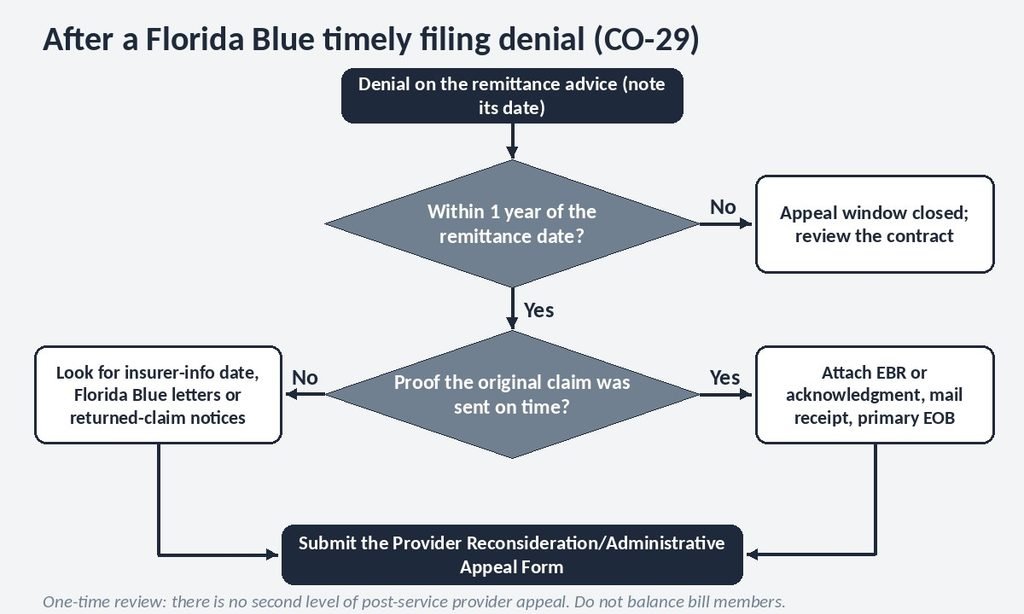
Florida Blue allows providers one year from the date on the remittance advice to submit a post-service appeal, including an administrative appeal marked “Timely Filing.” The Florida Blue appeals chapter adds that the review is one-time, with no second level of post-service provider appeal.
An administrative appeal must include the completed Provider Reconsideration/Administrative Appeal Form, a written explanation, a copy of the remittance advice and the documents that support the claim. The manual warns that Florida Blue will not overturn claim denials because a provider failed to follow required procedures and time frames. Providers also may not balance bill members for covered services, including disputed amounts.
For a late-filing denial, the strongest support is proof the original claim was sent on time. That means the EBR or acknowledgment, any returned-claim notices, the primary payer’s EOB when the claim was filed elsewhere first, and any dated record showing when insurer information arrived. A non-participating provider appealing a Medicare Advantage denial has only 60 calendar days from the remittance date.
Illustrative scenario (not an actual client record): a remittance advice is dated August 20, 2026. A commercial appeal is due by August 20, 2027, while a non-participating Medicare Advantage appeal is due by October 19, 2026. Set an internal date about 30 days earlier for commercial appeals, to leave time to collect proof.
Appeals and filing limits are separate clocks, as our comparison of filing and appeal limits explains. Missing the appeal date can turn a recoverable denial into a permanent write-off. When denials pile up faster than staff can review them, denial management support keeps each appeal date visible.
Why Can a Calm Average Hide Florida Blue Claims at Risk?
A blended days-to-submit average can look comfortable while one claim group uses most of its window, so each group needs its own measure. The metric is the percentage of the filing window used, calculated separately for every group a practice bills to Florida Blue.
Formula: Percent of window used = average days from service to submission ÷ filing window. Blended average = sum of (claims × average days) ÷ total claims.
Illustrative scenario (not an actual client record): a practice submits 1,000 Florida Blue claims in a month across three groups, measured against a 180-day window. Actual figures vary by practice.
| Claim group | Claims | Avg. days to submit | Percent of 180-day window used |
| Professional claims, no other insurance | 700 | 12 | 6.7% |
| Facility claims | 150 | 40 | 22.2% |
| Auto accident claims (PIP first) | 150 | 96 | 53.3% |
| Blended | 1,000 | 28.8 | 16.0% |
The blended figure is (700 × 12 + 150 × 40 + 150 × 96) ÷ 1,000 = 28.8 days, which looks comfortable. The auto accident group, however, uses 53.3% of the window before Florida Blue sees the claim. One slow exhaustion letter pushes those claims toward the deadline. In billing audits, a common pattern is a monthly report that shows only the blended average.
How to use these numbers correctly
Compare like for like: judge auto accident claims against their own workflow, and judge routine professional claims against a much faster internal target. One group above 50% of its window is a signal to investigate the cause, such as a missing exhaustion letter or an unresolved eligibility problem, not a verdict on the team. Review monthly when volume is steady and weekly when a new product or payer starts. A payer-level report that separates each group from the blended figure makes the review routine.
How Soon Can a Practice Fix Florida Blue Filing Gaps?
Most practices see partial improvement within two to three months and fuller results within three to six months. These are general planning ranges, not guarantees, and they vary with claim volume, staffing, backlog size and how quickly each payer’s windows are built into daily work.
- Payer-specific deadlines and alerts built into the billing system: roughly 2 to 4 weeks.
- Clearing unbilled claims, oldest dates of service first: roughly 30 to 60 days.
- Fewer timeliness denials in monthly reports: partial results often appear in 2 to 3 months.
- Stable performance across commercial, secondary and auto accident claims: commonly 3 to 6 months.
What Mistakes Lead to Florida Blue Late-Filing Denials?
Most late-filing denials come from a handful of repeatable process errors, all preventable with checks at registration, charge entry and submission. Each fix below is tied to the condition that triggers it, so staff know exactly when to act and what evidence to keep.
- Using a 365-day figure from a comparison chart. Confirm the window in the agreement and the manual when a chart disagrees with either.
- Holding auto accident claims for settlement. File with the auto carrier EOB or exhaustion letter when PIP is exhausted, and never withhold claims for a lawsuit.
- Sending a corrected claim too early. Wait for the original remittance advice when the first claim is still pending.
- Treating a rejection as a filed claim. Review the EBR when Availity returns an error, and resubmit at once.
- Leaving out required facility data. Add the service facility location on facility-based professional claims to avoid denials.
- Waiting on the 15- or 30-day rule too long. Check status near day 15 for electronic claims and resubmit promptly if the claim never posted.
Quick Summary
- The BCBS Florida timely filing limit is set by the provider agreement, and the Florida Blue provider manual states 180 days from the date of service.
- Florida law separately requires claims within six months, so plan around the earlier date.
- Statutory secondary claims run 90 days from the primary insurer’s final determination.
- Appeals are allowed one year from the remittance advice date, with 60 days for non-participating Medicare Advantage appeals.
- A practical internal target is filing within about 10 days of service and alerting at 50% of the window.
- Track percent of window used by claim group, because blended averages hide risk.
Self-Assessment: Are Your Florida Blue Claims Protected?
Answer yes or no to each question below, then use the scoring guide to see how exposed your process is to late-filing write-offs. Be honest about any answer that depends on one person’s memory rather than a system setting, because that kind of dependency is where deadlines usually slip.
- Have you confirmed the filing term in your Florida Blue participating provider agreement?
- Does your system use the earlier of the contract or manual date and the six-month statutory date?
- Are most Florida Blue claims filed within about 10 days of service?
- Do you flag unbilled claims at 50% of the window?
- Do you review the Availity EBR within two business days of each submission?
- Do you wait for the remittance advice before sending a corrected claim?
- Do you track secondary and auto accident claims separately from routine claims?
- Do you keep dated records of when insurer information was received?
- Do you calendar the one-year appeal date from each remittance advice?
- Do you review average days to submit by claim group, not only as a blended number?
*Scoring guide: 9 to 10 yes answers means the process is well controlled; keep the monthly review going. 6 to 8 yes answers means there are gaps; fix each “no” within 30 days. 5 or fewer yes answers means high exposure; review the claim backlog now and consider outside support.*
Signs You Need Help With Florida Blue Billing
In-house billing reaches its limit when payer rules multiply faster than staff can track them. Five signals usually appear first:
- Timely filing denials from Florida Blue recur despite reminders.
- Staff cannot list unbilled claims by payer and claim type on demand.
- Auto accident and secondary claims sit for weeks waiting on other carriers.
- The payer mix includes Florida Blue, Medicare Advantage and Medicaid with different clocks.
- Accounts receivable aged beyond 90 days keeps growing; our A/R management service addresses that backlog.
When comparing outside partners, look for payer-level reporting, a named contact, a maintained payer rules library, written escalation steps and a US-based team familiar with Florida payers. Ask how deadlines are assigned, who monitors them and how proof of timely filing is stored. Clean enrollment also matters, because claims fail when TINs, NPIs or taxonomy codes do not match the agreement, and a provider credentialing and enrollment process reduces that risk.
EON MED SOLUTIONS is one example. The team provides end-to-end medical billing, coding, credentialing, denial management and compliance support through a US-based team with transparent reporting and no hidden fees. Results vary by practice. Review EON MED SOLUTIONS’ billing and RCM services to see how that process works.
Expert Opinion
The BCBS Florida timely filing limit is not a single published number. It is a contract term, a 180-day manual statement, a six-month Florida statute and separate appeal and secondary clocks. Reading each source for what it actually says removes most of the confusion.
Firm, published standards in this guide are the 180-day statement in the Florida Blue manual, the one-year appeal window, the 60-day non-participating Medicare Advantage appeal window and the Florida statute’s six-month and 90-day periods. The contract controls where it differs. The 10-day target, the 50% alert and the improvement timeframes are practical targets, and every worked example is illustrative.
The natural next question is which of your Florida Blue claims are closest to a deadline today, and which clock each one is running, since the answer decides what to work first. Talk with EON MED SOLUTIONS about a Florida Blue timely filing review to find out.
Frequently Asked Questions
What is the BCBS Florida timely filing limit?
Florida Blue sets the limit in each provider agreement, and its provider manual states 180 days from the date of service. Florida law separately requires claims within six months. Because the two dates differ slightly, plan around the earlier one and confirm the controlling term in your contract.
Is Florida Blue’s timely filing limit 365 days?
Not for provider claims, according to the Florida Blue manual, which states 180 days. The 365-day and one-year figures online usually reflect the provider appeal window, counted from the remittance advice date, or the one-year period for member-filed claims. Confirm any longer term in your participating provider agreement.
What is a good internal filing target for Florida Blue claims?
A common practical target is filing most claims within about 10 days of service, with an alert at 50% of the window. These are industry conventions, not Florida Blue requirements. Track percent of window used by claim group so slower workflows, such as auto accident claims, stay visible.
What is a good timely filing denial rate?
No standards body publishes a target for timely filing denials. Because late filing is largely preventable, many practices treat any recurring denial as a process failure. Review denial counts monthly by payer and claim group, and investigate when average submission time passes half of the filing window.
How long do you have to appeal a Florida Blue denial?
Providers have one year from the remittance advice date to submit a post-service appeal, including an administrative appeal for timely filing. Non-participating providers appealing Medicare Advantage denials have 60 calendar days. Florida Blue offers one level of post-service provider appeal, so submit complete proof with the first request.
Can you bill the patient if Florida Blue denies a claim for timely filing?
The manual says participating providers accept payment as payment in full and may not balance bill members for covered services, including disputed amounts. It does not describe a late-filing exception. Review your participating provider agreement before moving any balance to the member, and appeal when proof of timely filing exists.
Sources and Methodology
(a) Published standards and definitions from named bodies
- Florida Blue, Manual for Physicians and Providers, Claim Submission and Billing Guidelines (Prompt Claims Processing/Timely Filing Limits; Corrected Claims; Electronic Claims).
- Florida Blue, Manual for Physicians and Providers, Care Review, Coordination of Benefits, Appeals and Grievances.
- Florida Blue, Major Medical Claim Form instructions (member-filed claims).
- Florida Statutes Section 627.6131 (Payment of claims) and Section 641.3155 (HMO prompt payment).
- 42 CFR 424.44 (Original Medicare filing limit); X12 Claim Adjustment Reason Code 29.
(b) Named benchmarking data providers
- None used. No benchmark provider publishes a Florida Blue timely filing denial rate that this article relies on.
(c) Practical or illustrative targets from general industry practice
- The 10-day filing target, 50% alert point, improvement timeframes and every worked example are practical or illustrative figures, not Florida Blue requirements.
(d) Survey or study data
- None used.
Methodology. Research was completed in October 2026. Third-party guides from Muni Health, QuickIntell, BehaveHealth, MediBillRCM and Revenuees were compared against the Florida Blue provider manual and Florida statutes. Where they conflicted, the primary document governed, and unresolved differences, such as 180 days versus 365 days, are stated in the text. Results vary by contract, plan and claim type. Figures reflect information available at the time of research; confirm current terms in your participating provider agreement and the latest Florida Blue manual.


