
Credentialed but Not Contracted: What It Means to Bill
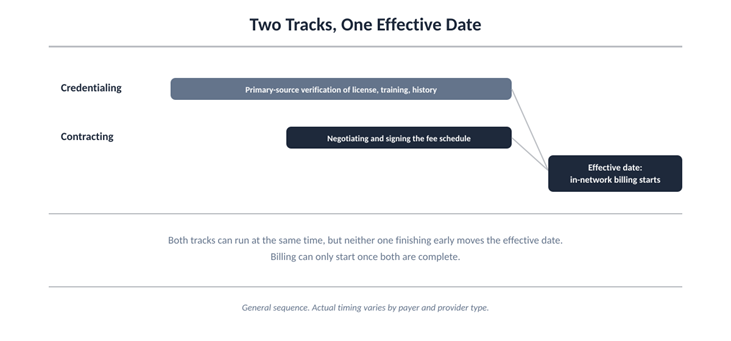
Credentialing vs. contracting is a distinction many new practices miss: credentialing verifies a provider’s qualifications, while contracting sets the rates and effective date that actually allow billing. This guide covers what each stage does inside provider credentialing, why one can finish without the other, and how to tell which stage a denial is pointing back to.
Key Takeaways
- Credentialing verifies qualifications; contracting sets the rates and the date billing can start.
- A provider can be fully credentialed and still unable to bill in-network without a signed contract.
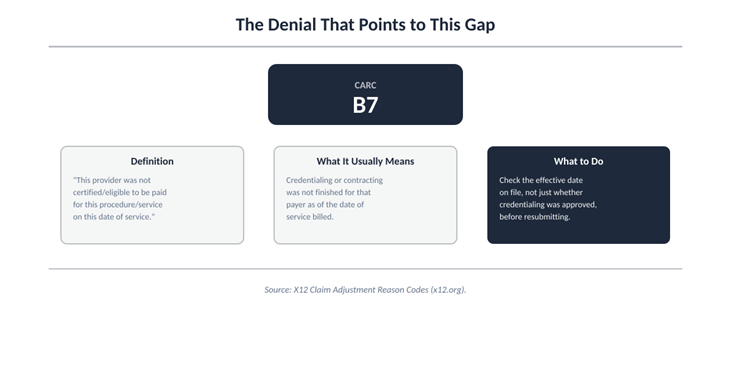
- CARC B7 is the denial code that usually points back to this specific gap.
- The contract’s effective date, not the credentialing approval date, is what starts in-network billing.
| Item | Detail |
| Credentialing verifies | License, education, training, work history, malpractice record |
| Contracting establishes | The fee schedule, rates, and the agreement’s effective date |
| Denial code to watch | CARC B7: not certified/eligible to be paid on that date of service |
| Billing starts | Only once both are complete and the contract’s effective date has passed |
What Credentialing Actually Verifies
Credentialing is the process a payer or a Credentials Verification Organization uses to confirm a provider’s license, education, training, work history, and malpractice record directly from the issuing source. NCQA accredits organizations on exactly this kind of credentialing operation. Passing credentialing adds a provider to the payer’s approved roster, but a roster spot is not a rate agreement.
What Contracting Actually Establishes
Contracting is the separate step of negotiating and signing a participation agreement with the payer. That agreement fixes the fee schedule, the services it covers, and the effective date on which in-network billing can begin. A practice can be verified and approved for months while this agreement is still being negotiated.
Why a Credentialed Provider Can Still Get Denied
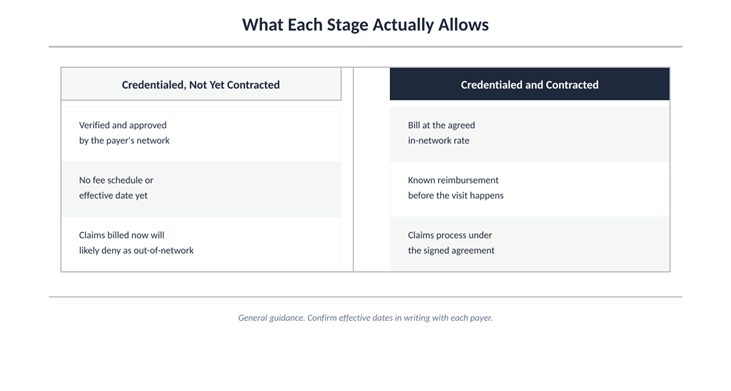
In billing audits, a common pattern is a practice billing as soon as a credentialing approval letter arrives, assuming that letter is the green light. It confirms eligibility to join the network; it does not confirm the contract is signed or that the effective date has passed, and claims billed before that date are typically processed as out-of-network or denied outright.
The Denial That Points to This Gap
When a claim denies with CARC B7, the payer is saying the provider was not certified or eligible to be paid for that service on that date, which almost always traces back to credentialing or contracting still being incomplete rather than a coding error on the claim itself.
What Each Stage Actually Allows
In billing audits, a common pattern is front-desk staff scheduling insured patients the moment a credentialing approval email arrives, without checking whether the contract’s effective date has actually passed.
Related Guides
This distinction sits next to two related steps: credentialing vs. enrollment covers the third milestone, registering with a specific payer system, and the average timeline for insurance payer enrollment covers how long the combined process typically runs.
If a credentialing application is already running behind, how to avoid delays in provider credentialing covers the common causes. For the B7 denial itself, claim adjustment group codes explains how CARC and group codes work together on a remit.
When to Bring In Billing Support
A few signals suggest this needs dedicated tracking: a new provider has an approval letter but no confirmed effective date, claims are denying with B7 and no one has mapped them to a stage, or multiple payer contracts are being negotiated at once with no shared tracker.
EON Med Solutions is one example of end-to-end billing, coding, credentialing, denial management, and reporting delivered by a US-based team with transparent reporting, tracking each payer’s credentialing and contracting status against its effective date; results vary by practice. Contact EON Med Solutions to review a current credentialing and contracting status.
Frequently Asked Questions
Can a provider bill once credentialing is approved?
Not necessarily. Credentialing approval confirms eligibility to join the network. In-network billing also requires a signed contract with a confirmed effective date, which can lag behind the approval by weeks or months.
What should a practice confirm before seeing a newly contracted patient?
Get the effective date in writing from the payer, not just a verbal confirmation. Scheduling insured patients before that date risks a claim denial even though credentialing is already complete.
Does every B7 denial mean the provider isn’t credentialed?
Not always. It can also mean the contract hasn’t taken effect yet, the provider type isn’t covered under that specific agreement, or the payer’s system hasn’t been updated with the current status.
Can credentialing and contracting happen in any order?
Payers vary. Some begin contract talks before credentialing finishes; others require credentialing approval first. Either way, billing waits for both to be complete, not whichever finishes first.
Expert Opinion
Credentialing vs. contracting is not a technicality; it is the difference between being allowed into a network and being paid inside it. What each stage verifies is a fixed, defined distinction. Exactly how long either stage takes for a given payer is a practical variable, not a published rule, and depends on that payer’s own process.
A practice chasing a B7 denial should ask which stage is actually incomplete before resubmitting anything. Talk with the EON Med Solutions team about tracking credentialing and contracting status for a new or growing provider roster.
Sources: X12 Claim Adjustment Reason Codes (x12.org); NCQA Credentialing Accreditation and Certification programs (ncqa.org), reviewed November 2026. Figures reflect information available at the time of research and results vary by practice and payer.