
Denial Rate in Medical Billing: Formula and Fixes
Denial rate measures the share of submitted claims a payer denies, and a rate that climbs month over month usually means a fixable problem upstream, not bad luck with one payer. It is one of the core metrics inside revenue cycle reporting and analytics. This guide covers the formula, common causes behind a rising rate, and how to investigate and bring it back down.
Key Takeaways
- Denial rate = denied claims ÷ claims submitted × 100, tracked monthly.
- A rate trending upward over several months signals a process issue worth investigating.
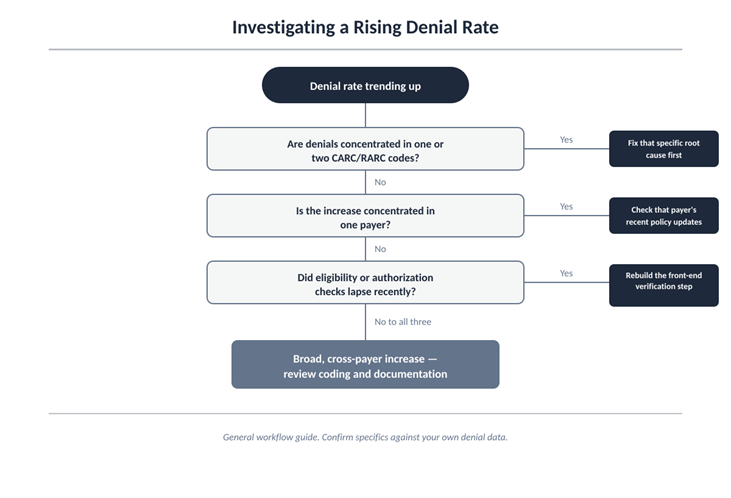
- Denials concentrated in one CARC code or one payer point to a specific, fixable cause.
- Read denial rate alongside net collection rate and clean claim rate, not in isolation.
| Item | Figure |
| Formula | Denied claims ÷ Claims submitted × 100 |
| Initial vs. final denial | Initial counts first-submission denials; final counts those never overturned |
| Measurement period | Monthly, tracked on a rolling trend rather than one snapshot |
| Best read alongside | Net collection rate and clean claim rate |
What Is Denial Rate?
Denial rate is the percentage of submitted claims a payer denies rather than pays, in whole or in part. Practices typically track initial denial rate (denials on first submission) separately from the smaller share of claims still denied after appeal, since the two point to different problems: initial denials usually trace to the claim itself, while persistent denials often trace to weak appeal follow-up.
Formula: How to Calculate Denial Rate
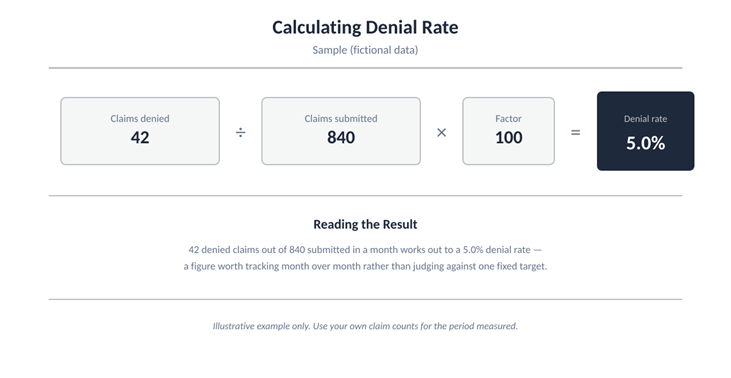
Denial rate equals the number of denied claims divided by the number of claims submitted in the same period, multiplied by 100. Walkthrough: a practice submits 840 claims in a month and 42 comeback denied. 42 ÷ 840 × 100 = 5.0%.
Why Denial Rate Rises
- Eligibility or authorization checks lapse, so claims go out for coverage that no longer applies.
- A payer updates its claim submission or documentation rules without the practice adjusting.
- Coding errors or missing modifiers recur on the same handful of CPT or HCPCS codes.
- Claims are filed close to the payer’s timely filing deadline, leaving no room for correction.
Common Mistakes and Fixes
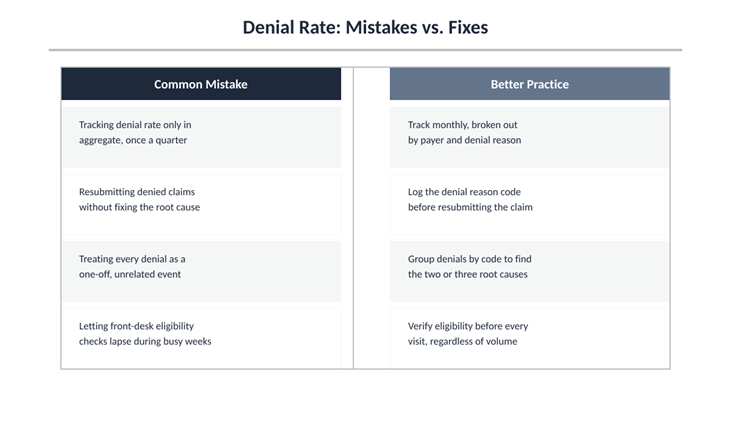
In billing audits, a common pattern behind a creeping denial rate is treating each denial as a one-off rather than grouping them by reason code to find the two or three root causes driving most of the volume.
How to Investigate a Rising Denial Rate
When denial rate trends upward, check whether it is concentrated before assuming a broad, practice-wide problem. A pattern narrowed to one code or one payer is far faster to fix than a diffuse increase across the board.
What Counts as a Good Denial Rate?
Published benchmarks for denial rate vary across industry sources, and some use different definitions of what counts as a denial, so no single percentage applies evenly to every specialty or payer mix. A more reliable signal than comparing against an outside number is watching the practice’s own trend: a rate holding steady or falling over a rolling few months is healthy, while one that climbs for two or more consecutive months warrants a root-cause review.
Related KPIs to Track Alongside Denial Rate
Denial rate is most useful read next to net collection rate, since a rising denial rate is often the first sign a collection rate is about to slip. See medical billing KPIs to track for the fuller set, and how to reduce claim denials for a deeper strategy guide once the pattern is identified.
A recurring denial tied to one specific reason code, such as CO-45, is worth checking against its own explainer before assuming the cause is broader than it is.
When to Bring In Billing Support
A few signals suggest denial review has outgrown in-house capacity: the rate has risen for more than one quarter, no one tracks denials by reason code or payer, or denied claims sit unworked past the appeal window.
EON Med Solutions is one example of end-to-end billing, coding, credentialing, denial management, and reporting delivered by a US-based team with transparent reporting, grouping denials by root cause and working them before deadlines close; results vary by practice.
Frequently Asked Questions
What is the difference between a denial and a rejection?
A rejection never enters payer adjudication, usually due to a data or formatting error, and is corrected and resubmitted. A denial was adjudicated and the payer declined payment for a substantive reason, which may be appealable.
How often should denial rate be reviewed?
Monthly, at minimum, with a rolling view across several months. A single month’s figure can swing with a small claim volume and is less reliable than a multi-month trend.
Does denial rate include partial denials?
Most practices count any claim line the payer did not pay as billed, including partial denials, though some count only claims denied in full. Define it consistently so month-to-month comparisons stay valid.
Can denial rate be too low?
Not meaningfully. An unusually low rate generally reflects clean claims and accurate eligibility checks rather than a problem, though it is worth confirming denials aren’t being miscategorized as adjustments instead.
Expert Opinion
Denial rate does not have one universal published target the way some revenue cycle metrics do, so the firm standard here is the formula itself: denied claims divided by claims submitted. How much movement is acceptable month to month is a practical judgment each practice makes from its own trend, not a fixed industry rule.
A denial rate worth investigating is one that climbs for more than a month or two, especially when it concentrates in one code or payer. That pattern is almost always fixable once identified. Talk with the EON Med Solutions team about reviewing your current denial trend by reason code.
Sources: X12 Claim Adjustment Reason Codes (x12.org), reviewed November 2026. Published denial-rate benchmarks vary by source and definition; figures reflect information available at the time of research and results vary by practice and payer mix.