
How a Medical Billing Clearinghouse Handles Your Claims
A medical billing clearinghouse is a company that converts, checks and routes electronic claims between a practice and its payers, then returns acknowledgment and payment reports. It does not decide whether a claim is paid. This guide explains what the clearinghouse does at each step, how to read the reports it sends back, how it differs from billing software and a billing company, and how to choose one.
| Key takeaways: A clearinghouse formats, edits and routes claims; it does not appeal denials or collect from patients. Read the 999 and 277CA reports daily, since they show rejections before any payer decision. A rejection stops a claim before adjudication; a denial arrives later on the remittance. Choose on payer coverage, rejection turnaround and ERA support, not on price alone. |
What Does a Clearinghouse Do Between Your Practice and the Payer?
A clearinghouse receives your claim file, checks it against standard format rules and payer edits, and forwards it to the right payer. Federal rules define the role: under 45 CFR 160.103, a health care clearinghouse is an entity, such as a billing service, that processes health information from a nonstandard format into a standard transaction, or the reverse.
In daily work that definition becomes five jobs, listed below with the report you get back from each.
| Step | What the clearinghouse does | What you receive |
| 1. Receive | Takes the electronic claim (837) from your billing system | Upload or transmission confirmation |
| 2. Edit | Checks format, required fields and payer-specific rules | A rejection list for claims it cannot send |
| 3. Route | Sends each claim to the correct payer connection | Payer acceptance or rejection of the file (999) |
| 4. Report | Passes back claim-level status from the payer | Claim acknowledgment (277CA) |
| 5. Deliver payment data | Returns the electronic remittance when the payer has processed the claim | Electronic remittance advice (ERA) |
Your payer and clearinghouse may call these reports by different names, so ask which files you receive and where they appear.
How Do You Read the 999 and 277CA Reports?
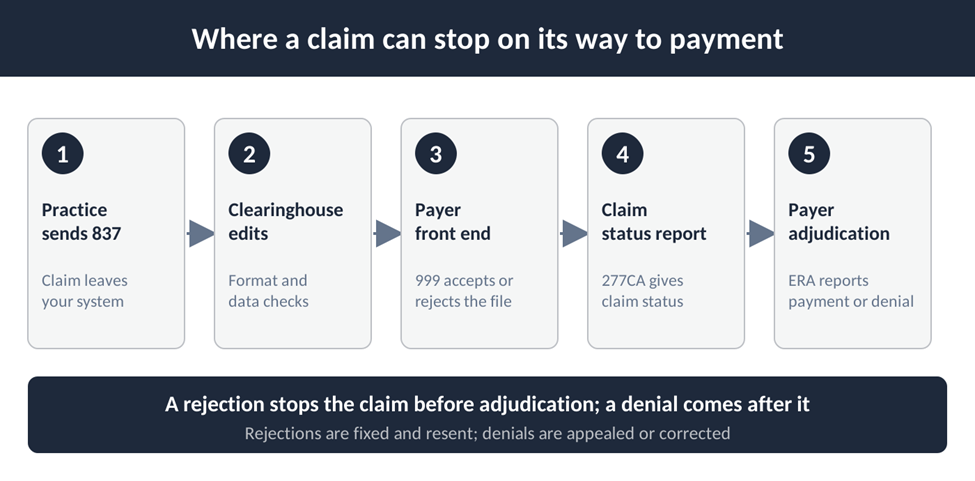
The 999 tells you whether the payer accepted the file, and the 277CA tells you the status of each claim inside it. Medicare contractor CGS describes the sequence in its EDI questions page: it returns a 999 to the submitter, and if the 999 is accepted, a 277CA is generated. A file rejected on the 999 is not forwarded for further processing.
CGS also notes that the 999-and-277CA process can take from one hour up to 48 hours, and that providers who cannot read the reports should contact their clearinghouse. In practice, check both reports every business day. A claim missing from the 277CA is not paid, and silence is not a status.
What Is the Difference Between a Rejection and a Denial?
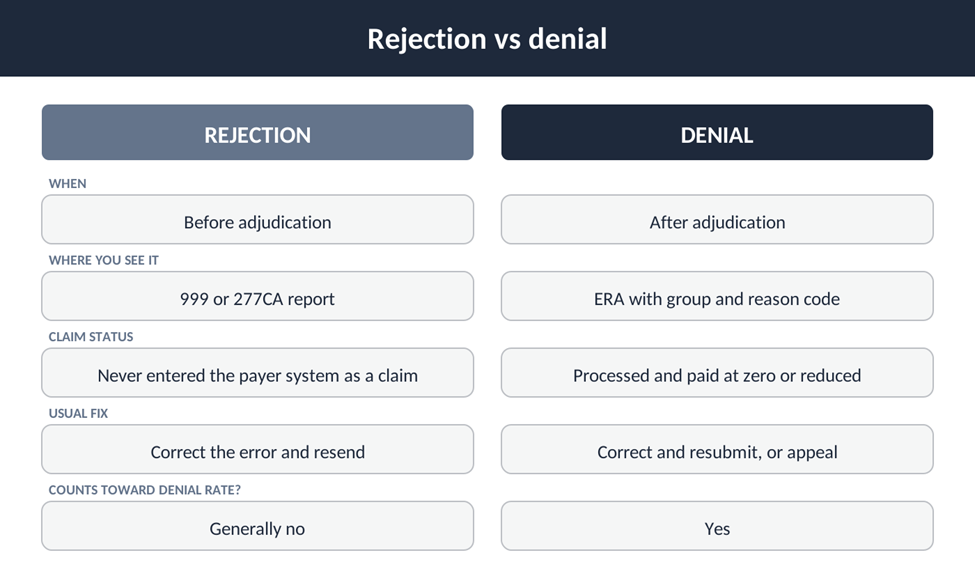
A rejection happens before the payer adjudicates the claim, and a denial happens after. The distinction changes who fixes the problem and where you find it.
| Feature | Rejection | Denial |
| Timing | Before adjudication | After adjudication |
| Where it appears | 999 or 277CA | ERA with group and reason code |
| Typical cause | Format error, missing field, invalid ID | Coverage, medical necessity, authorization, coding |
| Fix | Correct and resend | Correct and resubmit, or appeal |
Keep both queues separate. Rejections belong to front-end staff and should clear within a day; denials belong in your denial management process. For ways to cut the rejection side, see our guide on reducing claim rejection rate.
What Do Rejections Cost a Practice in Staff Time?
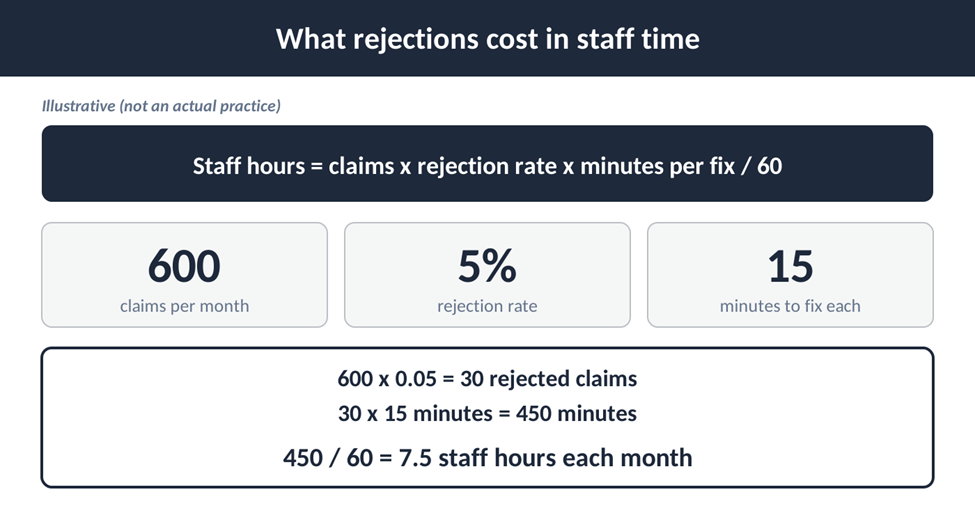
Rejections cost the minutes it takes to find, fix and resend each claim. The formula is simple: staff hours equal claims times rejection rate times minutes per fix, divided by 60.
Illustrative scenario (not an actual client record): a practice sends 600 claims a month, 5% reject, and each fix takes 15 minutes. That is 600 x 0.05 = 30 rejected claims, 30 x 15 = 450 minutes, and 450 / 60 = 7.5 staff hours a month. Your own rate and minutes will differ, so measure both for one month before judging a clearinghouse.
Cutting the rejection rate in half in this example returns almost four hours a month. For benchmarks and tactics, see our posts on clean claim rate improvement and the first pass claim rate.
Clearinghouse, Billing Software or Billing Company: Which Do You Need?
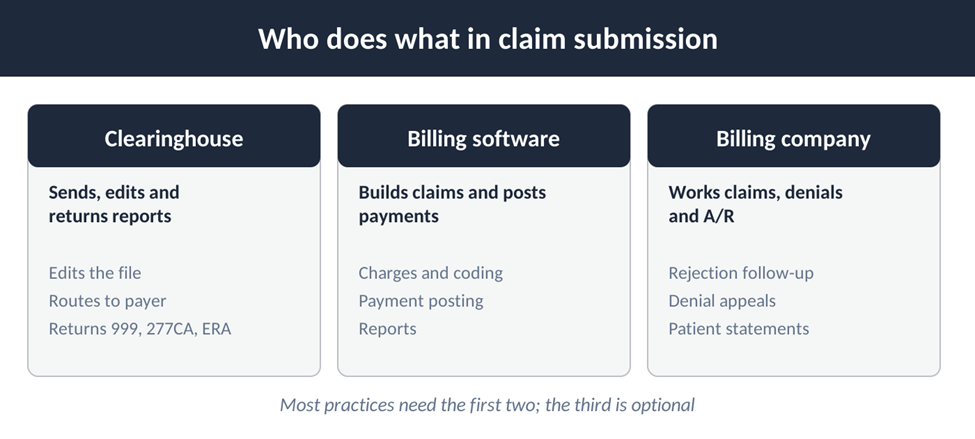
Most practices need a clearinghouse connection and billing software, and some add a billing company for the follow-up work. They overlap but do different jobs.
| Option | Main job | Does not do |
| Clearinghouse | Edits, routes and returns reports for electronic claims | Appeals, patient billing, A/R follow-up |
| Billing software | Builds claims, posts payments, tracks balances | Connect to every payer without a clearinghouse or direct link |
| Billing company | Works rejections, denials, A/R and statements | Replace the need for an accurate front end |
Many practice management systems include a clearinghouse connection, so check whether you already have one before buying another. A separate clearinghouse makes sense when your system lacks coverage for a payer you bill often.
How Do You Choose a Clearinghouse?
Choose on fit with your payers and your workflow, then compare price. Apply the checks below in order.
- Payer coverage: confirm it connects to your top payers, including Medicaid plans in your state.
- Rejection detail: look for plain-language messages that name the field to fix.
- Turnaround: ask how quickly reports reach you after transmission.
- ERA and EFT enrollment: ask whether it handles payer enrollment and how long that takes.
- Pricing structure: compare per-claim, flat and per-provider models against your own volume.
- Support and backup: confirm who answers when files fail and what happens if the service goes down.
Payers also keep their own submission rules, so ask whether the clearinghouse maintains them; our guide to payer-specific claim submission rules shows why. Eligibility checks before the visit prevent many rejections, a step covered in our insurance eligibility verification guide.
Mistakes That Leave Claims Stuck
The most common clearinghouse problems are reporting gaps, not technology faults. Here are three and their fixes:
- Reading only the payment reports. Review the 999 and 277CA daily so a rejected file never sits unnoticed.
- Treating accepted as paid. A 277CA acceptance means the payer received the claim, not that it will pay; follow up on claims with no ERA after your usual payer cycle.
- Letting rejections age. Assign one person to the rejection list each morning and clear it the same day.
In billing audits, a common pattern is a rejection report that nobody owns, so claims sit until the filing deadline approaches. Another is a clearinghouse change made without moving ERA enrollment, which leaves payments arriving as paper remittances for weeks.
When Claim Submission Needs Outside Support
It is time to consider help when these signals persist:
- Rejection lists that grow faster than staff can clear
- Claims missing from every report
- Several clearinghouse portals with no single view
- Rejections discovered only after payer deadlines near
- No weekly report of rejections by cause
EON Med Solutions is one example of a US-based team that delivers billing, coding, credentialing, denial management and reporting end to end, with transparent reporting. Its process is to monitor acknowledgment reports daily, route rejections for same-day correction and report causes by category. Results vary by practice. The medical billing service page describes how that fits with the rest of the revenue cycle.
Frequently Asked Questions
What is a clearinghouse in medical billing?
A clearinghouse is a company that converts, checks and routes electronic claims between providers and payers and returns acknowledgment and remittance reports. Federal rules define it as an entity that translates health information between nonstandard and standard transaction formats. It does not adjudicate or pay claims.
Do you need a clearinghouse to bill insurance?
Not always. Some payers accept claims through direct connections, and many practice management systems include a built-in clearinghouse. Practices that bill several payers usually need at least one connection to reach them all. Check what your software already provides before adding another vendor.
What is the difference between a 999 and a 277CA?
The 999 reports whether the payer accepted the claim file, and the 277CA reports the status of each claim inside an accepted file. CGS notes that a 277CA is generated only when the 999 is accepted. Review both daily.
Is a clearinghouse the same as a billing company?
No. A clearinghouse moves and checks claims electronically, while a billing company works the claims after submission, including rejections, denials, A/R and patient statements. Some billing companies include clearinghouse access, but the two roles are separate.
How long does a clearinghouse take to submit a claim?
Transmission is usually quick, but acknowledgment timing varies. CGS describes its 999 and 277CA process as taking from one hour up to 48 hours. Payer response times differ, so check your clearinghouse’s published turnaround and your payer’s rules.
Expert Opinion
From the EON Med Solutions Billing & RCM Team: a medical billing clearinghouse is only as useful as the attention paid to its reports. The tool catches many errors early, but a rejection that nobody reads is the same as a claim that never left the office.
The definition of a clearinghouse and the 999 and 277CA sequence come from the federal regulation and the Medicare contractor page cited above. The staff-hour example is illustrative, and the selection checklist and daily review routine are practical working standards, not payer requirements. Payer contracts and companion guides control the details.
The natural next question is how many of your claims reject each month and why. If you want a second set of eyes on that, contact our team to talk through your claim flow.
Sources: 45 CFR 160.103 (eCFR); CGS Medicare EDI questions page; CMS electronic health care claims page. Results vary by practice, and figures reflect information available at the time of research. This article is general information, not legal advice.