

ERA vs EOB in Medical Billing: Key Differences
An ERA is the electronic remittance advice a payer sends to a practice, and an EOB is the explanation of benefits a payer sends to a patient. Both describe the same processed claim, but only the ERA carries the payment and adjustment codes a biller posts from. This guide shows what each document contains, who receives it, how they connect to the bank deposit, and which one to trust when the two disagree.
| Key takeaways Post payments from the ERA or the standard paper remittance, never from the patient’s EOB.The EOB speaks to the patient; the ERA speaks to the billing team in codes.An ERA describes claims, while the EFT moves the money, so match them by reference number.Provider-level adjustments can make a deposit smaller than the sum of claim payments. |
What Is the Difference Between an ERA and an EOB?
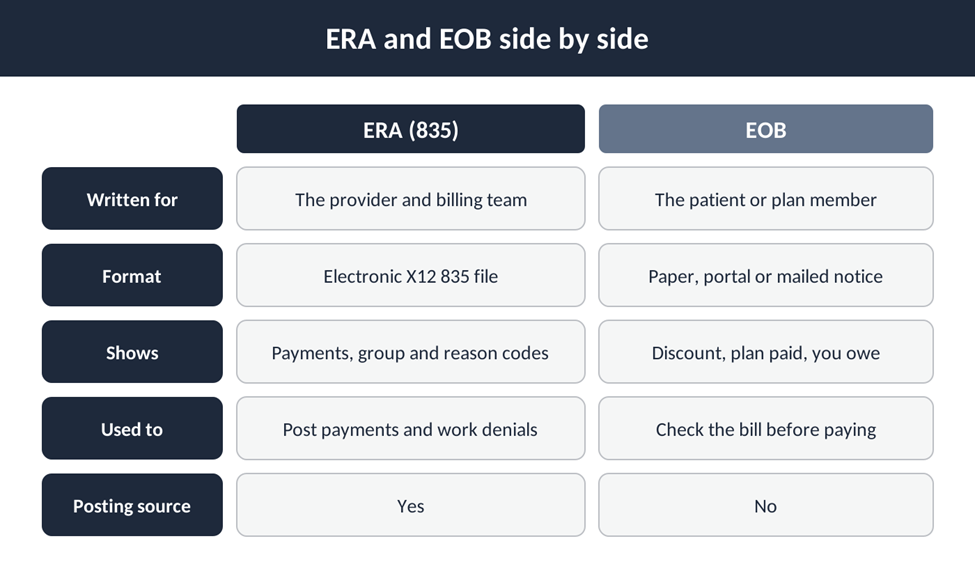
The difference is audience and detail: an ERA is a machine-readable file for the provider, and an EOB is a plain-language notice for the member. Medicare beneficiaries receive a Medicare Summary Notice in the same role. Practices that mix the two up end up posting from a document that was never built for posting.
| Feature | ERA (X12 835) | EOB |
| Written for | Provider and billing team | Patient or plan member |
| Format | Electronic file, or a paper remittance where no ERA is set up | Paper, mailed or portal notice |
| Core content | Payments, group codes, reason codes, remark codes | Billed amount, plan discount, plan payment, member share |
| Main use | Post payments, work denials, reconcile deposits | Let the patient check the bill before paying |
| Safe to post from? | Yes | No |
The CMS Health Care Payment and Remittance Advice page explains that after Medicare processes a claim it sends either an ERA or a standard paper remittance (SPR) with the final payment and adjustment information. ERAs can post to a billing system automatically, while SPRs must be posted by hand.
How Do the ERA, EOB and EFT Connect?
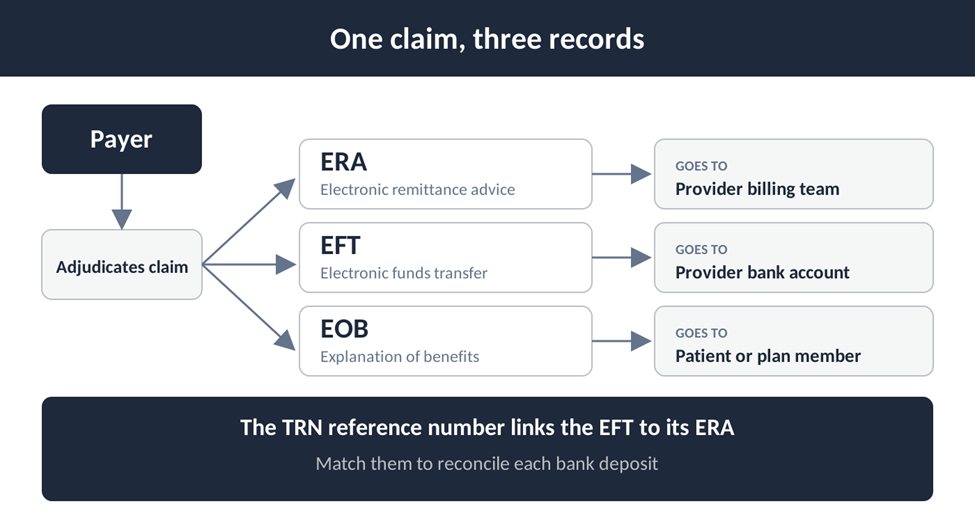
One adjudicated claim produces up to three records: the ERA for the practice, the EOB for the patient, and an electronic funds transfer (EFT) that moves the money. The ERA says how the claim was paid, and the EFT says how much actually arrived.
The federal operating rules for these transactions took effect January 1, 2014, according to CMS guidance on EFT and remittance advice operating rules. They call for the same trace (TRN) number in the EFT and its ERA, which is how reassociation works: you match the deposit to the remittance by that number. CMS also encourages providers to enroll for both EFT and ERA with each health plan they work with.
What Does the Same Claim Look Like on Each Document?
The same claim shows the same money on both documents, but the ERA labels it with codes and the EOB labels it in words. The pattern below uses a fictional claim.
Illustrative scenario (not an actual client record): a $250.00 office visit with an allowed amount of $180.00 and 20% coinsurance.
| Amount | On the ERA | On the EOB |
| $250.00 | Billed charge | Amount billed |
| $70.00 | CO-45, contractual adjustment | Plan discount |
| $144.00 | Payer payment | Plan paid |
| $36.00 | PR-2, coinsurance | What you owe |
The check is simple: $144.00 + $70.00 + $36.00 = $250.00. If the EOB shows a different patient share than the ERA, post the ERA amount and ask the payer to explain the gap before billing the patient. Our guide to posting insurance payments accurately covers the sequence, and the group codes behind CO and PR are the same ones used for secondary insurance claims.
How Do You Reconcile an ERA to a Bank Deposit?
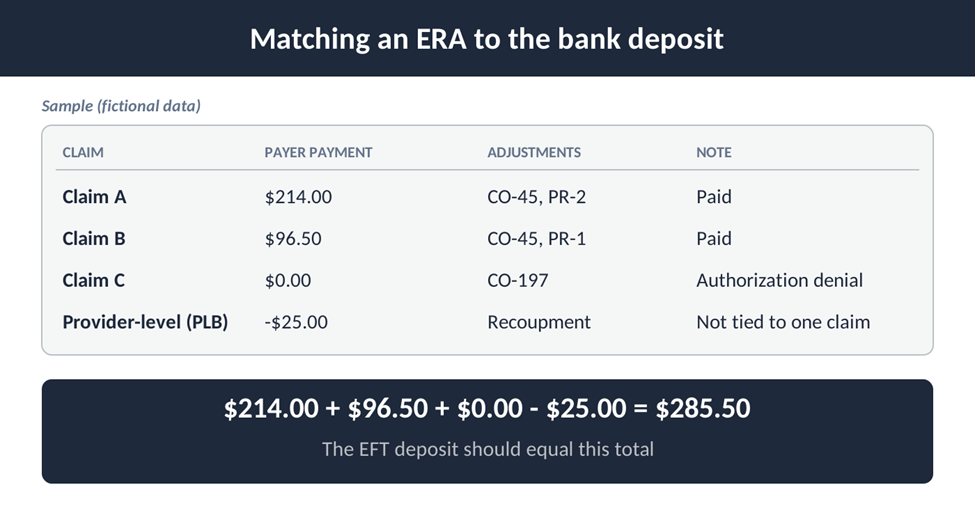
Reconcile by adding every claim payment on the ERA, subtracting any provider-level adjustment, and comparing the result to the EFT amount. CMS notes that provider-level balance (PLB) codes explain adjustments that are not tied to a specific claim, so a recoupment can shrink the deposit without touching any single claim.
Illustrative scenario (not an actual client record): one ERA covers three claims and one recoupment.
| Item | Amount |
| Claim A payment | $214.00 |
| Claim B payment | $96.50 |
| Claim C payment (authorization denial) | $0.00 |
| Provider-level recoupment | -$25.00 |
| Expected EFT deposit | $285.50 |
Do this when the deposit does not match: confirm the TRN first, then look for a PLB line, then check whether two ERAs share one deposit. Mismatches also surface slow-paying claims, which feed the work described in our post on tracking unpaid claims across payers.
How Do You Set Up ERA and Move Off Paper Remits?
Enroll with each payer, or through your clearinghouse, and ask for the ERA to replace paper. Start with your practice tax ID and each clinician’s NPI, since CMS lists both as the starting information for enrollment.
For Medicare, the Medicare Administrative Contractor (MAC) handles enrollment. First Coast Service Options, for example, describes the ERA as the electronic version of the standard paper remittance, carrying the same information plus additional data, and asks providers to complete its EDI enrollment form before using the free software. See the First Coast ERA overview. Other MACs run their own enrollment pages.
Do this when payers send both formats: keep posting from one source only, and use the other to spot-check. Duplicate posting is the fastest way to overstate cash.
Why Do ERA and EOB Totals Sometimes Disagree?
Totals disagree because the two documents are produced for different readers and can be sent on different days. The most common causes are listed below.
- The EOB reached the patient before a corrected claim reprocessed.
- A recoupment or interest line appears on the ERA only.
- The patient’s EOB groups services differently than the claim lines.
- A secondary payer’s EOB shows its own figures, not the primary’s.
In practice audits, a common pattern is a patient disputing a balance because the EOB was printed before an adjustment posted. Share the current ERA-based figure on your patient statement and note the date it reflects. Another pattern is a CO-45 amount that looks right on the ERA but sits below the contract rate, a gap our post on claim underpayments shows how to catch.
When Remittance Work Needs More Than the Front Office
Outside help is worth considering when these signs keep recurring:
- Deposits that cannot be matched to an ERA
- Unposted ERAs sitting for days
- Paper remits still arriving from several payers
- Patients receiving statements that conflict with their EOBs
- No report on adjustments by reason code
EON Med Solutions is one example of a US-based team that delivers billing, coding, credentialing, denial management and reporting end to end, with transparent reporting. Its process is to post from the remittance, reconcile each deposit and report adjustments by category. Results vary by practice. See the practice’s medical billing services for how that fits together.
Frequently Asked Questions
Is an ERA the same as an EOB?
No. An ERA is an electronic file sent to the provider with payment and adjustment codes, while an EOB is a notice sent to the patient explaining how the plan processed the claim. They describe the same claim but serve different readers, and billing staff should post from the ERA.
What does ERA stand for in medical billing?
ERA stands for electronic remittance advice. Medicare ERAs use the X12 835 version 5010 format, according to CMS. The file lists payments, group codes, reason codes and remark codes for each processed claim and can be posted to a billing system automatically.
Can you post payments from an EOB?
You can, but you should not when an ERA or standard paper remittance exists. The EOB is written for the patient and omits the codes billers need to separate write-offs from patient balances. Use the EOB only to answer patient questions or when no remittance is available.
What is the difference between an ERA and an EFT?
An ERA explains how claims were paid, and an EFT is the electronic transfer of the money itself. They travel separately and are linked by a shared trace number. Match them to confirm that the deposit equals the ERA total less any provider-level adjustments.
Does Medicare send an ERA or an EOB to providers?
Medicare sends providers an ERA or a standard paper remittance. Beneficiaries receive a Medicare Summary Notice, which plays the EOB role. CMS says ERAs can be post automatically, but paper remittances must be post manually.
Expert Opinion
From the EON Med Solutions Billing & RCM Team: the practical rule on ERA vs EOB is that the remittance is your posting source and the EOB is your patient-conversation source. Keeping those roles separate prevents most double postings and most wrong patient statements.
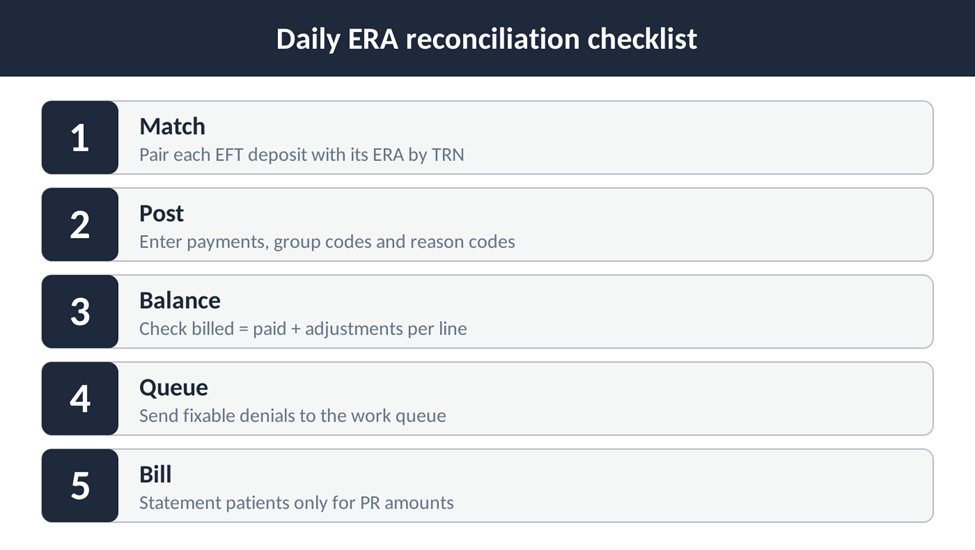
The facts about the 835 format, the 2014 operating rules effective date, trace number matching and enrollment come from the CMS and Medicare contractor pages named in this guide. The dollar examples are illustrative, and the daily checklist is a practical working routine, not a payer requirement. Your payer contracts and manuals control the details.
The next question most practices ask is how many of their payers still send paper remits. If you want help moving them to ERA and reconciling every deposit, contact our team to talk it through.
Sources: CMS Health Care Payment and Remittance Advice page; CMS EFT and remittance advice operating rules page; First Coast Service Options ERA overview. Results vary by practice, and figures reflect information available at the time of research. This article is general information, not legal advice.


