

How to Find and Recover Claim Underpayments
Claim underpayments are insurance payments that come in below the amount the payer’s contract or fee schedule says it owes for a correctly billed service. They rarely show up as denials, so they slip past most follow-up work. This guide explains where underpayments come from, how to tell them apart from valid adjustments, how to calculate the variance, how to recover the money and how to stop repeats. It supports our accounts receivable management service content.
| Key takeaways An underpayment is a paid claim, not a denial, so it needs its own check.Load expected allowed amounts by payer and code, then compare every 835 against them.Patient responsibility, sequestration and valid edits are not underpayments.Most underpayments repeat by payer and code, so one fix recovers many claims.Medicare allows a reopening for any reason within one year of the initial determination. |
What Counts as a Claim Underpayment?
A claim underpayment happens when the payer’s allowed amount, or the amount it paid after cost sharing, falls below the contracted rate for a correctly coded service. The key test is the contract, not the billed charge.
Practices usually bill a charge above their contracted rates, so a write-off is normal. The difference between charge and allowed amount is a contractual adjustment, reported with group code CO and often CARC 45 on the 835 electronic remittance advice (ERA). The full code lists are on the X12 external code lists page. An underpayment is the part of that adjustment the contract does not support.
Where Do Underpayments Come From?
Underpayments come from a small set of repeat causes, most of them on the payer side: wrong fee schedules, missed contract updates, misapplied reductions and modifiers the payer’s system ignored.
| Cause | How it shows on the 835 | Typical fix |
| Old fee schedule after a contract update | Same codes short by a fixed percentage | Send the amendment to the payer rep |
| Wrong place-of-service rate | Facility rate paid on an office visit | Check POS code, then dispute |
| Multiple procedure reduction misapplied | Highest-value code reduced | Correct the line order or dispute |
| Modifier not recognized, such as 25 or 59 | E/M or procedure paid at zero or reduced | Appeal with documentation |
| Wrong network tier or provider | Out-of-network rate on a contracted provider | Fix the provider record with the payer |
Multiple procedure payment reduction (MPPR) is a valid payer rule that reduces payment for additional procedures on the same day. It becomes an underpayment only when the payer applies it to the wrong line or to codes the rule does not cover.
In billing audits, a common pattern is a payer that keeps paying last year’s rates for months after a renewal. The amounts look normal, so nobody notices until someone compares them with the new contract. Our payer contract negotiation guide covers locking in rate effective dates during renewal.
How Do You Tell an Underpayment From a Valid Adjustment?
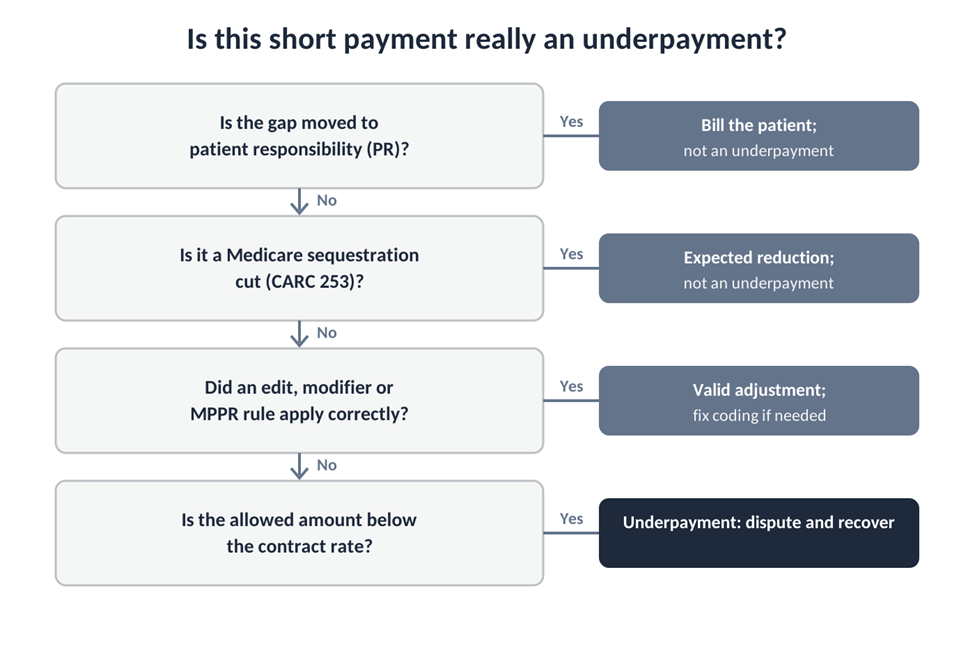
Tell an underpayment from a valid adjustment by ruling out the legitimate reductions first: patient responsibility, federal sequestration and correctly applied edits. What remains below contract is the underpayment.
- Amounts marked PR (patient responsibility) belong to the patient, not the payer.
- Medicare claims carry a small sequestration reduction, coded CARC 253; it is expected.
- Bundling edits and MPPR applied correctly are valid, though the coding behind them may need review.
- Interest on late clean claims, where state law or Medicare rules require it, should appear when payment is late.
Posting accuracy matters here. If staff post the full gap as a contractual write-off, the underpayment disappears from reports. Our guide to accurate insurance payment posting explains how to keep variance visible.
How Do You Calculate Underpayment Variance?
Calculate underpayment variance by subtracting the paid allowed amount from the expected allowed amount for each claim line, then adding the results by payer and code. The expected amount comes from the contract fee schedule loaded into the practice management system.
Formula: variance per line = expected allowed amount − paid allowed amount. Variance percentage = variance ÷ expected allowed amount × 100.
Illustrative scenario (not an actual client record)
- A family practice’s contract with one commercial payer sets 99214 at $132.00 and 99215 at $178.00.
- For a quarter, the payer allows $118.80 for 99214 and $160.20 for 99215, both 10% short.
- 99214: $13.20 short × 240 claims = $3,168.00.
- 99215: $17.80 short × 110 claims = $1,958.00.
- Quarterly variance: $5,126.00, or about $20,504 a year if the pattern continues.
A flat 10% gap across codes points to an outdated fee schedule, not a coding issue. That pattern is good news, because one corrected load at the payer can fix every future claim and support a single bulk dispute.

How Do You Recover an Underpaid Claim?
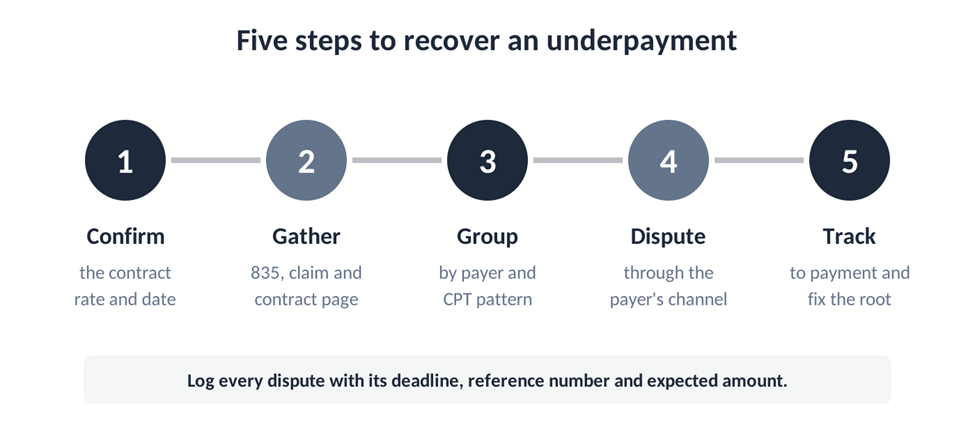
Recover an underpaid claim by confirming the contract rate, gathering the evidence, grouping claims with the same cause and disputing them through the payer’s required channel before its deadline.
- Confirm the contract rate and effective date that applied on the date of service.
- Gather the 835, the claim and the contract page or fee schedule that shows the rate.
- Group claims by payer and pattern so one dispute covers many lines.
- Dispute through the payer’s channel: provider rep, payment dispute form, reconsideration or portal.
- Track each dispute to payment, then confirm the payer fixed its fee schedule.
For traditional Medicare, a payment error is usually corrected through a reopening rather than an appeal. Under the Medicare Claims Processing Manual, Chapter 34, a reopening can be requested for any reason within one year of the initial determination, and within four years for good cause.
CGS Medicare’s reopening guidance notes that minor clerical errors and omissions can be corrected this way, and that its online portal is the preferred route for requests.
Commercial and Medicare Advantage contracts set their own dispute windows, which are often shorter than Medicare’s. Many states also have prompt-pay laws that require interest on late clean claims; your state insurance department publishes the rules. Underpayments still sitting in A/R also inflate days in A/R, as our A/R days reduction strategies explain.
How Can a Practice Prevent Repeat Underpayments?
A practice prevents repeat underpayments by keeping expected rates current in its system, reviewing variance every month and sending contract changes to payers before they take effect.
- Load every contract amendment and annual fee schedule update the month it takes effect.
- Run a monthly variance report by payer and code, with a set threshold for review.
- Name one owner for each major payer’s disputes.
- Review payer rate changes each January, when many fee schedules and code sets update.
Our team often sees practices chase denials closely while paid claims get no review at all. Adding variance to the monthly revenue cycle performance report keeps it in front of decision-makers. Claims that get no response at all need a different routine, covered in tracking unpaid claims across payers.
Some practices reach the point where outside help makes sense. Signals include:
- Expected rates are not loaded in the practice management system.
- Nobody compares payments with contracts after posting.
- Disputes start but are rarely followed to payment.
- Contract renewals happen without anyone checking the new rates arrive.
EON Med Solutions is one example of a partner that handles billing, coding, credentialing, denial management and reporting end to end through a US-based team with transparent reporting. The work includes variance reviews and payer disputes; results vary by practice. See our full list of practice services.
Frequently Asked Questions
How common are claim underpayments?
No federal source tracks underpayment rates for physician practices, and figures quoted online vary widely. The practical answer is to measure your own: compare a month of 835s with your contracts. Most practices that check find at least one payer and code pattern worth disputing.
What is the difference between a denial and an underpayment?
A denial pays nothing and carries a denial reason code. An underpayment pays the claim, but for less than the contract allows. Denials show up in work queues automatically; underpayments only show up when someone compares payments with expected rates.
How far back can a practice recover underpayments?
It depends on the payer. Medicare allows reopenings within one year for any reason and four years for good cause. Commercial and Medicare Advantage contracts set their own dispute windows, often much shorter, so check each contract and act quickly once a pattern appears.
What is a good variance threshold for review?
There is no published standard. Many practices review any line short by a set dollar amount or percentage, then look for patterns by payer and code. That threshold is an internal convention; choose one your team can actually work each month.
Can software find underpayments automatically?
Yes, when expected rates are loaded. Many practice management systems and contract management tools flag lines paid below the expected amount. The flags are only as good as the rate tables, so keep contract updates current.
Expert Opinion
From the EON Med Solutions Billing & RCM Team: claim underpayments are the quietest revenue leak in most practices. They look like paid claims, so they never land in a denial queue, and they repeat until someone compares payments with the contract.
The firm rules here are Medicare’s reopening timeframes and the X12 reason code definitions. The $132 and $178 rates, the 10% gap and the $5,126 quarterly variance are illustrative, and every contract sets its own rates and dispute windows.
The natural next question is whether your payers are paying what your contracts say. If you would like a variance check, talk with our A/R team.
Sources: X12 external code lists; CMS Medicare Claims Processing Manual, Chapter 34; CGS Medicare reopening guidance. Results vary by practice, and figures reflect information available at the time of research.


