

UHC New York Timely Filing Limit: What Applies to Your Claims in 2026
The UHC New York timely filing limit is the deadline for UnitedHealthcare to receive a provider’s claim, and the number varies by plan. New York Insurance Law §3224-a(g) sets a 120-day default from the date of service for state-regulated plans. UnitedHealthcare’s Participation Agreement can allow longer, while Medicaid managed care contracts cannot go below 90 days.
A New York claim that reaches UnitedHealthcare on day 121 can return with a CO-29 denial, even when the coding is flawless. The UHC New York timely filing limit is not a single number. UnitedHealthcare tells providers to follow their Participation Agreement, and New York law adds its own floor for state-regulated plans.
This guide shows which clock applies by plan type, how late claims are treated under state law, what UnitedHealthcare changed in its 2026 guide, and how to set deadline alerts. A self-assessment checklist near the end lets you score your own process.
| Situation | Usual window |
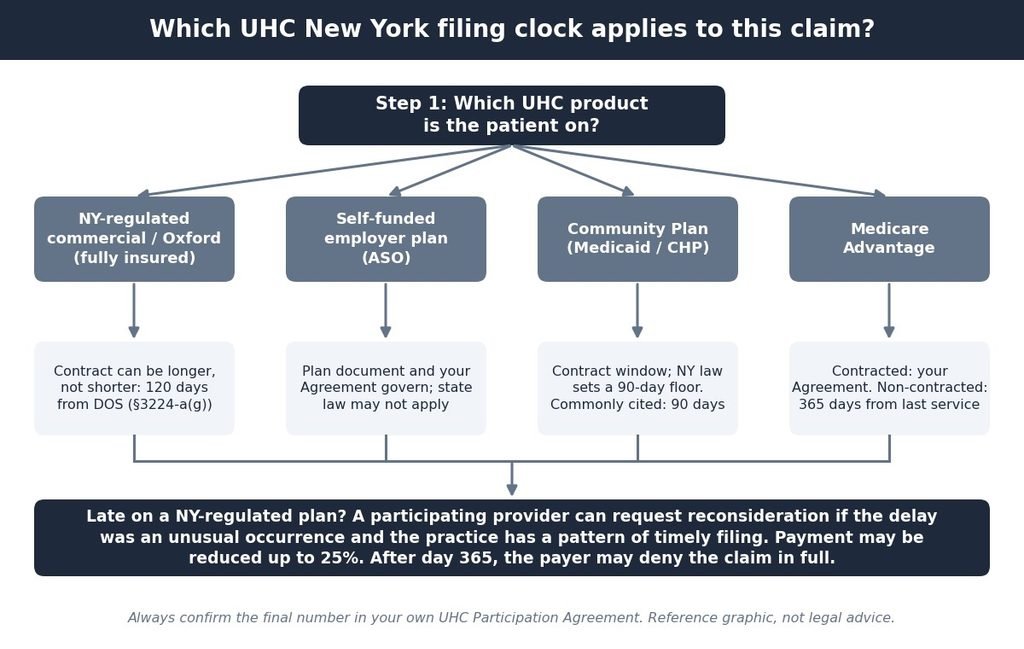
| Fully insured, state-regulated UHC commercial plan | 120 days from date of service by state default; the Participation Agreement may allow longer |
| UHC Community Plan (Medicaid managed care, Child Health Plus) | Set by your agreement; never below 90 days |
| UHC Medicare Advantage, non-contracted provider | 365 days from the through date of service; contracted providers follow the agreement |
| Self-funded employer plan administered by UHC | Plan document and your agreement |
Confirm every row in your own agreement. The sections below give the sources and the exceptions.
Which numbers matter most for UHC claims in New York?
Seven numbers cover most filing decisions for UnitedHealthcare claims in New York. The table separates firm legal limits from practical targets so that each figure can be quoted with the right label. Review each row at the frequency shown, since contracts renew and rules change.
| Metric | Practical target or range | Review frequency | Source type |
| State default filing window, state-regulated plans | 120 days from date of service | At contract renewal and each January | S: NY Insurance Law §3224-a(g) |
| Medicaid managed care contract floor | No shorter than 90 days (contracts often use 90) | At each contract renewal | S: §3224-a(g); contract terms vary |
| Outer limit for reconsidering late claims | 365 days from date of service; full denial allowed after | Monthly late-claim review | S: §3224-a(h) |
| Payment reduction cap on excused late claims | Up to 25% of the timely amount | Per late claim | S: §3224-a(h) |
| UHC commercial reconsideration plus appeal | 12 months from the original EOB or PRA, or as law or the Agreement requires | Quarterly | P: UHC 2026 Administrative Guide |
| In-house submission lag | 5 business days or fewer from the visit | Weekly | G: commonly used billing target |
| CO-29 denial rate | Under 1% of submitted claims, tracked by plan type | Monthly | G: commonly used billing target |
Source labels: S = statute or regulation. P = payer publication from UnitedHealthcare. G = practical target commonly used across billing teams; not a legal or payer requirement. Figures reflect information available in October 2026.
Does UnitedHealthcare publish one filing deadline for New York providers?
No. The 2026 UnitedHealthcare Care Provider Administrative Guide sends providers to their Participation Agreement for timely filing information and publishes no single statewide number. For commercial plans, the guide says to submit clean claims within the period in the Agreement or applicable law. Its capitation and delegation supplement adds that participating providers get at least 90 days.
Billing websites often print a flat 90 days for UHC commercial claims, a 65-day appeal limit and a 180-day corrected-claim window counted from the remittance. Those figures circulate widely, but the guide words the appeal and corrected-claim rules differently. Read the contract and the payer-specific claim submission rules before relying on any chart.
In billing audits, a common pattern is a desk cheat sheet that lists UHC at 90 days for every plan. When that sheet is wrong for one plan type, the error repeats on every claim in that group until a denial report exposes it.
What does New York law add to UnitedHealthcare’s filing rules?
New York adds a statutory floor. New York Insurance Law §3224-a(g) requires providers to submit claims within 120 days after the date of service for the claim to be valid and enforceable against covered insurers and HMOs. The same subsection allows the parties to agree on terms more favorable to the provider. Subsection (g) governs the initial submission window; subsection (h), covered below, governs reconsideration of claims denied only for lateness.
Read together, the text sets 120 days as the baseline and invites longer terms. When a Participation Agreement states 90 days for a state-regulated New York plan, ask UnitedHealthcare how the statute applies before writing off a denial at day 100. For Medicaid managed care, the statute lets contracts use a different period, but never less than 90 days.
Scope matters. The statute reaches insurers and HMOs licensed in New York, which means fully insured policies issued in the state. Self-funded employer plans that UnitedHealthcare only administers generally sit outside state insurance law, so the plan document and your Agreement control. When the eligibility response leaves the funding type unclear, ask Provider Services through the chat in the UnitedHealthcare Provider Portal.
The payer’s clock runs too. The New York Department of Financial Services guidance confirms that electronic claims fall under a 30-day prompt payment rule and fax or paper claims under 45 days. The statute adds interest of at least 12% per year on late payment.
How does the UHC New York timely filing limit differ by plan type?
The limit changes with the plan type, the funding arrangement and the provider’s contract status. The reference table below names the source for each row and says so where only a range exists. Confirm every row against your own agreement before you build alerts around it.
Reference table
| Plan type | Window or rule | Clock starts | Where to confirm |
| UHC commercial, fully insured New York policy | 120-day statutory default; the Agreement may allow longer | Date of service (last date for multi-day services) | Participation Agreement; §3224-a(g) |
| Oxford Health Plans (the guide lists most members in New York outside upstate) | Agreement and Oxford commercial supplement; the state default applies to fully insured plans | Date of service | Oxford commercial supplement, 2026 guide |
| Empire Plan (NYSHIP medical and surgical) | Set in the Empire Plan supplement; a separate Empire Plan network applies in New York unless the Agreement names the Empire Plan | Per supplement | Empire Plan supplement, 2026 guide |
| UHC Community Plan (Medicaid managed care and Child Health Plus) | Your agreement controls and cannot go below 90 days; UHC’s New York Medicaid appendix cites 120 unless law or the agreement says otherwise | Date of service | Your Community Plan agreement and provider manual |
| UHC Medicare Advantage | Contracted: your Agreement. Non-contracted: 365 days | Through date of service | 2026 guide, Medicare Advantage claims sections |
| Self-funded employer plan administered by UHC | Plan document and Agreement; state default may not apply | Date of service | Plan document; Agreement |
Windows come from the sources named in each row. Actual figures vary by contract, plan year and policy situs.
Two related rules sit outside this table. Original Medicare follows a different limit, explained in Medicare’s 12-month rule. When UnitedHealthcare is the secondary payer, the clock may start from the primary payer’s remittance, and §3224-a(g)(2) preserves existing coordination-of-benefits time periods. See the secondary claim timely filing rules before billing a crossover. State rules shape every answer, so compare the UHC California timely filing limit to see how another state changes the same payer’s deadlines.
A naming note avoids a common mix-up. The Empire Plan in the table is the New York State Health Insurance Program plan, which UnitedHealthcare administers for medical and surgical benefits. It has no connection to Empire BlueCross BlueShield, the Blue plan that became Anthem Blue Cross and Blue Shield in 2024. Check the member ID card before searching for a filing limit.
For Community Plan claims, use a simple rule. Read the agreement first, treat 90 days as the lowest permitted figure, and use the 120-day appendix figure only when the agreement incorporates it. Until the agreement is confirmed, set alerts at 90 days so no claim ages past the safer number.
What happens when a New York claim reaches UHC late?
A claim past its window can return as a timely filing denial under CARC 29, “the time limit for filing has expired.” Payers usually treat it as a contractual write-off, and in-network practices generally cannot bill the patient for it. Check your Agreement for the exact wording before adjusting a patient balance.
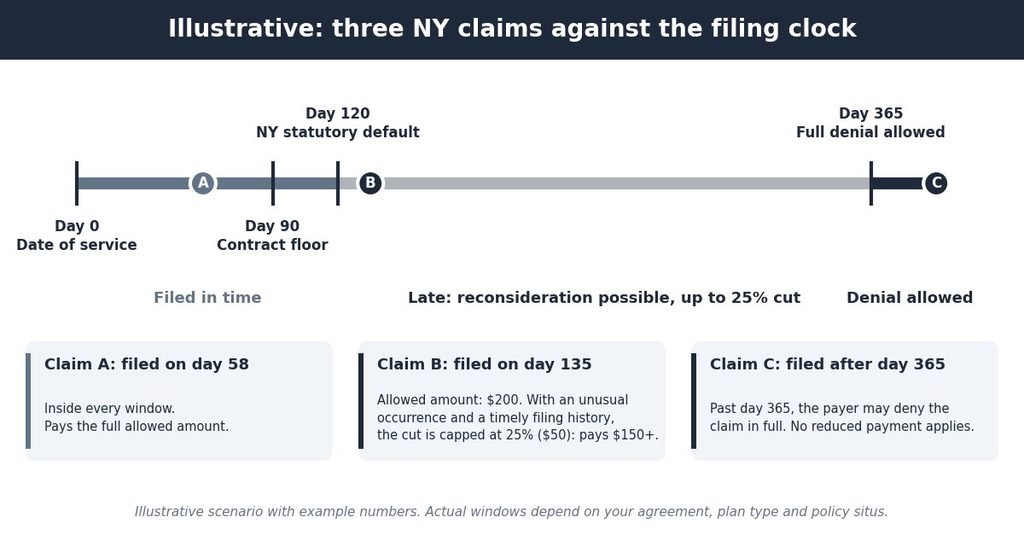
New York gives participating providers a second chance. Under §3224-a(h), the insurer must allow a request for claim reconsideration when a claim was denied only for late submission. It must pay if the provider shows two things: the delay came from an unusual occurrence, and the practice has a pattern of timely filing.
The insurer may reduce that payment by up to 25%. After 365 days from the date of service, it may deny the claim in full. Request reconsideration with documentation when the claim is under 365 days old and your filing history is clean. Calendar the two clocks separately; the guide to timely filing versus appeal filing limits explains why they do not match.
Illustrative scenario (not an actual client record): a participating practice files a claim with a $200 allowed amount on day 135 after a payer system outage. If UnitedHealthcare accepts the explanation, the maximum reduction is $50 and payment is at least $150. A claim filed after day 365 carries no reduction rule and can be denied in full.
In billing audits, a common pattern is a reconsideration request with strong proof of the unusual occurrence but no evidence of a timely-filing pattern. A monthly days-to-submit report by payer supplies that second proof. When late requests pile up faster than staff can document them, denial management services can take over the documentation and follow-up.
What changed in UnitedHealthcare’s 2026 guidance on corrected claims?
UnitedHealthcare revised Chapter 10 of its 2026 guide to update the timely filing requirements for corrected claim submissions. Per UnitedHealthcare’s announcement of the 2026 guide, the guide took effect April 1, 2026 for currently contracted providers and January 1, 2026 for providers contracted on or after that date.
As the guide describes the rule, the filing days in the Agreement also apply to corrections, counted from the date of service. In its own example, a May 1 service date with a 90-day agreement means all information, including corrections, must arrive within 90 days of May 1. That differs from the 180-days-from-remittance window many sites cite.
Do not assume a fresh clock after the first remittance. Send the correction as soon as the error is found when more than half of the original window is gone, and compare corrected claim deadlines by payer when your mix includes other carriers. For commercial plans, the guide gives 12 months from the original EOB or PRA to finish reconsideration and appeal, or as law or the Agreement requires.
How do you prove a claim was filed on time?
Proof of timely filing is an electronic acceptance record, not a submission report. UnitedHealthcare Community Plan reconsideration guidance states that a submission report alone does not prove timely filing for electronic claims and asks for an acceptance report showing receipt within the filing period. Billing teams commonly apply the same standard to commercial claims.
Save the clearinghouse acceptance report with the claim record when a claim goes out in the final 30 days of its window. In billing audits, a common pattern is claims sitting in clearinghouse rejection for weeks while the practice assumes UnitedHealthcare has them. The date that counts is the first accepted transmission, so keep your claim rejection rate low and follow the electronic claims submission tips for clean first passes.
How do you calculate your UHC New York filing deadline and risk?
Four calculations turn the rules above into dates and dollars. Each uses a formula and one numeric walkthrough, and each should be rerun with your own window when your Agreement differs. Repeat all four whenever a contract renews or a new UnitedHealthcare product joins your payer mix.
Deadline date
Deadline = last date of service + filing window in days
For a service on March 3, 2026 under the 120-day state default, the deadline is July 1, 2026. Under a 90-day window, the same claim would be due June 1. Use 120 days for a fully insured New York plan unless your Agreement gives more time, and use a shorter window only where state law does not apply.
Internal alert dates
Alert day = date of service + (window × 50%, 75% and 90%)
For the same claim, alerts fall on day 60 (May 2), day 90 (June 1) and day 108 (June 19). These thresholds are practical targets, not payer rules. Move them earlier when staff turnover or holidays slow your queue, and name an owner for each alert so the claim does not sit in a shared queue.
CO-29 denial rate
CO-29 rate = (CO-29 denials ÷ claims submitted) × 100
Illustrative scenario (not an actual client record): a practice submits 1,200 UnitedHealthcare claims and receives 18 CO-29 denials, a blended rate of 1.5%. The table below breaks the same claims out by payer group, which shows how the average hides two problem areas.
Illustrative
| Payer group (illustrative) | Claims submitted | CO-29 denials | CO-29 rate |
| UHC commercial | 600 | 6 | 1.0% |
| Oxford Health Plans | 200 | 8 | 4.0% |
| UHC Community Plan | 100 | 4 | 4.0% |
| UHC Medicare Advantage | 300 | 0 | 0.0% |
| Blended total | 1,200 | 18 | 1.5% |
Illustrative figures only. Actual denial rates vary by practice, payer mix and specialty.
The blended 1.5% looks acceptable, but two groups run at 4.0%, more than 2.5 times the blended rate. Investigate each group’s window and workflow when any one of them exceeds the 1% target. Do not redesign the whole process around a blended number; fix the groups that drive it.
Maximum reduction exposure
Exposure = excused late claims × allowed amount × 25%
If 40 late claims average a $200 allowed amount and every one wins reconsideration, the largest possible reduction is 40 × $200 × 0.25 = $2,000. Claims denied in full are a separate and larger loss, and no 25% cap limits it. Track the two outcomes on separate lines in your monthly report.
How should you use these numbers correctly?
Compare like with like. Measure each plan type on its own, because a blended rate mixes different windows, funding types and contract terms. A commercial claim under a 120-day default and a non-contracted Medicare Advantage claim under 365 days are not comparable.
Treat one missed benchmark as a signal to investigate, not a verdict. When a single month shows a CO-29 spike in one payer group, pull the claims, check the window used and look for a rejection backlog before changing the whole process.
How long does it take to fix a timely filing problem?
Process fixes such as alerts and daily rejection work often show up in CO-29 trends within 30 to 60 days. Clearing a backlog of aged claims and resolving contract questions commonly takes 90 to 180 days. These are general planning ranges, not guarantees, and they depend on claim volume and staffing.
Start with the claims closest to day 365, because those are the ones that still qualify for reconsideration. Sort the list by days remaining and assign each claim an owner. When the aged list outgrows your team, accounts receivable management support can work the oldest balances first.
What is the step-by-step process for tracking UHC New York deadlines?
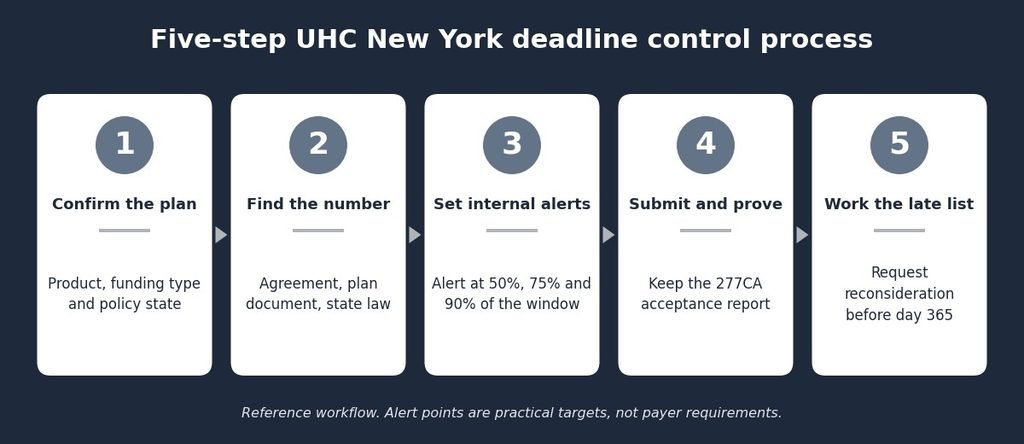
A five-step routine keeps every UnitedHealthcare claim tied to a verified window. The steps below match the workflow graphic and build on how to track timely filing deadlines across payers. Assign one owner per step when the team is small, so nothing depends on memory.
- Confirm the plan. Check product, funding type and policy state at every eligibility check. Escalate to Provider Services when the funding type is unclear.
- Find the number. Record the window from your Agreement, the plan supplement and state law, and note the source. Use the longer provider-friendly period when two documents conflict, then confirm with UnitedHealthcare.
- Set internal alerts. Calculate alerts at 50%, 75% and 90% of each window. Add a manager review at 75% when a claim is still unpaid or rejected.
- Submit and prove. Send the claim electronically and file the acceptance report. Resubmit the same day when a rejection appears.
- Work the late list. Request reconsideration before day 365 when the claim was delayed by an unusual occurrence and your filing history is documented.
Which mistakes cause most UHC New York timely filing denials?
Five mistakes recur in billing audits, and each one has a direct fix. Apply the fix when the condition in the item matches your workflow, and review the list each time a contract renews or a new UnitedHealthcare product joins your payer mix.
- Using 90 days for every plan. Map each plan type to its own source instead, and rebuild the chart when a contract renews.
- Counting from the remittance date. Count from the date of service unless your Agreement or the plan supplement says otherwise.
- Treating a clearinghouse submission as filed. Wait for the acceptance report, and work rejections within two business days.
- Ignoring funding type. Check for self-funded status when a state-law argument will drive an appeal.
- Skipping the filing-pattern proof. Keep a days-to-submit report by payer so a reconsideration request can show a timely history.
Quick summary
- The UHC New York timely filing limit depends on the plan, the funding type and your Participation Agreement.
- New York sets a 120-day default for state-regulated plans, a 90-day floor for Medicaid managed care contracts and a 365-day outer limit for late-claim reconsideration.
- Late claims may be paid with up to a 25% reduction when the delay was an unusual occurrence and your filing history is timely.
- UnitedHealthcare’s 2026 guide ties corrected claims to the same window, counted from the date of service.
- A practical target is submission within 5 business days and a CO-29 rate under 1%, tracked by plan type.
- Keep a clearinghouse acceptance report as proof of timely filing.
Self-assessment: is your UHC New York filing process under control?
Answer yes or no to each question below, and count a partial answer as no. Count your yes answers and use the scoring guide that follows the list to see where your process stands. Repeat the exercise each quarter, because plan mixes and contracts change.
- Can you list every UHC product your practice bills: commercial, Oxford, Empire Plan, Community Plan and Medicare Advantage?
- For each product, do you know whether the window comes from your Participation Agreement, a plan supplement or state law?
- Is funding type (fully insured or self-funded) flagged on the patient account at eligibility?
- Do most claims leave your office within 5 business days of the visit?
- Is your CO-29 rate under 1% of submitted claims, measured by plan type?
- Do alerts fire at 50%, 75% and 90% of each verified window?
- Do you save a clearinghouse acceptance report for every claim?
- Can you produce a days-to-submit report by payer to support a reconsideration request?
- Do you count corrected claims from the original date of service?
- Have you questioned any denial that applied a window under 120 days to a fully insured New York plan?
| Yes answers | What it suggests |
| 8 to 10 | Strong control. Review windows at each contract renewal and each January. |
| 5 to 7 | Needs attention. Fix the unchecked items starting with proof, alerts and rejection work. |
| 0 to 4 | At risk. Map every plan window first, then consider outside support. |
When should a practice consider professional billing support?
Outside help makes sense when the in-house approach has reached its limits and denials keep returning despite steady effort. The signals below are common in practice, and any three of them together usually justify a closer look at outside support, even if a capable biller is already on staff:
- A CO-29 rate above 1% in any payer group for two months in a row.
- Claims regularly leaving the office after day 60 of a 120-day window.
- No one owns rejection work, and acceptance reports are not saved.
- Staff turnover has left UnitedHealthcare plan types unmapped.
- Commercial, Oxford, Community Plan and Medicare Advantage claims all run on one flat deadline.
When choosing a billing partner, look for a US-based team, plan-level deadline mapping, written escalation steps for late claims, and reporting that shows results by payer rather than blended averages. Ask how the team proves timely filing and who handles reconsideration requests.
EON MED SOLUTIONS is one example. The company provides end-to-end medical billing, coding, credentialing, denial management and compliance support through a US-based team with transparent reporting. Review the medical billing, credentialing and RCM services to see how that process works. Results vary by practice.
Expert Opinion
The UHC New York timely filing limit is a layered answer: your Participation Agreement, the plan type and New York’s 120-day default all play a part. A practice that maps each plan to its own window, saves acceptance reports and works rejections quickly rarely needs the reconsideration path.
Some numbers here are firm. The 120-day default, the 90-day Medicaid managed care floor, the 365-day outer limit, the 25% reduction cap and the 30- and 45-day payment rules come from New York statute. UnitedHealthcare’s guide supplies the Agreement-first rule, the date-of-service count for corrections and the 12-month reconsideration and appeal window. The 5-business-day target, the 1% CO-29 target, the 50/75/90 alerts, the planning timeframes and every dollar figure are practical or illustrative.
The natural next question is which of your own UnitedHealthcare contracts sets a shorter window than the statute allows. A plan-by-plan review of your agreements answers it, and the EON MED SOLUTIONS billing and RCM services team can help you run that review.
Frequently asked questions
What is the timely filing limit for UHC in New York?
It depends on the plan. New York Insurance Law §3224-a(g) sets a 120-day default from the date of service for state-regulated plans, and a Participation Agreement may allow longer. Medicaid managed care contracts cannot go below 90 days, and self-funded plans follow their plan documents. Always confirm the number in your own agreement.
Can UHC deny a New York claim filed after 120 days?
Not automatically for participating providers. Under §3224-a(h), a claim denied only for lateness can be reconsidered when an unusual occurrence caused the delay and the practice has a timely filing pattern. The insurer may cut payment by up to 25%, and may deny in full after 365 days from the date of service.
What is a good timely filing denial rate?
A commonly used practical target is a CO-29 rate under 1% of submitted claims, tracked by plan type rather than blended. This is an industry convention, not a payer or legal standard. When any single payer group exceeds 1%, review its window, workflow and clearinghouse rejection backlog.
What is a good submission lag for UHC claims?
Many billing teams aim to send claims within 5 business days of the visit. That is a practical target, not a UnitedHealthcare rule. Faster submission leaves room to fix rejections before the window closes, especially when the Agreement window is short or the claim needs a correction.
What is the timely filing limit for UHC Medicare Advantage in New York?
Contracted providers follow their Participation Agreement. For non-contracted providers, UnitedHealthcare’s 2026 guide states that Medicare Advantage plans allow 365 days from the through date of service. Appeal clocks for non-contracted providers are shorter, including 60 days for a payment reconsideration request, so check the denial notice.
How long do you have to appeal a UHC timely filing denial?
For commercial plans, UnitedHealthcare’s 2026 guide gives 12 months from the original EOB or PRA to complete reconsideration and appeal, or as law or the Agreement requires. Many billing sites cite 65 days instead, so confirm against your contract and read the denial letter for the stated deadline.
Sources and methodology
Research was completed on October 6, 2026. The list below groups each source by type. Results vary by practice, and figures reflect information available at the time of research. Where sources conflict, the article gives the range and names the sources.
(a) Published standards and definitions from named bodies
- New York Insurance Law §3224-a (New York State Senate, current revision).
- New York State Department of Financial Services, FAQ: Network Adequacy Requirements for Health Insurers (claim submission and prompt payment answers).
- UnitedHealthcare 2026 Care Provider Administrative Guide for Commercial, Individual Exchange and Medicare Advantage, including the Oxford commercial and Empire Plan supplements.
- UnitedHealthcare provider news, 2026 Administrative Guide announcement (January 1, 2026).
- UnitedHealthcare Medicare Advantage non-contracted provider dispute and appeal rights notice; UnitedHealthcare Community Plan claim reconsideration quick reference guide.
- UnitedHealthcare New York Medicaid and Child Health Plus regulatory appendix (cites §3224-a).
(b) Named benchmarking data providers
- None used. This article does not rely on proprietary benchmarking data.
(c) Practical or illustrative targets from general industry sources
- The 5-business-day submission target, the 1% CO-29 target, the 50/75/90 alert schedule and the improvement timeframes are commonly used practical targets, not mandates.
- Billing reference sites (A3 Medical Billing, MedSole RCM, Muni Health) report 90-day, 65-day and 180-day figures for UHC. These are commonly cited across industry sources, are not confirmed UnitedHealthcare policy and conflict with the guide in places.
- All dollar amounts, claim counts and payer-group rates are illustrative.
(d) Survey or study data
- None used.


