

Medicaid Texas Timely Filing Limit: 95-Day Rule Guide
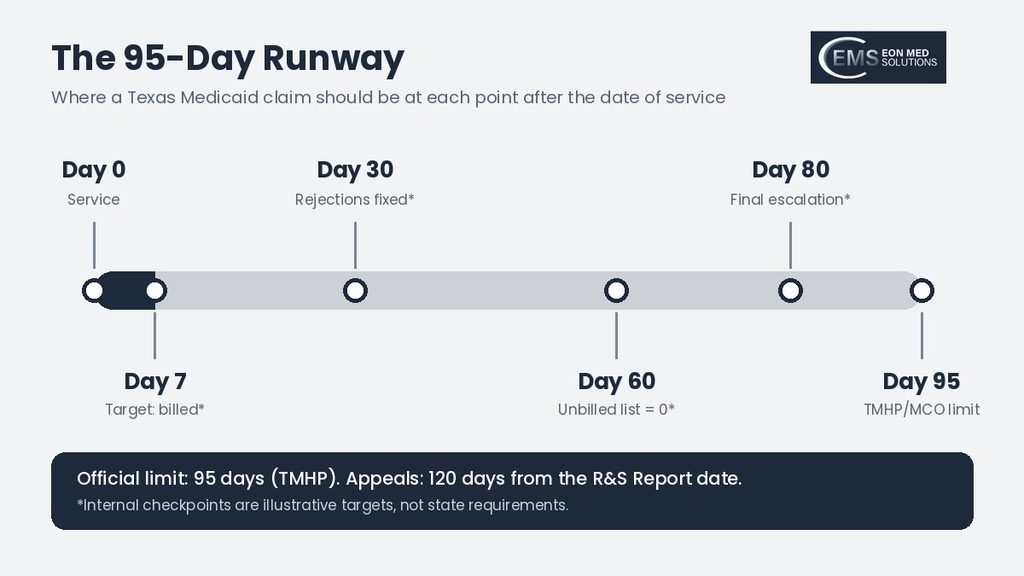
The Medicaid Texas timely filing limit is 95 days from the date of service for most claims submitted to the Texas Medicaid & Healthcare Partnership (TMHP), or 95 days from discharge for inpatient hospital claims. Medicaid managed care organizations must allow at least 95 days, and appeals of denied TMHP claims are due within 120 days of the Remittance and Status Report date. Texas does not pay late claims at a reduced rate; they are simply not payable.
Ninety-five days sounds like plenty of time until a claim bounces, sits in a rejection queue, and comes back on day 90. Texas Medicaid runs one of the shortest filing windows in the country, and it has almost no grace built in. This guide explains how the 95-day rule works for TMHP fee-for-service and Medicaid managed care claims. It covers the special start dates, the 120-day appeal window, worked calculations, and illustrative internal targets. Near the end, a ten-question readiness quiz helps you gauge how well your workflow protects Texas Medicaid revenue.
Texas Medicaid Deadlines: One-Page Reference
Set every claim’s due date from this table. Official rules come first; internal goals are labeled illustrative.
| Metric / Deadline | Practical Target or Rule | Review Frequency | Primary Source |
| Standard claim filing (TMHP) | 95 days from date of service | Weekly | Published standard: TMHP Provider Procedures Manual |
| Inpatient hospital claims | 95 days from discharge or last DOS on the claim | Weekly | Published standard: TMHP Provider Procedures Manual |
| Retroactive eligibility | 95 days from the eligibility “add date” and within 365 days of DOS | Per claim | Published standard: 1 TAC §354.1003 |
| Medicare crossover | 95 days from Medicare disposition | Per claim | Published standard: 1 TAC §354.1003; TMHP |
| Other insurance | 95 days from other insurance disposition; 365 days from DOS overall | Per claim | Published standard: TMHP quick reference guide |
| Out-of-state providers | 365 days from DOS | Per claim | Published standard: TMHP Provider Procedures Manual |
| Appeals / corrections (TMHP) | 120 days from R&S Report date | Per denial | Published standard: TMHP Provider Procedures Manual |
| Claim finalization | All claims finalized within 24 months of DOS | Quarterly | Published standard: 1 TAC §354.1003 |
| MCO filing window | At least 95 days; per MCO manual and contract | Per plan | Published standard: HHSC managed care rules, as reflected in MCO manuals |
| MCO clean-claim adjudication | 30 days from receipt | Monthly | Published standard: HHSC managed care contract terms, as published by MCOs |
| Federal Medicaid ceiling | 12 months from DOS | Reference | Published standard: 42 CFR §447.45(d)(1) |
| Days to bill (internal) | 3–7 days from DOS | Weekly | Illustrative target |
| Claims received by day 60 (internal) | 99%+ | Monthly | Illustrative target |
Source labels: “Published standard” means the rule appears in TMHP’s provider manuals, Texas Administrative Code, HHSC managed care requirements, or federal regulation. “Illustrative target” means a practical internal goal from general industry practice; no agency mandates it. Manuals update often, so confirm the current version.
How the Medicaid Texas Timely Filing Limit Is Calculated?
Ninety-five days, counted by receipt
According to the TMHP quick reference guide, claims without other insurance must be received within 95 days of the date of service. Receipt is what counts, not the date your team created or mailed the claim. For inpatient stays, the clock runs from discharge instead. Texas also treats late claims harshly: TMHP says it does not provide coverage for late claims at all. That is a sharp contrast with states that pay late claims at a reduced rate. In Texas, day 96 usually means zero.
Weekends, holidays, and electronic rejections
TMHP extends a 95-day or 120-day deadline that lands on a weekend or holiday to the next business day. Do not plan around that cushion, though. A more common trap is the electronic rejection. A claim rejected on the 277CA response file was never accepted, so the 95-day clock kept running. TMHP allows an electronic resubmission within 95 days of service. After that, a paper appeal with the rejection report must arrive within 120 days of the rejection. Work rejection reports daily, not weekly.
| Worked Example 1 — Filing and Appeal Dates Formula: Filing deadline = Date of service + 95 days; Appeal deadline = R&S Report date + 120 days Scenario: Office visit on March 2, 2026. • Claim must be received by June 5, 2026. • If denied on an R&S Report dated July 10, 2026, day 120 falls on Saturday, November 7, so the appeal is due Monday, November 9, 2026. |
How Texas fits inside the federal ceiling?
Federal regulation 42 CFR §447.45 requires states to demand claims within 12 months of service. Texas chose a much shorter window for most claims. However, the 365-day federal limit still matters in special cases, such as retroactive eligibility and other insurance. Texas rules also require all claims to be finalized within 24 months of service. So a claim can technically stay alive through appeals, but only if each step met its own deadline.
When the 95-Day Clock Starts Somewhere Else?
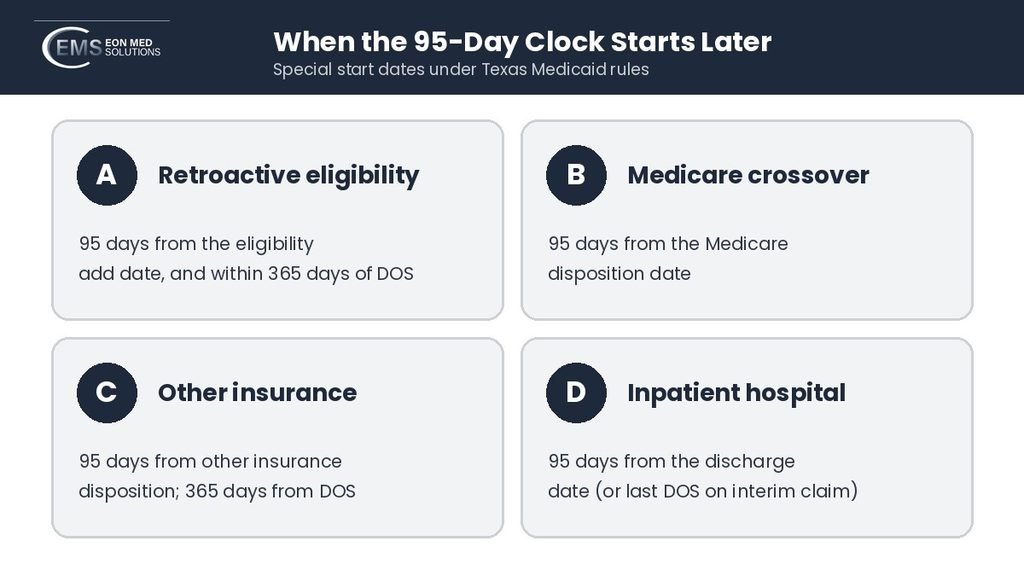
Several situations move the starting line. Each follows 1 TAC §354.1003 and TMHP’s manuals, and each needs documentation proving the later start date.
Retroactive eligibility and the “add date”
When a patient’s Medicaid eligibility is established later, the claim must be received within 95 days of the add date. That is the date eligibility appears in the state’s file. The claim must also arrive within 365 days of the date of service, whichever comes first. Patients without a Medicaid number yet create a special case. TMHP notes that filing electronically within 365 days produces a rejection report, which can later prove the federal deadline was met. Keep every eligibility check you run.
| Worked Example 2 — Retroactive Eligibility, Two Outcomes Formula: Deadline = the earlier of (Add date + 95 days) or (Date of service + 365 days) Case A: Service January 10, 2026; add date August 3, 2026. Add date + 95 = November 6, 2026, which is earlier than January 10, 2027, so November 6 controls. Case B: Same service date; add date December 20, 2026. Add date + 95 = March 25, 2027, but the 365-day limit of January 10, 2027 controls. |
Medicare crossovers and other insurance
Medicaid is the payer of last resort. For Medicare crossover claims, TMHP must receive the claim within 95 days of Medicare’s disposition. For other insurance, the claim is due within 95 days of that payer’s disposition, and within 365 days of the date of service overall. TMHP’s quick reference guide also lists 110 days from submission to the other insurer when no response arrives. Always record the other payer’s disposition date, because an appeal without it will be denied.
Provider enrollment dates
New or re-enrolling providers face another start date. Outpatient hospital claims, for example, may run 95 days from the date the Texas Provider Identifier was issued, if later. Delayed enrollment is one reason credentialing and billing should talk to each other. If your enrollment paperwork stalls, organized credentialing support prevents a backlog of claims aging before they can even be filed.
Managed Care Plans, Appeals, and the 120-Day Window
Deadlines for STAR, STAR+PLUS, and other MCO programs
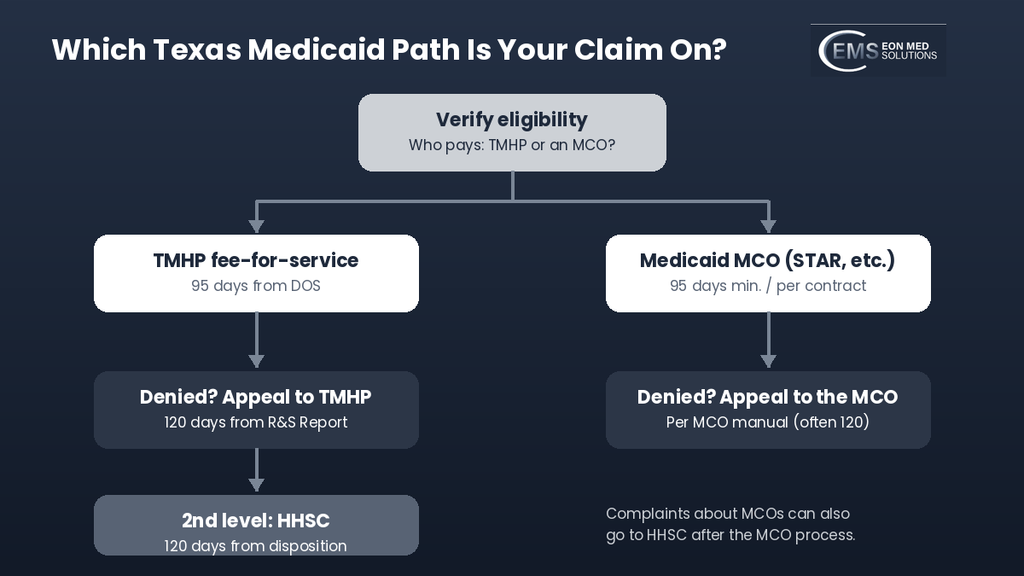
Most Texas Medicaid members belong to managed care programs such as STAR, STAR+PLUS, and STAR Kids. Claims for those members go to the managed care organization (MCO), not TMHP. Published MCO manuals show the same 95-day standard from service or discharge. Some exceptions exist, such as 365 days for certain nursing facility claims. Under HHSC contract terms reflected in MCO manuals, clean claims must be adjudicated within 30 days of receipt. Always check the member’s plan first, because sending a claim to the wrong payer burns days.
The 120-day appeal and correction window
For TMHP, appeals of denied claims and adjustment requests must arrive within 120 days of the Remittance and Status (R&S) Report date. That is stated directly in the TMHP appeals manual. If TMHP denies the appeal again, a second-level administrative appeal goes to HHSC, also within 120 days. MCOs publish their own appeal windows, often 120 days from the remittance date. Track every denial against its window, or let structured denial management support keep them on calendar.
Exceptions to the 95-day deadline
HHSC reviews formal exception requests for limited reasons, such as system errors that were not the provider’s fault. These are narrow and document-heavy. Treat them as a rare rescue, never as part of the plan.
Tracking Filing Performance With Internal Numbers
The 95-day rule tells you when money is gone. Internal measures warn you weeks earlier. The figures below are illustrative targets from general industry practice, not published Texas Medicaid benchmarks. Actual figures vary by specialty, payer mix, and staffing, so verify against your own data where precision matters. They fit alongside the medical billing KPIs you already watch.
| Metric (Illustrative) | Formula | Illustrative Target |
| Days to bill | Total days from service to submission ÷ claims submitted | 3–7 days |
| Claims received by day 60 | Claims accepted by day 60 ÷ total claims | 99%+ |
| Rejection turnaround | Average days from rejection to corrected resubmission | 2 days or less |
| Timely filing denials | Claims denied for late filing ÷ total claims | 0% |
| Appeals filed by day 90 | Appeals sent within 90 days of R&S date ÷ appealed denials | 100% |
Illustrative: compiled from general industry practice, not a named benchmark. Actual figures vary.
| Worked Example 3 — On-Time Rate and Days to Bill On-time rate formula: Claims accepted by day 60 ÷ total claims × 100. Scenario: 588 of 600 claims = 98%, just below the illustrative 99% target. Days to bill formula: Total days from service to submission ÷ claims. Scenario: 5,100 days ÷ 600 claims = 8.5 days, above the illustrative range. |
| Worked Example 4 — The Cost of Missing Day 95 Formula: Revenue lost = Late claims × Average expected payment Scenario: 25 claims averaging $95 miss the deadline. 25 × $95 = $2,375 lost, with no reduced-rate recovery available in Texas. |
How a blended rate can hide one struggling MCO?
Illustrative scenario (not an actual client record): a pediatric group bills TMHP and two MCOs. Its blended on-time rate is 96%, which looks close to target. Split by payer, TMHP and MCO A sit near 99%, while MCO B sits at 88%. The cause is a portal that requires a separate prior-authorization match, so claims reject silently. Without the split, nobody notices until timely filing denials arrive. Aging claims like these deserve dedicated accounts receivable management attention.
| Payer (Illustrative) | Claims | On Time | Rate |
| TMHP fee-for-service | 200 | 198 | 99.0% |
| MCO A | 250 | 247 | 98.8% |
| MCO B | 150 | 132 | 88.0% |
| Blended | 600 | 577 | 96.2% |
Using Benchmarks Without Misreading Them
The 95-day and 120-day windows are fixed rules, so they apply to every provider equally. Internal targets need more care, because they only work when compared like-for-like. Compare the same payer type, a similar service mix, a comparable practice size, and the same reporting period. A hospital-based clinic with frequent retroactive eligibility will look different from a small family practice. One missed internal target is a signal to investigate, not a verdict on your staff. Find the root cause before changing the whole process.
What to Expect After Fixing Your Workflow?
These are general planning ranges, not guarantees for any specific practice. Backlog size, payer mix, and staffing will shift them.
| Fix | Partial Results | Fuller Results |
| Eligibility and plan check at every visit | 2–4 weeks | 1–2 months |
| Daily rejection-report review | 1–2 weeks | 1 month |
| Due dates by payer and start-date type | 2–4 weeks | 1–2 months |
| Clearing claims already past day 60 | 1–3 weeks | 1–2 months |
| Appeal tracking against the 120-day window | 1 month | 2–3 months |
At-a-Glance Recap
- TMHP claims must be received within 95 days of service, or discharge for inpatient care (published standard).
- Retroactive eligibility, Medicare, and other insurance move the start date, within a 365-day outer limit.
- Appeals to TMHP are due within 120 days of the R&S Report date; weekend deadlines roll to the next business day.
- MCOs follow a 95-day standard in published manuals; always confirm each plan’s rules.
- Targets like 3–7 days to bill and 99%+ of claims accepted by day 60 are illustrative goals, not mandates.
Texas Medicaid Filing Readiness Quiz: 10 Questions
Answer yes or no, then count your yes answers.
- Do you check Medicaid eligibility and MCO assignment at every visit?
- Does each claim carry a due date based on its payer and start-date type?
- Is your average days to bill at or under seven days?
- Were 99% or more of claims accepted by day 60 last month?
- Do you review electronic rejection reports every business day?
- Did you have zero timely filing denials last quarter?
- Do you record the add date for every retroactive eligibility case?
- Do you log Medicare and other insurance disposition dates on each claim?
- Are appeals sent within 90 days of the R&S Report date?
- Do you review on-time rates separately for TMHP and each MCO?
9–10 yes: Strong control; keep monthly reviews. 6–8 yes: Clear gaps; fix the “no” items this quarter. 0–5 yes: Revenue is likely being lost now; audit every claim older than 60 days this week.
Knowing When to Get Outside Billing Help?
Plenty of practices meet the Medicaid Texas timely filing limit comfortably in-house. Others find the 95-day window too tight for their staffing. Watch for these signals:
- Timely filing denials appear on your R&S Reports more than once a quarter.
- Rejected claims wait more than a few days before anyone corrects them.
- Staff are unsure which MCO a patient belongs to until a claim denies.
- Retroactive eligibility add dates are not recorded anywhere.
- Appeals regularly go out in the last two weeks of the 120-day window.
Strong outside support should offer daily rejection handling, payer-specific due dates, and eligibility checks built into scheduling. Look for transparent reporting you can review, HIPAA-compliant processes, and one named contact. EON MED SOLUTIONS is one example of that structure. Its US-based team provides end-to-end medical billing, coding, credentialing, denial management, and compliance support, with a dedicated agent per provider and no hidden fees. Results vary by practice and situation. You can see the complete service list here.
Expert Opinion
The Medicaid Texas timely filing limit leaves little room for error. Ninety-five days from service is the standard for TMHP and published MCO manuals, and late claims are not paid at a discount; they are not paid. Special start dates help in real situations, but only with proof. The 120-day appeal window is the second line of defense.
To be clear about sources: the 95-day, 120-day, 365-day, and 24-month figures are published standards from TMHP manuals and the Texas Administrative Code. The 12-month ceiling comes from federal regulation, and the 30-day MCO adjudication figure from HHSC contract terms as published by MCOs. Days to bill, the day-60 target, and the improvement timelines are illustrative goals to adapt to your data.
Frequently Asked Questions
What is the Medicaid Texas timely filing limit?
Most claims must be received by TMHP within 95 days of the date of service, or 95 days from discharge for inpatient hospital claims. Special start dates apply for retroactive eligibility, Medicare, and other insurance.
Does Texas Medicaid pay late claims at a reduced rate?
No. TMHP states that claims received after the filing deadlines are not payable. Unlike some states, Texas has no reduced-payment tier for late claims.
What is a good days-to-bill target for Texas Medicaid?
Many practices aim for three to seven days from service. This is an illustrative target, not a TMHP rule, but it leaves time to fix rejections.
What is a good on-time rate for Texas Medicaid claims?
A practical goal is 99% or more of claims accepted by day 60. It is an illustrative target that builds a buffer before day 95.
How long do I have to appeal a denied Texas Medicaid claim?
Appeals to TMHP must be received within 120 days of the R&S Report date. Second-level appeals to HHSC also have a 120-day window.
What is the timely filing limit for Texas Medicaid MCOs?
Published MCO manuals show 95 days from service or discharge for most claims. Confirm each plan’s manual, since some claim types, like certain nursing facility claims, differ.
How does retroactive eligibility change the deadline?
The claim is due within 95 days of the eligibility add date. It must also arrive within 365 days of the date of service, whichever comes first.
What is a good way to avoid Texas Medicaid rejections?
Verify eligibility and plan assignment at each visit, and review rejection reports daily. Correct and resubmit rejected claims immediately, because the 95-day clock keeps running.
Is the Texas deadline different for out-of-state providers?
Yes. TMHP must receive claims from out-of-state providers within 365 days of the date of service. In-state providers follow the 95-day rule.
How This Guide Was Researched?
(a) Published standards: TMHP Texas Medicaid Provider Procedures Manual (claims filing and appeals sections) and quick reference guide; 1 Texas Administrative Code §354.1003; HHSC managed care requirements as reflected in published MCO manuals; and 42 CFR §447.45. (b) Named benchmarking data providers: none used. (c) Practical or illustrative targets: days to bill, day-60 acceptance rate, rejection turnaround, appeal timing, and improvement timeframes, compiled from general industry practice. (d) Survey data: none used. Actual results vary by practice and situation, and all figures reflect information available at the time of research in September 2026.
This article is educational and is not legal or compliance advice. Confirm current rules in TMHP’s manuals and each MCO’s provider manual.


2 Comments