

Medicare Timely Filing Limit: The 12-Month Rule Explained
The Medicare timely filing limit is 12 months, or one calendar year, from the date of service. Under 42 CFR 424.44, your Medicare Administrative Contractor (MAC) must receive the claim inside that window. Four narrow exceptions can extend it; otherwise, a late claim is denied.
A missed Medicare deadline is one of the few billing errors that cannot be fixed later. The service was valid and the patient was covered, yet the payment is gone. This guide explains the Medicare timely filing limit, how the clock is counted, and which exceptions apply. You will also find worked date examples, a tracking routine, and a short self-check near the end. Every figure is labeled by source, so you know what is fixed. It is written for practice owners and billing managers who want clear rules, not legal jargon.
Medicare Timely Filing Limit at a Glance
| Metric | Practical Target/Range | Review Frequency | Primary Source |
| Original Medicare filing window | 12 months from date of service | Every claim | ¹ Published federal standard |
| Extension after an exception | Through the last day of the 6th calendar month after the trigger | Per case | ¹ Published federal standard |
| Administrative-error request cutoff | No extension if requested over 4 years after service | Per case | ¹ Published federal standard |
| Medicare Advantage contracted window | Set by contract; commonly reported 90 days to 12 months | At contract signing | ² Commonly reported range |
| Submission target after service | Within about 7 days | Weekly | ³ Illustrative target |
| Escalation alert for unpaid claims | Day 180 from service | Weekly | ³ Illustrative target |
¹ Published federal standard: 42 CFR 424.44 and the CMS Claims Processing Manual define these figures. ² Commonly reported range: industry sources differ, so verify your own contract. ³ Illustrative target: a practical planning figure, not a Medicare requirement.
How the Clock Starts, Runs, and Stops?
Which Date Starts the Count
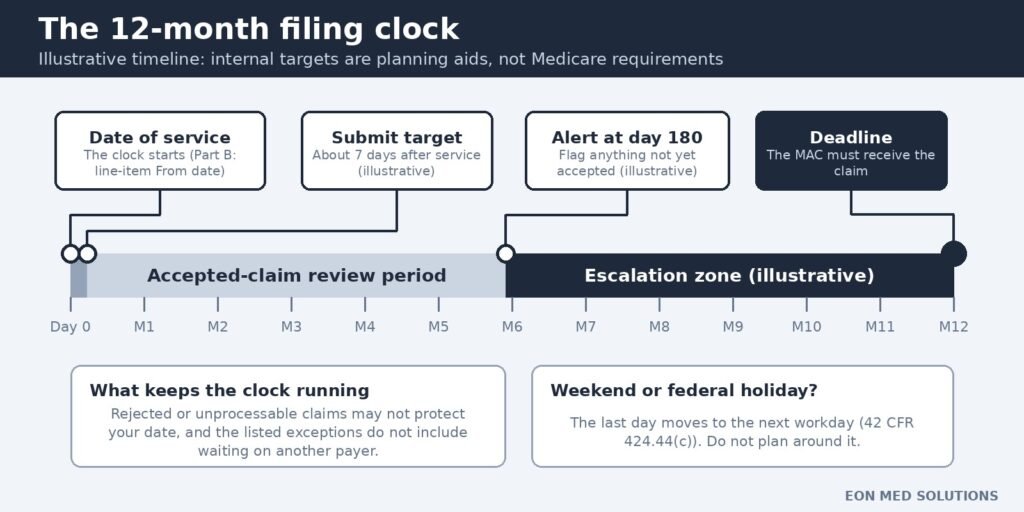
For physician and supplier claims, the count starts on the line-item “From” date. Institutional claims with span dates use the “Through” date instead, according to the CMS Claims Processing Manual. A service on February 29 must be filed by February 28 of the following year, per Noridian. What matters is the claim receipt date. Medicare denies a claim when that date falls beyond 12 months. A claim your clearinghouse sent, but the contractor rejected as unprocessable, may not protect your date. Always confirm acceptance instead of assuming it.
Weekends, Holidays, and a Worked Deadline
Worked example 1: deadline date
Formula: Deadline = date of service + 1 calendar year, moved to the next workday if it lands on a weekend or federal holiday.
A service dated October 2, 2026 reaches its one-year mark on October 2, 2027, which is a Saturday. Under 42 CFR 424.44(c), the deadline moves to Monday, October 4, 2027. Treat that extra weekend as a safety net, not a schedule. Build your process around the original date, and file long before it arrives.
Exceptions to the Medicare Timely Filing Limit
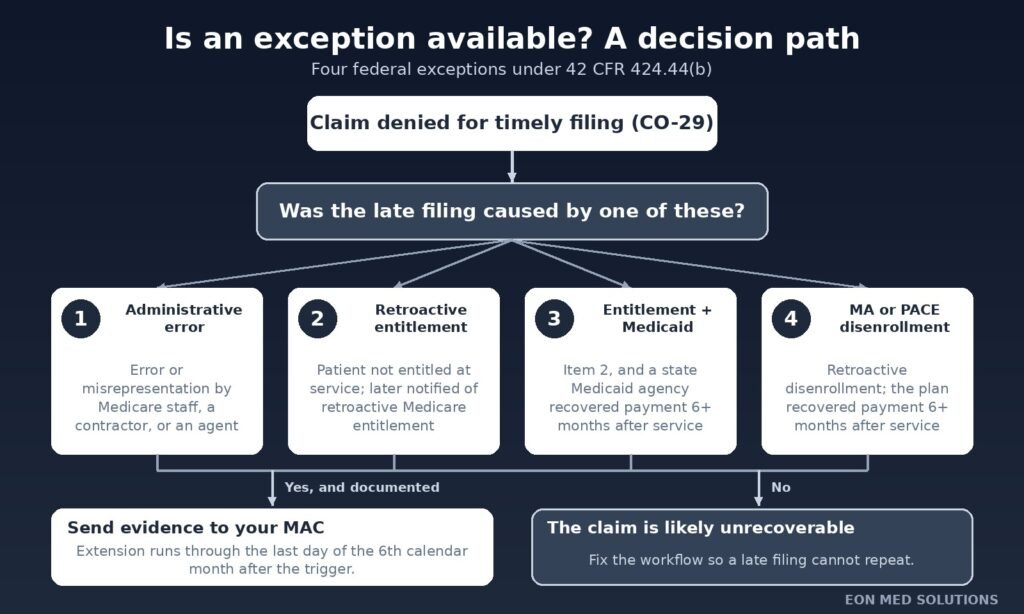
Federal rules allow only four exceptions, and each one requires documentation. Each is defined in 42 CFR 424.44(b), and your MAC decides whether the conditions are met. None covers being busy, short-staffed, or waiting on another payer. If your aging report shows claims nearing nine months without a payer response, act immediately. Delay only shrinks the options you still have, so review aging reports often and early. Practices that want a second set of eyes on aging can review A/R management support.
| Exception | What must be true | Extension: last day of the… |
| Administrative error | Error or misrepresentation by Medicare staff, a contractor, or an agent | Sixth month after notice of correction; none if requested over 4 years after service |
| Retroactive entitlement | Patient not entitled at service, then notified of retroactive entitlement | Sixth month after notification |
| Entitlement plus Medicaid recovery | Same as above, and Medicaid recouped payment 6+ months after service | Sixth month after the recovery |
| MA or PACE disenrollment | Retroactive disenrollment, and the plan recouped payment 6+ months after service | Sixth month after the plan’s recovery |
Worked example 2: extended deadline
Formula: Extended deadline = last day of the sixth calendar month after the month of the trigger.
A patient receives notice of retroactive Medicare entitlement on February 12, 2027. Count six calendar months after February: March, April, May, June, July, and August. If the exception is approved, the claim must reach the MAC by August 31, 2027. Keep the entitlement letter with the claim, because the contractor decides based on your documentation.
What Happens When a Claim Misses the Timely Filing Limit?
Medicare treats a late-filing denial differently from most other denials. The CMS manual states that it is not an “initial determination,” so it cannot be formally appealed. A CO-29 denial is the usual result on your remittance. Your contractor may informally review the decision if you ask. If the practice caused the delay, it generally may not bill the patient beyond deductible and coinsurance. An adjustment cannot add new items after the initial period closes. Corrections to a timely claim follow separate reopening rules.
Medicare Advantage and Secondary Claims Run on Other Clocks
The 12-month rule governs Original Medicare Part A and Part B claims. Medicare Advantage plans are private, and contracted providers usually follow the window written in their participation agreement. Industry sources disagree on whether a federal floor applies. Some report contract windows as short as 90 days. Treat your contract as the controlling document, and confirm doubts with the plan. For Medicare secondary claims, the exceptions do not include waiting on the primary payer. Track the original date of service.
Building a Deadline Tracker That Catches Problems Early
Most late claims do not come from ignorance of the Medicare timely filing limit. They come from encounters that never became claims, or rejections nobody worked. A short, consistent routine closes both gaps. It costs far less than a lost claim. Assign each step to a named person, so nothing falls between roles. Faster submission also lifts clean claim rates. These electronic claims submission tips show how to tighten the front end. When a filing denial does arrive, structured denial management helps you check exceptions and fix the root cause.
- Weekly: reconcile the schedule against submitted claims to find unbilled visits.
- Weekly: work rejected or unaccepted claims within two business days (illustrative target).
- Monthly: sort open claims by age, with an alert at day 180 (illustrative target).
- Always: save submission and acceptance proof for every claim.
Worked example 3: on-time rate by claims versus dollars
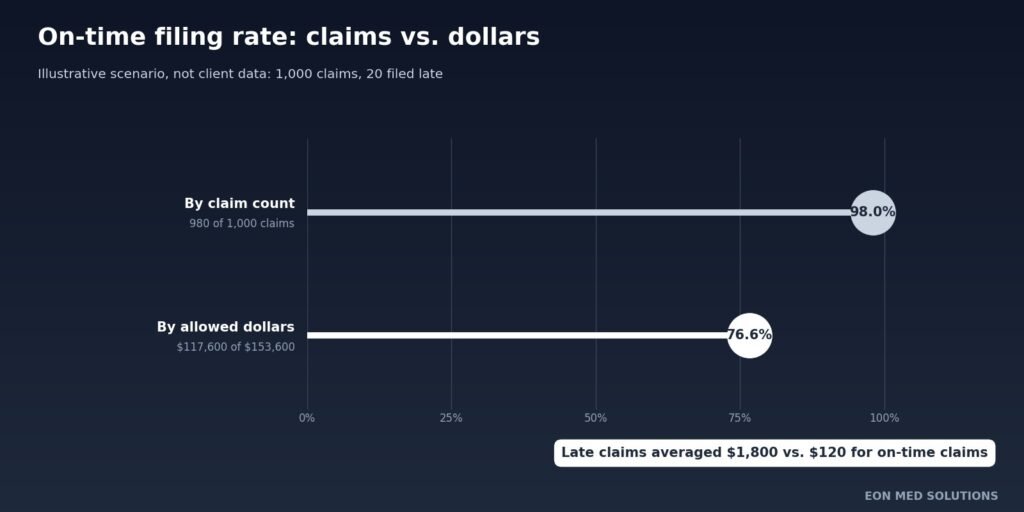
Formula: Dollar-weighted on-time rate = allowed dollars on claims filed on time ÷ total allowed dollars × 100.
Illustrative scenario (not an actual client record): a practice files 1,000 claims in a quarter, and 980 are filed on time. That is 98.0% by count, which looks healthy. The 20 late claims are surgical cases averaging $1,800 in allowed amount, while on-time claims average $120. On-time dollars total $117,600 and late dollars total $36,000. The dollar-weighted rate is 117,600 ÷ 153,600, or 76.6%. Counting claims alone made a costly problem look small.
Using These Numbers the Right Way
A benchmark helps only when you compare like with like. The Medicare timely filing limit is a federal rule for Original Medicare. The 7-day submission target and the day-180 alert are planning figures. Adjust them to your own mix. Compare the same payer group, a similar claim mix, and the same reporting period. One missed target is a signal to investigate, not a verdict on your team. Start with the payer group that looks worst, then trace the cause to one specific step.
How Fast Filing Problems Usually Improve?
| Fix | Partial Results | Fuller Results | What It Takes | Key Constraint |
| Weekly unbilled-visit report | 2–4 weeks | 2–3 months | Schedule-to-claim reconciliation | Reliable encounter data |
| Rejection work queue | 1–2 weeks | 1–2 months | Daily clearinghouse review | Staff time |
| Day-180 aging alert | About 1 month | 3–6 months | Aging report by payer | Clean payer and date data |
Illustrative planning ranges only. They are not guarantees, and results vary by practice.
The Short Version
- The Medicare timely filing limit is 12 months from the date of service (published federal standard).
- Receipt by the MAC counts, and rejected claims may not preserve your date.
- Four exceptions exist, each extending the deadline to the sixth month after a trigger.
- Late-filing denials are not formally appealable, and patients generally cannot be billed the balance.
- A 7-day submission target and a day-180 alert are practical targets, not Medicare mandates.
Self-Check: Is Your Filing Process Protected?
Answer yes or no to each question, then read the scoring guide below.
- Can you list every claim older than 180 days without payment in under an hour?
- Is each payer’s filing window documented in writing?
- Do you reconcile your schedule against submitted claims weekly?
- Do you confirm acceptance, not just submission, for every claim?
- Are rejected claims worked within two business days?
- Do you know whether the From or Through date starts each clock?
- Do you keep proof of timely filing for every claim?
- Does one person own late-filing denials and their root causes?
- 7–8 yes: Well protected. Keep monitoring monthly.
- 4–6 yes: Gaps exist. Fix the “no” answers first, starting with questions 1 to 4.
- 0–3 yes: At risk. Audit open claims by age this week.
Expert Opinion
The firm parts of the Medicare timely filing limit are short. Original Medicare allows 12 months from the date of service. Four exceptions extend that time by six calendar months after a trigger. Late-filing denials are not formally appealable. Those points come from 42 CFR 424.44 and the CMS Claims Processing Manual. Everything else is a practical or illustrative planning figure. That includes the 7-day target, the day-180 alert, and the improvement timeframes. Adjust each one to your specialty and payer mix. Each firm point is a published federal standard, not an industry habit.
One pattern is worth naming directly. Practices measure denial rates closely but rarely measure claims that were never filed. A late-filing loss leaves no appeal trail, so it hides inside write-offs. Even a few expired claims each quarter add up over a year. Nobody notices until the write-off report arrives. Tracking unbilled visits and claim age exposes the problem early. That habit supports related work, such as clean claim rate improvement. Both depend on fast, accurate submission. Small, steady checks protect revenue better than any one-time cleanup.
Frequently Asked Questions
What is the Medicare timely filing limit?
It is 12 months, or one calendar year, from the date of service for Original Medicare claims. The MAC must receive the claim within that period.
What is the timely filing limit for Medicare Advantage?
It depends on the plan and your participation agreement. Industry sources report windows from about 90 days to 12 months, so check your contract.
Can you appeal a Medicare timely filing denial?
Generally not. CMS states that a late-filing denial is not an initial determination. You may request an informal review or pursue a documented exception.
What does a CO-29 denial mean?
CO-29 is the adjustment reason code for an expired filing time limit. The CO group code places responsibility on the provider, so check exceptions before writing it off.
Does a corrected claim reset the 12-month clock?
No. An adjustment cannot add new items after the initial filing period ends. A correction to a timely claim follows reopening rules, so submit it promptly.
What is a good on-time filing rate?
No official benchmark exists, because the Medicare rule is pass or fail for each claim. Many practices aim for close to 100% and track it by payer, as an illustrative goal.
What is a good number of days to submit a claim after service?
Medicare sets no standard beyond the 12-month limit. A common practical target is about one week, an illustrative figure that leaves room to fix rejections.
What is a good aging alert for unpaid Medicare claims?
Many teams set an internal alert near day 180, an illustrative target rather than a rule. It leaves time to correct or resubmit before the deadline.
When In-House Filing Stops Being Enough?
Watch for these signals that your approach to the Medicare timely filing limit has reached its limits:
- Unbilled visits surface only after a payer or patient asks about them.
- Rejections sit for a week or longer before anyone reviews them.
- Nobody can produce claim age by payer on demand.
Look for support that understands how your Medicare contractor counts time. Ask for weekly aging reports, written payer-window tracking, documented rejection workflows, and a named contact. Ask how the four filing exceptions are documented, and how enrollment delays are handled, since credentialing gaps also affect billing dates. EON MED SOLUTIONS is one option to evaluate on those points. Its US-based team offers end-to-end medical billing, coding, denial management, and compliance support. It emphasizes transparent reporting and no hidden fees. Results vary by practice and situation, so compare its services against your own self-check results.
Sources and Methodology
- Published standards: 42 CFR 424.44; CMS Claims Processing Manual, Chapter 1, Section 70 (Rev. 12909); Noridian MAC guidance for date-counting details.
- Named benchmarking data providers: none used.
- Practical or illustrative targets: the 7-day target, day-180 alert, two-day rejection goal, improvement timeframes, and the count-versus-dollars scenario. Medicare Advantage windows are commonly reported ranges that disagree.
- Survey data: none used.
Actual results vary by practice and situation. Figures reflect information available in September 2026, so verify current rules with your MAC before acting.


One Comment