

CO-45 Denial Code: What It Means and How to Fix It
The CO-45 denial code means the billed amount exceeded the payer’s fee schedule, maximum allowable, or contracted fee arrangement, so the payer adjusted the claim down to that allowed amount. It shows up inside a broader denial management workflow as a routine write-off, but it is worth a second look when the allowed amount seems lower than your actual contract rate. This guide covers why CO-45 occurs, how to read it on a remit, when to dispute it, and how to prevent repeat write-offs.
Key Takeaways
- CO-45 means the billed charge exceeded the fee schedule or contracted rate, adjusted down to the allowed amount.
- Under the CO group code, it’s a provider write-off, not billable to the patient.
- Medicare redeterminations must be filed within 120 days of the remit.
- Frequent CO-45 on one code often points to an outdated chargemaster or wrong fee schedule.
| Item | What it means for your claim |
| CARC 45 definition | Charge exceeds the fee schedule or contracted fee arrangement |
| Status | Active X12 code; replaced deactivated code 42 (2007) |
| Group code pairing | Usually CO (provider write-off); PR if patient is contractually liable |
| Medicare appeal deadline | 120 days from receipt of the remit |
What Does the CO-45 Denial Code Mean?
CO-45 is a Claim Adjustment Reason Code (CARC) — a standardized code set maintained jointly by X12 and payers explaining why a line paid differently than billed. CARC 45 reads “charge exceeds fee schedule/maximum allowable or contracted/legislated fee arrangement”: the payer compared the billed amount to its allowed amount and adjusted the difference.
CO-45 almost always carries the CO group code (Contractual Obligation), so the provider absorbs the write-off. A PR (Patient Responsibility) code on the same adjustment is unusual; see claim adjustment group codes before billing the patient.
How to Read a CO-45 Remit Line
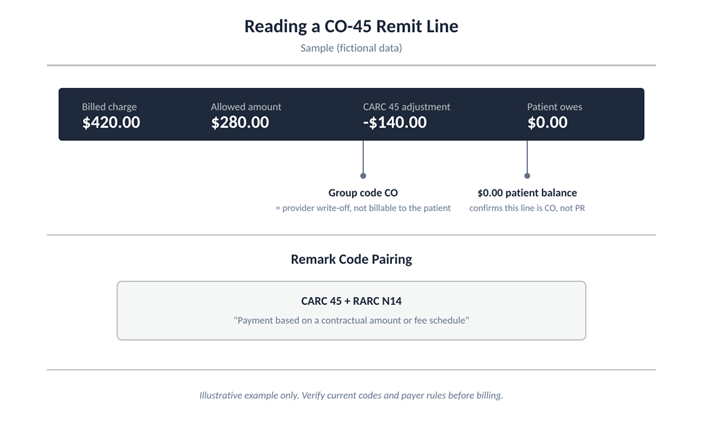
A CO-45 line on an Explanation of Benefits (EOB) or Electronic Remittance Advice (ERA) shows the billed charge, allowed amount, the CARC 45 adjustment, and often a paired Remittance Advice Remark Code (RARC) such as N14, “payment based on a contractual amount or fee schedule.” A $0.00 patient balance confirms the adjustment was not passed to the patient.
CO-45 vs. Other Denial Codes
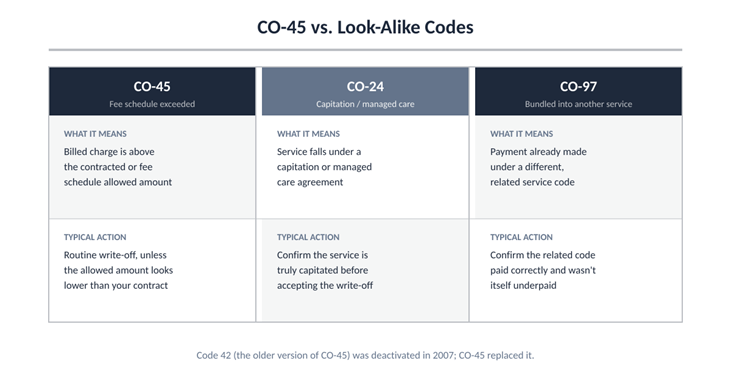
CO-45 is often confused with other contractual codes, including CO-97. The table below separates them by what triggers each one.
Why CO-45 Happens
- An annual fee schedule update pushes the allowed amount below the billed charge.
- The claim was priced against the wrong fee schedule, such as a commercial rate applied to a Medicare Advantage plan.
- A renewed contract’s new rate was never updated in the practice management system.
Formula: Checking the Adjustment Is Correct
Billed charge minus allowed amount should equal the CARC 45 adjustment. Walkthrough: a practice bills $420.00 for an office visit; the allowed amount is $280.00. $420.00 − $280.00 = $140.00, matching the remit. If the math is off, investigate before posting the write-off.
Is This CO-45 Worth Investigating?
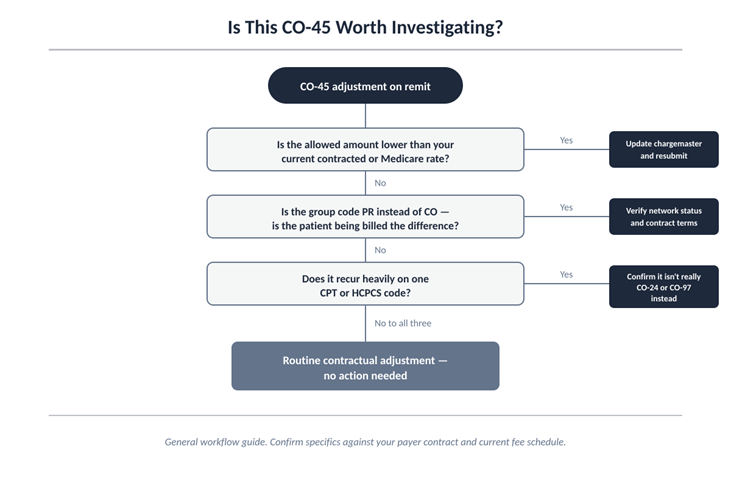
Most CO-45 adjustments are routine. Three situations are worth checking first: the allowed amount looks lower than the current contract or Medicare rate, the patient is billed under PR instead of CO, or one code shows CO-45 on an unusually high share of claims.
How Payers Set the CO-45 Allowed Amount
Medicare sets the allowed amount from its Physician Fee Schedule; the gap is a mandatory write-off. Medicare Advantage, Medicaid, and commercial payers each use their own reference rate, so the same code can show a different CO-45 adjustment by payer.
| Payer type | How the write-off is set |
| Medicare | Capped at the Medicare Physician Fee Schedule for the locality; a mandatory write-off |
| Medicare Advantage | Follows the plan’s own reference rate, set in its provider manual |
| Medicaid | Capped at the state Medicaid fee schedule; varies by state |
| Commercial | Set by the negotiated contract rate; check the fee exhibit before appealing |
Illustrative summary; confirm exact rates in the current fee schedule or contract for each payer.
How to Appeal or Dispute a CO-45 Adjustment
A CO-45 adjustment is disputable when the allowed amount doesn’t match the current contract or fee schedule, not simply because the write-off seems large. For Medicare, the first-level appeal is a redetermination, filed with the Medicare Administrative Contractor within 120 days of receiving the determination.
- Compare the payer’s current fee schedule or contract exhibit against the allowed amount on the remit.
- If they do not match, file a written redetermination or payer appeal citing the contract section or fee schedule date.
- If they match, the write-off is correct and needs no appeal.
When an appeal is warranted, see the medical billing appeal letter guide for a sample structure.
Preventing Repeat CO-45 Write-Offs
Recurring CO-45 adjustments on one code usually trace back to the chargemaster, not the payer. In billing audits, a common pattern is a fee schedule update that never reached the practice management system, so every claim for that code keeps generating the same write-off.
- Review the chargemaster against each payer’s fee schedule annually and at every contract renewal.
- Flag any code with CO-45 on an unusually high share of its claims for a manual check.
- Confirm the correct fee schedule is linked to each payer and plan type.
When to Bring In Billing Support
A few signals suggest CO-45 review has outgrown in-house capacity: growing claims on one code, uncertainty over loaded fee schedules, inconsistent appeals, or write-offs posted without checking the contract.
EON Med Solutions is one example of end-to-end billing, coding, credentialing, denial management, and reporting delivered by a US-based team with transparent reporting, reviewing fee schedules against posted adjustments and flagging recurring CO-45 patterns; results vary by practice.
Frequently Asked Questions
Is CO-45 the same as a denial?
Not exactly. CO-45 adjusts the allowed amount rather than refusing payment. The claim is paid at the allowed rate; only the difference from the billed charge is written off.
Can a patient be billed for a CO-45 adjustment?
Usually not. CO-45 carries the CO group code, so the provider absorbs the write-off. A patient can only be bill if the line instead carries a PR group code, reflecting a specific contract term.
What happened to code 42?
Code 42 cover similar ground and was deactivate in 2007. X12 guidance directs billers to use CARC 45 instead for any charge-exceeds-fee-schedule adjustment.
What is a good benchmark for CO-45 adjustment volume?
There is no published benchmark; it depends on each practice’s payer mix and contracted rates. A practical signal is a sudden increase on one code or payer versus the practice’s own recent history.
Expert Opinion
A CO-45 denial code usually reflects the system working as designed: the payer paid at its allowed rate and wrote off the rest under contract. The firm, published standard here is the Medicare appeal deadline — 120 days from receipt of the remit. How often CO-45 should appear on a given code is a practical target each practice sets from its own claims history.
The adjustments worth a second look break pattern: a lower-than-contracted allowed amount, a patient billed under PR instead of CO, or one code generating the adjustment far more than its peers. Those point to a fixable chargemaster problem, not a payer error. Talk with the EON Med Solutions team about reviewing current fee schedules and denial trends.
Sources: X12 Claim Adjustment Reason Codes (x12.org) and CMS Medicare Claims Processing Manual, redetermination guidance, reviewed November 2026. Figures reflect information available at the time of research; results and exact rates vary by practice and payer.


