

TRICARE Timely Filing Limit: Deadlines, Waivers & Tips
| What is the TRICARE timely filing limit? Under TRICARE’s published rules, a claim must be received within one year of the date of service, or one year from discharge for inpatient facility stays. Late claims are generally denied unless a documented exception applies, such as retroactive eligibility or delayed primary insurance. |
A missed payer deadline turns a paid visit into a permanent write-off. For practices treating military families, the TRICARE timely filing limit is the date that matters most. This guide explains the one-year rule, when the clock starts, which exceptions exist, and how to build a tracking routine that protects revenue. You will also find a key-numbers table, worked examples, and a short self-assessment checklist near the end, so you can score your own process.
Fast Facts: The Numbers Behind TRICARE Filing Deadlines
| Metric | Practical Target / Range | Review Frequency | Primary Source |
| Standard filing deadline | 1 year from date of service or discharge | Every claim; weekly aging review | Published TRICARE standard |
| Response to an information request | 90 days from request, or the original deadline if later | Per request | Published TRICARE standard |
| Claims delayed by other insurance | File within 90 days of the other insurer’s processing date | Weekly | Contractor guideline |
| Retroactive eligibility or authorization | File within 180 days of the determination | As it occurs | Published TRICARE standard |
| Waiver look-back period | 6 years before the request | Per waiver | Contractor guideline |
| Suggested submission speed | Within 30 days of service | Weekly | Contractor recommendation |
| Internal alert point | Flag claims with under 120 days remaining | Weekly | Illustrative target |
Source labels: “Published TRICARE standard” means TRICARE.mil or the TRICARE Operations Manual. “Contractor guideline” comes from a regional contractor’s provider materials. “Contractor recommendation” is advice, not a cutoff. “Illustrative target” is a practical figure, not an official benchmark.
How the One-Year Clock Really Works?
Where the clock starts
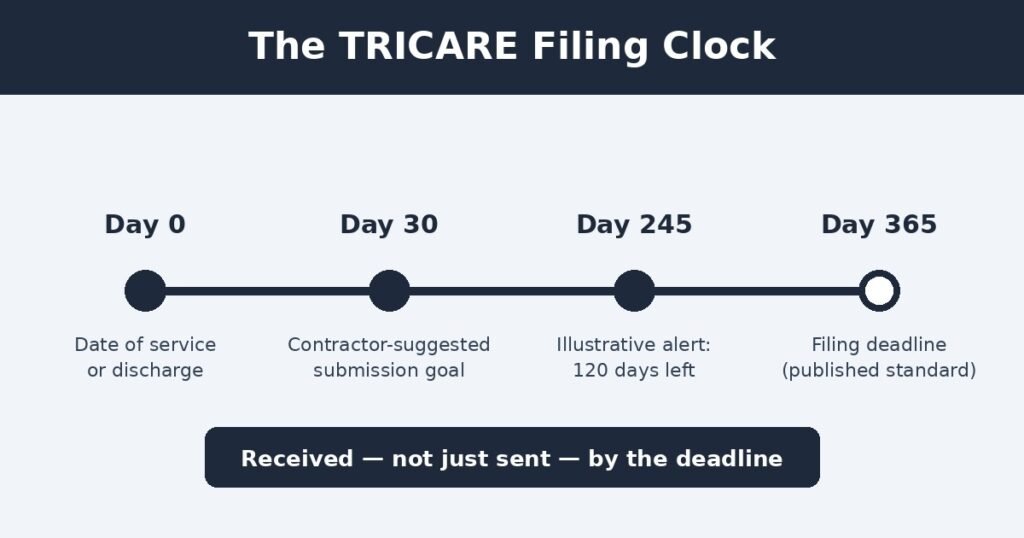
The claim filing deadline runs one year from the date of service. For inpatient facility stays, it runs one year from the discharge date. Professional services billed by a facility still follow the date of service. The contractor must receive the claim within that window; mailing it is not enough. If the contractor requests more information, you generally get 90 days from the request or until the original deadline, whichever is later. Rejected submissions are commonly treated as unfiled, so always confirm that each claim was accepted.
Who owns the filing duty?
Network providers must file TRICARE claims for the beneficiary, and the same deadline applies to them. Regional contractors process the claims: Humana Military for TRICARE East, TriWest for TRICARE West, and WPS for TRICARE For Life, which pays after Medicare. When other insurance is involved, coordination of benefits rules decide who pays first. TriWest suggests submitting within 30 days of service, but that is advice, not a legal cutoff.
Worked Examples: Counting Days Before They Count Against You
Example 1: Days remaining
Formula: days remaining = filing deadline − today’s date. A visit on January 15, 2026 creates a January 15, 2027 deadline. On September 20, 2026, that leaves 117 days. Alerting at 120 days remaining is an illustrative practice, not an official rule.
Example 2: Delayed other insurance
Formula: follow-up date = other insurance processing date + 90 days. If the other insurer processed the claim on June 10, 2026, the TRICARE submission target is September 8, 2026. This 90-day window comes from contractor guidance for claims held up by primary coverage.
Example 3: Retroactive authorization
Formula: exception window = determination date + 180 days. If a retroactive authorization is issued on November 3, 2026, after the one-year period has ended, the claim is due by May 2, 2027.
Example 4: Timely-filing denial rate
Formula: denial rate = timely-filing denials ÷ claims submitted × 100. Twelve denials on 800 claims equals 1.5%. At an assumed average allowed amount of $145 (illustrative), that is $1,740 in largely unrecoverable revenue. If claim denials like these keep recurring, a structured denial management process is worth reviewing.
Waivers and Exceptions: The Narrow Ways Back In
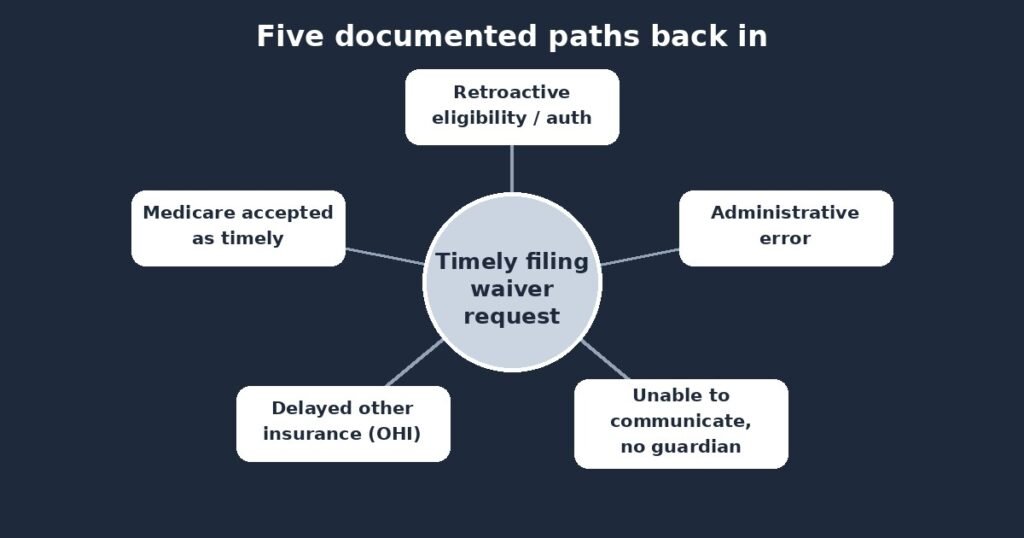
TRICARE grants a timely filing waiver only in specific situations, and every request needs documentation. TriWest’s waiver page lists retroactive eligibility or authorization, a patient who was mentally incompetent without a guardian, and claims submitted before the deadline. TRICARE East’s waiver form adds administrative error, delayed adjudication by other insurance, and Medicare-accepted dual eligibility. Contractors consider only services from the six years before the request. TriWest also notes that only claims with an assigned claim number can be appealed.
| Exception | What to document | Time limit |
| Retroactive eligibility or authorization | Date the determination was issued | 180 days from issue |
| Administrative error | Evidence of the contractor’s mistake | Contractor review |
| No communication ability, no guardian | Physician attestation; no guardian | Contractor review |
| Other insurance delay | Other insurer’s processing proof | 90 days from processing |
When One Root Cause Drives Most Denials?
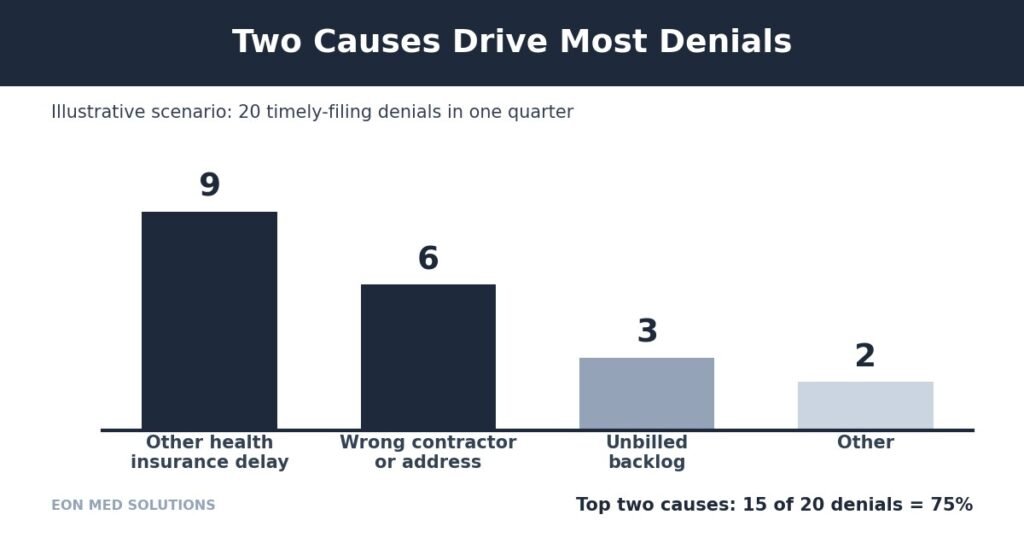
Illustrative scenario (not an actual client record): a practice sees 20 TRICARE timely-filing denials in a quarter. A total count says little about what to fix. Grouped by root cause, the picture changes. Nine waited on other insurance paperwork, and six went to the wrong contractor. Those two causes explain 15 of 20 denials, or 75%. Fixing them first protects the most revenue. Reviewing deadline denials by cause, provider, and location, and tightening electronic claim submission habits, exposes gaps like this early.
Reading These Benchmarks Without Fooling Yourself
A benchmark helps only when compared like for like. The one-year rule is a published standard, but alert points such as 120 days remaining are practical targets that suit some practices better than others. Compare the same payer, a similar claim mix, comparable volume, and the same reporting period. One late claim is a signal to investigate, not a verdict on your team. Pair deadline tracking with the billing KPIs you already follow, and confirm current contractor rules before disputing any denial.
How Long a Fix Takes: General Planning Ranges?
These ranges are general planning estimates, not guarantees for any practice.
| Improvement step | Partial results | Fuller results |
| Deadline tracking and alerts in place | 1–2 weeks | 1 month |
| Backlog of aging claims reviewed | 30–60 days | 2–3 months |
| Timely-filing denials trend down | 60–90 days | 3–6 months |
The Short Version
- The TRICARE timely filing limit is commonly summarized as one year from service or discharge, per TRICARE’s published rules.
- The claim must be received and accepted, not just sent.
- Waivers exist but are narrow, documented, and reviewed case by case.
- Alert points like 120 days remaining are illustrative practical targets.
- Track timely-filing denials by root cause and by payer so patterns show early.
Score Your Own Process: A Nine-Question Check
- Do most TRICARE claims leave your office within 30 days of service?
- Is a filing deadline recorded on every TRICARE claim?
- Does an alert fire when fewer than 120 days remain?
- Do you confirm each submission was accepted, not just sent?
- Can staff tell which contractor handles each patient’s claim?
- Do you log other insurance processing dates and file within 90 days?
- Do you keep proof of timely submission, such as claim numbers?
- Do you review timely-filing denials by payer every month?
- Do you have a written waiver checklist with documentation steps?
Scoring: 8–9 yes answers suggests a strong process. 5–7 means you need tightening in specific places. 0–4 signals meaningful revenue risk, and a process review is worth prioritizing.
Expert Opinion
The TRICARE timely filing limit is easy to state and easy to miss. Most lost revenue comes from process gaps, not confusion about the rule. Clear ownership, deadline tracking, and proof of acceptance close most of those gaps long before a claim ages out.
Know which numbers are firm. The one-year rule, the 90-day information window, and the 180-day retroactive window come from published TRICARE material. The 90-day other-insurance window and six-year look-back come from contractor guidance. The 30-day goal is a recommendation, while the 120-day alert, dollar figures, and planning ranges are illustrative practical targets.
Frequently Asked Questions
What is the TRICARE timely filing limit for providers?
One year from the date of service, or from discharge for inpatient facility stays. Network providers file on the beneficiary’s behalf, and the same deadline applies to them.
Is the limit different for care overseas?
TRICARE.mil lists 3 years for beneficiaries living overseas, with proof of payment required. Check the current TRICARE.mil deadline page before relying on it for a specific claim.
How do I request a TRICARE timely filing waiver?
Submit a written request with supporting documents to the regional contractor. Only listed exceptions qualify, and denials are possible if documentation is thin.
Does the state three-year rule apply to TRICARE?
No. A Medicaid.gov FAQ states the Department of Defense position that TRICARE’s one-year limit is not superseded by the three-year Deficit Reduction Act limit. It is an older document, so verify current guidance.
Are active duty service members treated differently?
TRICARE East’s waiver form states the timely filing guideline does not apply if the beneficiary was an active duty service member on the date of service. Confirm with your contractor.
What is a good timely-filing denial rate for TRICARE claims?
TRICARE publishes no benchmark. Many billing teams aim for under 1%, which is an illustrative goal. Track it by payer and investigate any spike.
What is a good internal deadline for submitting TRICARE claims?
TriWest recommends within 30 days of service. Many practices set a tighter internal cutoff, which is a practical choice rather than a requirement.
Do corrected claims reset the filing clock?
Do not assume so. Under many payers, corrected claims follow the original window. Ask your regional contractor how it treats resubmissions.
Signs Your Team Needs Backup
Your in-house approach may have hit its limits if you notice these signals:
- Unbilled claims older than 90 days appear regularly.
- Staff cannot say which contractor handles a given patient.
- Timely-filing write-offs are not tracked by payer.
- Waiver requests are rushed or missing documents.
- Enrollment or credentialing delays keep holding claims back.
TRICARE adds a wrinkle other payers lack: the regional contractor and other insurance both shape the deadline. Ask a partner how it confirms the contractor for each patient, how it tracks other-insurance delays, and how it documents waiver requests. Clear pricing and transparent reporting matter too. EON MED SOLUTIONS is one option to evaluate on those points. Its US-based team delivers medical billing, coding, credentialing, and revenue cycle management for urgent care, family practice, and multi-specialty groups, with an emphasis on transparent reporting and no hidden fees. Its end-to-end approach covers billing, credentialing, coding, denial management, and compliance support; see the full list of EON MED SOLUTIONS services. Results vary by practice and situation, and no specific outcome is promised.
Where These Numbers Come From?
(a) Published standards: TRICARE.mil’s claims-deadline FAQ and the TRICARE Operations Manual, Chapter 8, Section 3, support the one-year rule, the 90-day information window, and the 180-day retroactive window. Contractor guidance: TriWest, Humana Military, and WPS provider materials support the 30-day suggestion, the 90-day other-insurance window, the six-year look-back, and waiver conditions.
(b) Named benchmarking providers: none used. (c) Practical or illustrative targets: the 120-day alert, 1% denial goal, dollar figures, planning ranges, worked examples, and root-cause scenario. (d) Survey data: none used; the Medicaid.gov FAQ is cited for the state-law question only. Actual results vary by practice, and figures reflect information available in September 2026.


