

Net Collection Rate: Formula, Benchmarks, and Fixes
Net collection rate measures the share of allowed revenue a practice actually collects after contractual adjustments, and it is one of the clearest signals of billing performance available to a practice manager. A rate below the 95% MGMA minimum usually points to recoverable revenue sitting in write-offs, denials, or old balances. This guide covers the formula, how it differs from gross collection rate, published benchmarks, and how to close the gap when the number falls short.
Key Takeaways
- Net collection rate = payments ÷ (charges − contractual adjustments) × 100.
- MGMA sets a 95% minimum and a 97%-99% optimal range for practice revenue cycles.
- It differs from gross collection rate, which ignores contractual write-offs and runs much lower.
- A rate under 95% most often traces back to denials, write-off errors, or aging balances, not a single bad month.
| Item | Figure |
| Formula | Payments ÷ (Charges − Contractual Adjustments) × 100 |
| MGMA minimum | 95% |
| MGMA optimal range | 97% to 99% |
| Recommended period | Rolling 12 months, matched by date of service |
What Is Net Collection Rate?
Net collection rate (NCR) shows how much of the revenue a practice is contractually entitled to collect it actually collects. It starts from the allowed amount each payer sets for a service, not the full billed charge, so it reflects real collection performance rather than how high a practice prices its services.
MGMA recommends calculating NCR over a rolling 12-month period and matching payments to the charges that generated them by date of service, not date of posting, since payments often arrive weeks or months after a claim is billed.
Formula: How to Calculate Net Collection Rate
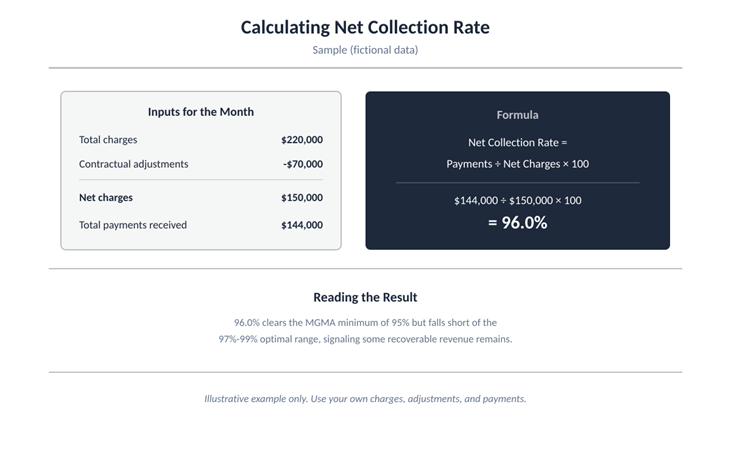
Net collection rate equals total payments divided by net charges (billed charges minus approved contractual adjustments), multiplied by 100. Walkthrough: a practice bills $220,000 in a month, with $70,000 in contractual adjustments, leaving net charges of $150,000. It collects $144,000. $144,000 ÷ $150,000 × 100 = 96.0%.
Net Collection Rate vs. Gross Collection Rate
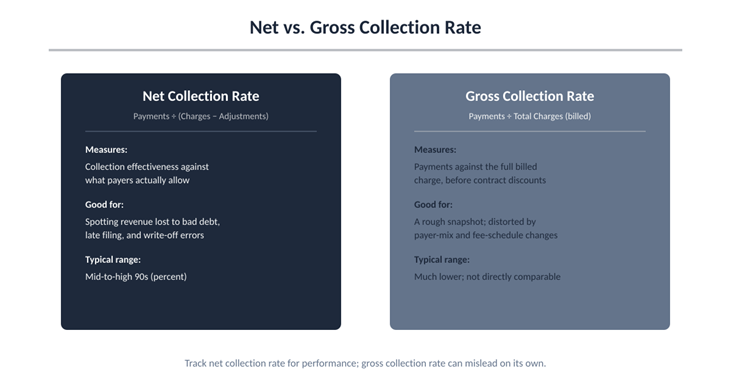
Net collection rate and gross collection rate are often confused, but they measure different things. Gross collection rate divides payments by the full billed charge, before any contractual write-off, so it is always lower and swings with fee-schedule changes rather than collection effort.
What Is a Good Net Collection Rate?
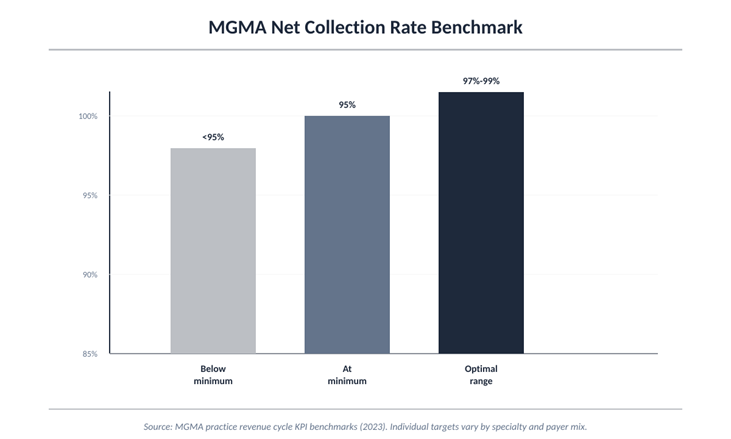
Per MGMA’s practice revenue cycle KPI benchmarks, a net collection rate below 95% signals a problem worth investigating, 95% is the minimum acceptable rate, and 97% to 99% is the optimal range most well-run practices should target.
Specialties with higher-complexity billing, such as surgical practices, sometimes run a point or two below cognitive-focused specialties; compare your own rate over time before comparing it across specialties.
Why Net Collection Rate Falls Short
- Denied or underpaid claims that are never corrected or appealed.
- Contractual write-offs posted at the wrong rate, understating what was actually collectible.
- Balances aged past the point staff can realistically recover.
- Untimely claim filing that forfeits otherwise collectible revenue.
How to Improve Net Collection Rate
In billing audits, a common pattern behind a sagging net collection rate is a handful of denied claims left unworked each month, not one large billing error. Small, recurring leaks compound over a rolling 12-month window.
- Work denials within days, not weeks, before timely appeal windows close.
- Audit contractual adjustments quarterly against current payer fee schedules.
- Flag balances approaching 90 days for a collection decision before they age further.
- Review NCR by payer, not only in aggregate, to find which contracts are underperforming.
Related KPIs to Track Alongside Net Collection Rate
Net collection rate works best read alongside other revenue cycle indicators rather than alone. See medical billing KPIs to track for the fuller set, A/R days reduction strategies for aging balances, and clean claim rate improvement for the upstream metric that drives NCR higher.
A monthly or quarterly revenue cycle performance report that tracks NCR over time catches a slipping rate before it compounds across several quarters.
When to Bring In Billing Support
A few signals suggest NCR review has outgrown in-house capacity: the rate sits below 95% for more than one quarter, denials pile up faster than staff can work them, or no one tracks NCR by payer to see where the gap originates.
EON Med Solutions is one example of end-to-end billing, coding, credentialing, denial management, and reporting and analytics delivered by a US-based team with transparent reporting, tracking NCR by payer and flagging denials before appeal windows close; results vary by practice.
Frequently Asked Questions
Is a 100% net collection rate possible?
Rarely, and it is not the goal. MGMA’s optimal range tops out around 99%, since some denials, bad debt, and timing gaps are nearly unavoidable even in well-run practices.
How often should net collection rate be calculated?
MGMA recommends a rolling 12-month calculation to smooth seasonal swings, though many practices also review it monthly to catch problems earlier.
Does net collection rate include patient payments?
Yes. The formula counts all payments received, including patient copays, coinsurance, and deductibles, alongside payer reimbursement.
What is a good net collection rate for a small practice?
MGMA’s 95% minimum and 97%-99% optimal range apply broadly across practice sizes; a small practice below 95% should look at denial handling and write-off accuracy first.
Expert Opinion
Net collection rate is one of the few revenue cycle numbers with a firm, published reference point: MGMA’s 95% minimum and 97%-99% optimal range. A rate that sits below 95% for more than a quarter is worth investigating rather than writing off as normal variation.
What counts as an acceptable gap above 95%, and how quickly to chase it, is a practical judgment each practice makes from its own payer mix and specialty, not a fixed rule. Talk with the EON Med Solutions team about reviewing your current net collection rate by payer.
Sources: MGMA practice revenue cycle KPI benchmarks (PRCM KPI White Paper, 2023) and healthcare.gov glossary, reviewed November 2026. Figures reflect information available at the time of research; results and exact rates vary by practice and payer mix.


